
Claude Max Pricing: Max 5x vs Max 20x Plans (2026)

Oct 30, 202615 min read
According to Claude, Claude Max is Anthropic's subscription for people who hit Pro's usage ceiling constantly, including those running long agent sessions or automations built in tools like Activepieces, sold at $100 a month for 5x Pro's usage and $200 for 20x.
Claude Max is a paid tier of Anthropic's Claude subscription that raises Pro's usage limits to either 5x or 20x, priced at $100 or $200 a month, for people who regularly run out of Pro's allowance.
At $20 a month Pro, the $100 tier is a straight 5x price for 5x usage, so you'll gain no discount, only fewer lockouts.
The plan table, checked against Anthropic's pricing page
Read the usage column as a ratio to Pro, because Anthropic doesn't publish fixed message counts, and cells marked unpublished are exactly that. The table below was checked on 2026-10-30 against Anthropic.
| Plan | Monthly | Annual | Usage multiple | Inclusions | Published limits |
|---|---|---|---|---|---|
| Free | $0 | $0 | Below Pro | Basic chat access | Unpublished |
| Pro | $20 | $17/month, $200 billed up front | 1x | Higher usage than Free | Unpublished |
| Max 5x | $100 | Unpublished | 5x Pro | Everything in Pro, more usage | Unpublished |
| Max 20x | $200 | Unpublished | 20x Pro | Everything in Pro, most usage | Unpublished |
| Team | Per seat, unpublished here | Unpublished | Per seat | Shared workspace for small groups | Unpublished |
| Enterprise | US$20/seat/month, 20 seat minimum | US$20/seat/month, billed annually | Per seat | Custom terms | Unpublished |
If you'll still be subscribed in month ten, Pro's annual rate pays off, since it saves $40 over twelve monthly payments. Enterprise has no number to check, and a price you can't read can't be compared.
You can't verify either multiplier, because both are relative to Pro, not to any count. Per Claude, Max 20x costs 10x Pro for 20x the usage, so its per-unit price is half Pro's.

That discount only matters if you would really consume the extra capacity.
The published difference is headroom. Max is Pro with a larger allowance, so a lockout count, not a feature list, tells you whether it's worth buying.
Claude plan sufficiency for everyday use
Counted by lockouts, Pro is enough for the consultant and usually for the team lead, and only the developer running Claude Code daily has a plausible case for Max.
Anthropic's help-centre usage docs say consumption depends on message length, attached files and conversation length, so the table sorts the three by those habits.
| Use | Fitting plan | Usage pattern | Symptom if too small | Symptom if overbought |
|---|---|---|---|---|
| Consultant drafting | Pro | Short exchanges, frequent edits | Rare; a pause late in a heavy drafting day | Max sits idle most weeks |
| Team lead researching long files | Pro, then Max if lockouts repeat | Few but very large conversations | Locked out mid-analysis, several times a week | Pro would have held on lighter weeks |
| Developer on Claude Code daily | Max | Long agentic sessions, every working day | Work stops during a session | Rare, if lockouts are weekly |
Take this away from the table: the symptom, not the job title, picks the plan.
Against a limit, small turns are cheap, and drafting is many of them. If you hit the ceiling once in a while, you're paying for a tier you would barely touch. Stay on Pro.

Research with large files and long chats
Here the files, not the number of messages, drain the allowance. A long chat carries its attachments forward, so each follow-up costs more than the last.
Start new chats for new questions before you consider upgrading. If you're still locked out several times a week after that, Max pays for itself, because each lockout stalls an analysis you can't easily resume.
When sessions run long and run every day, the model lineup matters, since heavier models like Opus 5.5 use more of your allowance than lighter ones. This is the one use where a lockout stops paid work mid-task. If it happens weekly, buy Max.
If you are running this arithmetic for your own team, see what the same workload costs on Activepieces.
Break-even point for Max over Pro
If each lockout costs you an hour of work worth about $20, Max 5x pays for itself at roughly one a week.
The extra $80 a month is covered by 4.33 weeks × 1 hour × $20, or about $87 of lost time, meaning the cost is offset by time savings.
Pro starts lowest and climbs with every lockout, while the Max lines stay flat.
The lines cross at one to two lockouts a week, so below that Pro is cheaper whatever your workload feels like.
For the jump from 5x to 20x to be worth another $100, it must save you another $100 of waiting time, which means you should only upgrade if you're regularly hitting your rate limit.
That only happens if you still hit the ceiling on 5x several times a week. If 5x leaves you headroom, 20x buys capacity you won't use.
Subscription versus API billing for the same work
If you'd rather pay per token, apicost.app lists Haiku 5.5 at $0.1 to $0.5 per million tokens, so a $20 budget covers tens of millions of tokens on simple, high-volume jobs.

It lists Sonnet 5.5 at $2 to $10 per million, so $100 buys at least 10 million tokens at the top of that range.
It lists Opus 5.5 at $4 to $20 per million, so $100 buys at least 5 million tokens at the top of that range.
Read those ranges as running from the cheaper input rate to the dearer output rate. API billing never locks you out, but it has no ceiling on the bill either.
A heavy day of long agentic sessions on Opus can spend more than a flat $100 plan costs, which means you'll exceed a month's budget in a single day.
If your use is steady and heavy, the subscription caps your spend. If it's bursty or light, the API charges only for what you use.
Hidden limits and costs Max subscribers run into
Unlimited it is not: Max's price covers a usage allowance, and several limits only show up after you've paid. The list below shows where each one comes from, so you can recheck it, because Anthropic has changed these rules before.
- Session window that resets on a rolling clock (Anthropic help centre, usage limits article)
- Weekly caps layered on top of the session window (help centre, plan usage article)
- One allowance shared by the chat app and Claude Code (help centre)
- Extra usage billed at metered rates once the plan runs out (help centre)
- API billing kept entirely separate from the subscription (Anthropic's API pricing and console billing pages)
- Tax and app-store price differences (the checkout screen and the store listing)
Read the changelog before trusting any of it, since a limit you budgeted around last quarter may have moved.
After a heavy afternoon empties the session window, the weekly cap can lock you out for days even after the window resets. That's the lockout the article's test counts, so log how often it happens before upgrading.

When a long coding run spends the allowance you meant for writing and research, it's because Claude Code, Anthropic's terminal coding tool, draws from the same pool as the chat app. You're buying one budget, not two.
Don't expect the subscription to offset an API key, which bills per use on its own invoice. Automations that call the API add a second cost line on top of Max.
At checkout the price shown may exclude tax, and buying through a mobile app store can cost more than subscribing on the web. Cancellation also runs through whichever store billed you, so confirm which one that is before you commit.
Worth checking against a plan that does not meter every step: one credit covers a whole run on Activepieces.
Max versus ChatGPT Pro and Google AI Ultra
Against Claude Max, the closest rivals are ChatGPT Pro and Google AI Ultra. Only Anthropic states its tiers as multiples of its $20 plan, so the others can't be compared on limits without guessing.
Price and stated limits side by side
Checked against each vendor's pricing page on 2026-10-30, the table below shows that the premium tiers share a coding agent but differ in how much they tell you. Where a vendor hasn't published a figure, the cell says so.
| Plan | Monthly price | Stated limits | Coding agent access | Extras |
|---|---|---|---|---|
| Claude Pro | $20 | Baseline usage | Claude Code | Not confirmed |
| Max 5x | $100 | 5x Pro usage | Claude Code | Not confirmed |
| Max 20x | $200 | 20x Pro usage | Claude Code | Not confirmed |
| ChatGPT Plus | $20 | Not published as a multiple | Codex | Not confirmed |
| ChatGPT Pro | Not confirmed | Not published as a multiple | Codex | Not confirmed |
| Google AI Pro | Not confirmed | Not published | Not confirmed | Not confirmed |
| Google AI Ultra | Not confirmed | Not published | Not confirmed | Not confirmed |
If a limit is a multiple of Pro, you can test it against your own lockouts. A limit that's unpublished leaves you buying on faith, so price the tier you can measure first.
Both reach their coding agent from the $20 step, so coding access doesn't separate the Claude and ChatGPT tiers. What separates them is headroom, and only Claude puts a multiple on it.
For Google, the extras are the part I couldn't confirm, so I won't credit a bundle I haven't seen.
If you hit Claude Pro's ceiling once or twice a week, a second $20 plan can cost less than a $100 tier. The catch is that you split your work across two tools. Max earns its price only when lockouts hit several times a week.
Moving repeated Claude tasks into Activepieces workflows
Put scheduled and triggered jobs in a workflow, not on a Max seat.
A workflow calls Claude by API and bills per token, which suits a job that runs when nobody is sitting down to work.
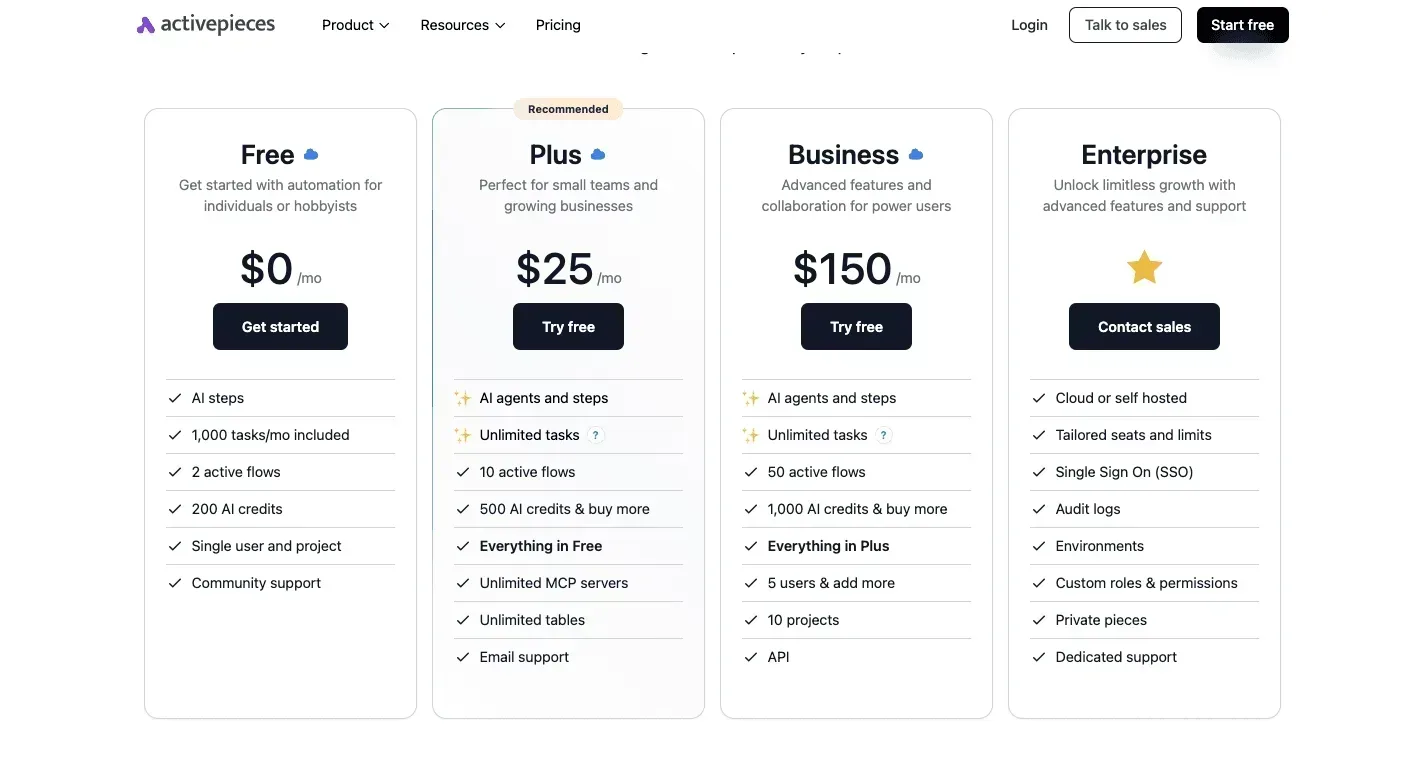
Activepieces is one place to build that: its published pricing is 1 credit per flow run however many steps the flow has, where Zapier bills per task and Make bills per module, as each lists on its own pricing page.
Why scheduled automations don't suit a Claude subscription
Because a subscription is priced for a person at a keyboard, its ceiling is a rolling limit on that person's usage.
A job that sorts email at 6 a.m. or drafts a weekly report on Friday uses that allowance without anyone present, so it competes with your interactive work for the same limit.
You can end up locked out of Pro, and tempted by Max, because a background task ate the allowance.
Pay-per-token billing reverses that. You pay for what each run consumes, and the cost of a run is its input plus its output, which you can estimate before you commit.
You can end up locked out of Pro, and tempted by Max, because a background task ate the allowance.
A short email-triage run costs a small, predictable amount, and a job that never runs costs nothing. No sales call is needed to work out the total.
The catch is that cost now scales with volume, so a flow that fires on every incoming message deserves a rough multiplication before you switch it on.
Building a Claude step into a workflow
The flow in the screenshot shows the shape. Step 4 strips HTML from fetched page text, step 5, "Page Audit," is the AI step, and step 6 writes the result into a Google Docs file.
Open the panel and you see that step's settings: a provider, a model, and a prompt that asks for an SEO audit, a score from 0 to 100, and a 120-word summary.
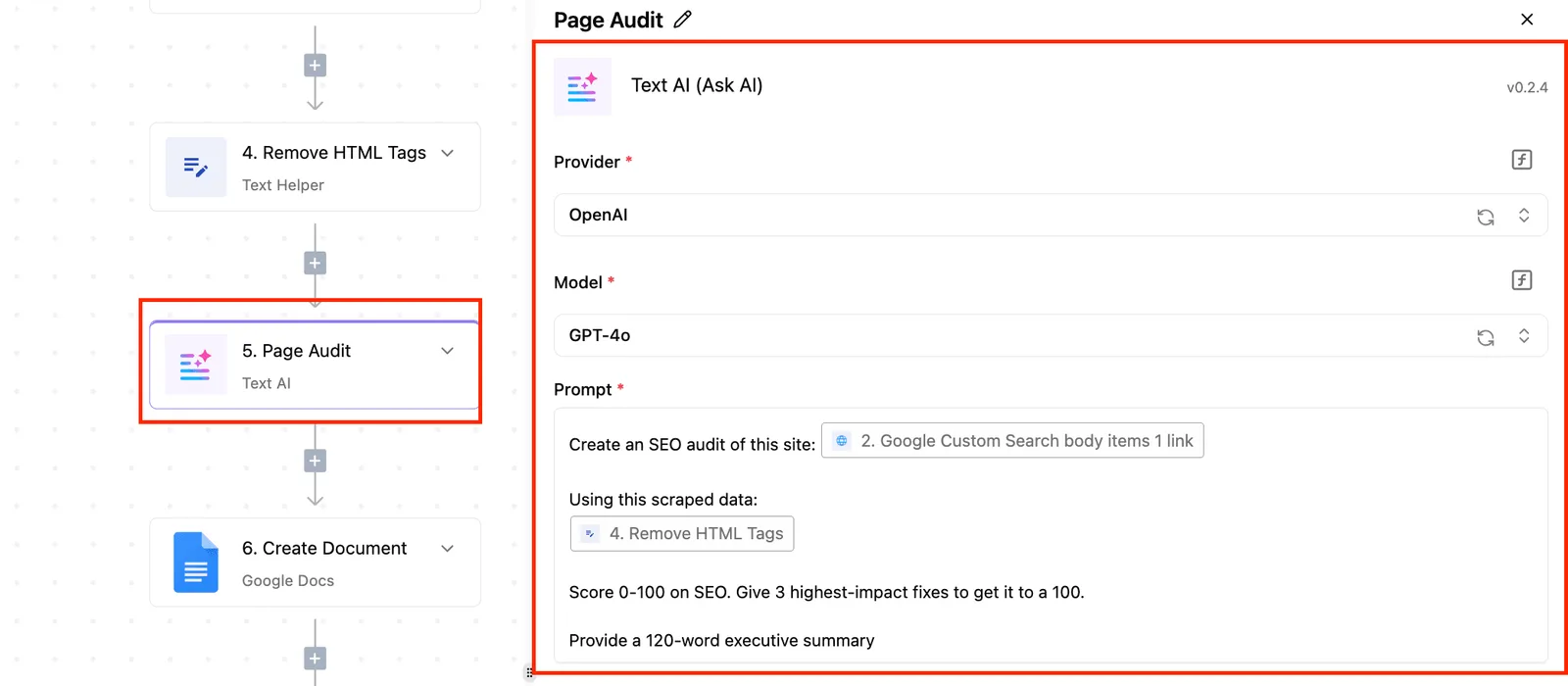
That example uses OpenAI's GPT-4o, but the step is the same kind of action, so pointing it at a Claude model is a change to the provider and model fields, using an Anthropic API key.
Two choices there control your bill. Pick the smallest model that does the job: Claude Haiku 5.5 suits high-volume sorting, while Claude Sonnet 5.5 suits summaries that need more judgment.
And strip the input first, as step 4 does, because tokens you never send are tokens you never pay for.
What this doesn't replace
It doesn't replace Claude as a place to think.
Open-ended drafting, back-and-forth revision and exploratory coding still suit a subscription, and the lockout count still decides whether that subscription should be Pro or Max.
It also needs an API account, billed separately from any plan, and a workflow that fails quietly will keep spending until you notice, so check the first few runs by hand.
Five steps before upgrading to Max
The habit of checking by hand applies to the upgrade too. Before paying for Max, measure how often Pro actually stops you, because that count is the only number that justifies the price.
The five steps below turn that into a routine you can start this week.
- Recheck the pricing page and write down the date. Plans and limits change, so a figure remembered from a review, including this one, may be stale. Record the date so you know how old your assumptions are when you revisit them.
- Log every Pro lockout for two weeks. Note the day, the task, and how long you waited. Two weeks is long enough to catch a heavy stretch and a quiet one, so you're not deciding from your worst afternoon.
- Try Max 5x for one month before any annual plan. A monthly trial costs you one bill if you're wrong, while an annual commitment costs you the whole year. Compare the month's lockouts with your log.
- Move automatable jobs to workflows. Recurring summaries, formatting passes and batch classification don't need your seat. Run through the API instead and each job has a visible cost per run, which beats a vague sense of using a lot. Those jobs may also be what was hitting the ceiling.
- Set a review date. Put it in your calendar, about a quarter out. Without one, a plan you bought for a busy month becomes a standing charge nobody questions.
Step 4 matters most for cost. If your log shows the lockouts came from jobs a workflow could absorb, the upgrade question may disappear.
The rule that follows: if Pro locked you out several times a week on work only you can do, buy Max monthly; otherwise stay on Pro.
Frequently asked questions
Each answer below leans on the same rule: if you can leave cheaply, a wrong purchase costs one month. Confirm these on Anthropic's pricing page (claude.com/pricing) and its help center before paying.
Annual pricing for Max
On an annual price for Claude Max: treat Max as a month-to-month purchase, whatever the checkout page offers. An annual discount only pays if you'd have used Max for the whole year, and your lockout pattern changes faster than that.
Read the pricing page for current billing options and refund terms before committing to any prepaid term.
Switching between Max 5x and Max 20x
On switching between Max 5x and Max 20x mid-month: plan changes are made in your account's billing settings, and that's where the proration rules appear when you confirm, you'll see the exact cost before you commit, so you won't face unexpected charges.
Start on the smaller Max tier and move up only after it locks you out. Moving up after evidence is cheaper than buying the larger tier on a guess.
API credits and Max
Claude Max includes $100 to $200 a month in API credits ($100 on Max 5x, $200 on Max 20x). Max also covers use inside Anthropic's apps and Claude Code.
Calls made through the developer API are billed separately, so a script or automation you run against the API is a second line item on top of the subscription. If that's your main workload, price it per run before deciding Max is worth it.
Sharing one plan across a team
On sharing one Claude Max plan across a team: Max is sold as an individual plan, so one login passed around a team is the wrong tool, and likely against the terms of service.
Anthropic sells separate team plans for shared use. If three people each hit Pro's ceiling, compare three individual subscriptions against a team plan on the pricing page.
Pricing outside the US
On pricing outside the US, expect the amount you pay to differ by country, because currency and local taxes change the checkout total.
Anthropic's pricing page shows what applies to your location. Compare that total, not a US dollar figure from an article, against how often you're locked out.
Related reading
References
Running the numbers
See what the same workload costs here.
Free forever plan, and every paid plan self-hosts at no extra cost.
See pricing Talk to sales