
CodeDesign v3: Features, Pricing and Review (2026)

Nov 20, 202612 min read
CodeDesign v3 is a new release from CodeDesign Inc. It launched on Product Hunt on 2026-11-19, the same day the Activepieces community was also busy trading launch-week notes. This account rests on the maker's own pages at ai.codedesign.app, which I read on 2026-11-20.
It's a day old.
Per those pages, CodeDesign v3 is an AI website builder. What it produces is a website, which is a generated site rather than a stream of text or model responses.
The pages I read don't name an API or an MCP server, so for both the answer here is "not stated".
A workflow platform will run the flow that calls it, but whoever wires it in there, or into a script, is the first person paged when it misbehaves.
CodeDesign v3 release: what happened and when
With only a single day between launch and reading, no outside review, incident report or user history exists to lean on yet. Ownership of any failure therefore falls to the team that adopts it, not to a track record.
Read the four facts below for how recent and how narrowly sourced they are, because they are all that this article treats as established.
- The maker is CodeDesign Inc, per ai.codedesign.app.
- The Product Hunt launch was on 2026-11-19, as listed on Product Hunt.
- The pages were read on 2026-11-20.
- The source for the product's claims is ai.codedesign.app, the maker's own site.
Because the maker is the only source, anything it states is a claim, not a measurement. What follows takes those claims as published and doesn't treat them as tested.
If you are running this arithmetic for your own team, see what the same workload costs on Activepieces.
What CodeDesign v3 means for teams automating work
If your team runs AI and app workflows, judge a new release on what the maker has published, and nothing beyond it.
The first question is who owns the integration when it breaks at 2am, and only the maker's pages can say what that person has to work with.
Why CodeDesign v3 matters for workflow wiring
When the workflows already in place can call a release, it matters to an automator. That is the use: wiring. Four things decide it, and each is read from the maker's pages alone.
Four checks before adopting CodeDesign v3
You can run the same four checks against CodeDesign v3 before assigning anyone to it, as a team would with any new release.
The first's how to reach it, meaning whether the maker documents an API, an MCP server, or both. The second's what it costs, meaning the pricing the maker publishes, if any.
The third's what it lists as included, meaning the features and limits the maker names. The fourth's what the maker documents: setup guides, reference pages and change notes.
Expect each check to end in a yes or a "not stated". A "not stated"'s a finding, not a gap to fill with a guess. A team that records those answers has something it can hand to whoever inherits the workflow.
What nobody has measured
Because the release is new, no tested speed or cost claim exists for v3.
Any figure a team sees for how fast it runs or what a run costs is therefore the maker's own and untried, so it shouldn't set a budget or a service target.
Until a team has run its own workload, ownership, fallback and failure handling stay open questions for that team to answer.
What's measurably new in CodeDesign v3
Today the only thing to measure against is what the maker states on its pricing page, which I read on 2026-11-20: a description, an operator and a price list.
That page calls CodeDesign "your go-to AI website maker", so the team has to test any claim about speed, output quality or uptime itself.
As for what is actually new in v3, the pages I read don't say. They give no changelog or list of what changed from earlier versions, so the only thing that can be called new is the release itself, dated by its Product Hunt launch.
Any feature-level difference from v2 is "not stated".
Start with the pricing page. The operator it names is CodeDesign Inc, at 256 Chapman Road STE 105-4, Newark, New Castle, 19702.
That gives you a named legal entity to put in a vendor record. It doesn't tell you who answers when a generated site breaks, so assign that owner internally before purchase.
CodeDesign v3 lifetime deal costs
Even though the two smaller lifetime deals sit at roughly half their struck-through list prices, a one-off payment says nothing about how long the maker will support the product.
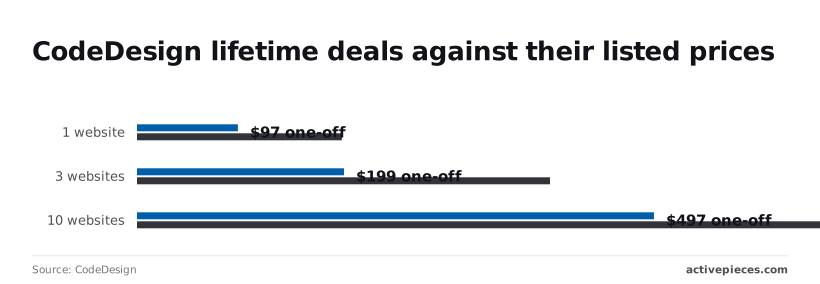
$97 buys the lifetime deal for 1 website, against a list price of $197, so you're saving roughly 50%. The deal for 3 websites costs $199 against $397, which means you're also saving about 50%. Each gives lifetime access for the number of websites named.
$497 buys the tier for 10 websites, against a listed $1,099. That's about $50 per site, against about $66 per site at the 3-website tier and $97 at the 1-website tier.

Buy more and cost per site falls, so the larger tiers only pay off if you'll actually build that many sites. Budget for the smaller deal first, then check the output against your own workflow.
The lifetime deals and the monthly plans are two ways to pay for the same thing, a site. The monthly plans, covered further down, charge per site each month, while a lifetime deal is a single payment for a fixed number of sites.
Set one against the other by counting the months until the monthly total passes the one-off price, and the pages don't say what the lifetime deals leave out compared with a monthly plan.
What Activepieces has shipped for CodeDesign v3: nothing yet
I found none.
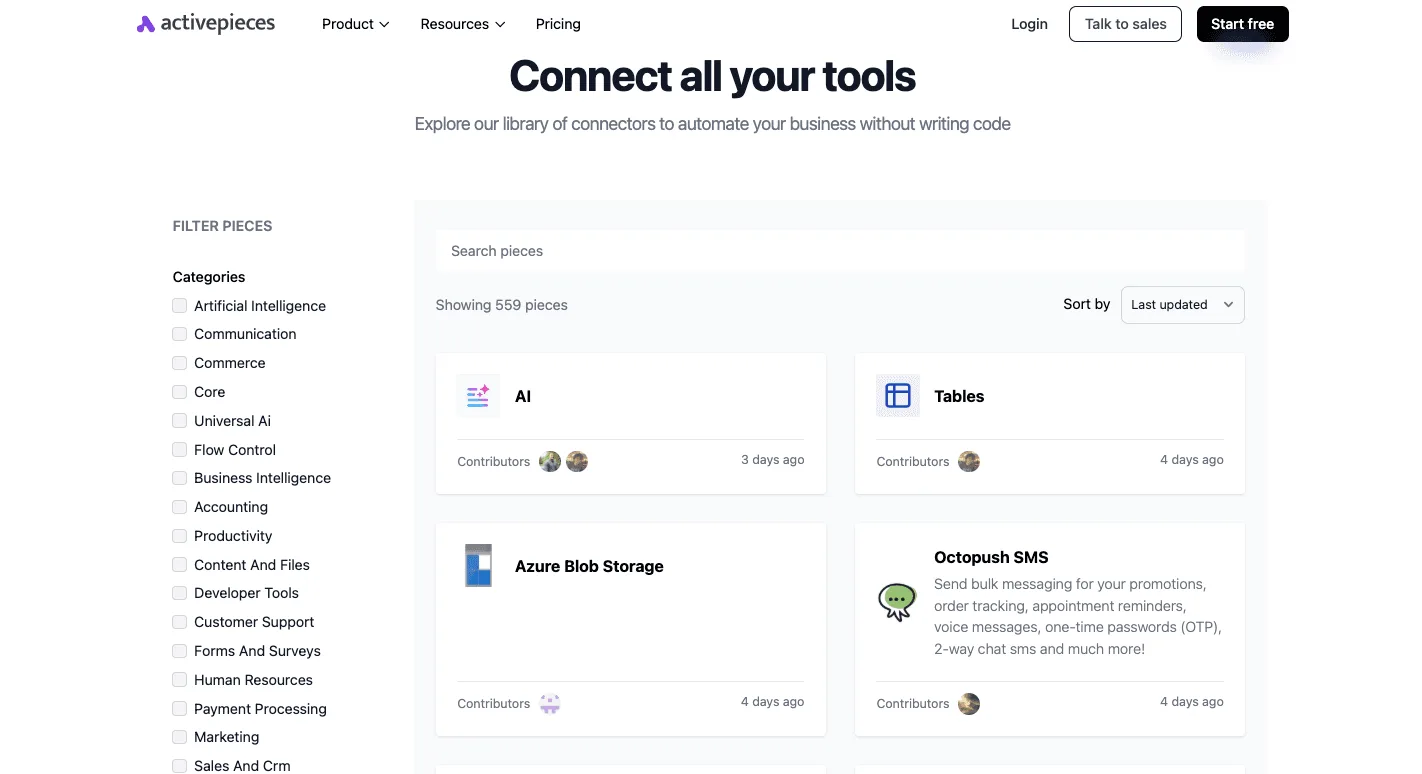
To confirm an integration is absent, the catalog's own listing is the only check, so here's that listing, sorted by last updated.
The most recently touched entries are AI, Tables, Azure Blob Storage and Octopush SMS, each updated within the past few days. None is CodeDesign.
So the catalog is actively maintained, and the gap isn't neglect. The product is simply too new to have a connector, and a team can't assume one is coming.
That changes what you can plan around. Anything you build today's your own work, with your own error handling and your own on-call owner, and the next step's deciding which of your existing workflows can carry that cost.
Worth checking against a plan that does not meter every step: one credit covers a whole run on Activepieces.
Connect CodeDesign v3 to your workflows
Cheapest to carry are the workflows that reach CodeDesign v3 through a plain HTTP request, then an AI step pointed at a custom provider, then an MCP server. Each depends on what the maker's docs publish, and each leaves you as the owner.
Because CodeDesign v3 is a site generator and the pages name no API or MCP server, all three routes below are conditional. Each assumes the maker publishes an endpoint, and today that is "not stated".
The AI-provider route fits least well, since a site builder isn't a chat model, so treat it as the route least likely to apply.
Read the table as a checklist: it shows how the three differ in setup effort and in what you must obtain first. If the vendor hasn't published the item in the second column, that option is closed to you today.
| Option | Setup effort | What you need from the vendor | Fit |
|---|---|---|---|
| HTTP request step | Lowest; you map fields and handle errors yourself | API docs and a key | One-off calls with fixed inputs and outputs |
| AI step, custom or OpenAI-compatible provider | Moderate; depends on how closely the API matches that format | A compatible endpoint and a key | Prompts that flow through a chat-style step |
| MCP server | Highest to verify; lowest to use once it exists | A published MCP URL | Agents choosing among several tools |
Prices and plan limits checked against ai.codedesign.app on November 20, 2026.
Whichever row you pick, name the person who gets paged when it fails before you build it.
Pick Option 1, the HTTP request step, and you use your workflow tool's generic request step, which needs only documented endpoints and a key. Retries, timeouts and malformed responses are yours to handle.
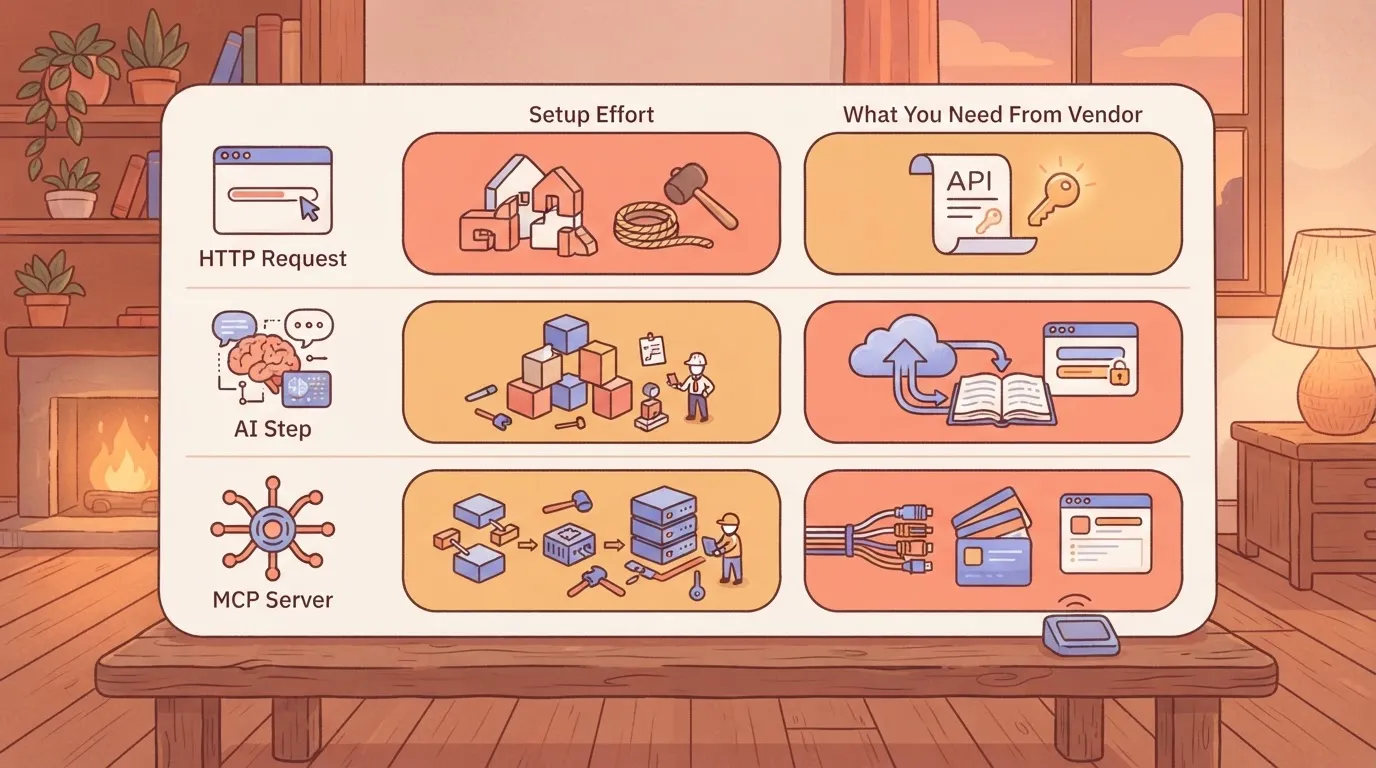
Option 2, an AI step with a custom or OpenAI-compatible provider, works only if the vendor documents an endpoint that accepts that request format. If it doesn't, you're writing a translation layer, and you should use Option 1.
Without a published MCP URL from the maker, Option 3, the MCP server, has nothing to connect, so check the docs before planning around it.
Nor do you have to wait for a connector, because you can generate the integration with AI and add it privately to your own instance.
Compare CodeDesign v3 pricing and performance
Don't read the published pricing as a task cost; it tells you what a site costs per month. Nobody has measured CodeDesign v3's speed or accuracy, so check the pricing page, then test it yourself.
Compare CodeDesign v3 published monthly plans
CodeDesign's pricing page lists three monthly plans per site, you can choose according to your budget, so the comparison stays straightforward. The plans are Portfolio at $9, Individual at $15, and Growth at $29.
viz type=step title="What CodeDesign monthly plans cost per site" unit="$ per month per site" source="CodeDesign - https://ai.codedesign.app/pricing" xaxis="Plan tier" yaxis="$ per month per site"5 on Individual and $29 on Growth, billed monthly." Portfolio: 9 Individual: 15 Growth: 29
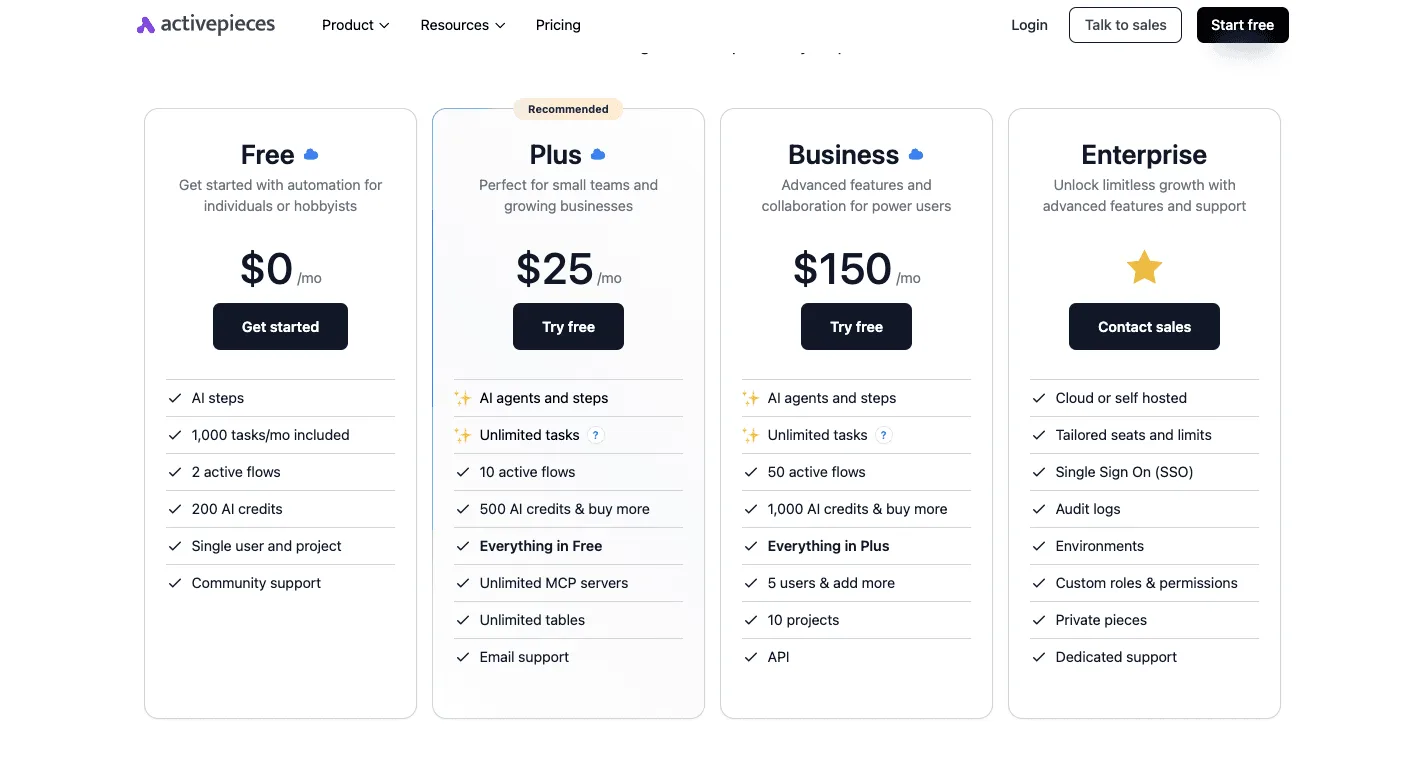
Because the price attaches to a site, not to usage, a team with ten sites on Growth pays $290 a month.
That's a budget line you can forecast, but it can't be set against a per-token model bill without knowing how many tasks each site generates.
What no one has measured yet
We haven't run CodeDesign v3, and the maker has published no tested speed, accuracy or cost-per-task figures. Treat any number you see quoted as unverified. Whoever owns the workflow gets the 2am page, so they should own the evidence too.
Because CodeDesign v3 generates websites, the test is not a model-for-model comparison on prompts. Compare it against how your team builds sites now, whether by hand, with a template tool or with another generator.
A task here is one site or page built from a real brief, and cost per task is the plan price plus the hours your people spend finishing and fixing it.
Measuring on your own work takes one afternoon of setup:
- Pick 20 real tasks from your existing workflow, such as actual site or page briefs rather than demos, and you'll see real performance instead of cherry-picked results, which means outliers won't dominate what you observe.
- Build each with your current method and with CodeDesign v3.
- Record the time per task, from brief to a page you would publish.
- Record the cost per task, counting the plan price and the labour of editing the output.
- Score output quality against a fixed checklist, ideally by someone who did not see which tool produced it.
- Compare the two sets side by side.

Twenty tasks is small, so it will expose large gaps but not subtle ones. If the results are close, widen the sample before switching.
What to watch next with CodeDesign v3
Recheck four published pages against how they read on 2026-11-20, and treat any difference as something to test rather than a verdict. Someone on your team must own that recheck, or the 2am page will be the first time anyone notices a change.
Below are the pages that can change what you wire in, each with the baseline of 2026-11-20, so a later difference is a dated change rather than a recollection:
- ai.codedesign.app/pricing, baseline 2026-11-20
- CodeDesign docs and changelog, baseline 2026-11-20
- The automation platform's repository, baseline 2026-11-20
- The same platform's integration catalog, baseline 2026-11-20
Each page answers a different question when it moves, as the paragraphs below set out.
On the pricing page, note what's billed and on what unit. A new tier or a changed unit alters your cost model, and no tested cost claim exists yet to fall back on.
In the docs and changelog, look for changed behaviour, deprecations and new integration points. Each entry's a reason to rerun your own comparison, since nothing published has been measured for speed.
Your workflows would be built in an open-source automation platform. Its integration catalog shows whether a ready-made connector for CodeDesign exists. Its repository shows whether one's in progress, who maintains it, and how recently they touched it.
Without a connector, you own the glue code yourself.
Related reading
References
Running the numbers
See what the same workload costs here.
Free forever plan, and every paid plan self-hosts at no extra cost.
See pricing Talk to sales