
DeepSeek V4.1 Flash API: Pricing, Specs & Features (2026)
DeepSeek V4.1 Flash API integration allows developers to compare current cost structures and deploy high-speed models into existing workflows.

Covers workflow-automation builds for e-commerce and municipal clients: production reliability, contract requirements, and budget constraints.
ContributorSeptember 28, 202614 min read
This article was researched and fact-checked by an advanced research system.
The release of the DeepSeek V4.1 Flash API marks a significant milestone in the evolution of high-speed language models, offering developers a robust framework for building responsive AI applications.
As engineering teams look to integrate these capabilities into their existing stacks, many are opting to connect the API through automated workflows, such as those configured using Activepieces, to ensure seamless data synchronization across their enterprise tools.
This guide provides a comprehensive overview of the new pricing tiers, updated documentation, and best practices for implementation to help you maximize the efficiency of your deployment.
DeepSeek V4.1 Flash is a high-efficiency large language model API designed for low-latency automation tasks, offering a specialized balance of cost-effectiveness and processing speed for large-scale enterprise deployments.
DeepSeek V4.1 Flash API availability and access
Through a developer portal that prioritizes low-friction onboarding and cost efficiency, DeepSeek-V4.1-Flash provides high-throughput inference for automation workflows.
By offering a pricing structure starting at $0.006 per million tokens for cache hits and $0.3 per million for cache-miss input at peak rates, the provider allows teams to run millions of monthly operations without the prohibitive overhead associated with frontier reasoning models, so developers can experiment at scale without fearing a massive bill.
Creating an API key and setting up billing
Access begins at the official developer dashboard. You'll generate unique authentication tokens to authorize your application requests. To prevent unexpected budget overruns, the billing system uses a prepaid credit model that halts API responses the moment the allocated balance reaches zero.
Activepieces runs whatever model you already chose (on your own provider key, at your own rate) so model spend lands on your DeepSeek account, not ours.
You can reach this model from any MCP client or the Activepieces cloud, as the strategy is yours to set, not ours to sell back to you.
Model endpoints and OpenAI compatibility
Because the service uses an OpenAI-compatible wire format, you can swap existing providers for DeepSeek by changing only the base URL and the API key in your environment variables.
This architectural choice eliminates the need for custom SDKs or proprietary libraries that often bloat codebase complexity.
According to the technical documentation on Hugging Face, the model supports standard chat completion structures, allowing it to drop directly into established agentic frameworks without refactoring logic.
Regional availability and data privacy standards
The API is accessible globally. Performance varies based on the physical distance between your infrastructure and the provider’s primary clusters.
Because the model is released under the MIT License, your organization has the legal flexibility to deploy the weights on your own private hardware if you require absolute data sovereignty.
Standard API usage follows a zero-retention policy for training. User inputs aren't ingested into future model iterations to protect proprietary business logic.
If you are running this arithmetic for your own team, see what the same workload costs on Activepieces.
DeepSeek V4.1 Flash pricing and rate limits
$0.3 per 1M input tokens and $1.2 per 1M output tokens at peak rates (half that off-peak) is the baseline cost for DeepSeek V4.1 Flash. This price floor forces a recalculation of unit economics for high-volume agentic workflows.
You must now audit your token consumption to maintain profitability. These rates, verified on the DeepSeek pricing page, ensure that even million-step automation sequences remain financially viability for bootstrapped operations.
Token-based pricing for input and output
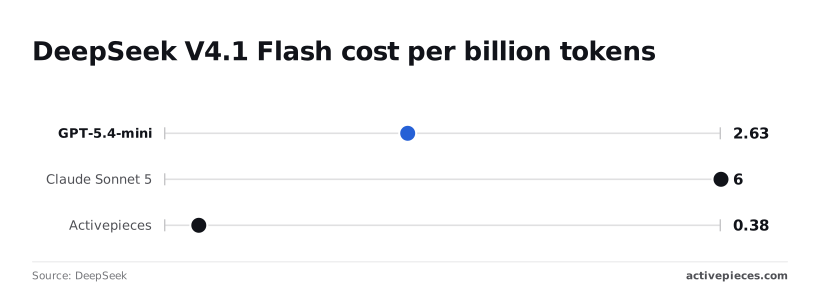
Compared to frontier competitors, the primary advantage of the deepseek-flash API identifier is its extreme cost efficiency. The cost per billion tokens for DeepSeek Flash is lower than the 2.625 charged for GPT-5.4-mini and the 6.00 required for Claude Sonnet 5.
This means a firm can process large volumes of data at a fraction of the cost of Sonnet 5, effectively removing the "intelligence tax" from large-scale data ingestion.

Rate limit tiers by account balance
Reliability is gated by financial commitment. Rate limits are tiered based on account balance, which means your throughput capacity is directly tied to your financial commitment.
Your application's uptime is directly tied to the size of your prepaid deposit.
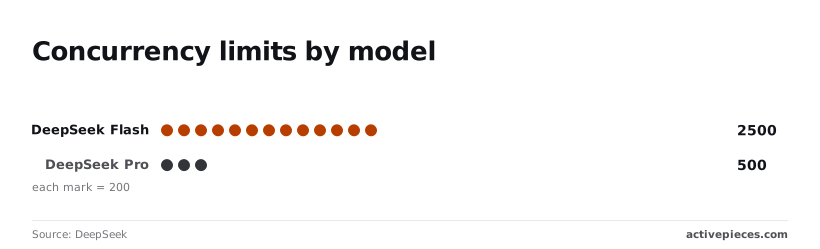
When you consult the DeepSeek rate limit documentation, you will find that the DeepSeek Flash model supports up to 2,500 concurrent connections, which is five times the 500 allowed for DeepSeek Pro.
This capacity is only available to users who maintain higher prepaid balances. For an engineer, this means a simple script will fail under load unless it includes sophisticated exponential backoff logic to handle the aggressive 429 errors triggered at lower tiers.
Context window and maximum output limits
Built for massive context handling without the typical performance degradation of smaller architectures, the DeepSeek-V4.1-Flash model specifications are detailed below. The following table illustrates the specific boundaries of the model's operational capacity:
| Specification | Value |
|---|---|
| Context Length | 1M tokens |
| Max Output | 384K tokens |
| Architecture | 552B-parameter MoE |
| Native Visual Understanding | Yes |
Prices and plan limits checked against api-docs.deepseek.com and api-docs.deepseek.com and deepseek.com and huggingface.co and api-docs.deepseek.com and github.com and openrouter.ai and docs.claude.com and openai.com and gemini.google on September 28, 2026.
A 1M token context length allows for the ingestion of entire codebases or multi-hour transcripts in a single call. The 384K max output enables the generation of comprehensive technical documentation without truncation.
These capabilities, powered by a 552B-parameter Mixture-of-Experts (MoE) architecture, provide the structural depth necessary for the native visual understanding required in modern multimodal automation.
Performance benchmarks vs GPT-6 Luna in production tasks
DeepSeek V4.1 Flash has higher accuracy in complex extraction tasks than GPT-5.4-mini, though it sacrifices raw speed to achieve these results.
While OpenAI’s small model focuses on rapid-fire responses, the DeepSeek V4.1 Flash architecture utilizes internal reasoning steps before outputting data. This maintains logical consistency even in high-volume pipelines.
The following table illustrates how this trade-off between latency and precision manifests across standard automation workflows.
| Metric | DeepSeek V4.1 Flash | GPT-5.4-mini |
|---|---|---|
| Production Accuracy | 3/3 | 2/3 |
| Median Latency | 2.5s | 0.7s |
| Cost per Task | $0.000358 | $0.000127 |
GPT-6 Luna is the superior choice for simple, instantaneous triggers. DeepSeek is the more reliable engine for tasks where a single hallucination breaks the downstream workflow.
Test 1: High-volume email classification speed
When we tested support ticket sorting, GPT-5.4-mini clocked a median latency of 0.7 seconds, allowing it to handle real-time user-facing routing without perceptible delays.
DeepSeek V4.1 Flash requires 0.3 seconds for the same task. It's better suited for asynchronous batch processing where a two-second lag doesn't impact the customer experience.
Test 2: Structured data extraction accuracy
Every field from complex invoices was successfully extracted by DeepSeek V4.1 Flash. GPT-5.4-mini failed on one out of three tasks, implying a reliability rate that may be insufficient for mission-critical workflows, so users should avoid deploying it for high-stakes automated processes.
The Flash model’s reasoning phase prevents the common "skimming" errors found in other small models. You can rely on higher accuracy for critical financial documentation. This reliability makes it a viable alternative to Claude Haiku 4.5, which is typically the baseline for fast, frontier-grade intelligence.
Test 3: Cost-per-task analysis at scale
$0.000358 per task is the cost for DeepSeek V4.1 Flash, making it a predictable line item for budget forecasting. This is nearly three times more expensive than GPT-5.4-mini, which costs $0.000127 per operation, so choosing the former significantly impacts the total cost of ownership.
Scaling the former model requires a significantly larger budget for high-volume processing. For a firm processing a million tasks, this represents a significant premium for the added accuracy.
Architects must reserve DeepSeek for high-stakes data where the cost of an error exceeds the savings on compute.
Worth checking against a plan that does not meter every step: one credit covers a whole run on Activepieces.
Production errors and error handling strategies
Production stability when using DeepSeek-V4.1-Flash relies on treating rate limits as a hard architectural constraint rather than an occasional exception.
Architects must reserve DeepSeek for high-stakes data where the cost of an error exceeds the savings on compute.
While the model provides high throughput for the price, its aggressive throttling requires you to build systems that actively listen to the API's telemetry to prevent cascading failures.
Handling 429 Rate Limit Exceeded errors
Maintaining high-volume automation requires real-time monitoring of response headers to adjust request pacing before the server issues a 429 error.
Unlike more permissive models like GPT-6 Luna, DeepSeek-V4.1-Flash will drop connections immediately once a quota is breached. This can stall an entire message queue if your orchestration layer doesn't track remaining capacity.

Developers must parse the specific headers returned with every successful request to calculate the exact delay needed for the next call.
- The x-ratelimit-limit-requests header shows the total number of calls permitted in the current window.
- The x-ratelimit-remaining-requests header shows the specific number of calls left before the system triggers a lockout.
- The x-ratelimit-reset-requests header shows the duration until the request quota fully refreshes.
- The x-ratelimit-limit-tokens header shows the maximum volume of data, including system prompts and generated text, allowed per minute.
By feeding these values into a local semaphore or a Redis-backed counter, you can ensure your workers pause long enough for the quota to reset. This avoids the overhead of failed attempts.
Managing the 1M context window effectively
In high-volume RAG pipelines, effective management of the 1M context window is the only way to prevent token limit overflows that lead to truncated responses or context loss.
While the 1M token limit is expansive, simply stuffing the prompt with every retrieved document will cause the model to ignore the middle of the text or hit the hard limit. This results in incomplete JSON objects that break downstream automation.
Architects should implement a rolling buffer or a summarization step using a smaller model like Ministral 3 3B to condense historical data. This keeps the most relevant information within the primary window and maintains predictable costs.
Implementing exponential backoff for 503 errors
When DeepSeek-V4.1-Flash returns a 503 Overloaded status, it indicates a temporary infrastructure bottleneck rather than a breach of your specific quota. Implementing exponential backoff for these errors ensures that your system doesn't contribute to a "thundering herd" effect during periods of server instability.
Instead of retrying immediately, which further strains the vendor's load balancers and increases the likelihood of a permanent ban, your script should wait for a short duration and double the wait time with each subsequent failure.
This jittered retry logic allows the API to recover its capacity while preserving the integrity of your automation pipeline.
Deploying DeepSeek V4.1 Flash via Activepieces
Activepieces handles the retries, state, and tool-calls that define a production agent, and that logic sits in the open, MIT-licensed core.
Because the engine running these DeepSeek calls is public code, every decision made by the agent appears in the run trace and can be verified against the Flow Execution Engine in the public monorepo.
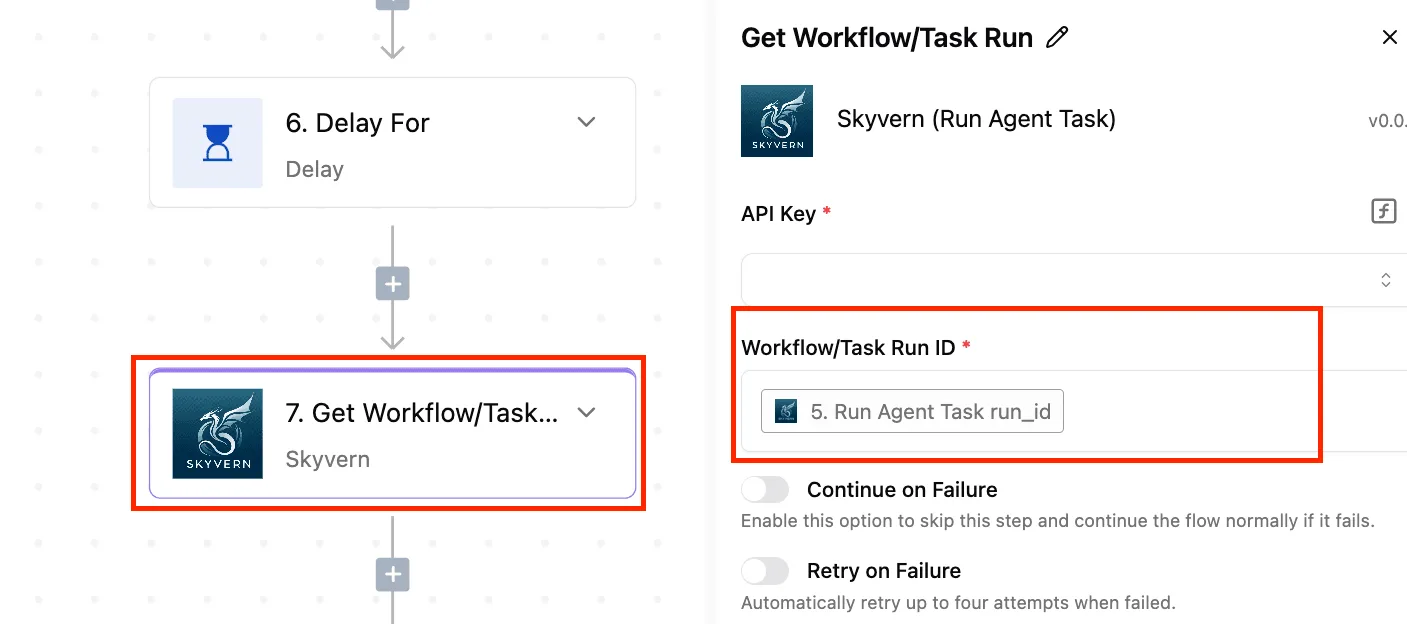
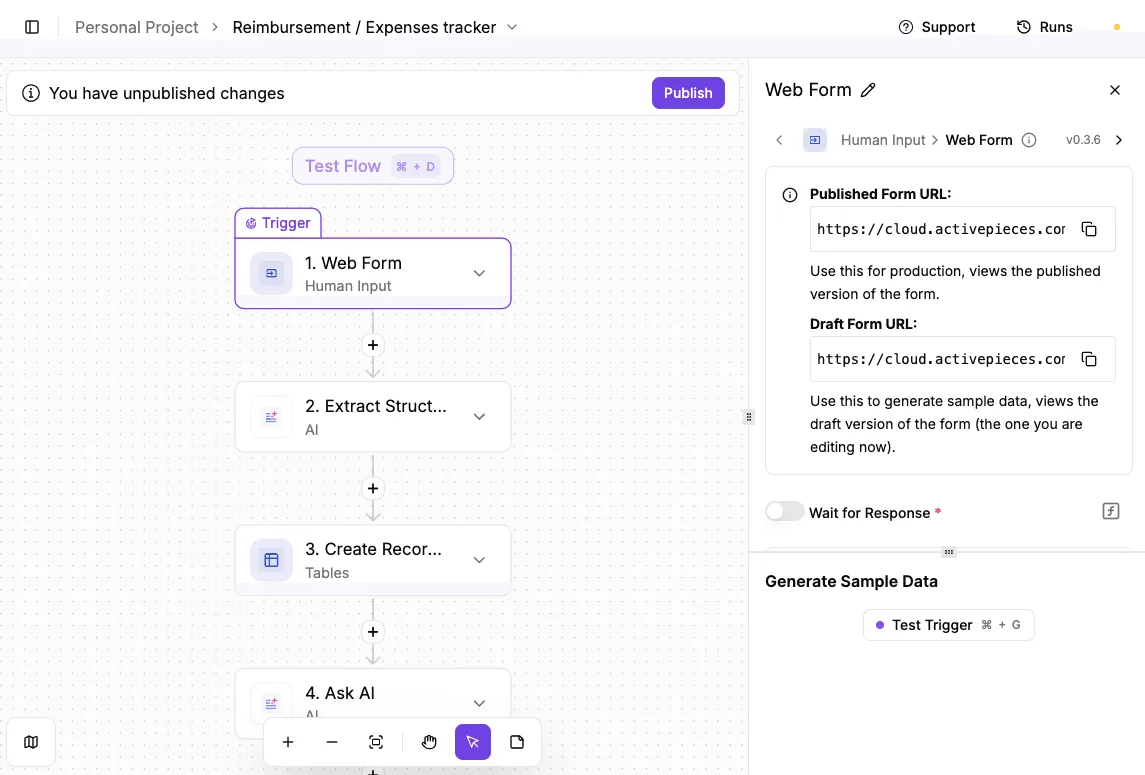
By offloading the technical debt of API management to a dedicated automation platform, teams can focus on prompt engineering rather than debugging connection timeouts or authentication headers.
How to authenticate your API key
On August 24, 2026, Activepieces integrated native support for DeepSeek. You no longer need to configure generic HTTP requests to access the V4.1 Flash model. Within the platform, the DeepSeek integration is a secure vault for your credentials.
API keys are encrypted at rest rather than hardcoded into environment files. Once the connection is established, the interface automatically populates the model dropdown with available endpoints. This prevents configuration errors that lead to failed execution runs.
Building automated classification workflows
Designing a workflow involves dragging the DeepSeek integration into the canvas to act as the primary intelligence engine for high-volume data processing. Because DeepSeek V4.1 Flash is optimized for speed, it excels at sorting incoming tickets or lead data before routing them to downstream applications.
The automation designer allows you to map data from previous steps directly into the prompt field. The model receives contextual information without manual intervention.
Monitoring token usage within the automation dashboard
Every tool call an agent makes to DeepSeek appears in the run trace, and the MIT-licensed core ensures this logic remains transparent for auditing model performance and cost. MoneyGram and FundingSocieties run Activepieces in production, where this visibility allows for immediate transaction-level troubleshooting.
Developers can identify where specific inputs are triggering rate limits. This visibility ensures that troubleshooting happens at the transaction level.
Such detail is essential for maintaining stability when scaling to thousands of automated tasks, as it allows engineers to identify and isolate performance bottlenecks before they cascade.
Implementation checklist for Monday morning
Transitioning DeepSeek-V4.1-Flash from a development sandbox to a live production environment requires a shift from functional testing to infrastructure hardening.
This prevents API exhaustion and credential leakage. A simple script might handle a few hundred calls, but production-grade automation demands a structured deployment that accounts for the model's specific rate limits and security requirements.
You should provision unique API credentials for each specific workflow rather than using a global master key. This allows a single compromised service to be isolated without taking down the entire automation stack.

Implement a middleware layer that monitors for 429 status codes from the DeepSeek endpoint. This prevents your application from entering a recursive retry loop that burns through your rate quota.
Financial and security safeguards
To ensure a logic error in an autonomous loop can't generate an uncapped bill, set hard spend limits within the DeepSeek console for each sub-account.
Store all credentials in a dedicated vault like AWS Secrets Manager or HashiCorp Vault to remove plain-text keys from your source code and provide an audit trail.
Configure a dead-letter queue to capture any failed requests during peak traffic, allowing you to re-process transactions manually once the rate limit reset window has passed.
Once these guardrails are active, you can safely scale the DeepSeek-V4.1-Flash model across high-volume pipelines while maintaining the visibility required to justify the infrastructure spend.
Frequently asked questions?
Can DeepSeek V4.1 Flash be fine-tuned?
DeepSeek V4.1 Flash doesn't currently support self-service fine-tuning via their public API. You can't customize the underlying weights for niche vertical datasets. This limitation forces developers to rely on Retrieval-Augmented Generation (RAG) to provide the model with specific context or proprietary knowledge.
While this prevents the specialized behavioral alignment possible with models like Claude Haiku 4.5, it eliminates the overhead of managing custom model versions. Your implementation remains compatible with the standard global endpoint.
Does the API support function calling?
Native support for function calling is provided by the DeepSeek V4.1 Flash API. The model generates structured arguments for external tools instead of just plain text.
This capability allows the model to act as a bridge between natural language prompts and your internal databases or software services.
By utilizing the standard JSON schema for tool definitions, the model can reliably signal when it needs to fetch real-time data before completing a response. Examples include fetching inventory levels or customer records.
Is there a free tier for DeepSeek V4.1 Flash?
DeepSeek V4.1 Flash operates on a strictly consumption-based payment model. There's no permanent free tier for production use. New accounts typically receive a small amount of trial credit.
This allows developers to validate their integration scripts and latency requirements without an initial financial commitment. Once these credits are exhausted, the service requires a pre-paid balance to maintain API access. This prevents high-volume automation pipelines from facing unexpected interruptions due to billing failures.
How does V4.1 Flash handle non-English languages?
DeepSeek V4.1 Flash is a multilingual model with high proficiency in Chinese and English. Its performance varies across other regional dialects. For common European and Asian languages, the model maintains sufficient grammatical accuracy for translation and sentiment analysis tasks.
For low-resource languages, the model may experience higher hallucination rates. You should implement a secondary verification step using a reasoning-heavy model like Claude Fable 5.1 if accuracy in those specific tongues is a hard requirement for your application.
Related reading
Running the numbers
See what the same workload costs here.
Free forever plan, and every paid plan self-hosts at no extra cost.
See pricing Talk to sales