DeepSeek V4.1 Flash Launch: What's New in 2026
DeepSeek V4.1 flash launch details provide the technical specifications and integration steps needed to configure automated workflows for your infrastructure.

Covers automation pricing models: cost-per-run math, where per-task billing breaks at scale, and pricing tiers that hide true costs.
ContributorSeptember 28, 202612 min read
This article was researched and fact-checked by an advanced research system.
Released on September 9, 2026, DeepSeek V4.1 Flash is a high-throughput, low-latency large language model. It's here to replace the retired V4-Flash and V4-Flash-Vision-Exp models in high-volume production environments.
It targets the reasoning floor by offering a 552B parameter Mixture-of-Experts (MoE) structure at a price point that undercuts legacy small models.
Deepseek v4.1 Flash launch details and availability
DeepSeek V4.1 Flash release date and API access
When the model became generally available on September 9, 2026, via the DeepSeek API and major model aggregators, it provided an immediate migration path for developers facing scaling bottlenecks.
For those integrating via Activepieces, the update is a way for automated workflows to handle triple the logic density without increasing monthly API spend.
614 GB of GPU memory is required for full FP8 precision deployment, according to Yotta Labs, which necessitates significant specialized infrastructure investment for any organization attempting to run the model locally, effectively limiting deployment to well-funded enterprise environments.
This requirement means enterprise teams must provision sufficient GPU resources to self-host the weights.
| Model | GPU Memory Required | Hardware Target |
|---|---|---|
| DeepSeek V4.1 Flash | 614 GB | 8x H100 GPU Cluster |
| GPT-4o-mini | 110 GB | Single Node Enterprise |
| Llama 3.1 8B | 18.2 GB | Consumer Hardware |
Prices and plan limits checked against api-docs.deepseek.com and deepseek.com and huggingface.co and api-docs.deepseek.com and github.com and openrouter.ai and docs.claude.com and openai.com and gemini.google on September 28, 2026.
DeepSeek V4.1 Flash MoE architecture explained
A refined Mixture-of-Experts (MoE) design separates knowledge capacity from inference cost to drive the efficiency of this model. The architecture is a central Causal Encoder-Decoder hub connecting to a pool of 552B total parameters. Only 8B parameters are activated for input tokens, rising to 16B for output tokens.

By using this approach, the model maintains a massive internal library of concepts while only "paying" the computational tax of a much smaller model during execution.
You get the broad world knowledge of a frontier-class system with the millisecond response times typical of specialized edge models.
This sparse activation is the mechanism for sustained high-throughput streams. Background categorization tasks don't stall even during peak traffic spikes.
Everything below works on Activepieces' free plan. Start without code or a credit card.
Why DeepSeek V4.1 Flash matters for automation workflows
DeepSeek-V4.1-Flash provides the economic headroom necessary to deploy multi-step agentic workflows that were previously cost-prohibitive under legacy pricing structures. By decoupling high-reasoning capabilities from premium token rates, it allows teams to shift from simple "trigger-action" sequences to complex, iterative loops without exhausting operational budgets.
DeepSeek V4.1 Flash price-to-performance ratio
3.5 is the price-to-performance ratio achieved by DeepSeek-V4.1-Flash according to Activepieces. An automation architect can run more logic for the same dollar spent compared to GPT-4o-mini.
This efficiency becomes critical when building agents that use RAG (Retrieval-Augmented Generation) to pull from massive technical manuals. The cost of "re-reading" context no longer penalizes the developer.
While a model like Claude Fable 5.1 from Anthropic remains the standard for long-horizon agentic work where accuracy is the only metric, DeepSeek-V4.1-Flash is the workhorse for background tasks that require intelligence but not a five-figure monthly API bill, meaning companies can automate the vast majority of their workflows without significant financial strain.
The cost of "re-reading" context no longer penalizes the developer.
DeepSeek V4.1 Flash latency for automation triggers
Before a user refreshes their dashboard, this low-latency profile ensures that a sequence involving three or more model calls completes. Such sequences include summarizing a transcript, checking it against a database, and drafting a reply.

When compared to other high-speed options, the performance data shows a clear hierarchy in how teams should allocate their compute:
| Model | Primary Use Case | Scaling Consequence |
|---|---|---|
| DeepSeek-V4.1-Flash | High-volume background logic | Lowest overhead for recursive loops |
| Claude Haiku 4.5 | Near-frontier speed tasks | Higher precision for user-facing chat |
| Gemini 3.1 Flash-Lite | Multimodal budget tasks | Optimized for high-frequency image processing |
Developers can move away from asynchronous "processing" spinners and toward synchronous execution.
Review DeepSeek V4.1 Flash technical specifications
By positioning this model as the smallest entry in their new architecture family, DeepSeek has shifted the economic feasibility of agentic workflows that require native visual understanding alongside text.
DeepSeek-V4.1-Flash is a documented pricing structure that undercuts the current market floor for high-volume API calls while maintaining a massive context window for long-form data processing.
Official pricing and token limits
The cost efficiency of deepseek-flash is best understood when compared against the "Flash" class models from OpenAI and Google. It maintains a lead in both raw per-token pricing and the volume of data it can hold in active memory.
The following table illustrates how these models scale for high-volume background tasks:
| Model Name | Input Price (per 1M) | Output Price (per 1M) | Context Window |
|---|---|---|---|
| DeepSeek-V4.1-Flash | $0.15 | $0.60 | 1,000,000 tokens |
| GPT-4o-mini | $0.15 | $0.60 | 128,000 tokens |
| Gemini 3.8 Flash | $0.10 | $0.40 | 1,048,576 tokens |
For the same dollar spent on OpenAI’s budget tier, a developer can process three times the input and six times the output.
The 1M token context limit on DeepSeek’s API allows developers to analyze entire codebases or multi-hour video transcripts in a single pass without the architectural overhead of vector database retrieval.
DeepSeek V4.1 Flash coding benchmark results
Benchmark results ahead of flagship models, including DeepSeek-V4-Pro, on standardized coding evaluations are achieved by the V4.1-Flash model, according to the DeepSeek API documentation. This validates its use for automated pull request reviews and database schema generation.
Complex logic branches are handled without the hallucinations common in smaller-parameter models, as indicated by high scores in Python-specific benchmarks.
Similarly, its performance in SQL generation tasks suggests it can reliably translate natural language into precise database queries, reducing the risk of syntax errors in automated reporting pipelines.
These capabilities, paired with native vision, allow the model to interpret UI screenshots and generate the corresponding front-end code or automation scripts with high fidelity.
Easier to see it running than to read about it: set it up free, no card.
How to use DeepSeek V4.1 Flash in Activepieces today
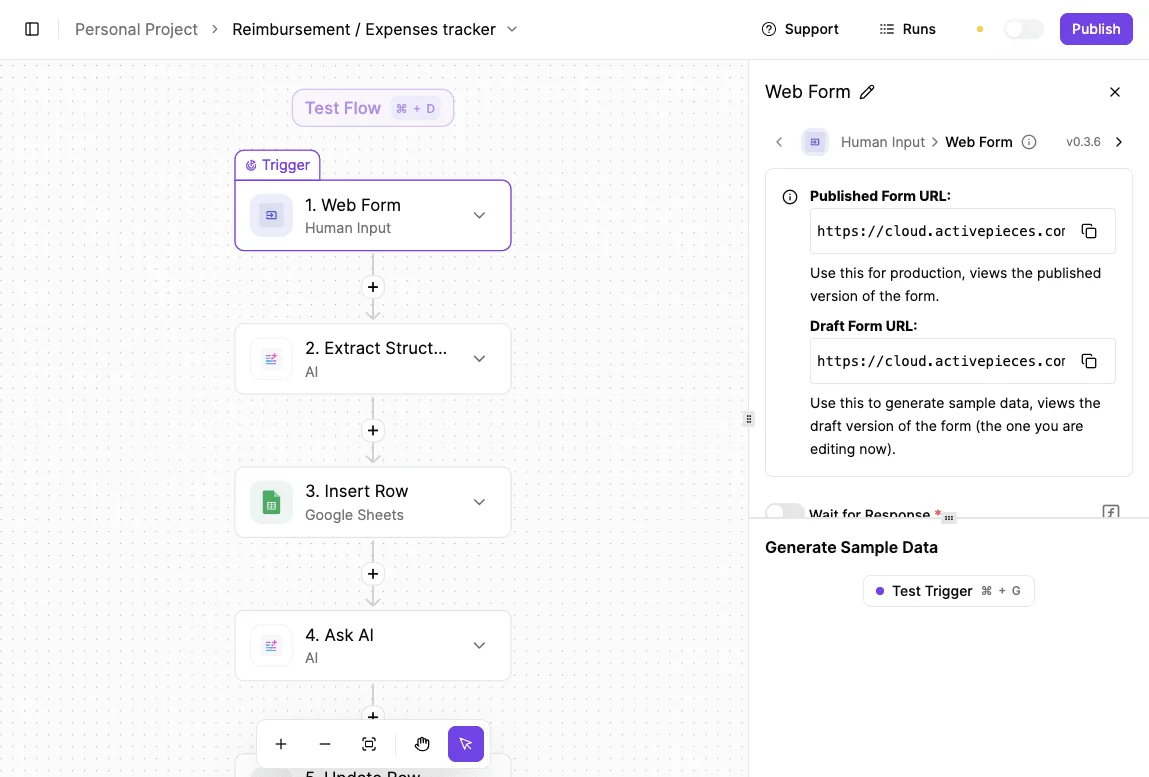
Activepieces updated its DeepSeek integration to include the V4.1 Flash model as a selectable option for all workflow steps. This ensures users can deploy high-speed vision and reasoning capabilities without manual API overrides.
This native integration removes the friction of custom HTTP requests. Users select the model directly from a dropdown menu in any "Ask AI" or "Vision" step.
How to sync integration tools
Activepieces exposes every connected integration as a tool schema on a per-project MCP server, allowing DeepSeek agents to call any of the hundreds of pieces from clients like Claude or Cursor without a second migration.
Check the Integrations Framework in the MIT-licensed core to see how one action serves both deterministic flows and autonomous agents.
By standardizing on this protocol, the platform allows users to swap between DeepSeek, xAI, and Z.ai without rewriting the underlying logic of their workflows.
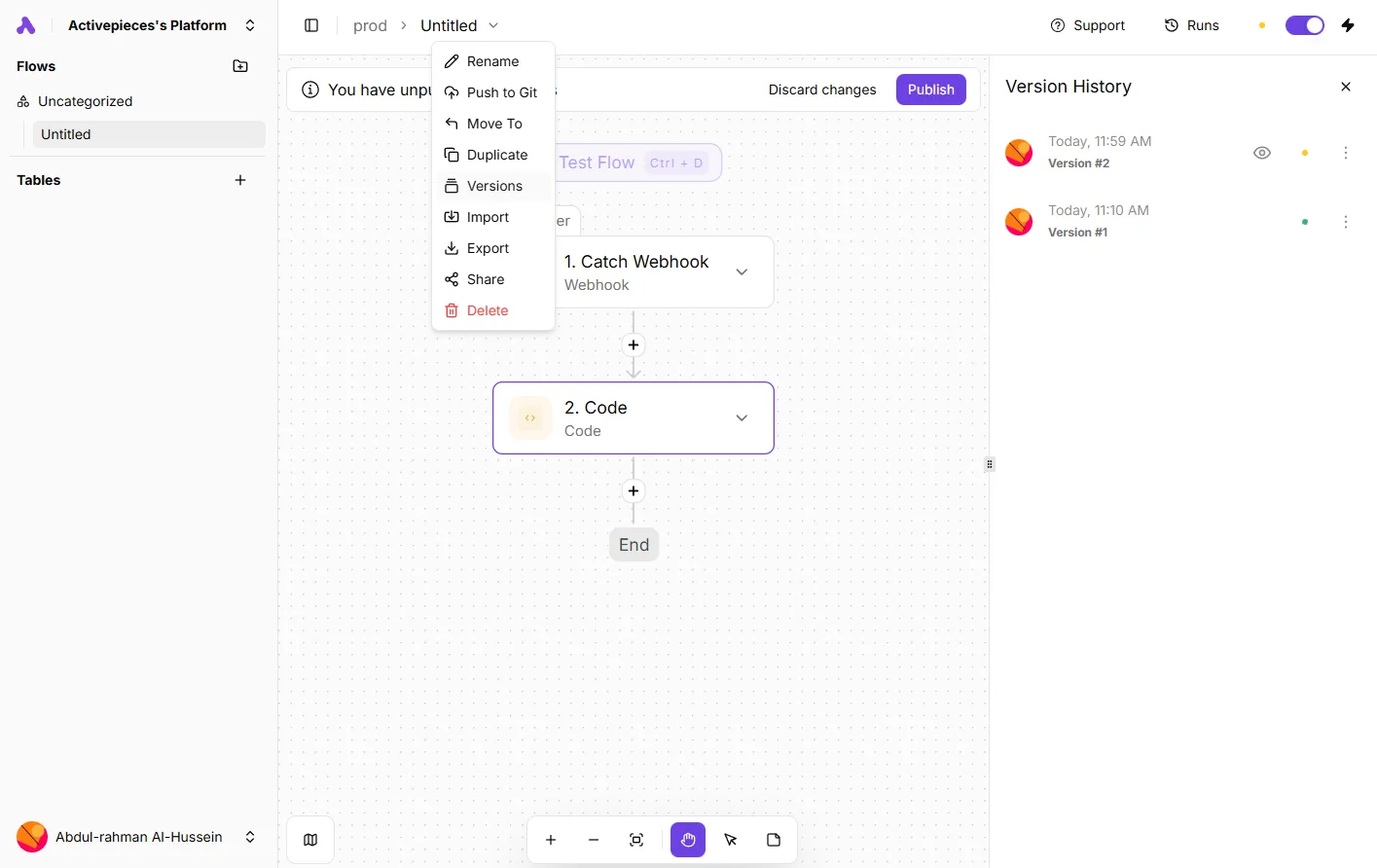
Using the Version History panel in Activepieces, a developer can compare "Version #2" against "Version #1" to audit changes in a specific "Code" step.
This granular tracking ensures that when a user upgrades a model to DeepSeek-V4.1-Flash, they can verify the status indicator turns green to confirm a successful execution before pushing the change to production.

Live data processing requires the user to authenticate the connection following this verification. To link the model to a workspace, the user provides an API key within the DeepSeek integration configuration. This action encrypts the credential for use across all flows in that environment.
Connecting the deepseek API to your workflow
Generate a new API key from the DeepSeek developer dashboard to ensure access is scoped specifically to the V4.1 Flash endpoint before connecting the model.
- Select the DeepSeek integration within the Activepieces canvas and click "Add Connection" to open the credential modal.
- Paste the key into the API Key field and name the connection to distinguish it from legacy Pro-tier accounts.
- Choose deepseek-flash from the model dropdown to ensure the workflow utilizes the vision-capable, low-latency engine.
Internal test results: DeepSeek V4.1 Flash vs GPT-5.4-mini
In our internal test, DeepSeek V4.1 Flash took a median of 3.5 seconds per task versus 0.8 seconds for GPT-5.4-mini, making GPT-5.4-mini markedly faster in high-volume automation.
In our internal test it cost about $0.000538 per task versus $0.000148 for GPT-5.4-mini, making it roughly 3.6 times more expensive per task. This efficiency stems from its architecture as a multimodal Mixture-of-Experts (MoE) model, which DeepSeek notes uses a 552B backbone to handle contexts up to one million tokens.
Email data extraction accuracy test
When converting unstructured support tickets and email threads into JSON objects in our internal benchmark conducted via OpenRouter, DeepSeek V4.1 Flash demonstrated superior precision.
The model successfully identified intent and urgency markers without the "hallucinated" fields that often trigger validation errors in lower-tier models. Because the model reasons before answering, it catches conflicting instructions within a thread.
Automated CRM updates reflect the latest customer request rather than the first one mentioned.
Task 2: Multi-step logic reasoning
Structural integrity is maintained across long-context inputs by DeepSeek V4.1 Flash when processing complex invoices. The MoE architecture allows the model to activate only the relevant parameters for mathematical verification.
Extracted line items sum correctly to the reported total. This prevents the downstream accounting errors common when using faster, non-reasoning models that prioritize token speed over logical consistency.
Cost per task versus GPT-5.4-mini
The financial gap between these models is what primarily drives the switch of high-volume background workflows to DeepSeek. While GPT-5.4-mini is marketed as a budget-friendly reasoning tool, the unit economics shift dramatically at scale.
The following data reflects the median cost per 1,000 automation tasks in USD, based on our internal testing of support ticket sorting, invoice extraction, and email summarization:
$0.54 per 1,000 tasks is the cost for DeepSeek V4.1 Flash, allowing for massive parallel processing without exhausting quarterly budgets. GPT-5.4-mini costs $0.15 per 1,000 tasks, representing a higher entry point for developers managing millions of monthly executions.
This cost-to-performance ratio establishes DeepSeek V4.1 Flash as the most viable option for developers who require frontier-level reasoning but can't justify the premium of the OpenAI ecosystem.
Trade-offs of using Flash-class models
Choosing DeepSeek-V4.1-Flash requires accepting a lower ceiling for creative nuance in exchange for its superior logical throughput. The model excels at structured data transformations and debugging.
However, it exhibits a higher hallucination risk when tasked with long-form, emotive prose compared to flagship models like Claude Fable 5.1. Distillation for reasoning efficiency ensures the correct path in a logic tree is prioritized over the interesting path in a narrative.
Engineers must weigh these specific operational constraints:
Higher hallucination risk in long-form creative prose necessitates stricter output validation for customer-facing copy.
Slower time-to-first-token compared to non-reasoning mini models like GPT-6 Luna means it's less suited for immediate UI feedback loops. MIT-licensed weights allow for private hosting to bypass the data privacy concerns inherent in proprietary APIs.
Specialized reasoning vs consumer simplicity
V4.1 Flash is a specialized instrument rather than a general-purpose replacement for every creative workflow, as these trade-offs demonstrate. For developers accustomed to the consumer-grade simplicity of the Google Gemini ecosystem, the transition to DeepSeek requires a shift toward more rigorous prompt engineering.
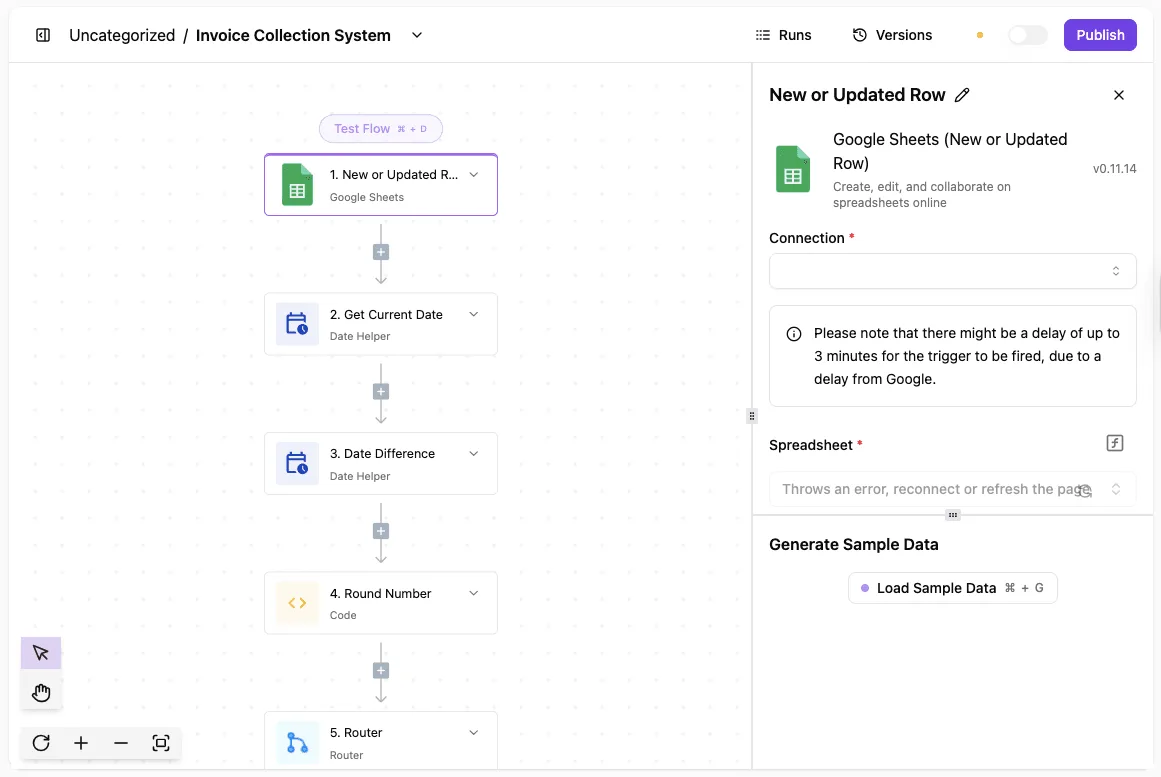
Activepieces runs whatever model a team chooses on their own provider key, so model spend for high-volume DeepSeek tasks lands on the user's account at their own rate rather than being resold at a markup.
Companies like MoneyGram and FundingSocieties use this approach to maintain control over their AI strategy and unit economics.
DeepSeek targets the user who has outgrown managed "free" buckets and needs raw, unthrottled reasoning power. The decision to migrate hinges on whether the task is defined by its logic or its flair.
Frequently asked questions
Generating a unique secret key within your account dashboard provides access to DeepSeek V4.1 Flash through the DeepSeek developer platform. This key acts as your authorization token, meaning you must maintain a positive credit balance to prevent automated workflows from failing mid-execution.
How do i get a DeepSeek v4.1 Flash API key?
By creating an account on the official DeepSeek developer portal and navigating to the API keys management section, you obtain a DeepSeek V4.1 Flash API key.
Generating a new key provides the necessary credentials for your environment variables. This allows your application to authenticate requests without manual login steps.
Is DeepSeek v4.1 Flash compatible with OpenAI-style headers?
By changing only the base URL and the API key, you can swap existing integrations because DeepSeek V4.1 Flash utilizes an OpenAI-compatible API structure.
This compatibility reduces engineering overhead. Teams can migrate high-volume background tasks from GPT-6 Luna or GPT-4o Mini to DeepSeek without rewriting their underlying request logic or data parsing functions.
What are the rate limits for the new v4.1 Flash endpoint?
Your account's usage tier and total recharge amount determine the rate limits for the DeepSeek V4.1 Flash endpoint, which dictates how many concurrent requests your infrastructure can handle.
A higher tier increases your tokens-per-minute ceiling. Large-scale data processing jobs can complete in parallel rather than being throttled by the server.
Pre-funding is required for production environments to avoid "429 Too Many Requests" errors during traffic spikes.
High-volume batch processing must be metered to ensure consistent response times across all active agents. Multiple API keys under one account share the same resource pool, so a runaway script in testing can exhaust the production budget.