
Gemini 4 Argon: Benchmarks, Pricing and Availability

Oct 18, 202611 min read
Gemini 4 Argon is Google DeepMind's flagship reasoning model, announced on Oct. 13, 2026 and available through Google's developer platforms and OpenRouter. Google calls it "our next era of frontier intelligence, built to solve your hardest problems," on its model page.
Gemini 4 Argon announced this month
Gemini 4 Argon is a reasoning model from Google DeepMind, designed for complex, difficult problems, that developers can call through Google's developer platforms and OpenRouter to power steps in automated workflows.

In Activepieces, you can call Gemini from a flow or an AI agent step and send the output to the apps you already use.
Whoever creates the connection owns its key, so name that person first. Try it free.
Text is not the only pitch. Google's developers blog describes Argon as "a general-purpose physical reasoning model" that "can be applied across the entire robotics lifecycle."
Check each of the four facts in the table below against its source before you build on it, because everything else rests on them.
| Item | Value | Source |
|---|---|---|
| Maker | Google (DeepMind) | Model page |
| Post date | Oct. 13, 2026 | Developers blog |
| Where to get it | Google developer platforms, OpenRouter | Developers blog |
| Pages checked | 2026-10-18 | Model page |
Expect the key you test with to differ from the one you later run in production, because both access routes issue their own keys.
I read both Google pages on 2026-10-18. This article doesn't reflect anything Google changes after that date.
If you are running this arithmetic for your own team, see what the same workload costs on Activepieces.
Argon's importance for automating work
When a new model launches, re-test rather than switch: the model behind an AI step decides how that step behaves. Google lists Gemini 4 Argon as its flagship reasoning model, and four common steps depend on which model sits behind them.
If you swapped the model, each step in the list below could change in its own way. Take from it that a swap is a measurable change you test on your own data first.
- Classify a ticket: accuracy on borderline categories, and how consistently the same ticket gets the same label.
- Extract invoice fields: accuracy on messy layouts and missing fields, plus the cost per document.
- Draft a reply: tone, length and factual care, with seconds per reply as the cost of a slower model.
- Route to an app: whether the step picks the right destination every time, since a wrong route sends data to the wrong place.
Run each step on a small sample of your real items, once with your current model and once with Argon, then compare.
Outside reports play no part in any of this. The article relies on Google's own pages and a small test.
Start from Google's model page. Before you build, confirm which account owns the key or connection your workflow will use, and what that connection can do.
I verified the model listing on Google's page on 17 October 2026.
What's measurably new in Gemini 4 Argon
As Google reports, Argon's measurable gains include a tied-first CWE-Bench result.
Capabilities Google states
You get four claims from Google's page, and none of them carries a price or a timing. Argon ties for #1 on CWE-Bench with 68%, so on that vulnerability-fixing test it matches the best listed result but doesn't beat it.
It claims resilience to prompt injection, but gives no figure, so you can't compare it with your current model.
On A100 GPUs under vLLM, Google reports a 2.85x speedup, and that is a serving setup you run yourself. So you get roughly triple the inference throughput when deploying on your own infrastructure.
That says little about hosted API latency.
Figures Google publishes
Not from Google: the spreadsheet numbers come from Surge AI.
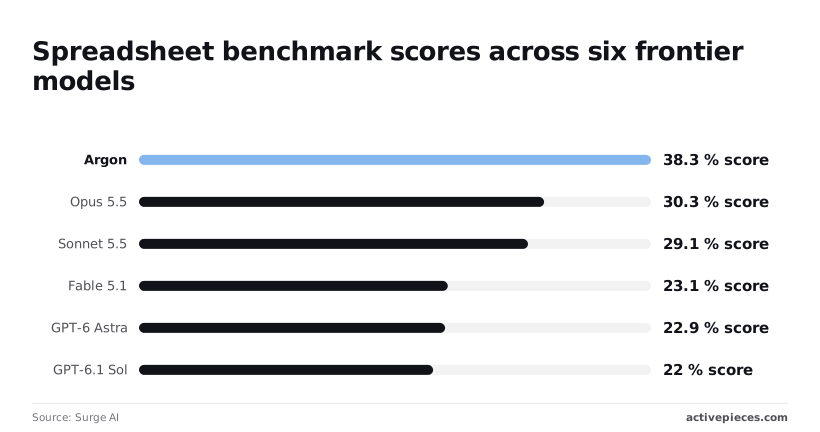
That is an eight-point lead over the nearest rival, which matters if your work is spreadsheets.
On the middle benchmark Argon trails both Claude models by two to six points, and it leads narrowly on the third. Opus 5.5 scores 30.3, 59.6 and 67; Sonnet 5.5 scores 29.1, 63.6 and 67.
No price, no speed figure: Google states neither. The two things you must compare against your current model are the two things you can't yet read off Google's pages.
What Activepieces shipped for Gemini 4 Argon
I found no Activepieces release specific to Gemini 4 Argon, so there's no ship date or link to give. The price and speed checks still have to come from your own test.
I won't infer a date from the model's launch, because Activepieces has confirmed nothing Argon-specific.
That matters less than it sounds, since Activepieces doesn't sell you a model: you choose the model, and you can bring your own provider key so the spend lands on your own bill.
Argon's cost then lands on your provider account at your rate, with no markup folded into a bundled plan, and the choice of model stays yours instead of being made for you.
The pricing page lists which tiers allow bringing your own key, and that rate is the one to set beside what a reseller charges.
Calling it from a workflow step
I can stand behind one route: an HTTP request step that calls Google's API with Argon as the model. Before building it, settle who owns the connection: the API key should belong to a project or service account your team controls, not a personal login.
That way the flow doesn't stop when one person leaves. Store the key as a connection, not in the step body.
Then run the same prompt you use today against both models and record price and latency per call, which are the two figures you couldn't read from Google's pages.
Sending Gemini 4 Argon output to your apps
Whatever the model returns can be passed to any later step, and the step picker is where you choose the destination.
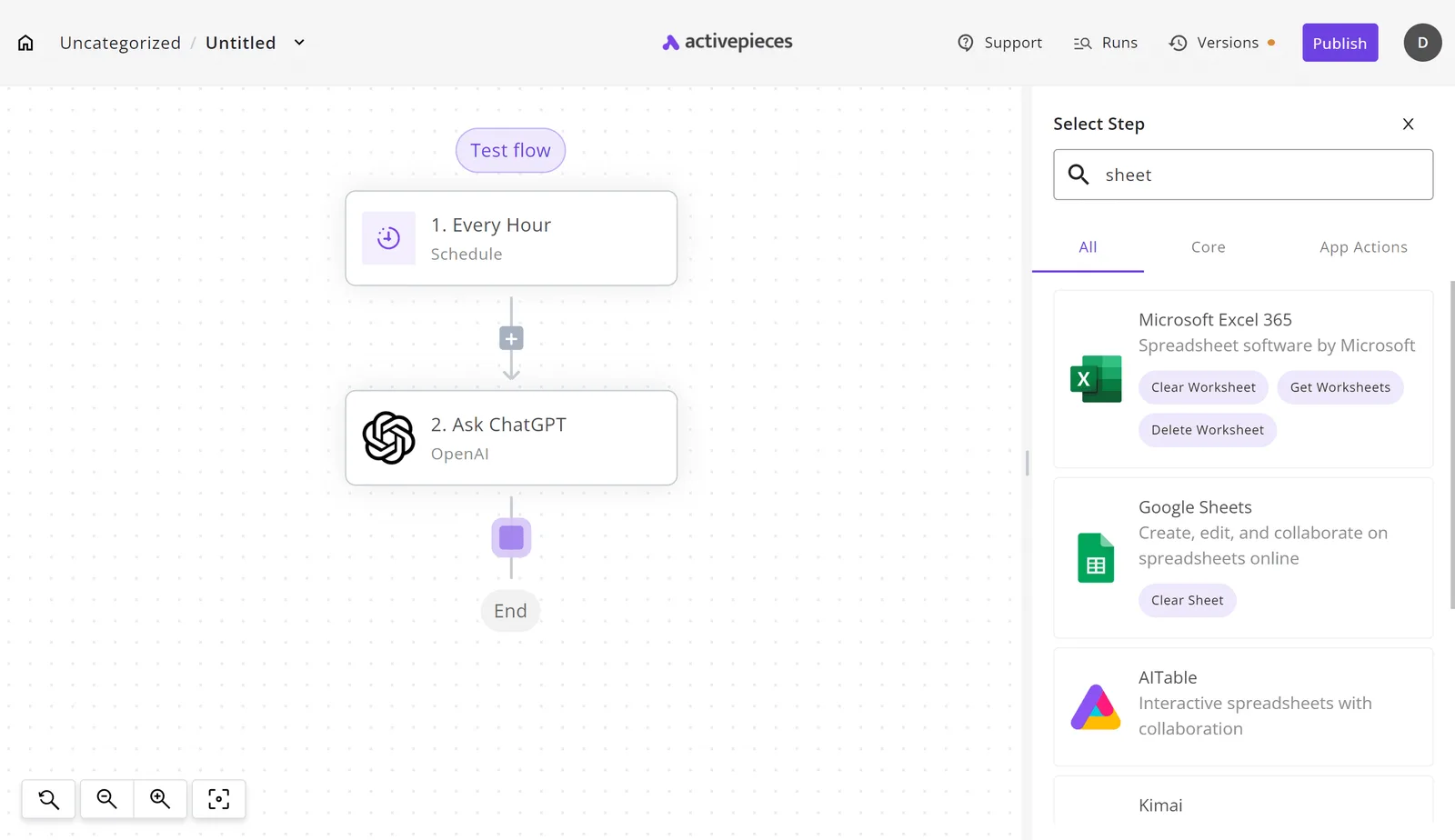
Searched for "sheet", the panel below lists spreadsheet integrations such as Google Sheets and Microsoft Excel 365, which suits a comparison log with one row per test call.
Each integration asks for its own connection, so check which account owns it and what it can write to before you switch the flow on.
Worth checking against a plan that does not meter every step: one credit covers a whole run on Activepieces.
Our test of Gemini 4 Argon against GPT-5.4-mini
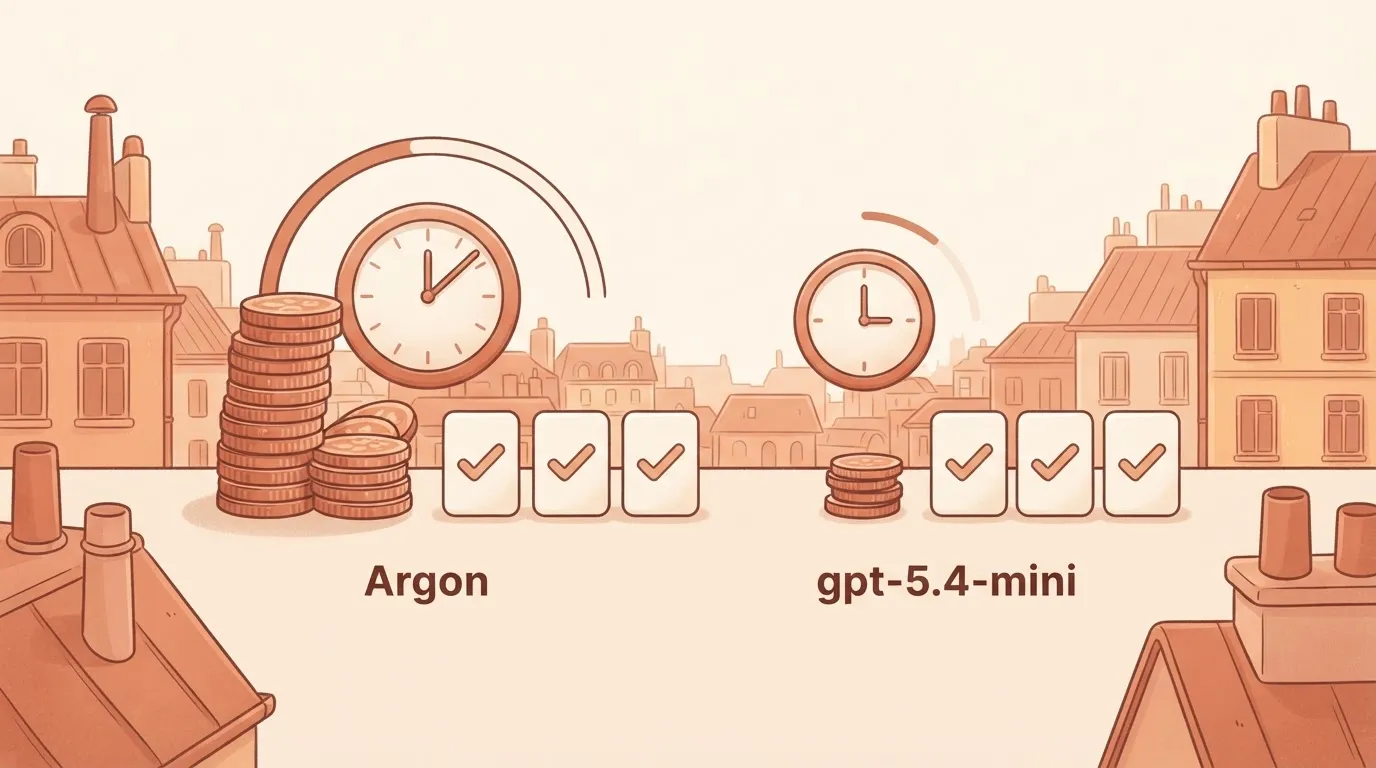
On correctness it was a tie: both models got all three tasks right, so neither offers an accuracy advantage on these benchmarks. Argon took more than twice as long and cost roughly fifteen times as much per task.
We ran them on 2026-10-18 through one OpenRouter key, so both calls were billed to the same account.
We sorted a support ticket, pulled fields from an invoice and summarised an email thread. Each output was checked against a known answer. Argon (google/gemini-4-argon on OpenRouter) ran on default settings, which reason before answering. The comparison model was openai/gpt-5.4-mini.
Argon vs GPT-5.4-mini results, speed and cost
On correctness the models tie; time and money are what separate them, and those are what you'd pay for on every run of a flow.
| Task | Argon | gpt-5.4-mini |
|---|---|---|
| Ticket sort | Correct | Correct |
| Invoice fields | Correct | Correct |
| Email summary | Correct | Correct |
| Median seconds per task | 2.0 | 0.9 |
| Median cost per task | $0.0022 | $0.000141 |
At 10,000 tasks a month, Argon costs about $22 against $1.41 for gpt-5.4-mini, rendering it cost-prohibitive for price-sensitive workloads.
If a person or a downstream step is waiting on the answer, the extra 1.1 seconds matters. For scheduled, offline work it's a non-factor.
Treat this as indicative, not a benchmark: three tasks, one run each. All six answers were correct, so the test can't show whether Argon's reasoning pays off on harder inputs. Run your own documents through both models before you switch.
Argon's cost and speed
Your own documents will tell you whether the quality gap justifies that.
OpenAI's pricing page lists GPT-5.4-mini at $0.75 per 1M input tokens. GPT-6.1 Sol is $2, and GPT-6 Astra is $10.
| Model | Price per 1M tokens (input / output) |
|---|---|
| Gemini 4 Argon | — |
| GPT-5.4-mini | $0.75 input |
| Gemini 2.5 Pro | $1.25 / $10 |
| Gemini 3.1 Pro | Not found |

Because Google publishes no Argon price, it cannot be ranked against the priced rivals, as the table shows.
For Gemini 3.1 Pro I found no published price, so it can't be costed.
I found it on Google's model pages. I didn't find a separate access route for each rival in the table.
I verified the Google model listing on 2026-10-17. Prices can change, so confirm them before you commit.
Checklist before switching to Gemini 4 Argon
Recheck three pages before you switch anything, then run your own three most common AI steps on both models and decide from the results. Google's pages are your only source for Gemini 4 Argon so far, and pages change.
Gemini 4 Argon pages to recheck
Start with the pricing page, because cost is the figure most likely to move.
Confirm which rate applies to your usage with whoever owns the billing account behind your API key. A test run on one rate can mislead a budget set on another.
Next, read the model's documentation page for limits, supported inputs and any note on how the model is called.
Last, read the changelog, which tells you whether behaviour has shifted since you last tested. A changed result on the same input is a reason to rerun, not to guess.
Work through the steps below to get from a sample of real work to a decision; the table you fill in at the end is where the comparison sits.
- Pick the three AI steps your team runs most often, such as summarising a ticket or classifying an inbound email.
- Run each one on the model you use now, with the same input and the same prompt.
- Run each one on Gemini 4 Argon, changing nothing else.
- Record three things per run: the result, the seconds it took, and the cost.
- Decide step by step. Switch only where the result holds up and the time and cost are acceptable.
Because you changed one variable, any difference belongs to the model. Keep the record, since it's what you compare against at the next price or changelog check.
Frequently asked questions
Is Gemini 4 Argon available to use in automations today?
Yes. Google lists Gemini 4 Argon as its flagship reasoning model on its model pages, so you can call it now.
Confirm access on your own account and project first, because who owns the key and what it can reach decides what a workflow may do.
Does using Gemini 4 Argon in a workflow require writing code?
Not necessarily. Any no-code workflow builder with a Google Gemini step or a generic HTTP request step can call it, and you then pass its output to your other apps.
Someone still has to own the API key behind that connection, so name that person before the flow goes live.
Should I replace my current model with Gemini 4 Argon?
Not yet. Try it alongside your current model on a copy of the workflow, and switch only if it does better on your tasks at a price and speed you can accept.
The evidence so far is Google's pages and one small test, which is enough to justify a trial but not a replacement.
How do I compare two AI models on my own workflow tasks?
Run the same set of real inputs through both models and score the outputs against one fixed standard.
- Collect a handful of inputs your workflow actually receives.
- Keep the prompt, settings and connection identical for both models.
- Record quality, response time and cost per run for each.
- Rerun after any price or changelog change.
Keep the results with the date, since they're your baseline for the next comparison.
Related reading
Running the numbers
See what the same workload costs here.
Free forever plan, and every paid plan self-hosts at no extra cost.
See pricing Talk to sales