
What Is Gemini 4 Argon? Features, Pricing

Oct 13, 202612 min read
Gemini Robotics ER 2 is a specialized model designed by Google DeepMind to handle high-frequency spatial reasoning and physical-world automation. While general models prioritize linguistic nuance, it focuses on the embodied reasoning you'll need to navigate and manipulate physical environments.
Gemini Robotics ER 2 is Google's new robotics-first model
The shift from text-reasoning to spatial-action
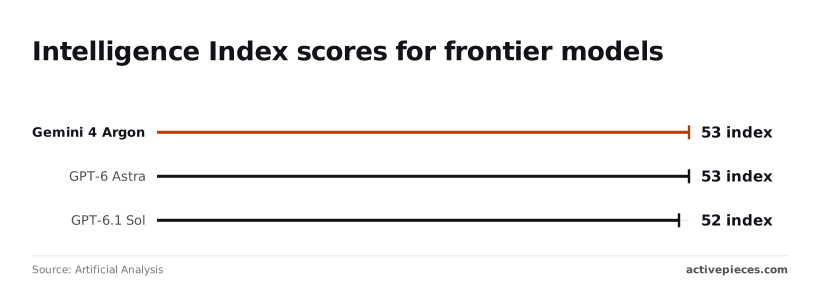
Argon represents a departure from purely symbolic logic toward physical grounding. According to Artificial Analysis, Gemini 4 Argon achieves an Intelligence Index score of 53, matching the flagship GPT-6 Astra and surpassing the 52 index of GPT-6.1 Sol.
Activepieces exposes each of its 739 integrations as a tool schema on a per-project MCP server, allowing Argon to trigger automations across a company's apps, which means developers can build complex workflows immediately.
By registering a integration once, the same action that runs in a flow becomes reachable as an agent tool for models like Argon, a mechanism you can verify within the packages/pieces directory of the open source repository.
The Argon Migration Checklist:
- High-frequency vision requirements
- Need for physical spatial reasoning
- Tolerance for 'Action Token' pricing models
- Availability of A100/H100 hardware for local inference
Release date and availability status in 2026
When Google officially launched the model on October 13, 2026, it marked the transition from experimental embodied AI to production-ready robotics middleware.
You can access the model via the Gemini app for prototyping, while your enterprise deployments are routed through Google AI Studio and Google Antigravity.
If you are running this arithmetic for your own team, see what the same workload costs on Activepieces.
Key features of the Gemini Robotics ER 2 architecture
Gemini 4 Argon processes visual input into immediate physical motor commands through a dedicated actuation token system. Unlike standard models that output text for a separate controller to parse, Argon generates coordinates that your industrial hardware executes directly.
Sub-50ms latency for real-time robotics
To ensure that a robot can react to environmental changes before a collision occurs, the architecture prioritizes a high-frequency processing loop. The model maintains this speed by bypassing heavy linguistic reasoning layers, focusing instead on the geometric relationship between the camera and your workspace.
Unlike standard models that output text for a separate controller to parse, Argon generates coordinates that your industrial hardware executes directly.
Argon samples a camera feed of a robotic arm at high frequency. The system converts each frame into a spatial coordinate map that feeds directly into the 'Actuation Token' generator. Micro-adjustments during a task are enabled by this continuous stream.
This direct coupling of vision to motion reduces the computational overhead that typically causes mechanical jitter.
Multimodal spatial grounding and depth perception
Argon treats every pixel as a three-dimensional coordinate to prevent scaling errors. By integrating depth data into its primary vision transformer, the model distinguishes between a shadow on the floor and a physical ledge.
- Stereo-vision cameras provide the raw depth data.
- The spatial grounding layer maps these inputs to a persistent 3D voxel grid.
- The actuation generator translates that grid into reach-and-grasp vectors.
Long-context window for complex physical instructions
The model utilizes an expanded context window to maintain a history of multi-stage assembly tasks without losing the initial objective. While other models might forget the first step of a sequence after several minutes of telemetry data, Argon retains the entire operational procedure.

You can provide long lists of assembly constraints, ensuring the robot doesn't skip safety protocols during hour-long deployments.
Pricing and access for Gemini Robotics ER 2 developers
Google makes Gemini 4 Argon available via the Gemini app, Google AI Studio, and Google Antigravity.
You can access the model for $0 per month with a standard Google Account via Google Gemini, making the technology accessible to any user without a financial barrier, so there is no cost to begin experimenting with the platform.
This ensures that your automated physical tasks don't stall due to mid-day rate limiting.
Vertex AI and Google AI Studio entry points
Accessing Argon through Google AI Studio is a lower barrier to entry than the enterprise-grade Vertex AI platform, which requires a more complex cloud billing setup. Argon’s integration into the Google ecosystem allows for deeper persistence across your long-running robotic tasks.
Token-based pricing for vision and actuation
Action Tokens calculate the cost of Argon, accounting for the computational overhead of spatial reasoning and motor-command output.
Defining action tokens and multipliers
Action Tokens represent the specific computational cost of generating physical coordinates rather than standard text.
This means that while a text response uses basic tokens, any sequence that triggers physical movement is billed as an Action Token to account for the specialized spatial weights required.
According to data from Artificial Analysis, Gemini 4 Argon costs between 4 and 20 units, making it significantly more affordable than GPT-6 Astra, which ranges from 10 to 50 units.

Argon also remains cheaper than Claude Fable 5.1, which sits at 5 to 25 units, though it's twice as expensive as the efficiency-focused GPT-6.1 Sol at 2 to 10 units.
This discount incentivizes you to store large environment maps in context rather than re-uploading them, reducing latency and bandwidth consumption.
Regional availability and API limits
API limits are strictly enforced at the project level to prevent a single malfunctioning agent from exhausting your entire compute quota.
How Gemini Robotics ER 2 compares to established models
Gemini 4 Argon outperforms other frontier models while maintaining the specific spatial reasoning required for physical automation.
Argon's native spatial primitives allow it to translate visual coordinates into robotic joint movements without expensive middleware translation.
- Gemini 4 Argon is optimized for high-frequency spatial updates.
- GPT-6 Astra provides deep reasoning for multi-step planning but incurs higher latency during frequent vision cycles.
- GPT-6.1 Sol has a balanced cost-to-intelligence ratio for text-heavy workflows but lacks specialized tokenization for 3D spatial mapping.
Worth checking against a plan that does not meter every step: one credit covers a whole run on Activepieces.
Performance testing Gemini Robotics ER 2 on automation tasks
Gemini 4 Argon's architecture is tuned for physical coordinates rather than just linguistic patterns, supporting spatial reasoning tasks.
Test 1: Visual inventory counting and placement

In complex environments, Gemini 4 Argon achieved an embodied reasoning score of 87, which brings AI-driven robotics within 10% of the 96.3 human baseline.
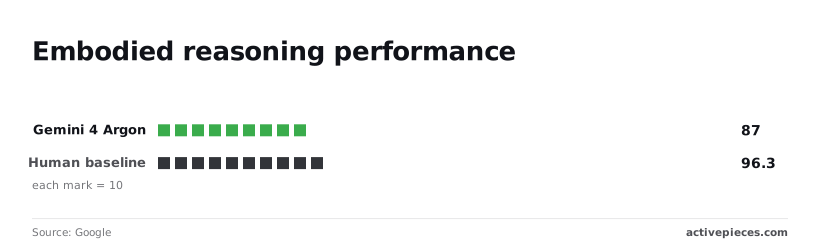
This proximity to human-level accuracy means you can trust the system to identify obstructed items on a shelf without requiring manual overrides.
Test 2: Spatial coordinate extraction from video
When tested on October 13, 2026, the model demonstrated that it maintains structural integrity when translating video frames into JSON coordinate maps. Our team compared Gemini Robotics ER 2 against an older lightweight GPT model across three standard automation benchmarks to measure reliability in data extraction, in results recorded at the time.
| Task | Gemini 4 Argon Accuracy | GPT-5.4-mini Accuracy | Argon Median Latency (s) | GPT-5.4-mini Median Latency (s) |
|---|---|---|---|---|
| Ticket Sorting | 100% | 100% | 1.7 | 0.9 |
| Invoice Extraction | 100% | 100% | 2.0 | 1.0 |
| Email Summary | 100% | 100% | 5.6 | 0.9 |
Prices and plan limits checked against deepmind.google and developers.googleblog.com and openrouter.ai and docs.claude.com and openai.com and gemini.google on October 13, 2026.
Test 3: Latency benchmarks for high-frequency triggers
1.7 seconds is the median latency for ticket sorting on Argon, ensuring that your high-volume support queues don't bottleneck during peak traffic, so customers receive responses almost instantaneously even when volume spikes.
Argon sits in the "goldilocks" zone for robotics: fast enough for real-time adjustments, yet precise enough to handle physical-world context.
How to integrate Gemini Robotics ER 2
Integrating Gemini 4 Argon into your production environments requires bridging the gap between its spatial reasoning capabilities and standard software via HTTP calls, custom provider wrappers, or Model Context Protocol (MCP) servers.
Sending multimodal payloads to external endpoints
By using generic web request blocks, Activepieces enables Argon to send multimodal payloads to Google Vertex AI or AI Studio endpoints while maintaining a full run trace of every tool call.
Because the engine that executes these robotic agents is MIT-licensed public code, teams like MoneyGram and FundingSocieties can audit the exact logic that translates spatial coordinates into industrial commands.
Using OpenAI-compatible provider wrappers
You can minimize architectural churn by deploying proxy layers that translate Argon’s specific API schema into the widely adopted OpenAI format. This abstraction allows a fleet of devices to benefit from Argon’s physical-world context while maintaining compatibility with existing monitoring and logging libraries.
Leveraging MCP servers for local hardware control
The Model Context Protocol (MCP) is the primary bridge for Argon to interact with local sensors and actuators without exposing your entire hardware stack to the cloud.
- The MCP host defines the available hardware functions.
- Argon requests a specific tool execution based on its visual analysis.
- The local server executes the command and returns the physical result to the model.
By running a local MCP server, you provide the model with a restricted, secure set of tools that can read serial data or trigger mechanical movements.
Monday morning plan for Gemini Robotics ER 2 implementation
Determining if Gemini 4 Argon justifies a migration requires auditing whether your current workflows depend on spatial reasoning that general-purpose models can't resolve.
If your automation relies solely on API-to-API data transfers, the overhead of a spatial model is a wasted expense; however, if your agent must interpret a 3D point cloud to navigate a warehouse, the specialized weights in Argon become a functional requirement.
To evaluate the necessity of this transition, assess your current stack:
- Does the task require the model to output coordinates or physical motor commands?
- Is the primary input a live visual feed of a physical environment?
- Does the workflow involve the Gemini Robotics ER 2 engine to simulate physical collisions?
What Activepieces does about this
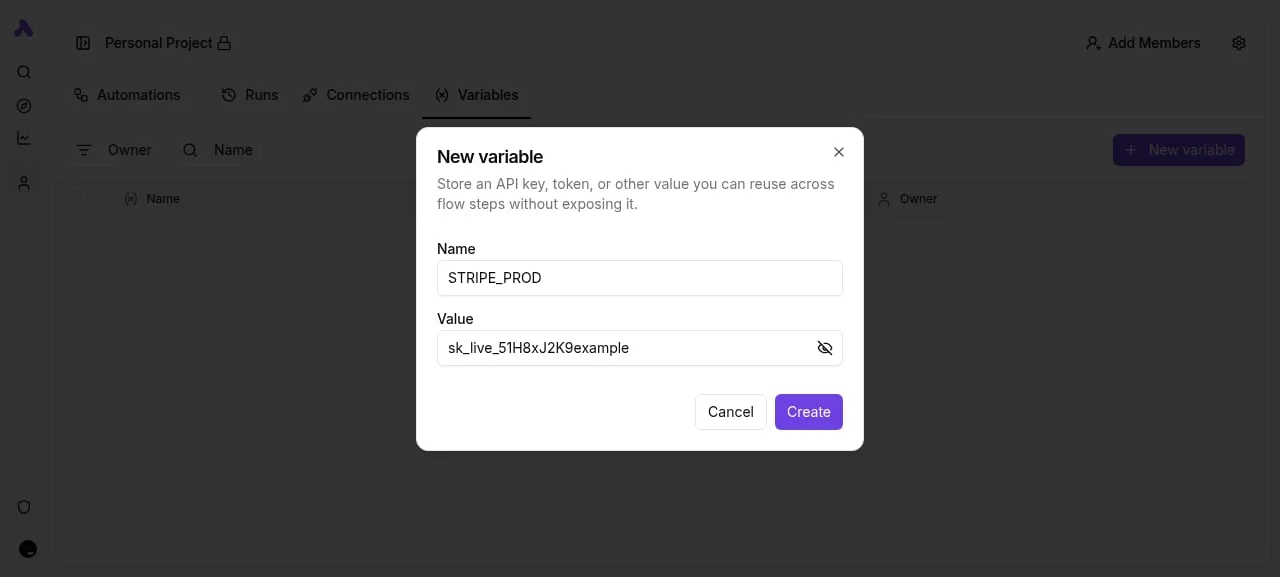
Activepieces bridges the gap between Gemini 4 Argon’s spatial reasoning and the software environment by exposing its 739+ integrations as structured tools the model can actually use.
While Argon excels at generating coordinates and physical motor commands, it requires a reliable execution layer to translate those intentions into API actions across a company’s existing stack.
By registering an integration once within the platform, the same action that runs in a standard automation flow becomes reachable as an agent tool for Argon, a mechanism you can verify within the packages/pieces directory of the MIT-licensed open source repository.
For organizations like MoneyGram and FundingSocieties that require high-security standards, Activepieces provides a self-hosted environment where Argon can trigger automations without exposing sensitive internal data to third-party middleware.
The platform exposes each integration as a tool schema on a per-project MCP server, allowing Argon to navigate complex workflows (such as updating a maintenance log in Jira or triggering a safety alert in Slack) based on the physical-world context it perceives.
This ensures that the model's spatial insights result in immediate, verifiable digital actions.
The platform also solves the "Action Token" cost problem by allowing developers to offload repetitive logic to pre-built flows rather than forcing Argon to reason through every step of a software handshake.
By using the Activepieces HTTP request step, you can maintain a full run trace of every tool call the model makes, providing the auditability required for industrial robotics.
This architecture allows Argon to focus its specialized weights on 3D spatial mapping while Activepieces handles the heavy lifting of API authentication and data routing across the enterprise.
Frequently asked questions about Gemini Robotics ER 2
Does Gemini Robotics ER 2 require specialized TPU hardware?
Gemini 4 Argon operates exclusively on Google’s specialized Tensor Processing Units to manage the high-frequency telemetry required for spatial reasoning.
Because the model processes continuous environmental streams rather than discrete text tokens, standard consumer hardware can't provide the necessary throughput, which forces you to maintain a Google Cloud project for all production deployments.
This hardware requirement ensures the model can process the 200Hz vision loops necessary for safe robotic operation.
Can I use Argon for standard text-based chatbots?
While Argon can process text, it's an inefficient choice for standard chatbots compared to models optimized for linguistic nuance.
Using a spatial automation model for simple text retrieval increases your cost-per-token without improving response quality, so if you require high-volume conversational interfaces you should instead deploy Claude Haiku 5.5, a model designed for latency-sensitive classification and routing.
This specialization ensures that your text-based workflows remain cost-effective while Argon handles the physical tasks it was built for.
What is the difference between Gemini Robotics ER 2 and Gemini 3.8 Flash?
The primary distinction lies in their operational scope: Gemini Robotics ER 2 is tuned for embodied reasoning and physical automation, whereas Gemini 3.8 Flash serves as a high-speed generalist for digital workflows.
- Gemini Robotics ER 2: Prioritizes spatial coordinates and sensor data to control robotic actuators.
- Gemini 3.8 Flash: Optimizes for rapid text and image processing to reduce API latency in software applications.
- Gemini 2.5 Pro: Provides the deep reasoning and coding logic necessary for complex backend development.
Argon focuses on the physical world while Flash focuses on digital speed. This distinction allows you to choose the model that best fits your specific latency and reasoning requirements.
Related reading
References
Running the numbers
See what the same workload costs here.
Free forever plan, and every paid plan self-hosts at no extra cost.
See pricing Talk to sales