Suno AI Review 2026: Is It Worth It?

Oct 2, 202615 min read
Suno has rapidly evolved into a powerhouse for digital composition, allowing users to generate full-length tracks with vocals and instrumentation from simple text prompts.
As creators look to scale their output, many are exploring how to connect these generative tools to their broader workflows, often using platforms like Activepieces to automate the distribution of their new tracks across social media and storage services.
However, as the technology matures in 2026, the conversation has shifted from mere novelty to the nuances of audio fidelity and the ethical implications of AI-generated melodies.
This review examines whether the current subscription tiers offer enough creative control and sonic quality to justify the monthly cost for professional musicians and hobbyists alike.
Create music with Suno generative AI
Suno is a generative engine that synthesizes complete musical compositions (encompassing arrangement, vocal performance, and lyrical content) from natural language inputs.
The platform represents the current frontier of rapid ideation. It allows you to bypass the traditional multi-day composition cycle in favor of near-instantaneous auditory drafts.
The core technology behind v4 and beyond
To map semantic text tokens directly to complex acoustic waveforms, the underlying architecture of Suno v4 utilizes a transformer-based diffusion model.
Unlike MIDI-based sequencers that trigger pre-recorded samples, this system generates audio from scratch. Every output is a unique realization of the prompt rather than a reassembly of existing loops.
This approach shifts your role from a technician managing signal chains to a creative director managing intent.
By integrating Activepieces into a content pipeline, your team can automate the delivery of these generated assets directly to social media managers or cloud storage buckets using an MIT-licensed core that keeps the automation logic under your own governance.
How text-to-audio synthesis has evolved
Modern synthesis has transitioned from rudimentary melodic mimicry to high-fidelity emulation of specific room acoustics and vocal timbres.
Current models like Lyria 3.5 or Suno’s latest builds produce clear, intelligible vocals that sit correctly within a stereo field. This fidelity ensures that a generated draft is usable for internal stakeholder reviews without requiring an immediate professional mixdown.
The difference between song and stem generation
Current generative tools operate primarily as "Black Boxes" where a single prompt yields a flattened stereo file, whereas professional production requires the granular control of a "Glass Box" environment.
When you use song generation, the system produces a final, mixed waveform containing all instruments and vocals in one file. This prevents you from adjusting the volume of the drums relative to the singer.
Stem generation includes isolated tracks for specific elements like bass, melody, and percussion. An engineer can process or replace these individual parts within a Digital Audio Workstation.
Suno output limitations and stem availability
Suno functions as a Black Box that delivers a single, flattened stereo file for every generation. It does not currently offer a native feature to export stems or MIDI data.
This means you cannot download a version of your song where the vocals and instruments are separated into different files. If the AI places the guitar too loud in the mix, you have no way to lower its volume without affecting the entire track.
The platform is designed for rapid delivery of a finished sound rather than surgical post-production. You must treat the output as a final, unchangeable master or use third-party isolation software to attempt a manual separation.
The following comparison illustrates the visibility gap between these two workflows.
This lack of internal access in standard generations necessitates a clear understanding of where Suno’s utility ends and traditional engineering begins.
Everything below works on Activepieces' free plan. Start without code or a credit card.
Suno pricing and commercial usage rights
Suno’s current subscription model separates users by generation volume and legal ownership. High-output creators pay for the indemnity required for professional distribution.
Basic vs Pro vs Premier plan breakdown
For the 12,000,000 monthly active users Forbes currently engaging with the tool, the three-tier structure functions as a funnel, which means the platform is systematically converting casual visitors into paying customers.

50 credits daily are included in the Basic Plan. You're limited to roughly 10 song generations every 24 hours without the ability to roll over unused capacity, so users must log in daily to avoid wasting their allocated quota.
$10 a month for the Pro Plan includes 2,500 credits, giving the subscriber a fixed budget to experiment with AI-generated tracks, ensuring that costs remain predictable for hobbyists, so users can plan their creative output without fear of surprise overage charges.
You can generate approximately 500 songs and have the right to monetize the output on streaming platforms.
10,000 credits monthly are provided in the Premier Plan for $30, effectively quadrupling the creative output capacity compared to the entry-level tier, allowing power users to scale their production significantly, as they gain a much larger sandbox for iterative development.
You can produce roughly 2,000 tracks to find the specific generation that fits a professional brief.
Understanding commercial ownership of AI tracks
Commercial ownership is restricted exclusively to paid subscribers, creating a legal firewall between hobbyist play and professional exploitation.
If you generate a track on the Basic plan, Suno retains the copyright. You can't upload that specific audio file to Spotify or use it in a monetized YouTube video without violating the Terms of Service.
Commercial ownership is restricted exclusively to paid subscribers, creating a legal firewall between hobbyist play and professional exploitation.
Only tracks generated while a Pro or Premier subscription is active are owned by the user.
You must ensure your billing cycle is current before hitting "Create" on a final project. This distinction has converted 2,000,000 people (Forbes) into paid subscribers, as the platform is now a commercial library.
The cost per song at scale
Roughly $0.015 is the cost of a single musical idea under the Premier plan, making the barrier to entry for high-volume experimentation remarkably low, meaning that the financial risk of exploring an unsuccessful creative direction is negligible.
This makes it a negligible expense for rapid prototyping.
This low barrier to entry has resulted in a massive disparity between AI generation and human-curated libraries. According to Edm, Suno users generate 7 million tracks daily.
The user base creates a library the size of the entire 100-million-song Spotify catalog every 14 days, indicating that the platform is generating an unprecedented volume of new music at a breakneck pace, which means the sheer scale of content is rapidly outpacing human curation.
The value of the tool is in the speed at which you can discard 99% of the output to find the one viable melody for further engineering, which means the user’s primary role shifts from composer to curator. The workflow prioritizes high-volume experimentation over perfectionism.
Absence of granular MIDI-level control
Suno is a closed-box rendering engine that prevents you from accessing the underlying note-level data required for precise composition. While you can influence the output through text prompts and style tags, you can't adjust the velocity of a specific snare hit.
Professional workflows typically rely on the ability to isolate and manipulate individual elements. Suno fails to meet this requirement because it outputs flattened audio files rather than multi-track stems or MIDI sequences.
Without these discrete layers, a mix engineer can't apply specific equalization to the bassline without affecting the harmonic resonance of the vocals.
The tool trails specialized competitors in total track length for complex compositions. Creators working on extended orchestral movements must stitch multiple generations together manually.
Specialized model comparisons
Claude Opus 5.5, a model for long-running agentic coding and knowledge work, can manage complex project structures that Suno’s flat interface can't replicate.
While Claude cannot generate audio, it serves as a superior logic engine for drafting lyrical metaphors or planning the structural arc of a concept album.
Gemini 3.1 Pro allows for the iterative debugging of logic that is physically impossible in a non-symbolic audio generator. It functions as a text-based creative partner that can analyze music theory concepts or script automation routines, providing the intellectual scaffolding that Suno lacks.
Lyria 3.5, the flagship music generation model for full-length songs, has a different scale of structural coherence that highlights Suno's limitations in sustained thematic development. Unlike the text-only LLMs, Lyria is a direct audio competitor designed for high-fidelity musical output.
Easier to see it running than to read about it: set it up free, no card.
Prioritize speed over manual precision
Suno is a zero-latency bridge between a conceptual "vibe" and a functional audio asset. It prioritizes immediate utility over the granular control found in professional workstations.
Rapid prototyping for content creators
To bypass the multi-hour setup required for traditional scoring, content creators utilize Suno. This allows them to test musical themes against visual edits in real time.
By generating multiple variations of a background track in seconds, you can verify the emotional resonance of a scene before committing to a specific edit.
This workflow reduces the sunk cost of abandoned ideas. You can discard a generated track that fails the "vibe check" without losing the labor hours associated with manual composition.
Overcoming the 'blank page' problem in songwriting
The platform is a generative starting point that eliminates the friction of initial composition for songwriters. Instead of staring at a silent MIDI editor, you enter a stylistic prompt to receive a structural foundation.

This output is a reference track that defines tempo, key, and instrumentation. The model provides a tangible draft immediately.
You shift your effort from generative labor to editorial refinement. This move from "creation from nothing" to "curation from something" accelerates the songwriting cycle.
High-fidelity output without audio engineering skills
Suno produces a polished final mix. This removes the requirement for specialized knowledge in signal processing or mastering. A standard production chain typically requires several distinct software tools.
- Digital Audio Workstations are used for sequencing and recording.
- Compression and EQ plugins provide tonal balancing.
- Spatial processors handle reverb and stereo imaging.
- Mastering suites are required for loudness normalization and final polishing.

Suno automates these technical layers. The resulting file meets playback standards for social media and web platforms immediately upon export.
For the non-engineer, the technical barrier to entry is effectively lowered to the level of descriptive language.
Managing Suno assets with Activepieces automation
Activepieces allows you to bridge the gap between Suno’s output silo and professional asset management systems by automating the ingestion of generated audio files using 738+ integrations to connect creative outputs to the rest of the business.

Bridging the output silo
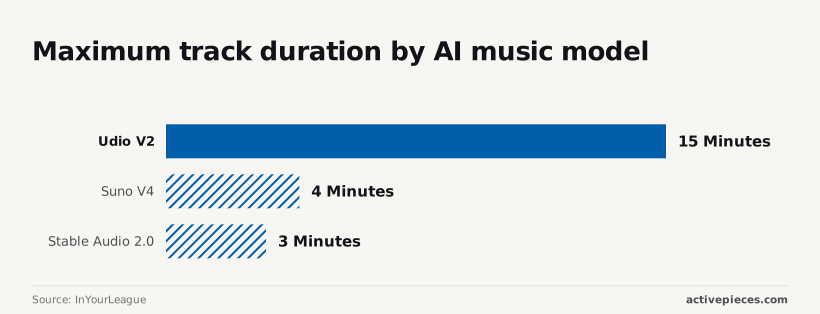
While Suno V4 produces tracks up to 4 minutes in length, the platform lacks native enterprise-grade library management, so professional teams will struggle to organize or retrieve their assets as their archives grow.
Activepieces provides the infrastructure to move these assets into a production pipeline, where every integration is available as an agent tool.
The per-project MCP server allows an agent to call Suno tracks directly into your project management suite without a manual export step, using the same integration actions that run in your standard flows.
Storage requirements across platforms
By comparison, InYourLeague reports that Stable Audio 2.0 is limited to 3 minutes and Udio V2 supports up to 15 minutes, creating varying storage requirements across different creative departments.
Visual interface for asset mapping
A visual interface for mapping these generated assets to organizational tools like Discord or Airtable is provided by the Activepieces flow builder, which offers unlimited flows on every plan to accommodate high-volume music generation.
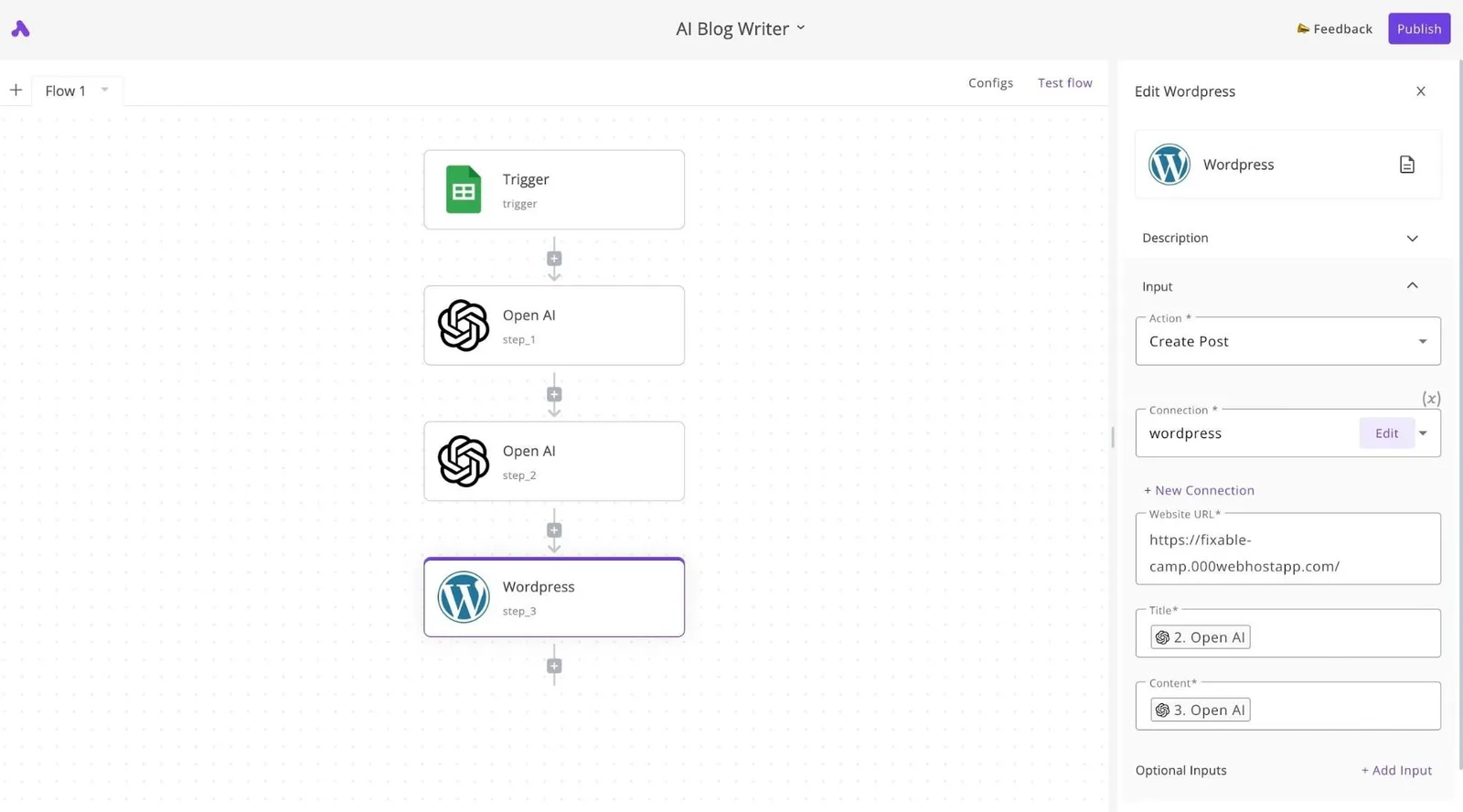
The "Community Summarizer - Get Messages" workflow demonstrates this capability by triggering a sequence whenever a new message is detected in a Discord channel.
This specific configuration uses a "New Message" trigger set to a limit of 50. The system captures a batch of assets large enough to maintain momentum without overwhelming the API rate limits.

Routing and human intervention
Following the trigger, the logic branches through a router to determine if a generated track requires human intervention or immediate archival.
Companies like MoneyGram and FundingSocieties run Activepieces in production to manage these types of complex automation environments.
The platform provides a per-step agent decision trace in the Run Details UI, ensuring that every automated routing decision for a Suno asset is logged and auditable alongside deterministic workflow steps.
Metadata preservation and categorization
By routing these files to a "Create Record" step, metadata such as prompt text and timestamp is preserved alongside the audio.
This allows teams to use Gemini 3.8 Flash to categorize the 4-minute tracks based on mood or instrumentation before they reach the final editor.
Alternative tools for users who need different outputs
Selecting the correct generative platform prevents technical debt because the output format matches the intended distribution channel.
Udio for high-fidelity vocal nuance
For creators requiring complex lyrical structures and professional-grade vocal clarity, Udio is the choice. The platform allows for extended track generation up to 15 minutes.
A producer can maintain thematic consistency across a full-length movement without stitching multiple files together.
Its processing engine prioritizes vocal frequency separation, so the resulting audio requires less subtractive equalization when placed into a final mix.
Soundraw for royalty-free background loops
Soundraw is a modular composition engine for editors who need to customize background music without managing complex licensing agreements.
Unlike prompt-based systems that generate static files, Soundraw allows you to toggle individual stems like "Drums" or "Bass" on and off.
A video editor can strip the melody to avoid clashing with a voiceover. This granular control ensures the music fits the pacing of a visual cut.
Ableton Live for total creative sovereignty
Ableton Live, a professional Digital Audio Workstation (DAW), remains the mandatory environment for users who require absolute precision over every millisecond of audio.
AI tools generate "black box" audio where the internal layers are flattened. A DAW provides a non-destructive timeline.
In this space, a sound engineer can manipulate MIDI data and VST plugins. Choosing this path ensures:
| Tool | Primary Output Feature |
|---|---|
| Udio | 15-minute extended tracks |
| Soundraw | Royalty-free mood loops |
| Stable Audio 2.0 | 3-minute high-fidelity clips |
| Traditional DAWs | Surgical editing and live performance |
In Ableton Live, for theatrical broadcast or streaming master files, this manual control is the only way to guarantee that a track meets the specific loudness standards.
Utilizing a DAW after the initial AI ideation phase bridges the gap between a generative concept and a commercial-grade product.
Frequently asked questions about Suno AI
Can I copyright a song made entirely in Suno?
Copyright protection is generally unavailable for works generated solely by artificial intelligence. Legal frameworks require a human author to qualify for ownership.
While a Pro or Premier subscription grants you commercial rights to the audio files, this is a contractual license rather than a government-recognized copyright.
To secure a copyright, you must contribute significant human creative labor, such as rearranging the output in a Digital Audio Workstation or adding original recorded vocals.
Does Suno offer a mobile app for iOS and Android?
Official Suno applications are available on the Apple App Store and Google Play Store to facilitate mobile generation.
Using these dedicated apps ensures you're accessing the legitimate processing API rather than a third-party wrapper that might compromise your account credentials.
Mobile access allows for rapid iteration during field recording or travel. High-precision editing still requires the desktop interface.
Can I upload my own lyrics to Suno?
To ensure the model adheres to specific thematic or rhythmic requirements, the Custom Mode interface allows you to input original text.
By selecting this mode, you bypass the automated lyric generator. This prevents the AI from inserting generic or repetitive stanzas into your composition.
This feature is the primary method for maintaining creative control over the narrative content of a generated track.
How do I cancel a Suno subscription?
Subscription management is handled through the Billing section of the user settings panel to prevent unwanted recurring charges.
Once you select the option to cancel, your account remains in the paid tier until the end of the current billing cycle. You don't lose access to features you've already funded.
To verify the change, you should check for a confirmation status in the billing dashboard. Failing to finalize the click-through workflow will result in an automated renewal.