
How Much Does Jellyfish Software Pricing Cost?

Nov 20, 202612 min read
You will not find a price for any plan on jellyfish.co; every route ends in "contact sales".
So the number you pay is set in a sales call, much like the custom enterprise quotes often required when scaling workflows with Activepieces, and the page can't tell you what to budget.

Jellyfish pricing, plans and limits
What Jellyfish is and which Jellyfish this is
This is Jellyfish the engineering management platform, not the marketing agency of the same name. It reads data from the tools engineers already work in, such as source control and issue trackers, and reports on where engineering time goes.
Its buyers are engineering leaders who need to show what a team's hours produced.
The plan table, verified from jellyfish.co
Here's what the site states for its plans as of the check date, 20 November 2026: every plan reads "contact sales", and inclusions and limits are not published.
Each of those gaps is a question you'll have to fill from a quote, so treat it as a question for the sales call.
What the pricing page does not say
Look for a monthly or annual price, a per-seat rate, a minimum contract or a free tier, and the page offers none of them.
It also doesn't say which integrations, data-retention periods or user counts sit inside a plan, or what costs extra. Ask for all of them in writing, and ask the same questions of at least one alternative that prints its rates.
A published price gives you a ceiling to negotiate against; without one, the first quote is only an opening bid.
If you are running this arithmetic for your own team, see what the same workload costs on Activepieces.
Jellyfish Cost at 50, 200 and 1,000 Engineers
Expect roughly $19,000 a year at 50 engineers, about $76,000 at 200 and about $380,000 at 1,000 if the quote scales linearly.
A published price gives you a ceiling to negotiate against; without one, the first quote is only an opening bid.
That's an extrapolation, not a price, because Jellyfish publishes no rate and the only way to confirm any of it is a quote.
Quoted-price formula and three team sizes
Work backward from the invoice:
- The formula is annual quote = engineers × per-engineer rate + modules + onboarding
- The only rate I can derive is from one buyer report: $19,000 for 50 users in 2024, or $380 per user, so anyone using this rate is testing against data that's two years stale
- Linear scaling from that single point gives the 200 and 1,000 figures above, with no volume discount assumed
By Vendr's recorded contract data, the market has moved well past that report. The chart below plots median annual contract value by year, labelled by sample size. Read the 2024 point as an anecdote and the later two as real medians.

$57,536 a year is what the median buyer now pays, across 36 deals in 2026, which means the typical cost of acquisition has climbed significantly since the previous cycle. That's up from $40,200 across 98 purchases in 2025.
A 43% rise in a year means a quote anchored on last year's price is already stale.
Contract terms, onboarding and data limits
Look past the headline rate, because three terms move the real cost more:
Ask whether onboarding is waived or billed separately, because a one-time fee inflates year one against what you'll pay at renewal.
Get the renewal uplift capped in writing, given how fast the median is climbing.
Confirm in writing how many engineers, repositories and months of history the quote covers, so an acquisition or a hiring wave doesn't trigger a re-quote mid-term.
The Strongest Case That Quote-Only Pricing Is Fine
Ask the vendor about those three terms and its best defense is this:
- A price that moves with seats, term and integrations is hard to print, so a quote is the honest form of it
- The defense holds on scoping
- The defense fails on leverage
The case for sales-led pricing
In the vendor's favor, a sales conversation scopes the deployment, sizes onboarding and unlocks volume discounts that a rate card can't express.
About 1% of loaded cost is the licence, so a buyer who haggles over a few hundred dollars is arguing over the wrong line.
Why a hidden price still weakens the buyer
Before it costs you money, opacity costs you time. In Vikram Here's funnel data, hiding the price lifted visit-to-request conversion from 2.8% to 4.6%, so more people fill in the form without knowing what they're signing up for.
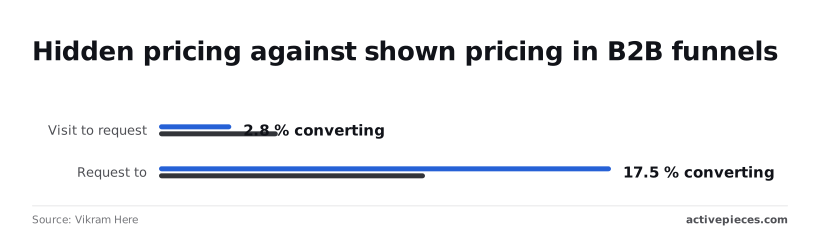
On the other side of that funnel, request-to-pipeline conversion fell from 17.5% to 10.3%, so the vendor treats your request as one of many weak leads and qualifies it before it quotes.
When a seller quotes far above a listed alternative, it has to explain the gap, so published-price rivals also cap what a quote can reach.
Jellyfish Compared With LinearB, Swarmia, DX and Haystack
Of these five, Jellyfish is the only one that gives you nothing to compare on the page. The table below shows where a quote has to be won against rivals that print their terms. Read it as a negotiating map, not a ranking.
| Vendor | Pricing model | Entry price per developer per month | Free tier | Minimum contract | Main strength |
|---|---|---|---|---|---|
| Jellyfish | Quote only | No public price | None published | Set in the quote | Tying engineering work to business and finance reporting |
| LinearB | Published plans | Listed on vendor page | Offered | Per plan | Workflow automation on delivery metrics |
| Swarmia | Published plans | Listed on vendor page | Offered for small teams | Per plan | Team working agreements and developer-friendly dashboards |
| DX | Quote only | No public price | None published | Set in the quote | Developer experience surveys |
| Haystack | Published plans | Listed on vendor page | Per vendor page | Per plan | Lightweight delivery analytics |
Where Jellyfish is the better buy
When finance, not engineering, is the buyer, Jellyfish earns its quote. If the invoice has to be allocated across teams or capitalized as R&D, you're paying for reporting the cheaper tools don't center on.
There is room in the quote, and the discount data shows how much. Vertice puts AI tools at 41.54% off list, so a buyer who accepts the first number overpays by roughly that much.
38.22% is the average for sales tools and 36.27% for productivity suites, which is the range to expect for a platform bought across many seats.
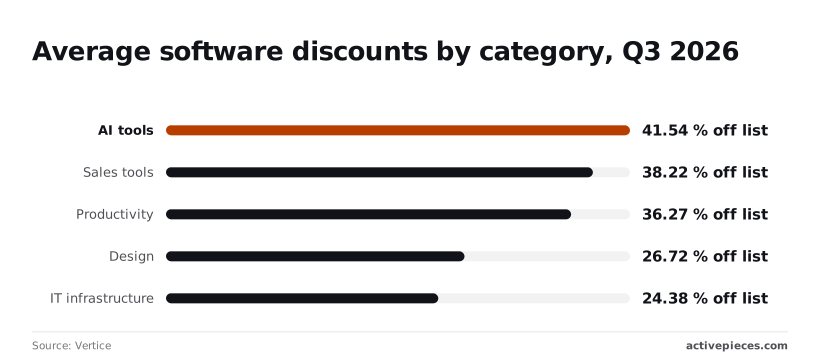
Design averages 26.72% and IT infrastructure 24.38%, so even the stingiest category leaves about a quarter on the table. Treat 24% as your floor for pushing back, not your target, so you leave yourself enough margin to negotiate a more favorable final outcome.

Where a published-price rival wins
If you need a number before a meeting, a rival wins. A published plan lets a team lead put a figure on an invoice without asking sales, and it gives you the anchor you were missing.
Verdict: buy Jellyfish only if the finance reporting is the requirement, and use a published-price rival's rate as the number you negotiate down from.
Worth checking against a plan that does not meter every step: one credit covers a whole run on Activepieces.
Automating Engineering Metrics Reporting With Activepieces
Around whichever metrics tool you buy, there is copying that Activepieces can automate, the Slack digest and the finance sheet. It doesn't replace Jellyfish's engineering data model or its finance reporting.
The hidden manual labor of using Jellyfish
Whoever signs the Jellyfish quote, someone on your team still pastes a weekly number into Slack and re-keys allocation figures into the spreadsheet finance actually reads.
That time is a quiet cross-subsidy. If you're pricing the tool honestly, price that labor too.
How automated workflows process data
Activepieces reaches every model provider a company uses among its 750+ integrations, and pushes the combined spend into the sheet finance already reads.
A trigger starts a flow, and each following step does one job, such as calling an HTTP endpoint, posting a message or writing a row.
Its published pricing page lists 1 credit per flow run, any number of steps, so a ten-step digest costs the same as the two-step workaround it replaced.
Billing by the run rather than the task means you can build granular, reliable flows without the per-step tax found on Zapier or Make.
The run is the meter, not the steps inside it, which is why you can cost this layer before you talk to anyone, unlike the Jellyfish quote.
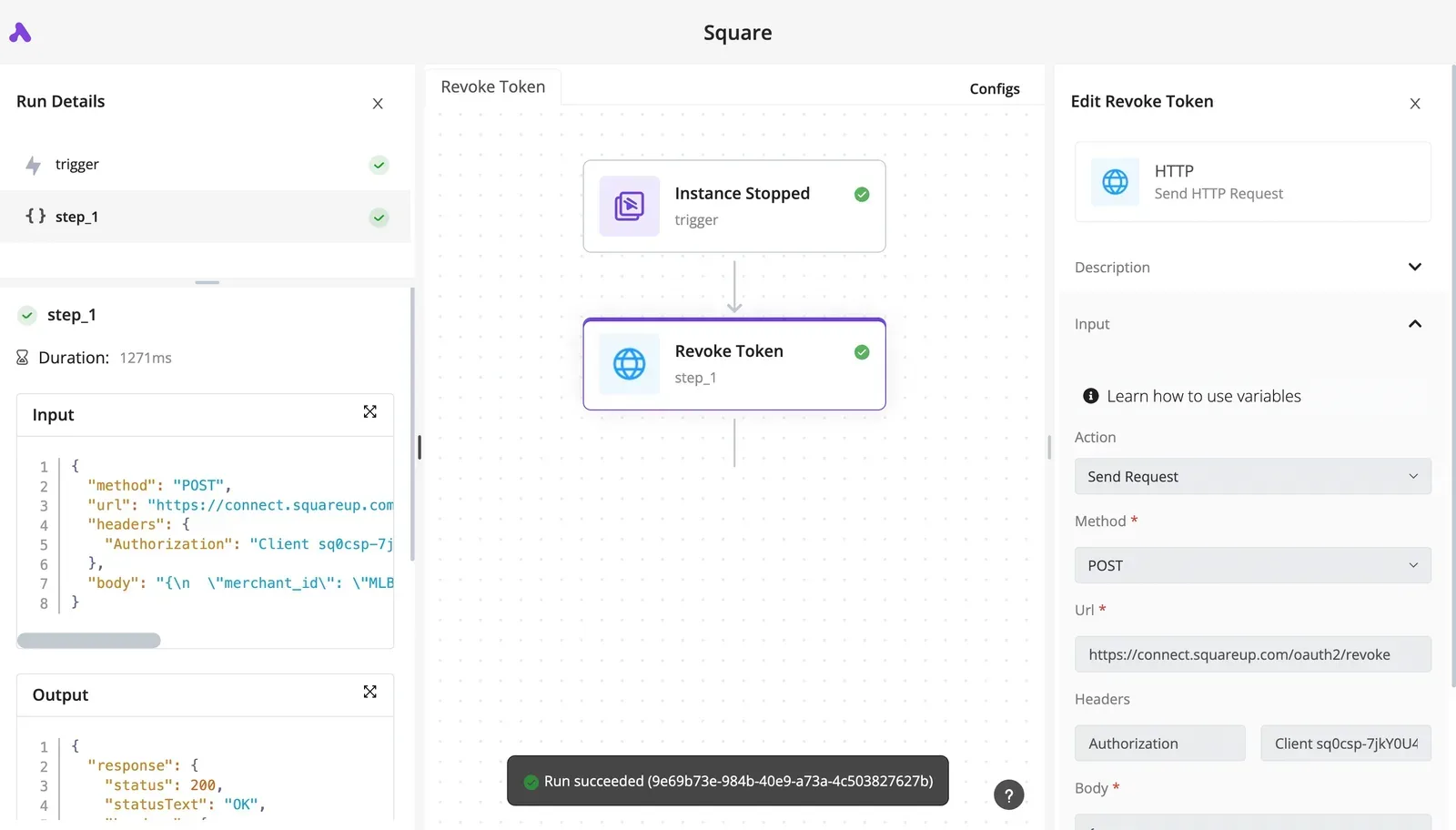
It is a different job, revoking an access token when an instance stops, but the run view below shows the shape every reporting flow shares.
A trigger step feeds an HTTP request step, the second step's method, URL, header and body are all visible in its panel, and the run log marks each step done with its input and output beside it.
What the automation cannot do
What follows from that is a limit. Activepieces moves numbers between systems. It doesn't compute cycle time, attribute engineering effort to a budget line, or produce the finance view you'd be paying Jellyfish for.
MoneyGram and Moneypenny run Activepieces in production to handle these flows under central governance.
The same enterprise features (including SSO, SCIM, custom RBAC, audit logs, and release management) available in the managed cloud are also provided in the self-hosted air-gapped edition, so regulated teams maintain full control without losing capability.
Steps to Take Before Signing a Jellyfish Quote
Done in this order, six actions turn an unpriceable quote into a number you can defend on an invoice, and you can start all of them Monday.
- Count billable contributors: everyone who commits, reviews or files tickets, including contractors on shared accounts.
- Request an itemised quote, with each module and each unit priced on its own line.
- Collect quotes from rivals that publish their prices.
- Pilot one team against a baseline you measured beforehand.
- Cap the renewal uplift in writing.
- Confirm your rights to export data and use the API, including after you leave.
Ask for the contributor count, the per-unit rate, each add-on and the term as separate lines. Without that, a heavy-use team quietly subsidises a light one, and you can't move the cost to the client or department that should be paying it.
Pull the public price for each rival at your contributor count and send the totals to the Jellyfish rep. Ask for the gap to be explained line by line, not waved away with a discount on the total.
Running a Jellyfish pilot with a baseline
Before the pilot, record what the chosen team's cycle time, review delay and reporting hours look like today. Run it for a defined period, then compare. If the pilot can't show a change you'd accept on an invoice, the full contract hasn't earned its price.
Frequently asked questions
Does Jellyfish offer a free trial or free plan?
Not one that its public pricing shows, so assume you start from a quote.
If you want to test it on your own repositories before committing, make a time-boxed pilot a condition of the quote and get the pilot's end date and conversion terms in writing.
Is Jellyfish worth it for a team under 50 engineers?
It depends on whether you'd have to pay for capacity you won't use. Quote-led platforms are usually sized for larger organizations, so a small team can end up paying for reporting layers nobody opens.
Price it against published-rate alternatives first. If Jellyfish still wins on a feature you'll actually use, the quote is defensible.
How long are Jellyfish contracts and can they be cancelled early?
Treat the term as negotiable and early exit as something you must write in, never assume.
Ask for the term length, the renewal mechanism, the notice window, and whether a mid-term seat reduction is allowed. Auto-renewal with a short notice window is where a quiet price increase usually lands.
Does Jellyfish charge extra for integrations or API access?
Nothing on the public page says, which is the point: you can't tell from outside whether connectors, API access or data export are bundled or itemized.
Ask for a line-item quote that names every integration your stack needs (source control, ticketing, CI) and states what API access is included.
What do Jellyfish reviews say about its pricing?
Reviewers tend to be more positive about the product than about the buying process, and the recurring complaint is that pricing is hard to learn before a sales conversation.
Read that as a reason to arrive with a comparison, not as a verdict on value. Check recent reviews on the major software review sites yourself, since pricing complaints from older contracts may not reflect today's terms.
Related reading
References
Running the numbers
See what the same workload costs here.
Free forever plan, and every paid plan self-hosts at no extra cost.
See pricing Talk to sales