
Idempotent Data Pipelines: Safe Retries Without Duplicates
Data infrastructure requires distinct technical oversight to prevent pipeline failures and ensure accurate reporting for stakeholders.

Covers automation pricing models: cost-per-run math, where per-task billing breaks at scale, and pricing tiers that hide true costs.
ContributorSeptember 21, 202614 min read
This article was researched and fact-checked by an advanced research system.
Data teams operate at a unique intersection of engineering rigor and business strategy, requiring a specialized infrastructure to maintain the integrity of their pipelines.
Unlike marketing or sales departments that rely on static software suites, data professionals must manage complex extraction layers, ensuring that every byte of information is validated before it reaches the warehouse.

This often involves orchestrating diverse workflows, which might include leveraging tools like Activepieces to automate routine data transfers, while simultaneously monitoring for schema drift and latency issues.
Because their output serves as the single source of truth for the entire organization, these teams require robust version control and observability frameworks that go far beyond the standard administrative tools used elsewhere in the company.
Data infrastructure refers to the specialized framework of tools and processes designed to manage complex information flows through granular control, idempotent operations, and verifiable architectural integrity.
Data engineering is the foundation of departmental intelligence
When you build systems to collect, transform, and validate raw information, you are practicing data engineering to ensure downstream consumers work with a single, verifiable version of the truth.
Without this structural layer, you'll rely on fragmented spreadsheets that inevitably produce conflicting reports during executive reviews.
Raw data versus actionable insights
Disorganized logs and event streams make up the bulk of raw data, yet they lack the context necessary for business decision-making. Converting these points into actionable insights requires a transformation layer that maps disparate inputs to a common schema.
A marketing lead needs to see customer lifetime value instead of a list of unlinked transaction IDs. This process often involves tools like Activepieces to facilitate the initial movement of information between disparate cloud services.
When this transformation fails, the cost of compute rises because you'll have to run repetitive, expensive join queries on unoptimized tables just to answer basic questions.
The three pillars of the data lifecycle
Three distinct phases allow a data architecture to ensure information remains reliable as it moves through your organization.
- Ingestion: is the systematic collection of data from sources like production databases or third-party APIs. This determines the maximum freshness of the entire stack.
- Transformation: is the application of business logic and cleaning scripts to prevent malformed strings or null values from breaking downstream visualization tools.
- Governance: is the enforcement of access controls and audit logs to ensure you meet compliance standards and can trace the lineage of any specific metric back to its source.
Why data teams sit outside the standard IT stack
Workflows in data teams prioritize stateful transformations and long-running batch jobs over the stateless, high-concurrency requests handled by traditional software engineering teams.
While IT focuses on uptime for user-facing applications, you'll manage idempotent pipelines where a single failure requires a precise re-run of historical data rather than a simple server reboot.
Because of this distinction, generic automation tools often lack the granular error handling needed to prevent "zombie" data from polluting the warehouse. These records appear correct but are missing the last hour of updates.

Everything below works on Activepieces' free plan. Start without code or a credit card.
Why data maintenance eats your entire work week
60 percent of operational capacity is currently lost to system upkeep and error correction, leaving the majority of your resources unavailable for growth.
Most of your labor is spent simply keeping the lights on. When architecture lacks idempotency, every failed run requires manual intervention to ensure duplicate records don't inflate cloud storage costs or distort metrics.
The hidden cost of data debt
34 percent of your time is claimed by data quality issues, according to a breakdown of a typical work week, so over a third of your payroll is effectively spent cleaning up messes.
Firefighting (unplanned reactive work) consumes 26 percent of the schedule, which forces teams to abandon their planned roadmaps constantly.
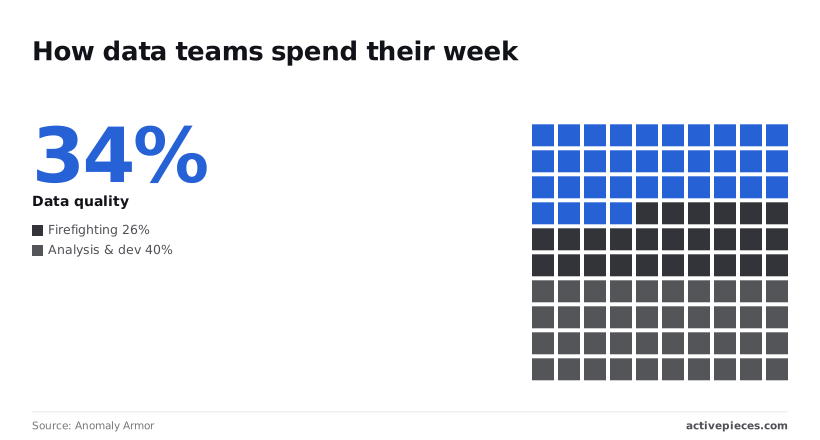
The remaining 40 percent dedicated to analysis and development represents the only portion of the payroll that generates new business value, placing a hard ceiling on how much innovation your team can actually deliver.
Choosing between shipping new features and maintaining the integrity of the existing stack is a choice this lopsided allocation forces you to make.
How bad data destroys executive trust in dashboards
Trust required for data-driven decision-making is eroded by inconsistent data delivery. Even a single day of corrupted reporting can lead a CFO to disregard a dashboard entirely.
When a business intelligence tool like Tableau (a platform used to visualize complex datasets) displays conflicting numbers because of a botched sync, your engineering team loses the authority of truth that justifies their headcount.
A "zombie" record can persist for weeks if a pipeline lacks a verification layer. Executive leadership then bases their quarterly projections on phantom revenue that doesn't exist in the bank.
Automating data validation to save time
For teams struggling with manual ingestion, moving beyond basic triggers to a system where you validate every step against the target schema is the only way to reclaim the work week.
Anomaly Armor suggests that by implementing automated checks, you can reduce the 26 percent of time lost to firefighting. You can finally focus on the 40 percent of work that moves the needle.
A security review moves faster when you can audit the underlying logic yourself rather than taking a vendor's word for it.
Activepieces ships an MIT-licensed core, which allows you to clone the repository and trace the queue and worker architecture directly, or run it fully air-gapped to meet strict internal compliance.
Understanding queues and workers in data pipelines
A queue acts as a temporary holding area or a digital waiting room for incoming data tasks, ensuring that bursts of information do not overwhelm the system.
Workers are the specialized background processes that pull tasks from the queue to execute the actual computation or transformation. By separating the reception of data from its execution, workers can operate independently, allowing the system to scale horizontally.
Specific protections are ensured by a robust architecture. The system validates data at the source to prevent schema drift from breaking downstream models.
Data infrastructure requires higher fault tolerance than standard SaaS
Strict state consistency must be maintained across distributed systems because a single unhandled exception results in permanent record divergence rather than a temporary UI glitch.
While standard business logic can often treat operations as isolated events, data pipelines function as a continuous ledger where the integrity of the destination depends entirely on the verifiable history of the source.
Stateful versus stateless data pipeline design
Persistent state tracking is required for data workflows to ensure that the system knows exactly which records it processed before a connection dropped.
In a stateless environment, a mid-stream crash forces you to choose between re-running the entire batch and risking duplicates, or skipping the batch and accepting data loss.
A persistent metadata layer is utilized by effective infrastructure to track offsets and high-water marks. A high-water mark acts as a durable pointer or timestamp that records the last successfully processed entry in a sequence.

When a job restarts, the system queries this mark to identify the exact point where the previous execution stopped. This allows a pipeline to resume from the exact millisecond of failure without manual intervention.
Persistent storage for pipeline metadata
Implementation of this mark requires a state-store that exists outside the volatile memory of the execution engine. You must utilize a persistent metadata database, such as a Redis instance or a dedicated SQL table, to record these timestamps and unique identifiers.
If the execution environment crashes, the state-store preserves the progress because it resides on a separate, durable storage layer. Your code simply fetches the last recorded ID from this database upon initialization to resume the stream.
Managing the impact of API rate limits
Rate limits of external services, such as the CRM platform Salesforce or the marketing suite HubSpot, are treated by resilient data architecture as a primary resource constraint rather than an occasional error.
| Stream Type | Profile | Infrastructure Requirement |
|---|---|---|
| Sales API stream | delivers jagged, broken segments when the source system throttles requests | forcing the pipeline to buffer and reassemble fragments |
| Legacy DB stream | produces oversized, heavy blocks that can saturate network bandwidth | requires the infrastructure to implement chunking to maintain throughput |
| Webhooks stream | sends a high-frequency burst of small packets | requires a queuing layer to prevent concurrent connections from overwhelming the downstream lake |
Cascading timeouts that can lock up the entire ingestion engine are the direct result of failing to manage these distinct stream profiles.
The necessity of idempotent data pipelines
Reliability in a pipeline is measured by its ability to produce the same result regardless of how many times a specific operation is executed.
Idempotency ensures that if the system sends a "Write" command twice due to a network retry, the destination database recognizes the duplicate and prevents a double-entry.
Reliability in a pipeline is measured by its ability to produce the same result regardless of how many times a specific operation is executed.
Data teams cannot rely on logic that lives only in a private UI history, so Activepieces provides Git Sync and Release Management to promote versioned flows through separate projects.
This ensures that every change to a production pipeline is a deliberate, reviewed deployment rather than an accidental click in a live environment.
Every transient network flicker adds "ghost" revenue or duplicate users to the analytical layer without this architectural guarantee. This destroys the credibility of the resulting financial reports.
Easier to see it running than to read about it: set it up free, no card.
Activepieces has the control data teams need over their pipelines
Ownership of your execution logic is maintained through Activepieces by providing an open-source framework. Every automated step is a transparent piece of code rather than a proprietary black box.
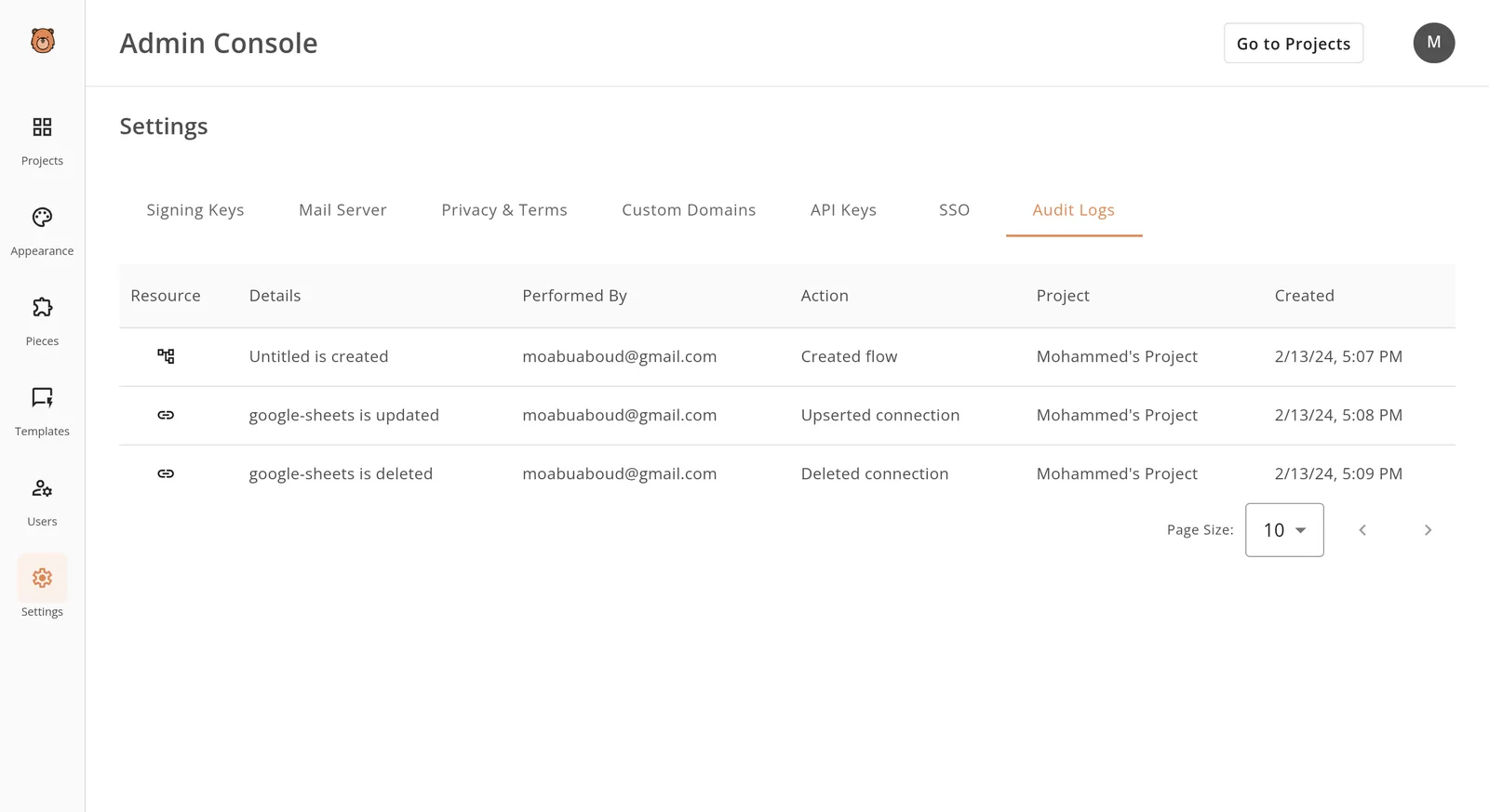
When a sync fails, this architectural openness ensures that you can inspect the raw TypeScript execution logs to identify exactly which record triggered the exception. This is faster than waiting for a third-party support ticket to resolve a generic "internal server error."
Customizing connectors without vendor lock-in
Every integration is treated as a decoupled piece of code by the platform. You can fork a connector to add custom API endpoints without losing the ability to pull upstream security patches.
This prevents the "last mile" integration trap where you're forced to build a separate, brittle microservice just because a standard connector lacks a specific custom field required for tax compliance.
Logic remains portable because these integrations are built on an open framework. You can migrate your entire workflow to a different infrastructure if a vendor changes their pricing model or deprecates a critical feature.
Securing sensitive data with self-hosted environments
Data remains within your private cloud when you self-host Activepieces via Docker (a platform for running software in isolated containers). This setup prevents personally identifiable information from touching an external vendor's database.
Risk of data residency violations is eliminated by this deployment model, as the execution engine sits behind your own firewall rather than on a shared public server.
Nearly half of all teams experience between 11 and 25 failures over two years, according to the data. MoneyGram and FundingSocieties run Activepieces in production to manage these complex environments where local control over error logs is a security requirement.
Creating reusable data actions for your organization
Complex, idempotent operations can be packaged into "Actions" that non-technical users can deploy. This ensures that every department uses the same verified math for calculating metrics like Net Promoter Score.
Centralizing this logic reduces the "logic debt" created when different departments build their own disparate versions of the same calculation.
This creates a single source of truth where a change to a central logic block automatically updates every workflow using it. A correction in a tax calculation formula propagates across the entire company instantly.
The Monday morning data infrastructure audit checklist
Mapping your organization's data lineage
Technical debt reveals its hidden cost through a comprehensive map of data lineage. It exposes how many manual interventions are required to keep a dashboard live.
To regain control, you must document the path from raw ingestion to the final presentation layer to see exactly where logic is duplicated or orphaned.
Mapping all upstream API dependencies and identifying the top 3 failing cron jobs is part of the 24-Hour Data Audit. You must also audit manual spreadsheet-to-DB uploads and verify alerting thresholds for silent failures.
Identifying where your current architecture deviates from the intended design is the purpose of this diagnostic framework. Completing these steps gives you the raw data needed to justify a shift toward more idempotent workflows.
Identifying single points of failure in existing pipelines
Financial liability is created by infrastructure that lacks redundancy or granular error handling. A single API timeout can halt your company’s reporting for a business day.
If a critical transformation depends on a specific script running on a developer’s local machine, you're one hardware failure away from a total data blackout.
Several high-risk patterns are identified by the audit. These include legacy cron jobs running without centralized logging or retry logic.
If a critical transformation depends on a specific script running on a developer’s local machine, you're one hardware failure away from a total data blackout.
The audit also flags hard-coded credentials for the PostgreSQL database stored in plaintext within scripts and single-user API keys for the Stripe payment gateway that expire when an employee leaves.
Setting the baseline for data quality metrics
Future infrastructure changes are measured against their ability to reduce the frequency and duration of data outages by establishing a baseline for data health.
Without a documented starting point for record completeness and latency, you can't prove that a new tool has actually improved the bottom line.
Specific metrics that guide the selection of stateful infrastructure tools are transformed from vague complaints about "bad data" by this baseline.
Frequently asked questions about data team requirements
How many people do I need for a dedicated data team?
At least two people are required for a dedicated data team to ensure that no single individual holds the exclusive keys to the production environment.
Relying on a solo practitioner creates a high-risk bottleneck where a single sick day or resignation can halt all reporting pipelines and leave critical system failures unaddressed.
Your team should be composed of a data engineer to manage the extraction and loading protocols and an analytics engineer or analyst to transform raw inputs into business logic to maintain a resilient architecture.
The data engineer keeps the infrastructure idempotent and recoverable. The analyst prevents the technical debt that accumulates when one person attempts to both build the pipes and interpret the flow.
Silent failures are less likely to pass into executive dashboards when the person auditing the data quality isn't the same person who wrote the ingestion script.
Should we buy an all-in-one platform or a best-of-breed stack?
Immediate deployment speed versus long-term operational sovereignty is the choice you face between an all-in-one platform and a modular stack.
All-in-one solutions often use proprietary logic that obscures the underlying state of the data, which means you lose the ability to perform granular troubleshooting when a specific sync fails.
Conversely, a best-of-breed stack makes it possible to replace individual components without migrating the entire data ecosystem.
Integration complexity is low for the all-in-one platform because components are pre-wired for compatibility, but vendor lock-in is high because data logic is often trapped within the vendor's walled garden.
A best-of-breed stack requires high integration complexity for custom configuration of APIs and service accounts, but vendor lock-in is low, allowing you to swap out a specific warehouse or orchestrator as costs scale.
If you anticipate high volume, selecting a modular approach is generally the more fiscally responsible path. It prevents the "success tax" where a vendor increases prices once the cost of migrating away becomes prohibitive.