
IFTTT Alternatives: Top Competitors Compared

Oct 8, 202616 min read
A stripped self-hosted build is how most vendors monetise control. Activepieces does not sell a smaller product to the buyers who need the most control.
The enterprise feature list (including SSO, SCIM, custom RBAC, audit logs, release management, and secret managers) is identical whether you check the self-hosted air-gapped docs or the managed cloud pinned to an EU or US region.

Regulated and public-sector organisations run this air-gapped edition in production today. MoneyGram and FundingSocieties run Activepieces to maintain this level of oversight while automating across departments. Air-gapped means full control, not a fraction of the cloud features.
1. Activepieces for open-source control and privacy
Self-hosting for total data ownership
Total data ownership is the primary advantage gained when you deploy the entire stack on private infrastructure. It keeps sensitive operational data within a company’s own firewall.
Total data ownership is the primary advantage gained when you deploy the entire stack on private infrastructure.
The cloud version is convenient. However, the self-hosted model ensures that API keys for a customer relationship manager like Salesforce or internal employee records never traverse a third-party server.
The Activepieces Privacy Model illustrates this by showing a central Self-Hosted Server icon connected to a Local Database and Private API Keys, isolated from the Public Cloud icon.
Data ingress and egress are strictly governed by local security policies.
Consequently, organizations in regulated sectors can automate high-stakes tasks without violating data residency requirements. For example, they can pass PII to a local instance of Claude Opus 5.5 for analysis while maintaining total control over the data flow.
Extending the platform with custom integrations
Modular connectors called "pieces" form the core of the ecosystem. They function as pre-built wrappers for external services and internal logic.
If a specific tool is missing from the library, the open-source nature of the framework allows developers to build and contribute their own connectors using TypeScript.
- Community integrations are verified integrations maintained by the core team and contributors, covering common stack staples like GitHub for version control or Slack for team communication.
- Custom integrations are private integrations developed for proprietary internal APIs, allowing a business to treat their unique legacy software as a native part of the automation builder.
- Logic integrations provide functional programming blocks, such as branches and loops, which enable the construction of multi-path workflows that adapt to the data they process.
For organizations that define security as having absolute sovereignty over their infrastructure, Activepieces is the better choice for maintaining feature parity in a disconnected environment.
By offering the same enterprise tools for SSO, RBAC, and secret management in its air-gapped edition as it does in the cloud, the platform ensures that choosing private infrastructure does not require a sacrifice in functionality.
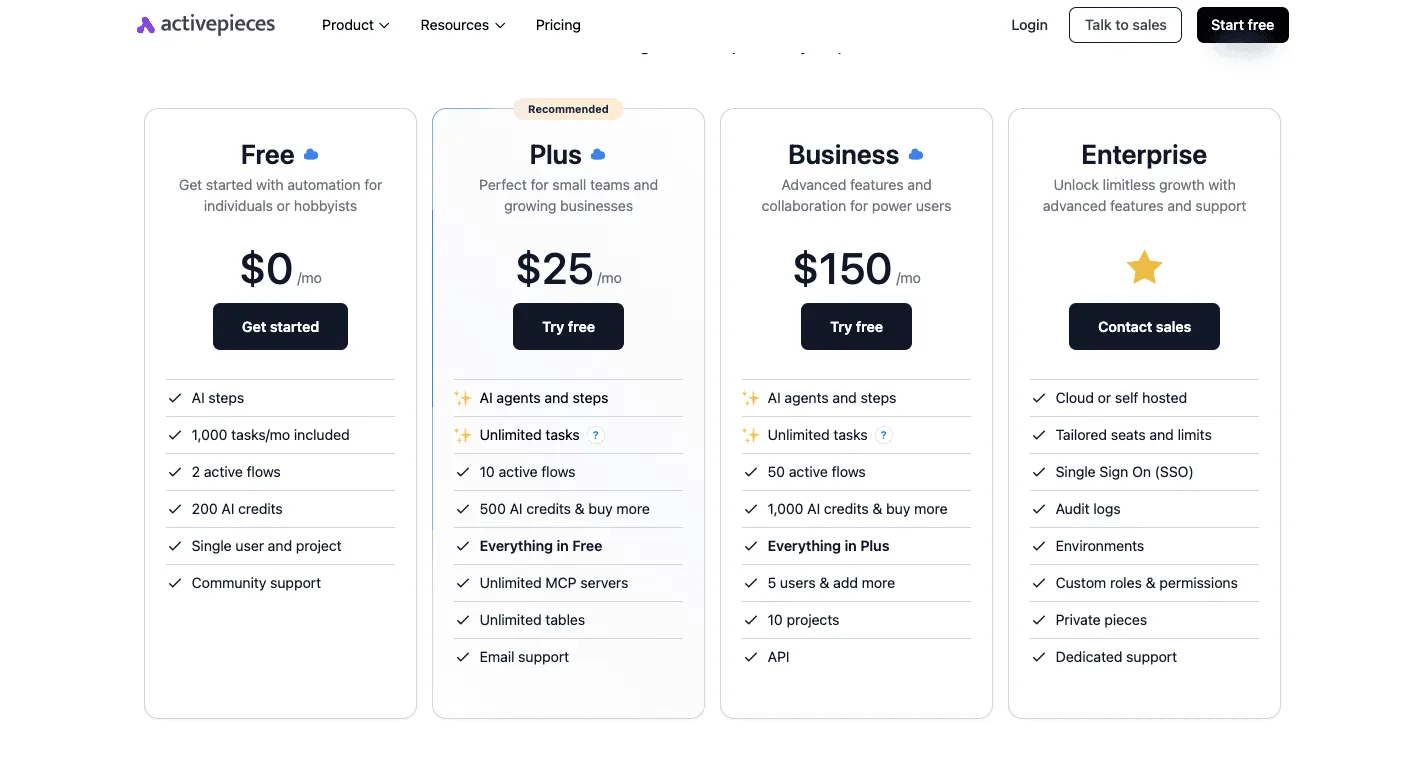
Activepieces is the better fit for regulated entities that require full control over their data without losing the sophisticated management capabilities of a modern automation stack.
The fastest way to settle a shortlist is to try one. Activepieces is free to try, no credit card.
Why users seek IFTTT alternatives
Users are migrating away from IFTTT because its rigid applet structure and escalating subscription costs no longer satisfy the technical requirements of modern, data-heavy workflows.
While the platform pioneered simple "If This, Then That" triggers, the three primary drivers for migration have forced a shift toward platforms that handle complexity at a lower cost per operation.
These drivers include pro-tier price hikes reaching business-level costs, a lack of multi-step conditional logic, and limited depth in business API fields.
Why IFTTT's trigger-action model falls short
The linear trigger-action model of IFTTT fails when a process requires branching paths or data manipulation.
In a landscape where users deploy Claude Sonnet 5.5 to analyze incoming leads, IFTTT’s inability to filter by specific business API fields means a user can't distinguish between a high-value SQL and a support ticket within a single automation.
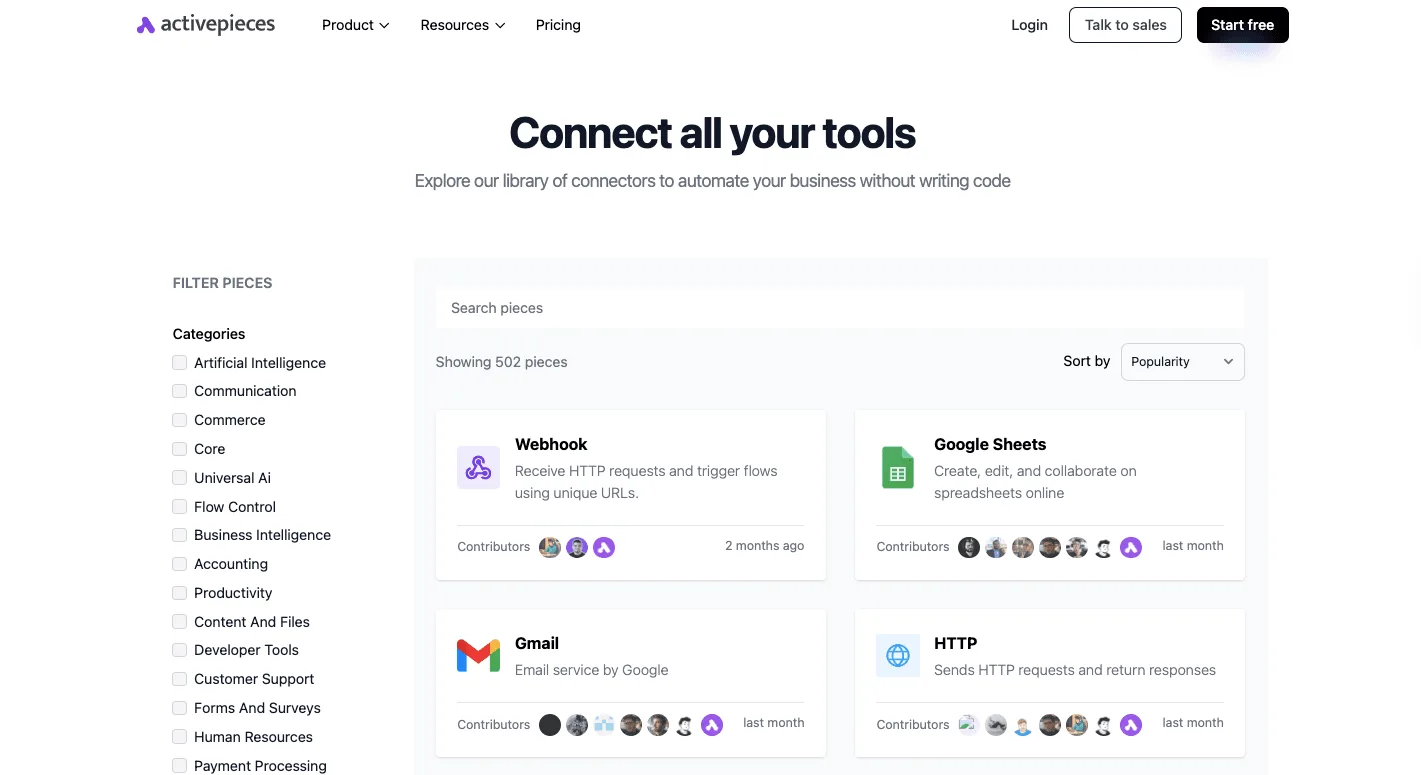
This lack of multi-step logic forces users to build dozens of individual applets for a single workflow. The resulting fragmented environment is difficult to debug or audit.
Rising costs of personal automation tiers
The financial math of automation has shifted as IFTTT transitioned from a low-cost utility to a tiered service where "Pro" costs can mirror enterprise tools.
Toolradar puts IFTTT’s entry point at $2.99, making it the most accessible option for users with basic automation needs, which means casual hobbyists can start building workflows without a significant financial commitment.
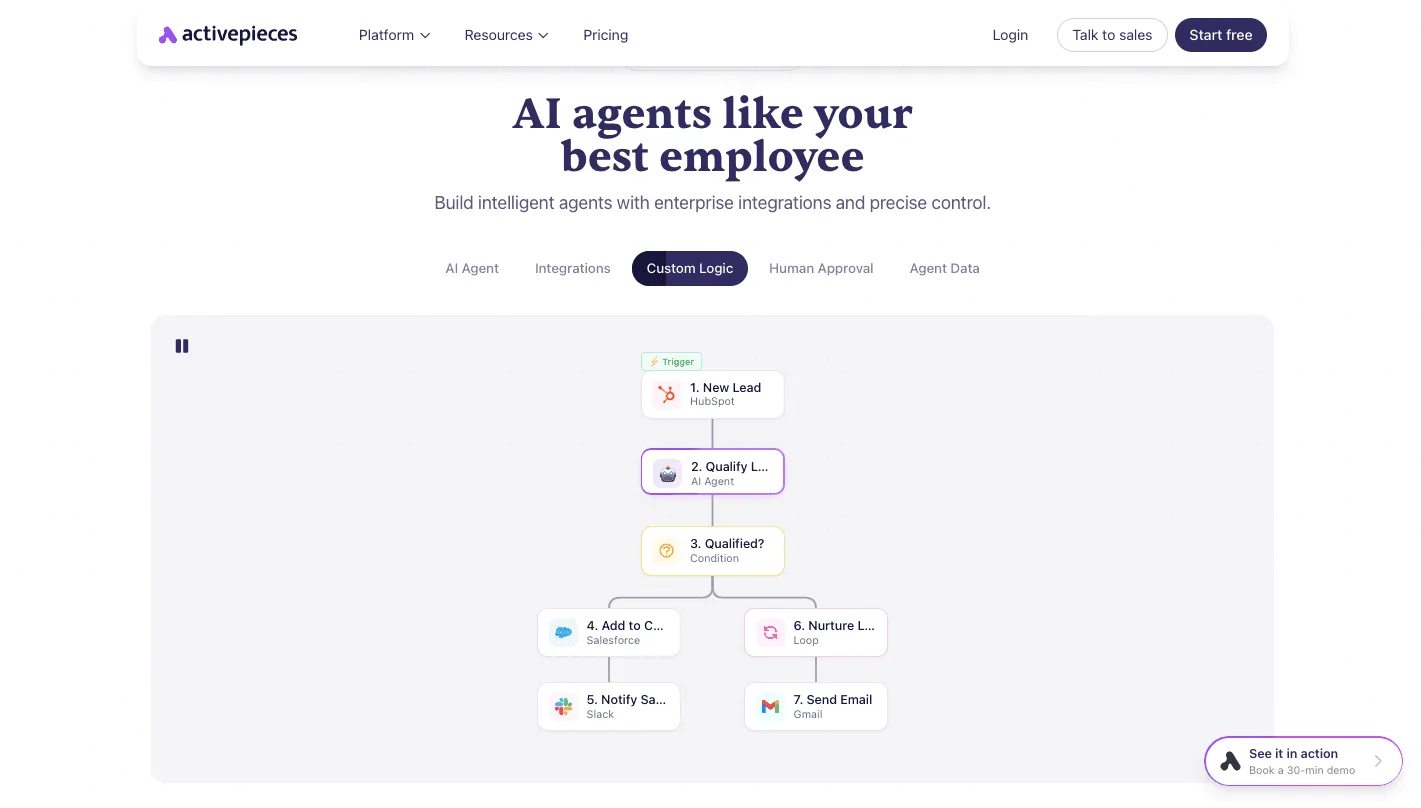
This provides basic functionality for casual users. Hobbyists can automate simple tasks without a significant financial commitment. However, as complexity grows, the market reveals a steep curve:
- Make: $29, allowing for intricate visual logic at a mid-market price point.
- Zapier: $69, which reflects the premium for its massive library of over 7,000 integrations.
- Pipedream: $99, a price justified by its developer-centric environment for running custom code.
The shift toward data privacy and local execution
As automation moves from turning on smart bulbs to handling sensitive customer data, the demand for Activepieces and other self-hosted solutions has increased.
The core of the platform is published under an MIT licence, which you can verify by opening the LICENSE file in the activepieces/activepieces repository. Unlike source-available alternatives, every commit released under MIT is yours to run, fork, or embed without a fair-code clause.
This ensures that even if a vendor changes their pricing, the logic you built remains under your control.
Top four IFTTT alternatives compared
The selection of an automation platform in 2026 depends on whether a user requires simple linear triggers or complex data routing across high-compute AI models like GPT-6 Astra.
While IFTTT serves the consumer market, professional alternatives have diverged into distinct categories based on how they handle logic, cost, and infrastructure.
The following table compares the primary architectural differences between the market leaders to help identify where a workflow might outgrow its current environment.
| Platform | Pricing Model | Technical Barrier | Execution Speed | Ideal User Profile |
|---|---|---|---|---|
| Zapier | Task-based | Low | Polling/Real-time | Sales and Marketing Ops |
| Make | Operation-based | Medium | Real-time | Visual Logic Designers |
| Pipedream | Credit-based | High | Real-time | Software Engineers |
| Activepieces | — | — | — | AI automation platform |
By looking at these dimensions, you can avoid the common mistake of migrating a simple home routine to a developer-centric tool that requires custom code for basic authentication.
This comparison highlights that as technical control increases, the abstraction of the pricing model typically shifts from simple tasks to granular resource consumption.
Simple "If This, Then That" structures fail when a workflow requires conditional branching or multi-step data transformations.
In a linear applet, a user can't easily send data from a CRM like Salesforce to a reasoning model such as Claude Opus 5.5 and then route the output to different Slack channels based on the sentiment analysis.
This lack of sophisticated routing forces users to create multiple redundant applets. This increases the management overhead and makes it difficult to debug a broken sequence.
Subscription models for entry-level automation have shifted toward usage-based billing, which often penalizes users for frequent, low-value updates. When a platform charges per execution, a simple weather check that runs every fifteen minutes becomes a significant monthly expense regardless of whether the underlying data changed.

This pricing structure makes high-frequency polling prohibitively expensive for individual developers who don't have a corporate budget to absorb the cost of idle runs. Monitoring a GitHub repository for new commits is one such example.
Modern automation requirements now frequently include strict data residency rules that prevent sensitive information from leaving a specific geographic region or private network.
Organizations using advanced agentic models like Gemini 3.8 Flash for internal document processing often require that the orchestration layer resides on their own hardware to avoid exposing proprietary API keys to a third-party cloud.
Self-hosted runners ensure that even if the primary automation service suffers a global outage, the local triggers governing physical security or industrial hardware continue to function without interruption.
Reading a table only gets you so far. Build the same workflow in Activepieces and compare it yourself.
2. Zapier for maximum app compatibility
Zapier is the primary market leader for users who prioritize immediate connectivity over granular control or low-cost execution. While technical alternatives offer deeper customization, the platform’s value proposition rests on its ability to bridge disparate software ecosystems without requiring a single line of custom code.
Zapier's app integration library
The utility of an automation platform is strictly limited by its supported endpoints, and Zapier maintains the Ecosystem for connecting third-party services.
As shown in the following chart, Zapier leads in total app integrations, providing a significant safety net for businesses using niche or legacy software.
| Platform | Supported App Integrations |
|---|---|
| Zapier | 7,000+ |
| Pipedream | 3,000 |
| Make | 2,000 |
| IFTTT | 1,000 |
| Activepieces | 738 |
According to data from Zapier, the platform supports over 7,000 applications. This is more than double the 3,000 apps offered by Pipedream.
This means a user is significantly less likely to encounter a "dead end" where a specific tool lacks a pre-built connector.
This gap widens against Make’s 2,000 integrations and IFTTT’s 1,000 apps, ensuring that for complex enterprise stacks, Zapier remains the A method for achieving a "no-code" connection.
Zapier's task-based pricing explained
The premium for this connectivity is reflected in a rigid task-based pricing model that penalizes high-frequency polling. In Zapier, every successful action consumes a task, which can lead to exponential cost increases for high-volume workflows.
Examples include sending a prompt to Gemini 3.8 Flash or updating a row in Google Sheets. Theexpertranking notes that the Starter plan begins at approximately $20 USD per month for only 750 tasks.
A workflow that triggers every ten minutes will exhaust a user's entire monthly budget in just over five days.
Unlike platforms that allow for unlimited internal logic steps, Zapier’s overhead means that sophisticated multi-step automations often require the Professional tier to avoid service interruptions, making it a significant line item for operations teams.
3. Make for visual multi-step workflows
Make serves users who require granular control over data transformation through a spatial, canvas-based interface rather than a linear list of triggers and actions. IFTTT handles simple "if this, then that" pairs, but Make permits infinite branching and data manipulation within a single execution path.
Visualizing complex data routes
By utilizing a drag-and-drop canvas where users map the journey of a data packet through various modules, the platform makes the relationship between different services immediately apparent.
This spatial arrangement is necessary for workflows that involve conditional routing, where a single piece of information must be filtered or transformed before reaching its final destination.
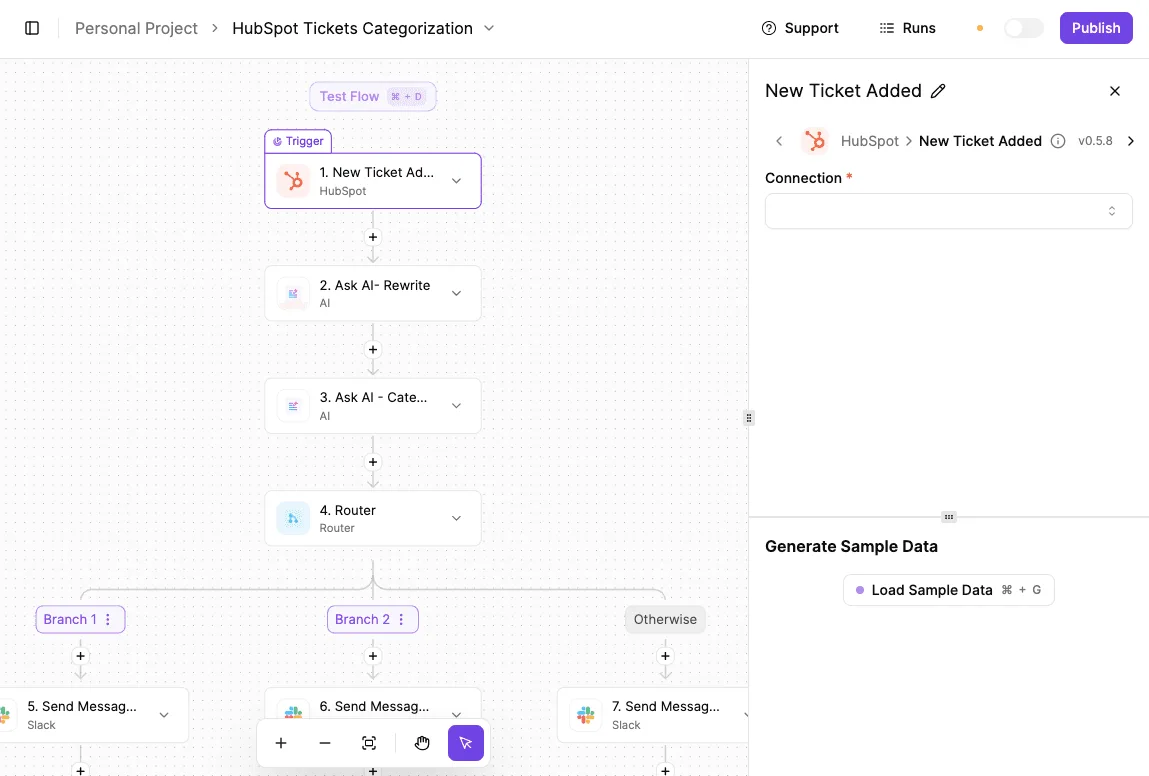
The "HubSpot Tickets Categorization" workflow shows a HubSpot CRM trigger initiating a sequence. Incoming data passes through two AI steps before hitting a router that directs the output to specific Slack channels based on the ticket type.
The two AI steps consist of one for rewriting content and another for classification.
This visualization ensures that a developer can trace the logic of the two distinct branches and the "otherwise" fallback path without scrolling through nested menus. By exposing the raw data structure at every step, the canvas enables precise mapping of variables between incompatible apps.

Operations-based pricing vs IFTTT applets
Every time a module performs a task or checks for new data, Make calculates costs based on "operations." This differs fundamentally from the flat-rate or per-applet models found in simpler tools.
This granular accounting means a single workflow run can consume multiple operations if it involves searching a database, filtering results, and updating a spreadsheet.
For teams using advanced models like Gemini 3.8 Flash for agentic reasoning or GPT-6 Astra for complex coding tasks, this model requires careful optimization of polling intervals to avoid depleting the monthly operation quota on empty checks.
While this introduces a steeper learning curve regarding budget management, it gives the transparency needed to audit exactly which step in a complex sequence is driving up the monthly bill.
4. Pipedream for developer-centric automation
Pipedream is an integration platform built specifically for technical users who find visual builders too restrictive for complex logic. By treating every workflow as a sequence of serverless functions, it removes the abstraction layer between the automation engine and the underlying execution environment.
Pipedream's Node.js and Python code steps
Workflows in this environment function as managed scripts where developers can import any package from the npm registry for JavaScript or PyPI for Python.
This allows the direct implementation of libraries like Gemini 3.8 Flash for agentic reasoning or specialized data processing tools without waiting for a vendor to release a pre-built "block."
Because the platform includes built-in state management via a $.service.db object, developers can persist data between executions without configuring an external database. This is useful for tracking a cursor in a database or storing an OAuth token.
Pipedream's event-driven webhook handling
Unlike traditional polling-based tools that check for updates on a fixed schedule, this system utilizes an event queue that ingests incoming requests immediately.
The architecture is designed to handle asynchronous, event-driven triggers where a single webhook might fire hundreds of times per second, preventing data loss during traffic spikes.
- A 10 req/s HTTP rate limit defines the maximum sustained velocity for incoming webhooks before the platform begins throttling requests.
- A 512KB payload maximum caps the size of individual incoming JSON or binary objects, requiring developers to architect large file transfers using signed URLs rather than direct body uploads.
- A 100-event free tier queue limits the backlog of pending executions for non-paying accounts, meaning high-burst activity will result in dropped events once the buffer is full.
- 11.4K GitHub stars: indicate a large pool of peer-contributed components and shared code snippets available for troubleshooting.
These constraints necessitate a disciplined approach to script optimization and resource management.
How to migrate your automation stack
Systematic migration ensures that transition costs don't escalate through redundant subscription fees or broken production workflows. Moving away from a legacy stack requires a cold-eyed assessment of which triggers actually drive business value and which are merely digital clutter.
The following sequence is a framework for shifting operations without losing data integrity or operational uptime.
- Auditing active Applets for API usage.
- Exporting IFTTT data logs.
- Mapping triggers to new platform steps.
- Running a parallel pilot for 24 hours.
This checklist forces a confrontation with your current resource consumption, revealing where simple triggers can be consolidated into sophisticated multi-step workflows.
It also highlights where high-priority logic, such as a Claude Sonnet 5.5 call for sentiment analysis, is prioritized over low-value notifications.
Selecting a platform based on these dimensions prevents the common mistake of migrating a simple home routine to a developer-centric tool that requires custom code for basic authentication. By mapping these dependencies, you ensure that high-priority logic, such as a Claude Sonnet 5.5 call for sentiment analysis, is prioritized over low-value notifications.
Testing your new automation platform safely
Redundancy is the only protection against the edge cases that emerge when switching API providers or logic engines. Before decommissioning an old service, you should route the same webhook to both your old and new platforms simultaneously.
This allows you to compare the execution speed and output accuracy of a model like Gemini 3.8 Flash across both environments. Once the logs match consistently for a full business cycle, the legacy connection can be severed with minimal risk to the broader architecture.
Frequently asked questions about IFTTT alternatives
Is there a completely free alternative to IFTTT?
No service offers unlimited, complex automation at zero cost because the compute power required to monitor third-party APIs incurs ongoing server expenses for the provider.
While several platforms offer "Free Forever" tiers, these function as entry-level trials that restrict the number of active workflows or the frequency at which the system checks for new data.
Pipedream has a free tier for developers, but it enforces a daily limit on "invocations." A high-traffic sensor will pause your automations until the next billing cycle.
Zapier has a free version that supports only single-step triggers. This prevents you from adding conditional logic or secondary actions without a paid subscription.
Make allows for multi-step sequences on its free plan but caps the total data transfer volume, so moving large files or high-resolution images will quickly exhaust your monthly allowance.
Can I export my IFTTT applets to another service?
IFTTT doesn't provide a native migration tool to move your logic directly into a competitor's environment, as each platform uses a proprietary format for defining triggers and actions.
To move your workflows, you must manually recreate the logic by selecting the equivalent "if" and "then" components in your new tool.
If you use specialized AI steps, such as a Gemini 3.8 Flash prompt for summarizing emails or GPT-6 Luna for categorization, you can copy the specific text prompts between services. However, the underlying API connections must be re-authenticated individually.
Which alternative is best for smart home devices?
The most effective alternative depends on whether you require broad hardware compatibility or deep, programmatic control over your environment.
Zapier connects to high-end professional hardware like Netatmo security cameras or Ecobee thermostats. Its pricing model is designed for business lead-processing rather than toggling consumer lightbulbs.
Pipedream allows you to write custom Node.js or Python code to interact with any device that has a public API. This gives you the ability to build complex routines that standard consumer "applets" can't handle.
Make uses a visual canvas to map out home logic. This is useful if you need to see how a single motion sensor trigger branches off to affect multiple rooms simultaneously.
Related reading
References
Still comparing
The fastest way to settle it is to build something.
Open source under MIT, so you can self-host the same thing later.
Start free Talk to sales