
Inkling 2 Small Alternatives: Models Compared in 2026

Nov 21, 202614 min read
As of 21 November 2026, the credible alternatives to Inkling 2 Small are whichever models pass your own failing case, not whichever list price is lowest.
You can only name them once you know which limit broke your run, and the easiest way to find out is to replay that case through a workflow tool such as Activepieces against each candidate and see where it stops.
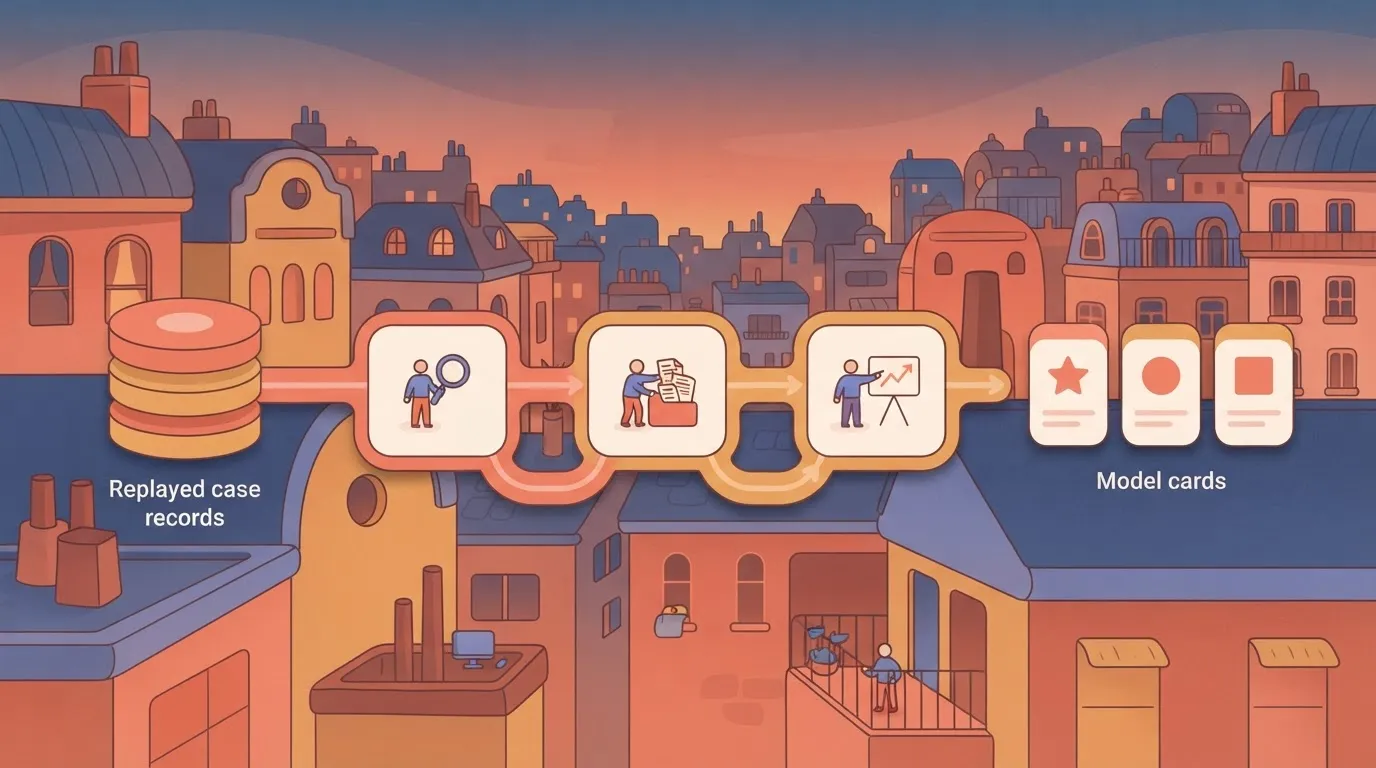
Identify Inkling 2 Small alternatives from failed runs
What Inkling 2 Small is, per its own documentation
Before you read any comparison table, read the vendor's model page. It is the only place that authoritatively states the limits of Inkling 2 Small, the lower-cost tier of the Inkling 2 family.
The price is the reason teams adopt it.
The documented limit is the reason some of them leave. The rest of this article treats the gap between the two as a billing question: what a failure costs against what the cheaper tier saves.
The moment the workflow broke
Nothing here is a reported incident; the case is illustrative. Take a support-triage workflow running unattended overnight, which calls a small model to classify each incoming ticket.
At 02:14 a long customer thread arrives. The model receives more input than its documented limit comfortably handles, and it returns a confident but truncated classification.
Nothing errors. The downstream step reads the output as valid and routes a billing dispute to the wrong queue.
Nobody sees the failure until morning, and the cost is the cleanup, not the tokens. A silent degradation like this is more expensive than a loud failure because no retry or alert fires. That's the pattern that makes teams reconsider a cheap model.
A silent degradation like this is more expensive than a loud failure because no retry or alert fires.
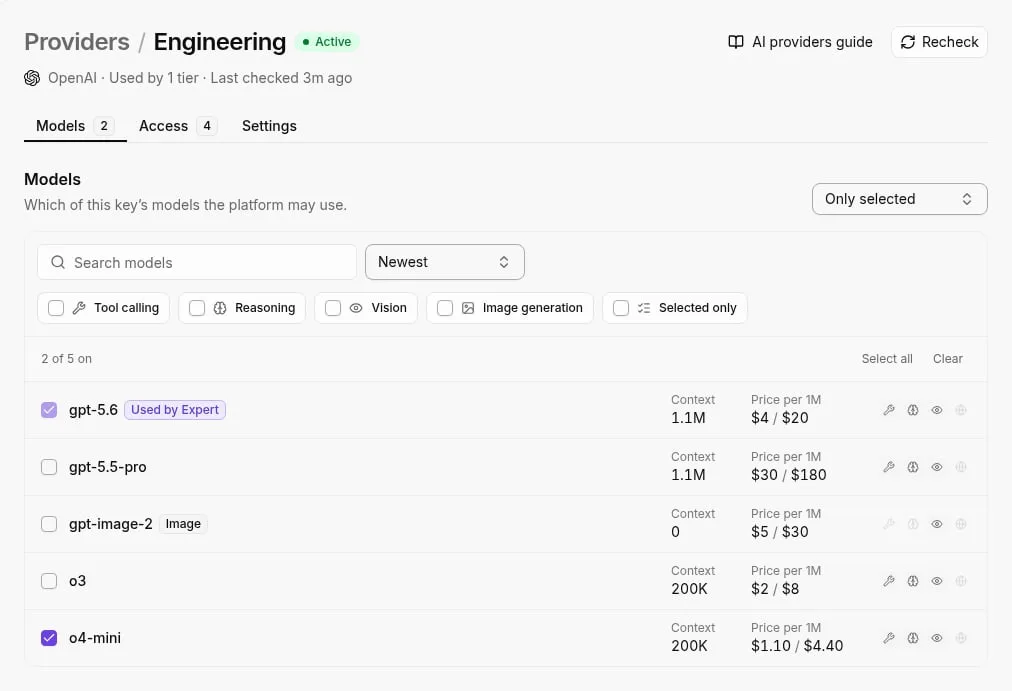
To see where the fix belongs, look at the provider configuration below. You select models per provider, each provider lists its context window and price per million tokens, and the tier using the provider is tracked separately.
The fastest way to settle a shortlist is to try one. Activepieces is free to try, no credit card.
What one failure cost in hours and records
Set against what Inkling 2 Small's monthly price might save, a failure like this could cost far more in rework, wrong records and customer trust. That's why the incident itself should become the replacement's first test case.
Hours lost finding and fixing it
To see where the time went, follow the sequence below. The model hit its limit mid-run, and the damage came from what happened after that, not from the limit itself.
We give the order of events without clock times, because the team's logs don't support exact ones.
- The batch run starts and processes normally.
- The run hits the model's limit partway through.
- The run writes bad output to the records without failing loudly.
- Someone notices the output is wrong, well after the run wrote it.
- The team identifies and reprocesses the affected records.
- Customers who received the bad output are told.

The run hadn't stopped, so nothing pointed to where the bad output began, and engineers had to work backward from the first wrong record. That is where most of the effort went, in steps four and five.
Fail loudly and a limit costs minutes. Fail silently and it costs the time between step three and step four, plus the cleanup, so by the time you notice, downstream steps have already acted on the error.
Records and customers hit by the Inkling failure
Once the limit was hit, every record written after it had to be treated as suspect until it was checked. That's why reprocessing covered the whole stretch after the failure, not just the records that were visibly wrong.

Spend compared with the monthly price
None of the engineering hours, reprocessing compute or customer communication this incident consumed sit inside the monthly price, which covers tokens. Those costs weren't budgeted against the model, yet they were caused by it.
Switching to the cheapest rival wouldn't remove that exposure, since any model has limits. The protection is a tested, swappable choice and a written rule for when to swap.
Teams leaving Inkling over documented limits
When one documented limit produces a failure that costs more than the model's lower price saves, teams leave. The limit is usually written on a vendor page long before the failure happens.
The limit that caused this failure
No model wins every task, so a limit only hurts when your workload sits on the weak side of it. On AutomationBench,
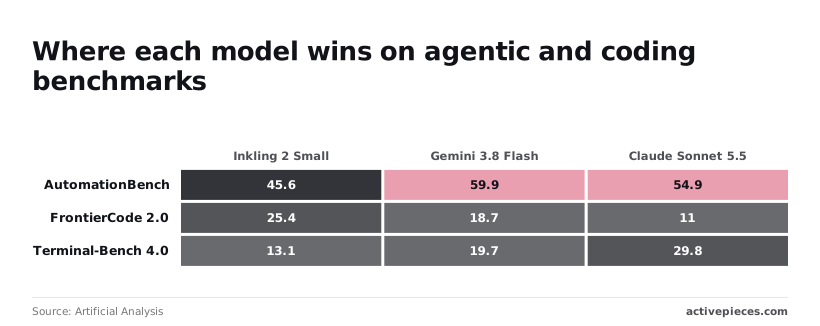
On Terminal-Bench 4.0 the gap shows up again: Inkling scores 13.1%, against 19.7% and 29.8%, so Inkling reveals pronounced weakness in terminal operations. For shell-driven agents, the best rival completes more than twice as many tasks.
Switch to coding and the order reverses. On FrontierCode 2.0, Inkling scores 25.4%, against 18.7% and 11%. A team that moves everything to a rival because of automation results gives up its strongest result.
Exit triggers for leaving Inkling 2 Small
The three exit reasons below each point to the vendor page where the change or limit is published:
If the vendor changes the price or lowers a rate or context limit, your cost per completed task changes, not just the headline rate.
Check the vendor's pricing and limits pages on a schedule, because a quota cut can break a job that passed testing last month.
Because of the benchmark figures above, test per task type. Run your own prompts on both models before you commit, and route coding and automation work separately if the results split the way Artificial Analysis shows.

Model deprecation notices and workflow migration
A deprecation notice sets a date by which you must migrate.
A model hard-coded into every pipeline turns that notice into an emergency, while a swappable choice turns it into a planned test.
Reading a table only gets you so far. Build the same workflow in Activepieces and compare it yourself.
Inkling 2 Small Alternatives Compared in One Table
You need candidates for a planned test. On cost per task the field is wide: the cheapest tracked option is MiMo-V2.6-Pro at 0.26 $, and the dearest is Gemini 3.8 Flash at 6.26 $.
Sources and dates for the model comparison
For cost per task, the source is Artificial Analysis, which prices one Intelligence Index task on each model. Inkling 2 Small costs 1.18 $, so MiMo-V2.6-Pro is about a quarter of that.
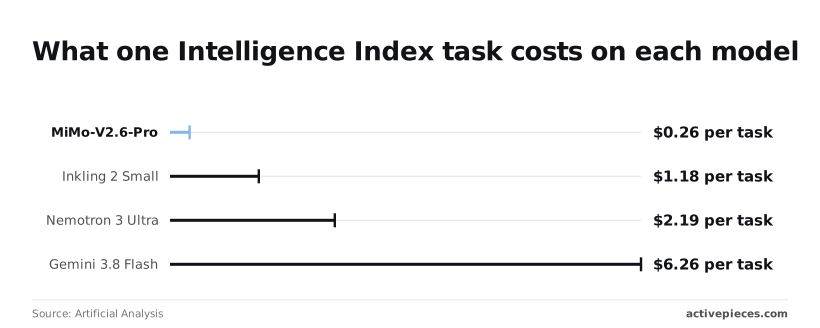
At 2.19 $, Nemotron 3 Ultra costs nearly double Inkling's price. Gemini 3.8 Flash costs 6.26 $, more than five times Inkling's, so a switch there raises the bill.
For strengths and suitability, each vendor's model page is the source, checked on 2026-11-21. Where a cost is absent from the chart, the table says so rather than guess.
Read the price column first, then the limit column: it shows which models have a measured cost and which have only a vendor description.
| Model | Price | Strength | Main limit | Suits | Source and date |
|---|---|---|---|---|---|
| Inkling 2 Small | 1.18 $ per task | Low cost per task | The failure that prompts this review | Teams whose workload stays inside its limit | Artificial Analysis, no date shown |
| Gemini 3.8 Flash | 6.26 $ per task | Engineering and agent work | Highest cost per task in the chart | Agent pipelines where cost is secondary | Artificial Analysis; Google model page, 2026-11-21 |
| Claude Sonnet 5.5 | Not in the cost chart | Speed and intelligence together | No measured per-task cost here | Teams that can benchmark it first | Anthropic model page, 2026-11-21 |
| DeepSeek V4.1 Flash | Not in the cost chart | Vision and 1M context | No measured per-task cost here | Long-context, cost-sensitive work | DeepSeek model page, 2026-11-21 |
| Mistral Large 4 | Not in the cost chart | Open-weight, multimodal | No measured per-task cost here | Teams that want open weights | Mistral model page, 2026-11-21 |
Which Inkling 2 Small alternative fits your team
By itself, none of these would have prevented the failure, because each has its own limit that a different workload will hit. MiMo-V2.6-Pro at 0.26 $ is the cheapest, but cheapest isn't safest.
What would have prevented the failure is a tested fallback and a written rule for when to switch to it. Pick the candidate whose limit your workload never reaches, and run it against your own failing case before the notice arrives.
Activepieces as a Swappable Model Layer in Workflows
Don't mistake Activepieces for an Inkling 2 Small alternative; it isn't a model.
It's what lets you swap the model behind a step without rewriting the process around it.
A platform that resells you its own model has decided your model choice and priced it before you opened the product; Activepieces calls whichever model you picked on your own provider key, so from the $20 Plus tier up every AI step costs 1 credit and the model charge lands on your provider bill at your own rate, with the flows reachable from Claude, ChatGPT, Cursor or any MCP client.
Where a workflow tool helps
It fits when a workflow calls a model as one step among several. You connect more than one provider, name one primary and one fallback, and the flow reroutes when the primary errors out.
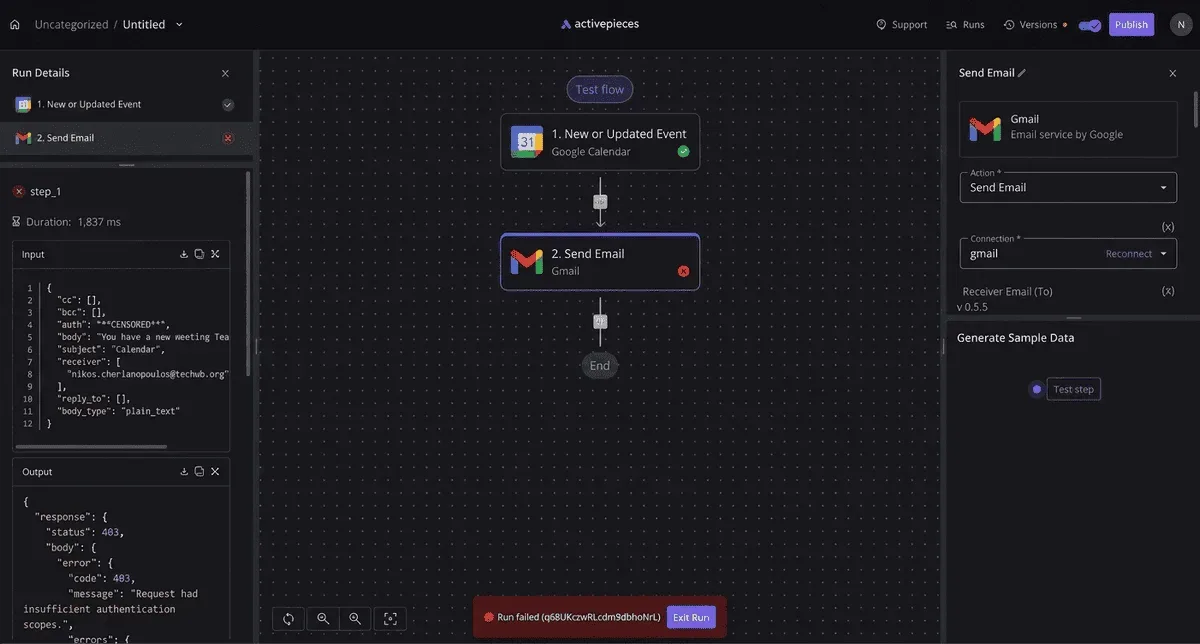
The swap then becomes a configuration change you can test, not a migration.
The written rule lives in the flow itself.
The owner who gets the alert is the person who decides whether the fallback stays.
The sentence after the diagram matters as much as the diagram: each box is a place where a failure becomes visible instead of silent.
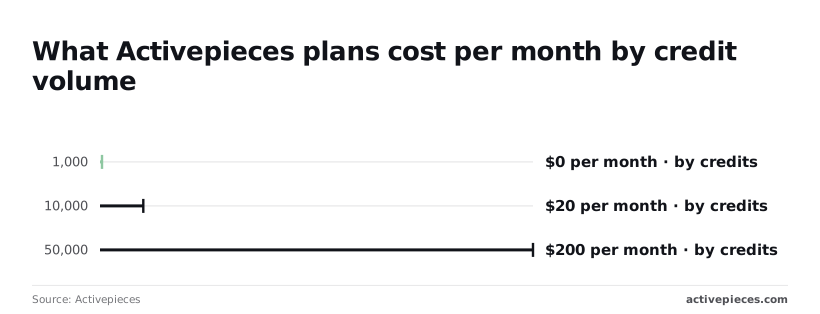
Pricing is measured in credits. At 1,000 credits the plan costs $0 per month, so you can build and rehearse the failover path before spending anything.
At 10,000 credits it's $20 per month, which is a small cost for a team running one production flow.
At 50,000 credits it is $200 per month: five times the credits for ten times the price, so the cost per credit doubles. Budget by expected volume, not by the entry tier.
Where a swappable model layer doesn't help
You don't need it if a single script calls one model, the output is never customer-facing, and a failure just means rerunning the job. A short retry in code does that cheaper.
It also doesn't fix quality. A fallback provider that fails your format check is still a failure, only a better-announced one. The tool routes and alerts; the testing against your own failing case, described above, remains your work.
If your volume sits at the top of the credit range, price the doubled per-credit rate against writing the fallback yourself.
The guard sequence for model switching
Whoever prices that fallback should also fix the order in which a switch happens, because a swap that follows a written sequence fails somewhere a named person is watching.
Before the spend cap and the fallback comes the format check, so a model that can't produce your output shape never reaches production traffic. The list below shows the full order:
- Run the fixed test set.
- Check output format.
- Set the spend cap.
- Enable the fallback.
- Name the owner.
- Set the recheck date.
The three phases below explain why each step sits where it does.
Before switching: test on your own records
Run the fixed test set against real records from your own workload, including the ones that caused the original failure. Vendor benchmarks measure someone else's tasks, and a model that scores well on them can still break on your longest document or your strangest input.
Then check output format on every response: valid structure, required fields present, no prose wrapped around a payload. A candidate that fails here is rejected, however cheap it is, because downstream parsers fail silently more often than they fail loudly.
During the switch: caps and a fallback
Set the spend cap before traffic moves. A cheaper per-unit rate doesn't protect you if the new model is verbose or retries more often, so the cap turns a surprise into an alert.
Enable the fallback next, routing to the previous model when the new one errors or fails the format check.
Then name one owner who receives those alerts and can approve a rollback. A rule with no owner tends to be everyone's assumption and no one's job.
After: a dated recheck of vendor pages
Put a recheck date on the calendar and, on that date, reread the vendor's pricing and limits pages.
Rates and model availability change, and the trade-off that justified the switch can reverse without any failure to announce it.
Rerun the fixed test set at the same time, so the decision stays tied to evidence rather than to the last invoice.
Frequently asked questions
Can I move from Inkling 2 Small without rewriting my prompts?
Usually not without edits, but the edits are small if the prompts are already separated from application code.
Expect to adjust output-format instructions and anything that relied on Inkling's particular truncation behavior. Run the fixed test set against the candidate first. The failures it shows are your actual migration list.
Is a cheaper small model safe for customer-facing output?
Only after it passes your own test set on your own prompts, with the failure that prompted the move included as a case. A vendor's benchmark tells you about average behavior. Customer-facing output fails at the edges: tone, refusals, malformed structured responses, and long inputs.
Release it behind a fallback to the current model, and write the rule for when traffic reverts. Until it has been tested against your worst case, a cheaper model is a billing decision, not an engineering one.
How often do these vendors change pricing and limits?
Often enough that a one-time comparison goes stale, and rarely on a schedule you control. Pricing, limits and model versions can each change independently, and older versions get retired.
Tie rechecks to two triggers: a vendor announcement affecting a model you use, and a fixed calendar review. At each one, rerun the test set and compare cost per accepted output, not the price per token on the invoice.
Do I need an automation tool to switch models?
No. What you need is a thin interface in your own code that takes a prompt and returns a result, with the provider and model name held in configuration. That makes a swap a config change plus a test run.
If your team already runs workflows through an automation platform, it can help, but it doesn't replace the written rule. The rule says which failure triggers a move, which tests must pass, and who approves it.
If a team has a single provider, it can stay on one when its test results remain stable and no failure has exceeded the savings. The swappable layer is what keeps that choice reversible.
Related reading
References
Still comparing
The fastest way to settle it is to build something.
Open source under MIT, so you can self-host the same thing later.
Start free Talk to sales