
Inkling 2 Small MCP Cost and Requirements in 2026

Nov 21, 202612 min read
Inkling 2 Small MCP is the Small-size Inkling 2 model used with the Model Context Protocol. That open standard, which tools such as Activepieces can also speak, lets a model call external tools and read external data through a common interface.
Inkling 2 Small MCP basics
What Inkling 2 Small MCP means
Pull the name apart and you find two things that fail separately: a model and a way of connecting it to tools.
Treat them as one product and you end up debugging the wrong layer. If a tool call fails, the fault may sit in the model's tool handling, the connector, or the permissions on the system the model calls.
Treat them as one product and you end up debugging the wrong layer.
The vendor's model page describes the first. Whether a connector ships with it is a separate question, and only the vendor can answer it.
What MCP means here
When the model needs a tool, MCP defines how a client application discovers the tools a server offers and how the model's requests reach them. The model doesn't reach out on its own.
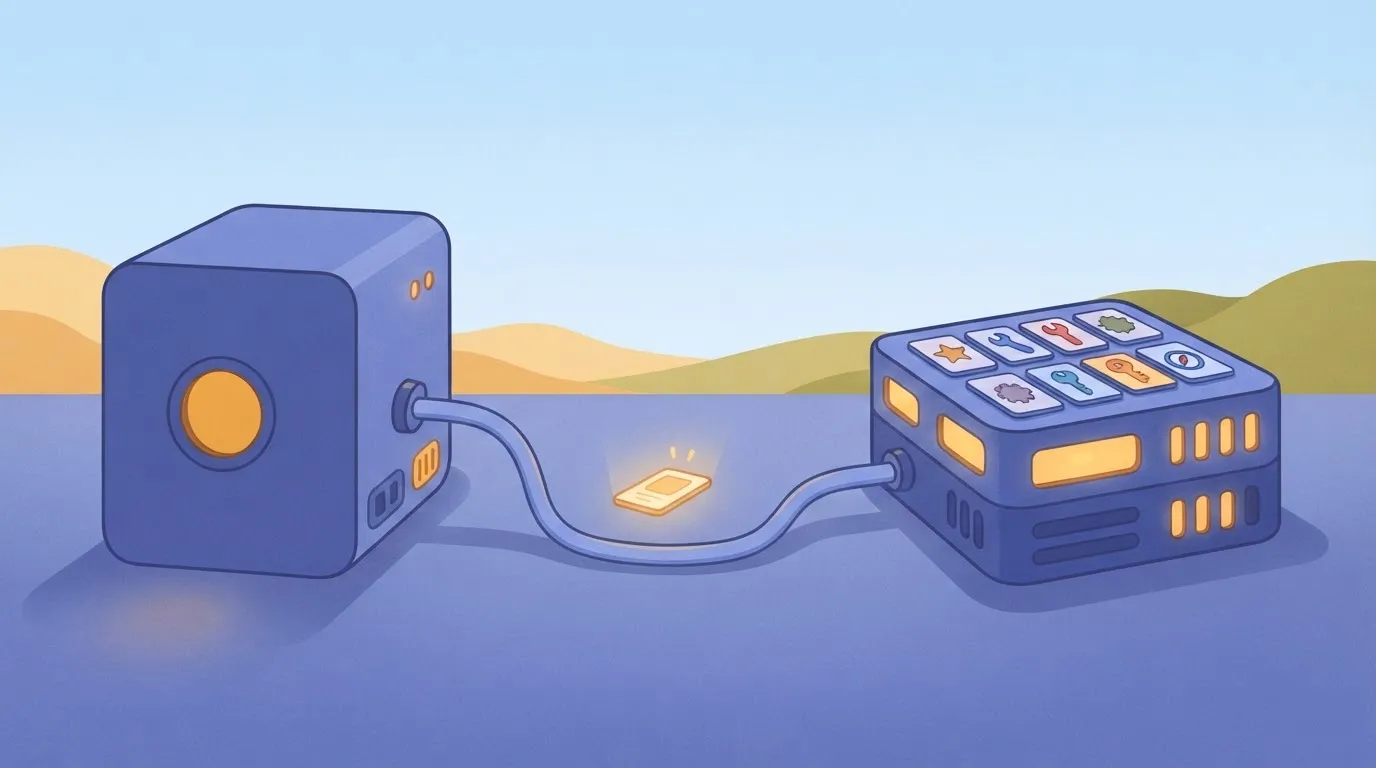
A client sits between them, whether you write it by hand or use a workflow tool.
Even when a model is capable of tool calling, it does nothing until you wire something to it. So "supports MCP" is a claim about the client and server pair as well as the model.
What Inkling 2 Small MCP vendor pages confirm
If it is stated on the vendor's model page, it counts as confirmed here. If you infer it from third-party summaries, forum posts, or the name itself, it doesn't.
In particular, the vendor pages reviewed here don't confirm that the vendor bundles an official MCP server, so treat that as unconfirmed until you find it on a vendor page yourself. The rest of this account marks each claim by its source.
Everything below works on Activepieces' free plan. Start without code or a credit card.
Inkling 2 Small MCP first-day setup
Count a step as known only once you can pin it to a vendor page or changelog entry; anything else is an assumption carried forward. Six steps fill the first day, so your first day is entirely consumed by setup.
Decide what you'll record before you open a client. For every step, note the page or changelog entry that supports it, and the date you read it.
Where a step has no citation, log it as unsourced, because that's where a wrong guess later looks like a server fault.
Inkling 2 Small MCP connection steps
When a failure turns up, you want to trace it to a step instead of to the whole setup. The sequence below is the order the evaluation followed, and it shows where each claim must come from.
- Find the vendor's own documentation for Inkling 2 Small MCP, and cite its landing page.
- Choose the MCP client, and cite the vendor's list or description of supported clients.
- Point the client at the server, using the address the vendor documents and cite where it appears.
- Authenticate, using the method the vendor describes, and cite the page. Check what access the credential grants before using it.
- List the exposed tools, and cite the vendor's tool reference. Compare it with what the server returns.
- Run one test call against a tool that changes nothing, and cite the entry that describes it.
Steps 3 and 4 are where a wrong assumption does the most damage, because a mismatched address or an over-broad credential produces a failure that looks like something else.
Wherever a step has no vendor page behind it, write "not documented" in the log. Don't fill the gap from another MCP server you have used. Those gaps are the questions to put to the vendor before anything depends on the connection.
Where Inkling 2 Small MCP is used
First a test, then a first real task, then shared use: that is how teams meet Inkling 2 Small MCP, and the capability evidence that matters differs at each stage.
Inkling 2 Small MCP documented use cases
Match each stage to the benchmark that fits it best and you get the table below, though the pairing is my reading, not the vendor's.
The scores come from Artificial Analysis, which compares Inkling 2 Small with its predecessor and Claude Sonnet 5.5. Read it as the spread to expect, then confirm on your own workload.
| Stage | Benchmark | Scores across the three models | Source |
|---|---|---|---|
| First test | HLE-Diamond | 12, 28.7, 53.3 % | Artificial Analysis |
| First real task | AutomationBench | 5, 45.6, 71.8 % | Artificial Analysis |
| First shared use | FrontierCode 2.0 | 5, 25.4, 41.7 % | Artificial Analysis |
On AutomationBench, scores run from 5 to 71.8 %, so the wrong model choice can mean an automation that almost never completes.
Even the best FrontierCode 2.0 result fails more often than it succeeds, since scores span 5 to 41.7 %, and any coding step needs review.
HLE-Diamond spans 12 to 53.3 %, so a hard-reasoning answer in a first test is a lead to verify, not a result to circulate.
Those spreads show where a failure is most likely. They don't replace the use cases and checks on the vendor's own pages.
Inkling 2 Small MCP supported clients and limits
Before a second person connects, confirm that their client appears on the vendor's supported list. A client the vendor doesn't list can fail in ways nobody has documented, and that's the postmortem you want to avoid.
The benchmark gaps above also argue for keeping the first shared use narrow, with one task and one reviewer, until your own results match the published ones.
What the first failure cost the team
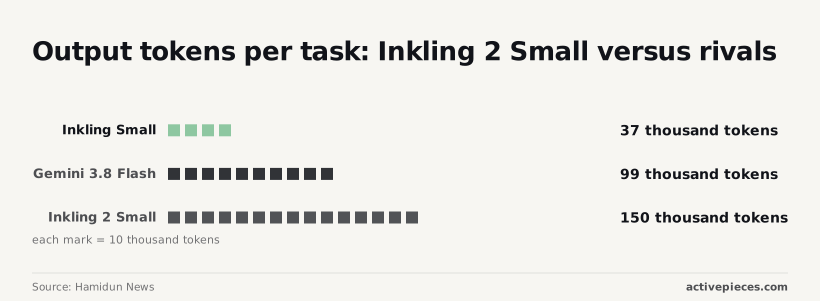
The bill followed the tokens. Inkling 2 Small spent about four times as many output tokens per task as Inkling Small, and the team's budget assumed the predecessor's output, which is why a narrow first run matters.

Inkling 2 Small MCP pricing and quotas
Don't look for a vendor rate card behind the cost figures below; they come from Artificial Analysis index runs. The figures date from 2026-11-21.
The chart shows average output per task, with a small panel for cost per task. The takeaway is that token volume, not list price, drove the spend.
37 thousand tokens per task is what Inkling Small averaged, against 99 thousand for Gemini 3.8 Flash (high) and 150 thousand for Inkling 2 Small, so Inkling Small performs at less than half the token cost of either alternative.
That makes roughly four times the resources per task for Inkling 2 Small.
The sentence after the chart is where the budget breaks: anyone who sized capacity from the older model's 37 thousand was planning for a quarter of the real output.
Cost of an unnoticed overrun
On Artificial Analysis, one index task cost $1.18 on Inkling 2 Small, $1.64 on Claude Sonnet 5.5 and $7.77 on Gemini 3.8 Flash.

So the model that talks the most was still the cheapest per task here, and the overrun hurts only if you forecast from the wrong baseline.
Scenario arithmetic, not a measurement: 100 tasks at $1.18 is $118, and the same 100 at $7.77 is $777, meaning the pricier option is $659 more expensive for identical work.
A team that picked a model by token count alone could have chosen the wrong one in either direction.
Because more generated text means a longer wait per task, output of 150 thousand tokens per task is also a latency question. The team's first failure wasn't noticing this until a reviewer was already waiting.

Reading the published per-task figures first would have set that expectation before the first run.
Easier to see it running than to read about it: set it up free, no card.
Connecting an MCP client to business apps with Activepieces
Activepieces has no connection to Inkling itself; it matters only if you want an MCP-capable assistant to reach your business apps.
Every integration you connect there is an agent tool: the same integration that runs as a step in a flow is exposed as a tool on a per-project MCP server, which Claude, ChatGPT, Cursor or an agent you built can call.

That means no separate catalog to publish and nothing to wire twice. The mechanism is visible in packages/pieces in the open source repo, which counts 750 integrations, so you're looking at a substantial, proven ecosystem.
The Integrations Framework and MCP Server documentation describe this mechanism, and the core is MIT-licensed, so the repo is there to read alongside them. Record the date you read each, as you did for each setup step.
When an assistant calls a tool that exists on paper but is wired to the wrong account, nobody notices until the output is wrong. That is the failure this guards against, the one the earlier tests produced.
A hosted integration layer moves that risk. You no longer maintain the connector, but you still choose which connections the assistant can reach.
When Inkling 2 Small MCP fits
It fits when the work is routine actions in business apps you already use: creating a record, posting a message, reading a row from a sheet.
The assistant gets a defined set of tools instead of free-form access, so you can see what it was able to call when something goes wrong.
It also fits when you want to try an MCP client against real apps before deciding whether to build anything custom.
When Inkling 2 Small MCP does not fit
It doesn't explain or replace Inkling 2 Small.
Activepieces connects your apps to an MCP client through its 750 integrations, but connecting it tells you nothing about how Inkling behaves, which versions support MCP, or why an earlier setup failed, leaving you to troubleshoot blindly when issues arise.
If your problem is the model's own MCP behavior, this layer adds a second variable to the test.
It also doesn't help when the app you need has no integration. Roughly 60% of the 750 are community-contributed, so look for your app by name in the community pieces directory before assuming coverage from the product name.
Pricing and usage limits change, so read the current plans page before committing a team to it.
Why Inkling 2 Small MCP setups fail
When a setup goes wrong, it is because people acted on assumptions the vendor's pages never made. The assumptions are capabilities that aren't listed, permissions wider than the task needs, version changes nobody read, and Small treated as a larger tier.
Size quota and spend from Inkling 2 Small's own published figures, not from the older tier's habits, since it spends heavily on output. The output-token chart below compares it with Inkling Small and Gemini 3.8 Flash. Each cause breaks a documented limit:
- Assuming capabilities the docs don't list breaks the published feature boundary.
- Over-broad server permissions break the scope the MCP documentation describes.
- Ignoring changelog version changes breaks the behavior that applied to the version you actually run.
- Treating Small like a larger tier breaks the tier's own quota and output limits.
The first three get a paragraph each. The fourth runs through all of them.
If the feature list omits a capability, you can't rely on it. When a tool call fails, the cause is often a feature that was never documented, so check the list before debugging the server.
Give the MCP server broad access "to get it working" and you hide the failure you needed to see. A misconfigured agent with wide scope can read or change data it was never meant to touch.
Grant the narrowest scope the documented task requires, then widen it only when the server refuses a specific call.
When the changelog announces a version change, a setup that worked last month can break. Read it before upgrading, and record which version each test ran against.
Inkling 2 Small MCP FAQ and checklist
A guessed answer is how a team ends up on the wrong plan, so each answer here says where it stands, and most are unconfirmed from the vendor's pages.
Whether Inkling 2 Small MCP is free to use is unconfirmed. No free-tier statement turned up that can be quoted, so treat it as paid until the vendor's plans page says otherwise. Assuming free is how an unexpected invoice starts.
Which clients work with it is also unconfirmed. Any client the vendor's setup page names is supported, and anything else is untested. Check your client against that page before rolling it out to a team.
Whether it needs a paid plan is unconfirmed too. The plans page decides this, and it changes, so a plan that worked last quarter may not cover your usage now.
To find out whether the docs have changed since this article, compare the vendor's pages against the notes you took on the day you set up. The checklist below turns that comparison into four checks. Run them on Monday, before anyone connects a production account:
- Open the plans page and write down what your tier includes. If a limit is missing, assume it exists and ask the vendor.
- In your client's MCP server configuration, grant read access only to the data the task needs. A broad grant lets one bad tool call touch data it should never see.
- Set an explicit version in the same configuration instead of "latest". An unpinned server can change behavior overnight with no change on your side.
- In the account's billing or usage settings, set a threshold that notifies a human before it blocks anything.