
Perplexity Decider: How the Decisions API Works

Nov 14, 202613 min read
How to understand perplexity decider
What is Perplexity Decider?
Bridging the gap between real-time web research and the structured logic gates required by software agents is the primary role of the Perplexity Decider. Unlike standard text generators that provide conversational prose, this tool functions as a general-purpose classifier.
Developers can use this to output binary or multi-choice responses that code executes immediately without additional parsing.
According to Modeldrops, grounding every decision in a fresh crawl of the live web prevents the hallucination drift common in models like Claude Haiku 5.5. This drift occurs when models rely on static training data for time-sensitive routing.
The architectural value of separated logic
The architectural value lies in how it separates data acquisition from executive logic. The model operates on a multi-layered stack where a base Shared State layer of live search results feeds into isolated Question Layers for parallel processing.

Platforms that resell model access often dictate your AI strategy by choosing the provider and markup before you even start building.
Activepieces runs the Perplexity Decider or any other model on your own provider key at your own rate, ensuring model spend stays on your account rather than ours. MoneyGram and FundingSocieties run this in production to maintain direct control over their provider relationships and billing.
Decisions API release date and versions
On November 12, 2026, the public rollout of the Decider API began. This date marked the transition from experimental research to a production-ready endpoint for enterprise agents. This release included two distinct versions to accommodate different operational budgets.
| Version | Optimization |
|---|---|
| Decider v1.3 | Nuanced judgments, detailed rubrics, and workflows where errors are costly |
| Decider Flash v1.3 | High-volume routing, labeling, and filtering where latency and cost are the main constraints |
Prices and plan limits checked against perplexity.ai and perplexity.ai and docs.perplexity.ai and github.com on November 14, 2026.
These models are currently available through the Perplexity API, giving developers a direct path to integrate real-time decision-making into autonomous systems.
Everything below works on Activepieces' free plan. Start without code or a credit card.
Why the Decisions API matters
The Perplexity Decisions API ensures every logical branch is informed by live web data rather than a model’s static, potentially outdated training set.
This architectural shift prevents the hallucination loops that occur when an agent attempts to route a task based on facts that have changed since its last update.
Why live search beats static LLM knowledge
Because standard LLMs operate within a frozen knowledge base, an automation designed to flag "high-risk news" might ignore a breaking market crash because the event isn't in its weights.
By forcing a search-before-decide loop, the Decisions API allows teams to build "if/then" logic that accounts for today’s reality.
When a workflow in GitHub needs to determine if a new security vulnerability requires an immediate patch, the API can verify the current exploit status on the open web before triggering an alert.
GitHub is a platform for version control and collaborative coding. This verification ensures that developers aren't woken up by a pager for a bug that was downgraded three hours ago.

Reducing error rates in automated branching
How often a system takes the wrong path is the primary measure of reliability in business automation. This failure mode usually stems from the model guessing when it lacks information.
How often a system takes the wrong path is the primary measure of reliability in business automation.
The Decisions API provides a significant accuracy lift over standard classifiers.
91.6% accuracy is reached by Decider v1.3, while standard production classifiers achieve a mean of 85.06% across 63 tasks, suggesting that the new model provides a measurable performance upgrade for complex workflows.
This jump in performance represents the difference between an automation that requires human oversight and one that can run autonomously.
When a system moves past the 90% accuracy threshold, the volume of manual corrections drops enough to justify scaling the process across the entire enterprise.
How to evaluate decider capabilities
The Decider API replaces the probabilistic guesswork of standard chat completions with a dedicated logic gate that requires external verification before returning a boolean or multi-choice result.
While a model like Claude Sonnet 5.5 might hallucinate a company’s current stock price to satisfy a prompt, the Decider endpoint halts the generation. It waits until it retrieves live telemetry or news to justify its branch in the logic.
The implementation follows a strict sequence to ensure the decision is reproducible:
- Install Perplexity Python library 0.44.0+
- Define state and questions
- POST to /v1/decisions
- Parse binary or multi-choice response
Waiting for a verified signal is forced by this structure, preventing the "hallucination cascade" that occurs when an agent makes a wrong turn early in a workflow.
Understanding the confidence score field
The API response object returns typed answers with associated probabilities. This value represents the mathematical probability that the chosen option is correct based on the retrieved search context.
Developers can access this field directly from the JSON response alongside the selected label. By extracting this score, an automation can programmatically decide whether to trust the result or escalate it.

If the score falls below a certain threshold, the system can trigger a fallback mechanism. This allows the logic gate to act as a self-aware filter that knows when the web data is too ambiguous for a definitive answer.
Defining valid output options
Developers control the specific labels the model returns by populating the options parameter within the API request body. This parameter accepts an array of strings that represent the only valid responses the model is permitted to return.
If a developer requires a binary decision, they define the options as True and False or Yes and No. For more complex routing, the array can contain specific category names like Urgent, Routine, or Spam.
The model evaluates the live search data against the query and selects the single most appropriate label from this predefined list. This constraint ensures the downstream code never receives an unexpected text string that would crash the automation.
How source citations enable auditable decisions
Every decision returned by the API includes a specific array of source URLs to ensure the logic can be audited by human supervisors or downstream logs.
Unlike standard RAG (Retrieval-Augmented Generation) which often buries sources in a block of text, this endpoint maps every reasoning step to a specific citation index.
A developer can see exactly which webpage triggered a "True" or "False" result. This granular mapping transforms the black box of LLM reasoning into a transparent ledger.
This transparency is necessary for compliance-heavy industries like fintech or legal services where an unverified action can lead to regulatory fines.
Pricing per 1,000 decisions vs standard tokens
The Decider API is billed per million input tokens, with output tokens provided free.
Precision in forecasting automation overhead is made possible by this unit-based pricing.
Easier to see it running than to read about it: set it up free, no card.
How to use Perplexity Decider in Activepieces workflows
Activepieces added Perplexity AI agent capabilities, including answering yes/no, choice, and score questions over content.
This allows users to insert real-time web-grounded logic gates into automated flows without writing custom fetch requests or handling manual JSON parsing.
This integration moves the model from a passive text generator to an active router that dictates whether an automation proceeds or halts based on live data.
The perplexity integration update details
Activepieces allows you to connect any major model and use its output within structured automation steps like branches.
The moment this integration is connected, an agent can call it; every action in the catalog is exposed as a tool schema on the per-project MCP server, reachable from Claude or ChatGPT.
By selecting this specific action within the flow builder, users bypass the method of asking a standard model to "return only the word Yes."
Conversational filler often causes that method to fail by breaking downstream logic. The integration handles the system prompt engineering internally to ensure the response is a strict logic signal.
The interface allows for direct configuration of the search depth and domain filtering, which ensures the decision is made against specific, trusted sources rather than the open web. This is visible when configuring the step:
[A Schedule trigger step labeled "Every Hour" is selected on the canvas. Below it, a integration selector modal is open showing spreadsheet integrations. These include Google Sheets, Microsoft Excel 365, AITable, and Retable on the left, with action options on the right including Insert Row, Insert Multiple Rows, Delete Row, Update Row, and Find Rows.
The modal has category tabs: All, AI, Core, and Apps. On the right side, a settings panel shows the Schedule trigger configuration with a "Run on weekends" toggle, and below that a "Generate Sample Data" section showing a successful test result.]
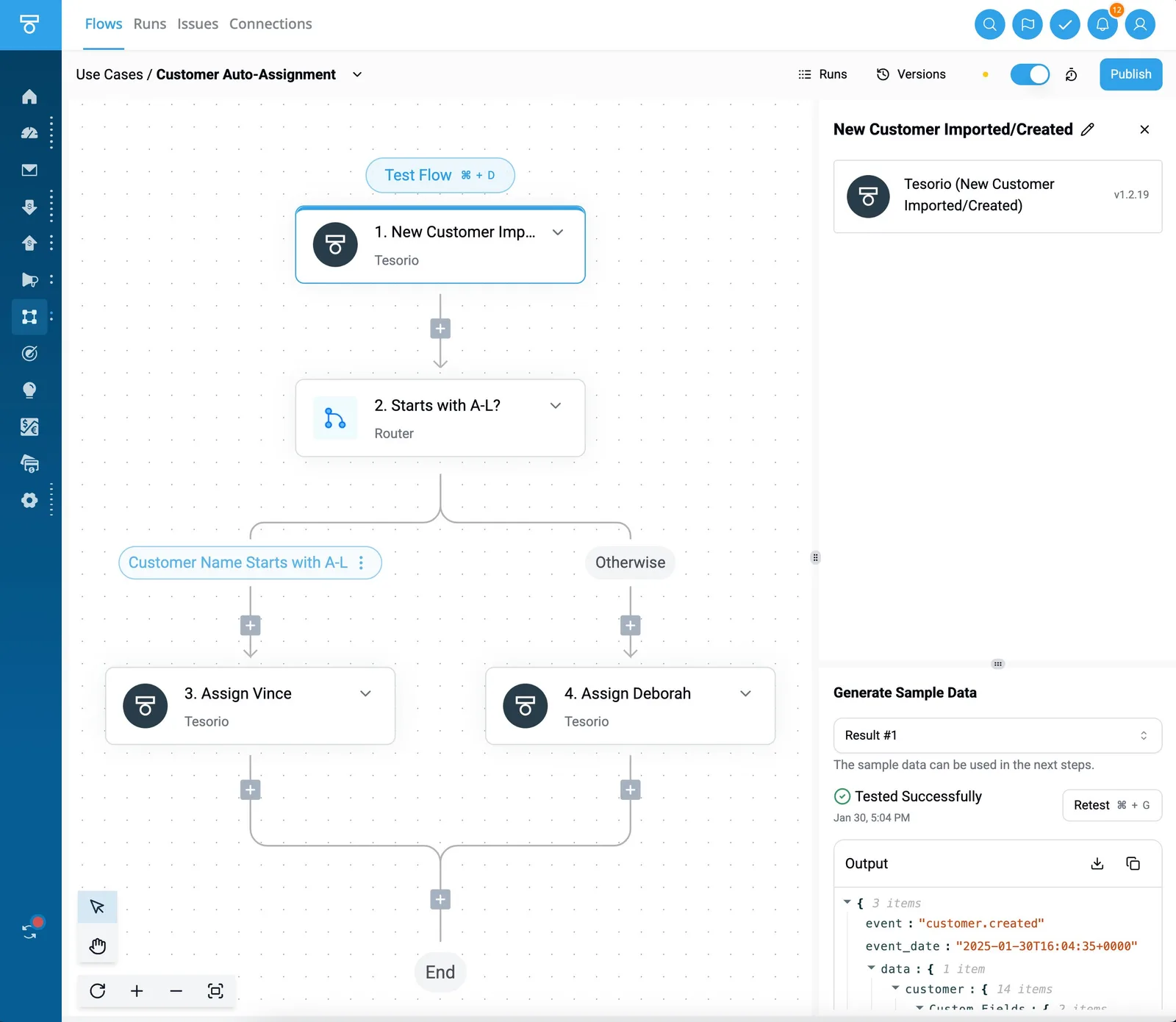
Logic node placement
Once the trigger and the initial data retrieval steps are established, the Decider node acts as the primary filter before any data reaches the spreadsheet actions shown in the modal. This placement ensures that high-resource actions only execute when the real-world criteria are met.
Connecting the decisions API to your workflow today
Implementing this requires an active Perplexity API key and a defined "Search Query" that references data from a previous step in the Activepieces canvas.
The MIT-licensed core allows for unlimited flows on every plan, so teams can test these logic gates at scale without hitting platform-imposed architectural limits.
- Drag the Perplexity integration into the flow immediately following a trigger, such as a Webhook or a Schedule.
- Select the "Decide" action from the dropdown menu to toggle the model into its calibrated logic mode.
- Map the "Query" field to a dynamic variable, such as a company name from a new lead, and specify the condition, such as "Has this company raised a Series A in the last six months?"
- Add a Branch step below the Perplexity integration and set the condition to check if the output from the Decider is exactly "True."
High-resource actions, like the "Insert Row" commands for Google Sheets or Microsoft Excel 365 seen in the integration selector, only execute when the real-world criteria are met.
If the Decider returns False, the flow terminates, saving the task execution credits and preventing the pollution of CRM data with irrelevant entries.
Impact on workflow speed and operational costs
The Decider API combines information retrieval and logical evaluation into a single request, running one Fast Search per question and adding the top results as evidence before it answers.
By removing the need to shuttle data between a search engine and a reasoning model, you eliminate the compounding network overhead that typically stalls automated decision-making.
Consolidating search and logic into one call
Executing a conditional check based on live data traditionally requires a multi-step sequence that bloats both token consumption and execution time.
Modeldrops states that when you use a model like Claude Haiku 5.5 to classify a lead based on recent news, the system must first query a search tool.
Parsing the HTML into text is the next required wait. It then feeds that unrefined context back into the LLM for a final verdict.
The Decider API bypasses this middleman by performing the web-grounded verification internally, returning a simple boolean or short-string response.
This consolidation means your middleware handles a fraction of the data, reducing the risk of hitting payload limits or timeout errors in high-volume environments.
Comparing Decider to standard GPT-6 Luna search loops
Standard search loops rely on a "chain-of-thought" approach that is inherently slow. This is because each link in the chain introduces a fresh round of inference and API roundtrips.
In a typical GPT-6 Luna implementation, the model must decide it needs a tool, call the search plugin, wait for the results, and then generate a final response.
Real-time applications often feel sluggish during this process. The following comparison highlights the drastic reduction in wait times when moving from these fragmented chains to the dedicated Decider architecture.
This shift from seconds to milliseconds allows for synchronous decision-making where asynchronous background processing was previously the only option. Consequently, developers can integrate live-web logic directly into user-facing interfaces without the loading spinners that define traditional agentic workflows.
Why AI decision engines evolve
Reliability in automated decision-making depends on the stability of the confidence scores returned by the Perplexity Decider API.
A raw text generation from a model like Claude Haiku 5.5 is useful for high-volume classification. However, the Decider API adds a grounding layer that must remain consistent across model updates to prevent silent failures in production logic gates.
You should monitor the variance in these scores, as a sudden shift in how the engine calculates certainty can turn a functioning "if" statement into a permanent "else."
This shift breaks downstream integrations in tools like the GitHub issue tracker or Jira project management software. The following table outlines how to calibrate these thresholds based on the severity of the automated outcome. High-stakes actions require a higher mathematical certainty before execution.
| Use Case | Suggested Auto-accept Threshold |
|---|---|
| Medical/Fraud (Very High Risk) | — |
| Financial Routing (High) | — |
| Support Routing (Medium) | — |
Setting confidence thresholds for human review
Setting these thresholds correctly ensures that an ambiguous search result triggers a human-in-the-loop review rather than an incorrect automated payment or diagnosis.
Beyond simple thresholds, the next phase of development involves moving toward multi-step reasoning agents that can verify their own search queries.
Models like Gemini 4 Carbon or GPT-6 Astra are beginning to handle more complex, long-horizon tasks. The Decider API will likely evolve from a single-gate check into a recursive verification loop.
This evolution will allow a system to decide if a fact is true based on one search. It will then cross-reference multiple conflicting sources before passing a boolean value to the next stage of the workflow.
Monitoring the latency of these recursive checks is vital, as every additional reasoning step adds milliseconds that could eventually degrade the real-time performance that makes this API viable for user-facing applications.