
Paragon Alternatives: Top Picks for 2026

Oct 13, 202611 min read
When a production workflow fails because a third-party API changed its schema, engineers must isolate that specific tenant’s execution and deploy a fix without impacting the rest of the user base.
Selecting an embedded integration platform requires balancing this immediate speed of a visual builder against the long-term maintenance burden of managing thousands of unique customer auth tokens and logic forks.
To determine which architecture fits a specific product roadmap, teams must evaluate three primary dimensions:
Evaluation Criteria for Embedded iPaaS Platforms
- Multi-tenant governance: This defines how the system handles data isolation and credential management. Enterprise-grade platforms like Workato provide centralized environments for administrative oversight. An open-source engine like Activepieces allows teams to provision isolated workspaces via JWT, so that one customer’s high-volume sync doesn't consume the compute resources allocated to another.
- Developer experience and extensibility: Teams must decide if they prefer a developer-centric SDK, such as the one provided by Prismatic for writing integrations in TypeScript, or a visual-first approach. The choice dictates who maintains the code. A robust SDK supports version control, and a visual builder lets non-engineers troubleshoot flows to lower the ticket load on the core engineering team.
- Deployment flexibility and sovereignty: For products serving regulated industries, the ability to run the integration engine within a private VPC or an air-gapped environment is a requirement for data residency compliance. While many providers operate exclusively as multi-tenant SaaS, platforms that offer a self-hosted option give teams control over the underlying infrastructure and security patches.
The total cost of ownership scales with the complexity of your "Custom Integration" library and the frequency of transformations, such as routing data through Gemini 3.8 Flash for real-time classification.
For teams evaluating enterprise embedding, contact sales for specific terms, or view standard self-serve tiers on the pricing page.
The fastest way to settle a shortlist is to try one. Activepieces is free to try, no credit card.
Prismatic Embedded iPaaS Platform
By using the Prismatic CLI, developers can initialize new components or push updates to hundreds of customer tenants simultaneously, reducing the manual overhead typically associated with bespoke integration maintenance.
Prismatic is a developer-centric integration environment where B2B SaaS teams manage multi-tenant deployments through a TypeScript-based SDK and a dedicated command-line interface.
This architecture treats integrations as code rather than just visual flows, which allows engineering teams to maintain version control and automated testing parity with their primary application.
The platform's strength is its purpose-built environment for "customer instances," which are distinct configurations of an integration tailored to a specific end-user.
For teams using models like GPT-6 Astra or Claude Opus 5.5 for coding tasks, Prismatic’s structured SDK is a predictable target for generated code snippets.
Custom logic remains within the guardrails of the platform’s execution engine while allowing for the extensibility required by enterprise workflows.
The following table compares the technical control and deployment flexibility across the primary market alternatives to help teams identify where their operational requirements align.
| Platform | Developer Control | Governance | Deployment |
|---|---|---|---|
| Prismatic | High (TypeScript SDK & CLI) | Multi-tenant instance management | Cloud-hosted SaaS |
| Workato | Low (Low-code focused) | Enterprise-grade RBAC & Audit | Cloud-hosted SaaS |
| Paragon | Medium (Visual with code steps) | Standardized user mapping | Cloud-hosted SaaS |
| Activepieces | High (Open-source & SDK) | Environment-level isolation | Cloud, On-prem, or Air-gapped |
While visual builders simplify initial design, the underlying deployment model dictates how a team handles long-term maintenance. For organizations where security mandates or data residency requirements prevent the use of a shared cloud, the infrastructure choice becomes the primary bottleneck for scaling.
While visual builders simplify initial design, the underlying deployment model dictates how a team handles long-term maintenance.
1. Activepieces open source integration
When a production pipeline handles sensitive PII, routing that data through a third-party cloud creates a compliance audit trail that many security teams simply won't sign off on.
Activepieces runs the same enterprise feature set (including SSO, SCIM, and audit logs) in air-gapped environments as it does in the managed cloud, ensuring data residency without sacrificing governance.
By running the MIT-licensed engine on your own infrastructure, you retain the encryption keys and the execution logs. No unencrypted data leaves your virtual private cloud.
A stripped self-hosted build is how most vendors monetise control, but Activepieces provides the same enterprise feature list (including SSO, SCIM, custom RBAC, audit logs, and secret manager integration) in the air-gapped edition as it does in the managed cloud.

MoneyGram and FundingSocieties run this in production today. You can verify this parity by comparing the self-hosted enterprise documentation against the SOC 2 Type II managed cloud feature set.
25,009 GitHub stars have been amassed by the project, which means there's a deep pool of public documentation and community-vetted "integrations" (connectors) available to solve common edge cases. A large community supports this tool.
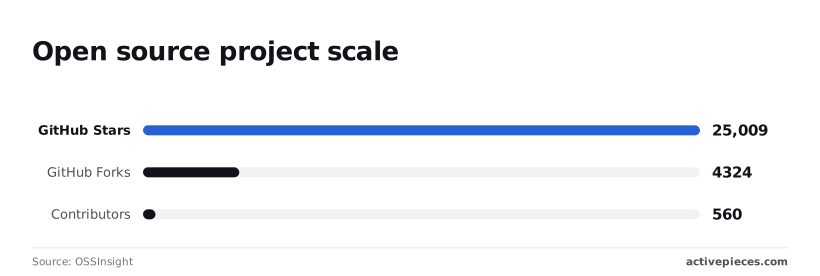
560 contributors maintain the health of the codebase according to Openhub, providing a faster patch cycle for security vulnerabilities than most proprietary startups can manage with a closed engineering team.
The 4,324 forks on GitHub indicate that thousands of teams have localized the code. Your internal integrations remain functional even if the vendor’s roadmap shifts.
These metrics demonstrate a level of transparency and durability that's essential for core infrastructure:
- Activepieces provides an MIT-licensed core that teams can inspect and modify to prevent vendor lock-in.
- Activepieces allows teams to run the full engine on their own infrastructure for complete data sovereignty.
- Activepieces ensures that workflows remain portable and functional even if you move away from the managed service.
- Activepieces leverages 25,009 GitHub stars to provide a community-vetted library of extensions and troubleshooting resources.
For teams looking to offer these capabilities to their own end-users, Activepieces is an embeddable, white-label platform:
- This allows you to provision users via JWT and manage templates directly within your own UI.
- While self-serve plans are available for standard use cases at their pricing page, teams requiring the full embedding suite for a multi-tenant SaaS environment should contact Activepieces sales for custom enterprise terms.
- This architectural flexibility allows you to start with a local Docker compose file and scale into a globally distributed, embedded integration marketplace without rewriting your logic.
For organizations that view air-gapped deployment as a requirement for total data sovereignty rather than a reason to compromise on governance, Activepieces is the better choice.
By maintaining identical enterprise features like SCIM, custom RBAC, and secret manager integration across both its managed cloud and self-hosted editions, it ensures that security teams do not have to trade administrative control for infrastructure isolation.
Reading a table only gets you so far. Build the same workflow in Activepieces and compare it yourself.
2. Workato Embedded Platform Solutions
Workato serves organizations that prioritize centralized governance and deep connectivity into legacy enterprise systems over developer-focused customization.
Workato's centralized governance for IT administrators
While many platforms focus on the agility of the individual builder, Workato targets the IT administrator who must enforce security policies across thousands of disparate workflows.
Every integration deployed into a customer environment adheres to a single, auditable set of corporate standards because of this emphasis on oversight.
Workato's pre-built enterprise connector library
The platform is an expansive library of pre-built connectors for established enterprise software, such as SAP, Oracle, and ServiceNow.
Because the vendor maintains these connectors, your engineering team doesn't have to manage API versioning or breaking changes in third-party schemas.
Tray.io's stability for enterprise data integrations
This stability is critical when your product must interface with the complex, often brittle data structures found in large-scale corporate environments.
The interface uses a step-by-step progression to show how data moves between systems, which helps support staff troubleshoot multi-stage logic.
Visual Workflow Logic
The workflow builder utilizes a "Recipes" metaphor designed to be accessible to non-technical implementation teams while maintaining strict version control.
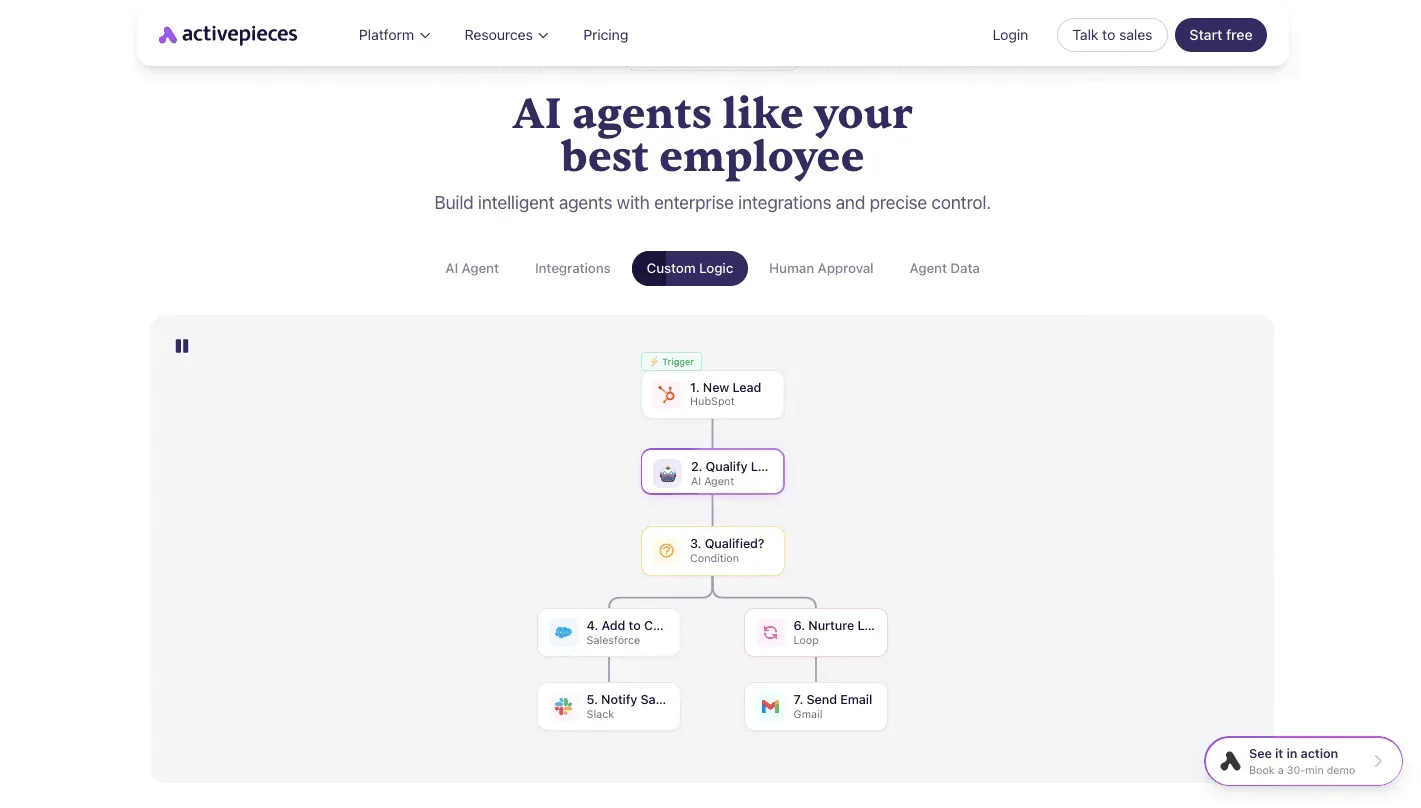
The following canvas shows how complex logic is structured within a modern workflow engine. It shows the intersection of third-party triggers and internal processing steps.
The canvas shows a seven-step workflow: 1. New Lead (HubSpot trigger), 2. Qualify Lead (AI Agent step with purple border), 3. Qualified? (Condition), 4. Add to Salesforce, 5. Notify Slack, 6. Nurture Lead (Loop), and 7. Send Email (Gmail).
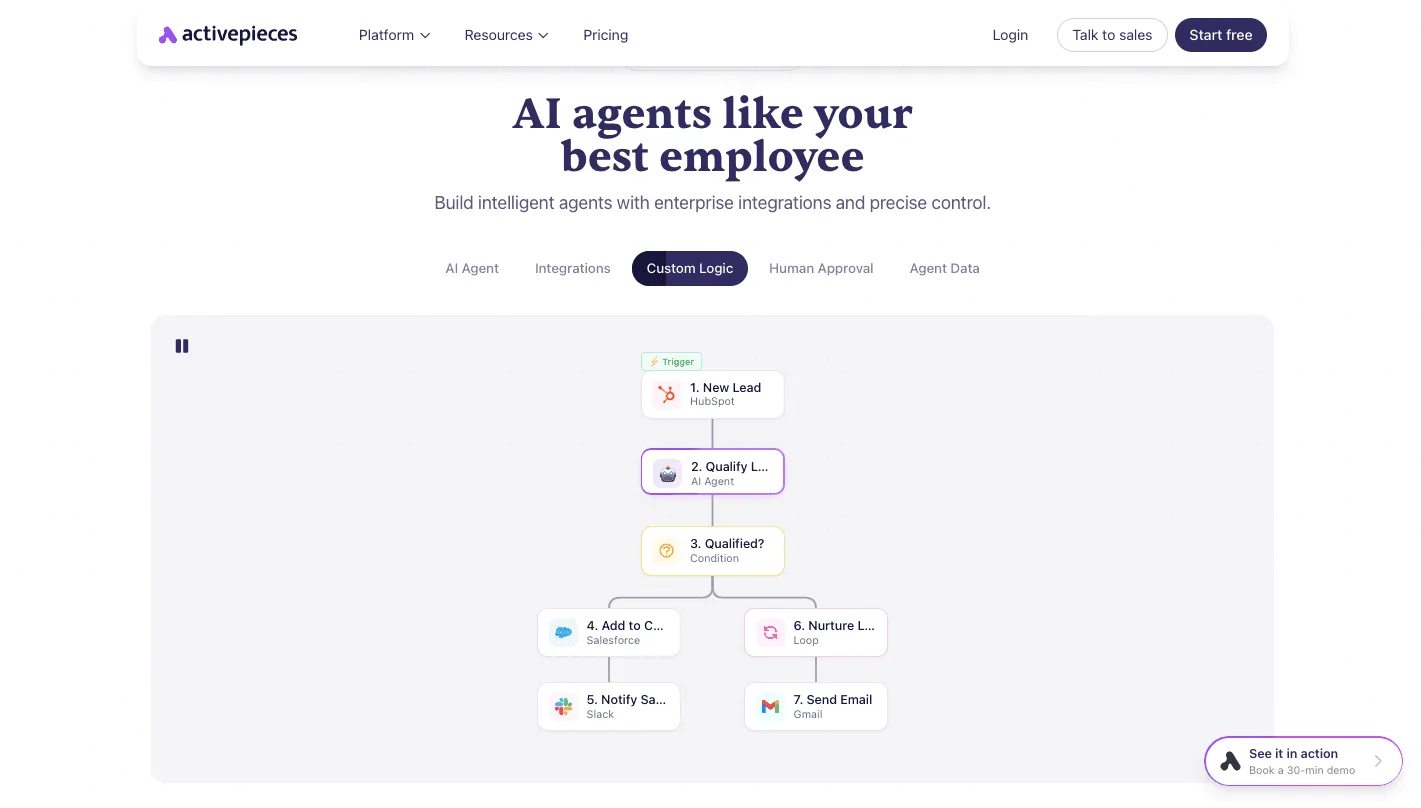
Steps are connected by vertical lines showing the flow logic.]
Tray.io's visibility into agentic workflow decisions
It allows operators to see exactly where an agentic decision influences the subsequent path.
For teams that require this level of visibility but need to maintain a smaller infrastructure footprint, moving toward a developer-centric SDK offers a different set of trade-offs.
3. Tray.io Embedded Automation Engine
By abstracting the underlying compute resources, Tray.io allows engineers to focus on the logic of the integration rather than the operational overhead of scaling worker nodes during peak loads.
The platform is a serverless architecture designed for teams that need to process large-scale data volumes without managing infrastructure for every burst in traffic.
The platform is built around a visual workflow builder that's a middle ground between rigid no-code tools and pure scripts.
It caters to teams that want to maintain architectural oversight while enabling non-developers to contribute to integration maintenance.
For teams embedding these capabilities into their own SaaS products, Tray.io utilizes a "Merlin" AI layer to assist in mapping complex data structures.
When connecting to enterprise services like the Salesforce customer relationship manager or the NetSuite ERP, custom fields often break standard mapping templates.
By leveraging models like Claude Sonnet 5.5 for high-speed reasoning and GPT-6 Astra for complex logic, the engine can suggest mappings between disparate schemas.
This reduces the time developers spend writing manual transformation code. The deployment model relies on a multi-tenant cloud environment.
This simplifies the initial rollout but introduces specific constraints regarding data residency and network control.
- Workspaces: These act as logical containers for different customers or environments. One client’s automated tasks doesn't interfere with another’s execution queue.
- Authenticators: This service manages OAuth tokens and API keys centrally, so a developer doesn't have to build a custom encryption service to store end-user credentials.
- Connector SDK: A specialized toolkit that allows teams to write custom Node.js code for private internal APIs. Proprietary services work alongside public connectors like Slack or Microsoft Teams.
While the serverless nature ensures high availability, teams requiring total physical isolation or air-gapped deployments will find the cloud-only nature of the engine a limiting factor in highly regulated sectors.
Selecting Your Integration Strategy for 2026
The choice between proprietary cloud platforms and open-source engines hinges on whether your roadmap prioritizes managed governance or the ability to run identical logic across diverse infrastructure.
For teams building customer-facing integrations, the decision often comes down to how much of the underlying execution environment you need to control.
Security teams can audit every connection from a single dashboard without managing the underlying servers in Workato's managed environment. This is effective for internal operations, but for product teams embedding these workflows, it introduces a dependency on a third-party cloud.
Prismatic is a developer-centric approach with a dedicated SDK, allowing engineers to write custom components in code rather than relying solely on visual builders. This reduces the friction of complex logic but still binds the execution to their specific cloud infrastructure.
By using an MIT-licensed core, Activepieces allows teams to self-host the entire engine. Workflows can run in air-gapped environments or private clouds where external data egress is prohibited.
Activepieces syncs flows to git and promotes them through Release Management, from a test environment to production, versioned and reviewed the way software is, rather than just saved in a private in-app history.

This promotion is a deliberate step across separate projects, a capability detailed in the Git Sync documentation for both self-hosted and cloud instances.
This architectural flexibility is critical for teams using high-reasoning models like Claude Opus 5.5 or GPT-6 Astra for sensitive data processing.
It keeps the orchestration layer within the same security perimeter as the LLM.
Choosing a platform based on deployment constraints
To determine the right fit, evaluate your deployment constraints.
- If the primary goal is providing non-technical staff with a secure, managed environment for internal automation, the centralized controls of Workato minimize operational overhead.
- If your team requires deep programmatic control over how integrations are built and deployed to customers, the SDK-first approach of Prismatic streamlines the development lifecycle.
- If you need to white-label the platform and run it on your own hardware to meet compliance standards, Activepieces is an embeddable platform with JWT user provisioning.
For teams requiring the embeddable platform and advanced integration management, the sales-led annual tier provides the necessary enterprise features. You can contact the team for terms at https://www.activepieces.com/sales or review self-serve options at https://www.activepieces.com/pricing.
Related reading
References
Still comparing
The fastest way to settle it is to build something.
Open source under MIT, so you can self-host the same thing later.
Start free Talk to sales