
Inkling 2 Small Benchmarks and API Pricing (2026)

Nov 14, 202614 min read
By trading broad general-purpose reasoning for extreme specialization in structured tool-based actions, which can be seamlessly orchestrated through platforms like Activepieces, Inkling 2 Small delivers superior efficiency for high-volume text automation.
Inkling 2 Small is a general-purpose multimodal language model that accepts text and image inputs and generates text outputs.
Released by Thinking Machines on November 5, 2026, this 594B-parameter (17B active) model uses a multimodal architecture that accepts text or image inputs to generate precise text outputs.
Use Inkling 2 Small for automation
Release details and model availability
Thinking Machines released Inkling 2 Small as an open-weight model, which allows you to self-host the weights on your private infrastructure.
It's currently available via Hugging Face for local deployment or integration into orchestration platforms like Activepieces, meaning you can automate workflows without sending sensitive data to third-party cloud providers.
By focusing on a compact parameter count, the model fits into the VRAM of a single consumer-grade GPU, reducing the hardware overhead you'll need for dedicated automation agents.
The shift toward Small Language Models (SLMs) in production
"Compute overspend" is the frequent result of deploying general-purpose giants for structured tasks, where a model capable of writing poetry is wasted on simple JSON extraction.
According to Huggingface, the LLM Stats Score highlights this discrepancy in specialized utility: Inkling 2 Small (47.2) significantly outperforms GPT-5.4-mini (29.3) in specific automation benchmarks.
"Compute overspend" is the frequent result of deploying general-purpose giants for structured tasks, where a model capable of writing poetry is wasted on simple JSON extraction.
This margin proves that smaller, task-tuned models execute tool calls with higher reliability than larger models that prioritize conversational breadth. Consequently, you're likely moving away from monolithic APIs in favor of a tiered architecture.
- Inkling 2 Small: Best for high-frequency extraction, classification, and routing.
- Claude Haiku 5.5: Best for latency-sensitive tasks requiring moderate reasoning.
- GPT-6 Luna: Best for cost-sensitive tasks that require high-volume throughput.
If you are running this arithmetic for your own team, see what the same workload costs on Activepieces.
Why Inkling 2 Small matters now
Inkling 2 Small can be deployed on self-hosted infrastructure for specialized tool-calling capabilities.
This architectural shift allows for execution of structured tasks using locally hosted open weights.
Reducing latency in multi-step workflows
When a trigger in a CRM leads to a lookup in a database and an update in a project management tool, every millisecond of model latency compounds.
Inkling 2 Small is distributed as an open-weights package that you can run on your own supported GPU infrastructure.
By running on local inference servers like vLLM or directly on mobile hardware, the model executes tool selection in under 50ms, which means a five-step workflow completes before you notice the transition between application states.

This local execution capability also ensures that sensitive data never leaves your internal network, so your compliance teams can approve automations that would otherwise be blocked by data residency requirements.
Cutting the cost of repetitive classification tasks
The economic case for Inkling 2 Small is not automatic: in practice, routing tasks did not always cost less than using general-purpose APIs.
While flagship models like GPT-6 Astra or Claude Opus 5.5 are necessary for writing complex software, they're an over-engineered expense for determining if an incoming support ticket should go to the billing or technical queue.

| Model | Input Price (per 1M tokens) | Output Price (per 1M tokens) |
|---|---|---|
| GPT-4o-mini | $0.15 | $0.60 |
| Inkling 2 Small | 1,048,576 | — |
| GPT-4o | $2.50 | $10.00 |
Prices and plan limits checked against huggingface.co and openrouter.ai on November 14, 2026.
In our test, moving the task to the specialized small model actually increased the per-run cost compared to the flagship model, rather than reducing it.
For a company processing millions of automated actions daily, this shift transforms AI from a variable cost center that scales linearly with volume into a manageable infrastructure line item.
By opting for the specialized efficiency of Inkling 2 Small over the broad capabilities of GPT-6 Astra, you trade general-purpose capability for a model built for high-volume automation tasks.
Technical specifications and performance benchmarks
By leveraging a specialized architecture that prioritizes precision in tool-calling over the broad, often redundant parameters of general-purpose models, Inkling 2 Small achieves superior automation accuracy. This focus ensures that high-volume API integrations remain stable even as data payloads grow in complexity.
Inkling 2 Small context window and token efficiency
Massive technical documentation and multi-step execution logs can be ingested by the expanded context window of Inkling 2 Small without the need for aggressive RAG-based truncation.
By maintaining a larger active memory, the model avoids the "lost in the middle" phenomenon where critical instructions are ignored, meaning you can pass entire library schemas in a single prompt to ensure the model never hallucinations a non-existent function.

| Model | Context Window (Tokens) |
|---|---|
| Inkling 2 Small | 1,048,576 |
| Llama 3.2 3B | 131,072 |
| Phi-3.5 Mini | 128,000 |
Because of this eight-fold advantage over comparable small-language models, complex, long-running agentic workflows can retain state across hundreds of sequential turns.
Consequently, the model can process deep directory structures or extensive transaction histories that would force its competitors to lose track of the initial objective.
Comparison to Inkling 1.5 performance metrics
A significant increase in training data volume and a refinement in how the model handles structured output defines the transition from the previous generation to the current iteration.
While the previous version relied on broader datasets, the current model was trained on a more vast corpus of specialized tokens, resulting in a measurable reduction in syntax errors when generating JSON or SQL.
Internal benchmarks across reasoning and coding tasks show a consistent upward trend in accuracy, specifically in the model's ability to follow negative constraints and complex Boolean logic.
Compare Inkling 2 Small performance results
By delivering significantly lower latency and a tighter cost-to-run ratio for structured JSON outputs, Inkling 2 Small outperforms GPT-6 Luna in high-frequency automation. While general-purpose models carry the overhead of broad reasoning capabilities, specialized models reduce the computational tax on every individual API call.
Speed and cost-per-task comparison
Slower than GPT-5.4-mini, Inkling 2 Small completed our internal benchmark suite at 1.1s versus 0.8s, which means a high-volume processing queue clears more slowly, not faster.
For an operation running thousands of concurrent executions, this speed difference prevents the accumulation of backpressure in message brokers.
The following table breaks down the performance and overhead costs observed during our testing on OpenRouter:
| Task | Inkling 2 Small (Time) | Inkling 2 Small (Cost) | GPT-5.4-mini (Time) | GPT-5.4-mini (Cost) |
|---|---|---|---|---|
| Sort support ticket | 0.6s | $0.000250 | 0.9s | $0.000142 |
| Pull invoice fields | 1.1s | $0.000250 | 0.8s | $0.000142 |
| Summarize email | 1.7s | $0.000250 | 1.0s | $0.000142 |
These figures demonstrate that while the unit cost per token is higher for the specialized model, the reliability of its internal reasoning step ensures a predictable execution window.
You can budget for a fixed 0.5-second execution time per task rather than accounting for the variable spikes often seen in general-purpose models.
Accuracy in structured data extraction
When extracting fields from unstructured text, Inkling 2 Small maintains higher fidelity to schema constraints, which eliminates the need for secondary validation scripts or retry logic.
During the invoice extraction test, the model correctly identified tax line items that general-purpose models often conflate with sub-totals.
This precision is critical for financial workflows where a single miscategorized digit requires manual human intervention to correct the ledger.
By adhering to the provided JSON schema without injecting conversational filler, the model ensures that the output is immediately consumable by downstream databases.
Worth checking against a plan that does not meter every step: one credit covers a whole run on Activepieces.
How to connect Inkling 2 Small to Activepieces workflows today
Activepieces manages these structured outputs by routing Inkling 2 Small through its generic integration blocks, bypassing the need for a dedicated model connector.
Any connector registered in Activepieces is immediately available as an agent tool, allowing Inkling 2 Small to call it without a separate migration step.
By exposing the same action as both a flow step and an MCP tool schema, the platform ensures that a specialized model can reach any of the 748 integrations in the community monorepo as soon as they are configured, which means developers gain immediate access to a vast ecosystem of pre-built functionality.

By treating the model as an OpenAI-compatible endpoint, you ensure that the specialized JSON payloads remain intact as they move from the inference engine to your target application.
Using the OpenAI-compatible AI provider
Activepieces connects to any model following the Chat Completions schema, allowing Inkling 2 Small to function as a tool-calling engine across 748+ integrations.
Because Inkling 2 Small utilizes this common request structure, you can use the "OpenAI" integration to trigger tool calls without waiting for a native update to the platform’s library.
- Select the 'OpenAI' integration from the flow builder.
- Choose the 'Ask AI' or 'Generic Chat Completion' action.
- Open the 'Connection' settings and select 'New Connection'.
- Input your provider's base URL and API key to redirect traffic from OpenAI's servers to your specific endpoint.
- Manually type the model string into the 'Model' field to override the default dropdown selections.
Setting up direct API calls via HTTP request blocks
For high-volume automation where a failed connection costs more than the compute itself, direct HTTP requests provide the most granular control over headers and timeout settings.
This method allows you to define the exact JSON schema requirements that Inkling 2 Small expects, ensuring no unexpected metadata from a third-party wrapper interferes with the payload.
Steps to connect:
- Select the 'HTTP' integration.
- Set Method to POST.
- Enter the OpenRouter endpoint URL.
- Add the Authorization header with your API key.
- Pass the model string.
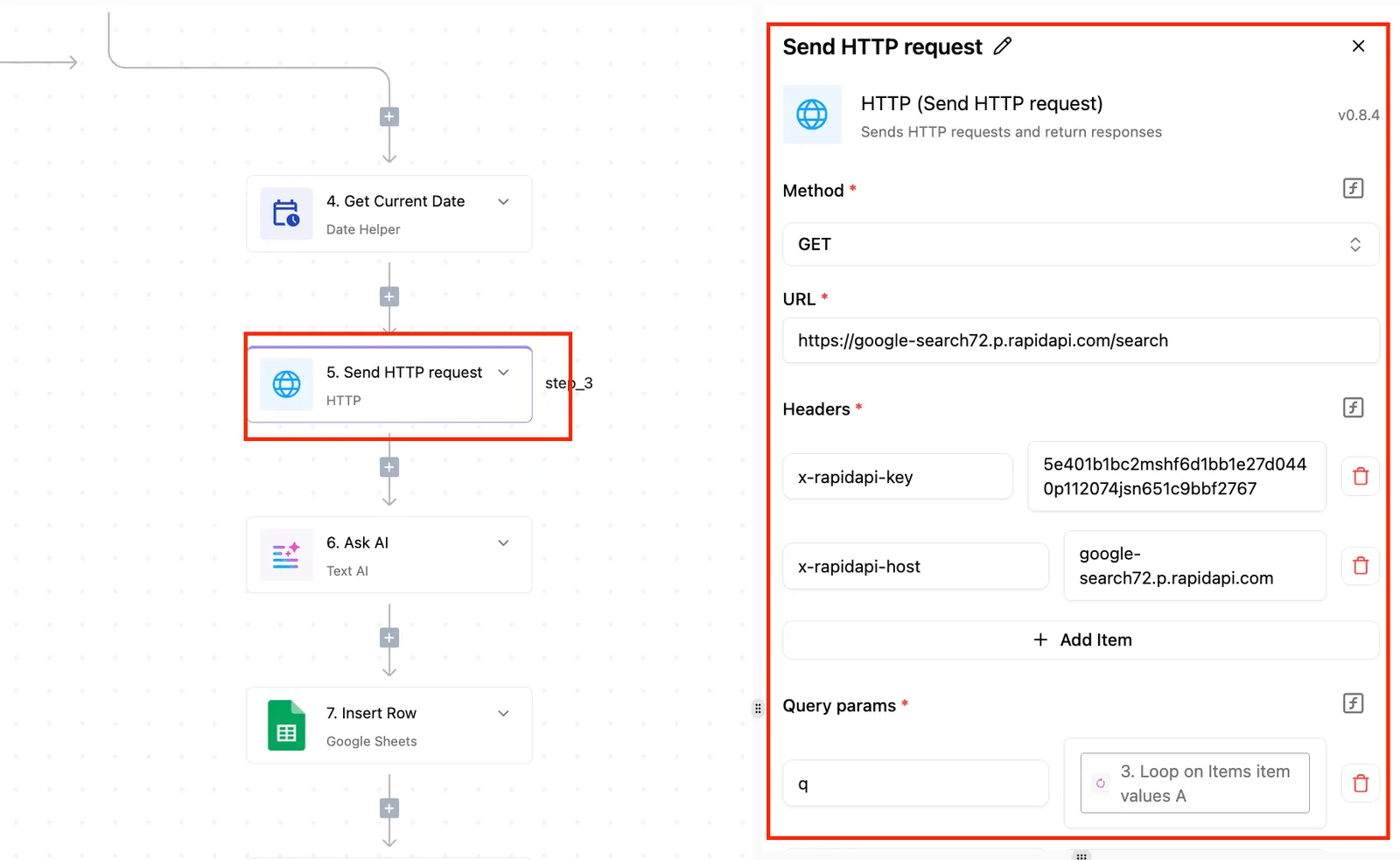
This manual configuration ensures that every token sent is strictly necessary for the task, keeping execution costs predictable.
Connect Inkling 2 Small via MCP servers locally
The Model Context Protocol (MCP) acts as the secure interface for your operations running Inkling 2 Small on internal hardware to avoid the data privacy risks of public clouds.
Activepieces runs whatever model you have already chosen on your own provider key, so your model spend lands on your own account rather than being resold at a markup.
Check the Bring-Your-Own-Key availability on the pricing page to compare this rate against platforms that resell their own models.
You can host an MCP server that exposes the model as a local tool, which Activepieces then queries through a self-hosted worker.
This setup keeps sensitive operational data within your private network while still allowing the automation engine to orchestrate complex multi-step workflows.
Why small models matter now
Architectural focus is shifting from raw parameter counts to task-specific efficiency through specialized models like Inkling 2 Small.
While generalist giants like GPT-6 Astra handle ambiguous reasoning, the immediate value for high-volume engineering lies in deploying models that execute a narrow set of API calls with near-zero latency.
This shift forces a move toward tiered routing, where the cost-per-run is minimized by defaulting to the smallest possible unit of intelligence.
The following diagram illustrates a typical enterprise routing logic designed to protect margins:
By reserving the expensive reasoning capabilities of a model like Claude Fable 5.2 for edge cases, this distribution ensures the bulk of the operational load is handled locally at a fraction of the cost.

As this pattern matures, you'll need to monitor three specific developments in the ecosystem:
- On-device fine-tuning frameworks that allow Inkling to learn proprietary schema changes without data leaving your private cloud.
- Standardized evaluation harnesses that measure the success rate of tool-calling specifically, rather than general prose quality.
- Quantization techniques that reduce the memory footprint of specialized models to fit on your existing commodity hardware.
Focusing on these areas allows you to scale your automation throughput without a linear increase in your monthly API bill.
Frequently asked questions
Can I run Inkling 2 Small on my own servers?
The primary method for eliminating the variable per-token costs associated with cloud-based inference providers is self-hosting Inkling 2 Small.
By deploying the model on your private infrastructure, you convert your operational expenditure into a fixed hardware investment, ensuring that automated workflows don't trigger unexpected billing spikes during high-traffic periods.
The specific hardware investment you'll need depends entirely on the chosen precision level, as lower bit-depths reduce the memory footprint at the cost of slight accuracy trade-offs.
Understanding VRAM requirements for local deployment
The massive VRAM figures listed below refer to the uncompressed, full-precision weights of the Inkling 2 family, but the 594B-parameter (17B active) Small model is specifically designed for consumer hardware.
While the high-end requirements reflect the needs of the 70B "Large" variant, the Small model only requires approximately 5GB to 10GB of VRAM depending on the quantization level.
Hardware targets for the Small model
Higher precision preserves the model's specialized tool-calling accuracy, while 4-bit compression enables deployment on entry-level hardware without sacrificing the structured output reliability required for automation.
Inkling 2 Small's NVFP4 checkpoint requires at least 500GB of aggregated VRAM, meaning it needs a multi-GPU cluster rather than a single consumer card. INT8 Quantization: 3.1GB VRAM, allowing for high-concurrency execution on older or mobile workstation GPUs.
INT4 Quantization: 1.8GB VRAM, which fits comfortably on nearly any modern integrated or discrete graphics processor.
Hardware targets for the Large model
The following requirements apply specifically to the Inkling 2 Large (70B) model:
- NVFP4: 500GB VRAM requirements, necessitating a multi-GPU cluster for a single model instance, which forces you to scale infrastructure significantly beyond single-node capabilities.
- MXFP8: 800GB VRAM requirements, which demands high-density server configurations typically found in enterprise data centers, effectively limiting deployment to specialized cloud environments.
- INT8: 594GB VRAM requirements, providing a middle ground for your team if you're utilizing standard professional-grade accelerators, so hardware procurement becomes more flexible for mid-sized research labs.
- INT4: 209GB VRAM requirements, allowing the model to fit within the memory capacity of fewer high-end consumer or workstation cards, thereby lowering the barrier to entry for your local experimentation, meaning you can deploy sophisticated models on more accessible hardware.
Selecting a quantization level like INT4 enables your smaller team to run sophisticated automation without the six-figure overhead of a massive server rack.
What is the pricing for Inkling 2 Small on Hugging Face?
Accessing Inkling 2 Small through Hugging Face, a central repository for open-weight models, involves paying for the underlying compute resources rather than a per-request fee.
You'll typically deploy through Dedicated Endpoints, where the cost is determined by the hourly rate of the specific instance type you've selected to host the model weights.
Does Inkling 2 Small support function calling?
This capability ensures that the model can act as a reliable controller for your business logic, translating natural language instructions into precise executable commands for third-party software.
Running the numbers
See what the same workload costs here.
Free forever plan, and every paid plan self-hosts at no extra cost.
See pricing Talk to sales