
GPU Requirements for Self-Hosting Mistral Large via API

Sep 27, 202613 min read
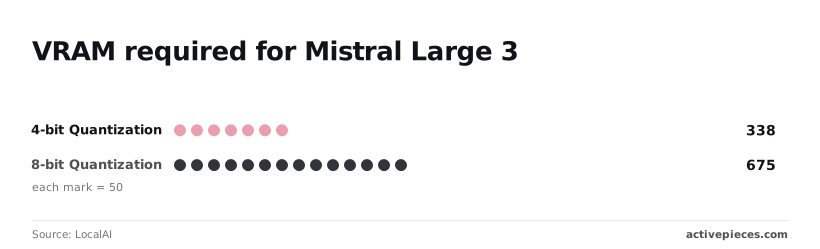
When you attempt to initialize Mistral Large 3 (675B), LocalAI reports that the system demands a minimum of 338GB of VRAM just to clear the boot sequence, which means standard consumer hardware is entirely incapable of running the model.
This fixed infrastructure floor eliminates the variable costs of external API calls.
It allows you to predict long-term operational expenditures with greater certainty.
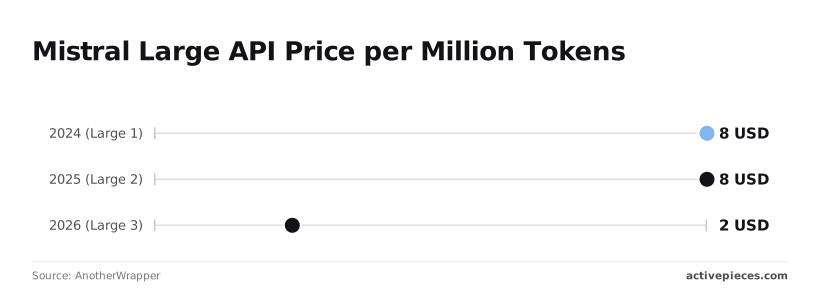
While the AnotherWrapper pricing index shows API costs dropping from 8.00 USD per million tokens in 2024 to 2.00 USD by 2026, these recurring fees function as a perpetual tax on scale that self-hosting avoids.
Mistral Large 3 675B VRAM requirements
Deploying a model with 675 billion parameters requires enough physical memory to hold every weight simultaneously. According to LocalAI, the VRAM floor for 4-bit quantization is 338GB. This necessitates at least six H100 80GB GPUs to avoid out-of-memory errors.
If you step up to 8-bit quantization, the requirement hits 675GB of VRAM. This doubles the hardware footprint to ten H100s and significantly increases the power and cooling overhead of your local rack.
| Quantization | VRAM Required (GB) | Recommended Hardware |
|---|---|---|
| 4-bit | 338 GB | 6x H100 80GB |
| 8-bit | 675 GB | 10x H100 80GB |
| FP16 | 1350 GB | 17x H100 80GB |
These requirements dictate the initial capital expenditure for you when moving away from managed services.
4-bit vs 8-bit quantization for Mistral Large
Choosing between 4-bit and 8-bit quantization is a choice between hardware density and mathematical precision. 4-bit weights reduce the VRAM requirement to 338GB, allowing for a more compact cluster, so you can avoid the expense of a massive multi-node setup.
8-bit quantization at 675GB preserves more nuance in complex reasoning tasks at the cost of four additional GPUs, effectively doubling the hardware footprint required for higher accuracy, which means scaling this model demands a significant increase in infrastructure investment.
You must choose between hardware efficiency and model precision.
While many vendors gate enterprise governance behind a cloud subscription, Activepieces provides the same SSO, SCIM, custom RBAC, and secret manager integration in its air-gapped build as it does in the managed cloud.
Compare the enterprise feature list in the self-hosted air-gapped docs against the managed cloud, pinned to an EU or US region with SOC 2 Type II; it is the same list either way.
This ensures that the administrative control over your local H100 cluster is never a fraction of the cloud experience, a requirement for the regulated organizations that run it in production today.
KV cache memory for long context windows
The VRAM figures cited above only cover the model weights. You must reserve additional memory for the Key-Value (KV) cache to handle long-form inputs.
If your system allocates exactly 338GB for a 4-bit model, it'll crash when a user submits a large document.
Beyond the base weight requirements, a standard additional buffer of 10-20% is required to ensure stable performance during peak inference loads, meaning you must over-provision your memory to prevent system crashes during active use.
The argument for avoiding self-hosted GPU infrastructure
High upfront hardware costs can be traded for predictable operational expenses by using managed API services. Deploying Mistral Large on-premises requires a cluster of NVIDIA H100 or A100 Tensor Core GPUs, representing a significant sunk cost.
By opting for a managed provider like Azure AI Studio or Mistral’s own La Plateforme, you bypass the procurement delays and hardware depreciation cycles that typically stall internal AI initiatives.
Self-hosting carries financial risk in three areas:
- Hardware Obsolescence: The rapid release cycle of Blackwell and future architectures means that today’s top-tier server nodes may be inefficient for next year’s larger models.
- Power and Cooling Overhead: High-density GPU racks require specialized data center environments with advanced cooling infrastructure.
- Engineering Headcount: Maintaining a local inference stack requires dedicated Site Reliability Engineers to manage Kubernetes orchestration and driver updates.
The pay-as-you-go model ensures that costs scale exactly with usage. Physical hardware makes this flexibility impossible; debt or lease payments continue regardless of whether the GPUs are processing requests.
Everything below works on Activepieces' free plan. Start without code or a credit card.
Why local GPU clusters ensure privacy
Self-hosting Mistral Large on local hardware replaces the recurring "privacy tax" of managed services with a one-time infrastructure investment. This investment guarantees data remains within your enterprise firewall.
Physical hardware makes this flexibility impossible; debt or lease payments continue regardless of whether the GPUs are processing requests.
Data privacy risks of managed LLM APIs
Every prompt sent to a managed API represents a potential exposure point where intellectual property leaves the controlled environment of your company network.
Entrusting sensitive data to a provider involves accepting inherent vulnerabilities:
- Data retention policies that allow providers to store prompts for a set duration.
- Exposure to third-party sub-processors used for moderation or logging.
- Latency overhead from regional routing as traffic bounces through public internet exchanges.
- Per-token cost scaling that penalizes the use of long-context documents.
The moment you move inference to a local cluster, you ensure that the data never touches a network interface you don't own.
Predictable costs at high request volumes
AI expenses shift from a volatile operational cost to a fixed capital expenditure when using local GPU clusters. In a token-based billing model, a successful feature becomes a financial liability as every user interaction increases the monthly invoice.
On a dedicated H100 or A100 node, you amortize the cost of the hardware over its lifespan. Once the server is racked, the cost of the millionth token is functionally zero beyond electricity and cooling.
In a token-based billing model, a successful feature becomes a financial liability as every user interaction increases the monthly invoice.
Latency benefits of local network inference
Running Mistral Large on a local NVLink-connected cluster eliminates the unpredictable round-trip times associated with public API endpoints.
When an application relies on agentic workflows, the cumulative delay of several dozen API calls can make a tool unusable. Local inference happens over high-speed internal switches, ensuring the bottleneck is compute speed rather than internet congestion.

Calculating the true cost of Mistral Large infrastructure
Minimum specs: The 80GB VRAM requirement
80GB of VRAM is the minimum requirement for Mistral Large to load its weights in 4-bit precision, which implies that at least one high-end enterprise-grade GPU is mandatory for even the most basic deployment, leaving no room for smaller, budget-friendly hardware configurations. A single NVIDIA H100 or A100 is the smallest possible unit of deployment for a production-ready node.
Multi-GPU scaling for Mistral Large 3
A single 80GB card is insufficient for the weights of this specific model, so you are forced to scale horizontally across multiple interconnected devices. While an H100 represents the base unit of hardware, Mistral Large 3 requires a multi-GPU cluster to function. You must pool at least six of these cards to meet the 338GB threshold for 4-bit quantization, so any deployment strategy must account for the physical space and power consumption of a multi-GPU cluster.
Functional hardware minimums for inference
A single 80GB card is a technical starting point for enterprise AI, but it is physically impossible to run Mistral Large on one, forcing users to procure additional hardware before they can even begin testing. You must treat the 80GB H100 as a modular building block rather than a standalone solution, meaning your architectural design must prioritize interconnectivity between multiple units. The absolute functional minimum for a 4-bit deployment is a cluster of six cards, as anything less will fail to load the model into memory.
While consumer-grade cards can be pooled, the memory bandwidth on a single enterprise-grade H100 reaches 3.35 TB/s, ensuring that data bottlenecks are virtually eliminated during inference, so performance remains fluid even under heavy computational loads.
Cloud providers offer immediate availability, but the 300% markup on managed instances serves as a convenience fee. Moving from a rental model to owned hardware shifts the financial burden from an unpredictable OpEx line item to a predictable CapEx asset.
Multi-gpu scaling with NVLink and PCIe lanes
High-speed interconnects like NVLink are required when deploying Mistral Large across multiple GPUs to prevent communication from becoming a processing bottleneck.
If you utilize standard PCIe Gen4 slots, the 64 GB/s transfer limit forces the GPUs to wait for data synchronization, resulting in a measurable drop in tokens-per-second.
- NVLink Bridges: Connects two cards at up to 600 GB/s to treat disparate VRAM pools as a single contiguous memory block.
- PCIe Switch Fabric: Manages data flow in 4-way or 8-way configurations to ensure every GPU has a direct path to the CPU.
- RDMA-capable NICs: Allows for multi-node clusters by bypassing the CPU entirely, reducing latency when scaling beyond a single chassis.
Power and cooling costs for H100 GPUs
A single H100 node pulls significant power under load, necessitating a dedicated 240V circuit. Because these units convert nearly all consumed energy into heat, the cooling infrastructure must be rated to displace the thermal output of the entire server rack.
Silicon will downclock to protect itself if cooling is insufficient. For facilities housing H100 nodes, calculating the Power Usage Effectiveness (PUE) is the only way to determine if local utility rates beat the bundled energy costs of a specialized data center.
Easier to see it running than to read about it: set it up free, no card.
Standardizing LLM deployments with Activepieces
Activepieces routes the connection secrets for every app you connect to your own secret manager in the self-hosted edition, ensuring that no vendor holds the credentials your local Mistral Large instance runs on.
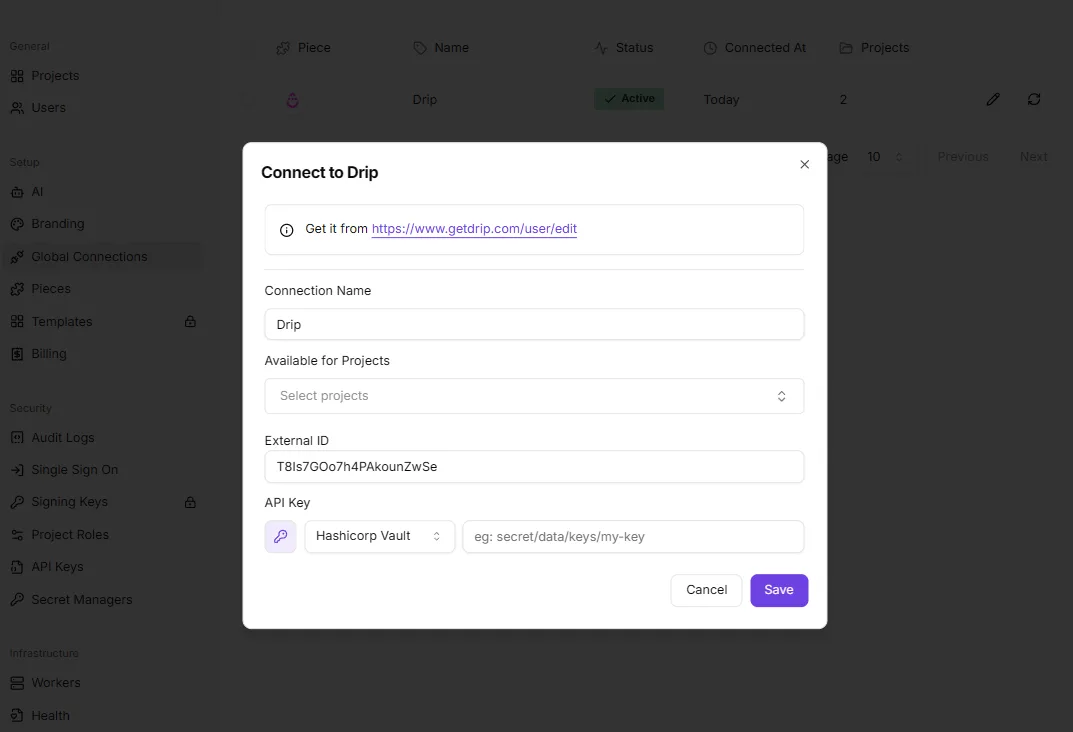
You can configure a self-hosted instance against an external secret manager and inspect the Activepieces database yourself to verify the credentials are not there; the same secret-manager integration is listed alongside SCIM, custom RBAC, SSO/SAML and audit logs in the enterprise governance feature set.
By deploying this open-source automation engine alongside your local model, you eliminate the need for custom middleware code that typically creates a maintenance burden for your DevOps teams.
Connecting local LLM endpoints to SaaS apps
Self-hosting Mistral Large creates a secure data perimeter. That security is only functional if the model can ingest and act upon data from external platforms like Salesforce or GitHub.
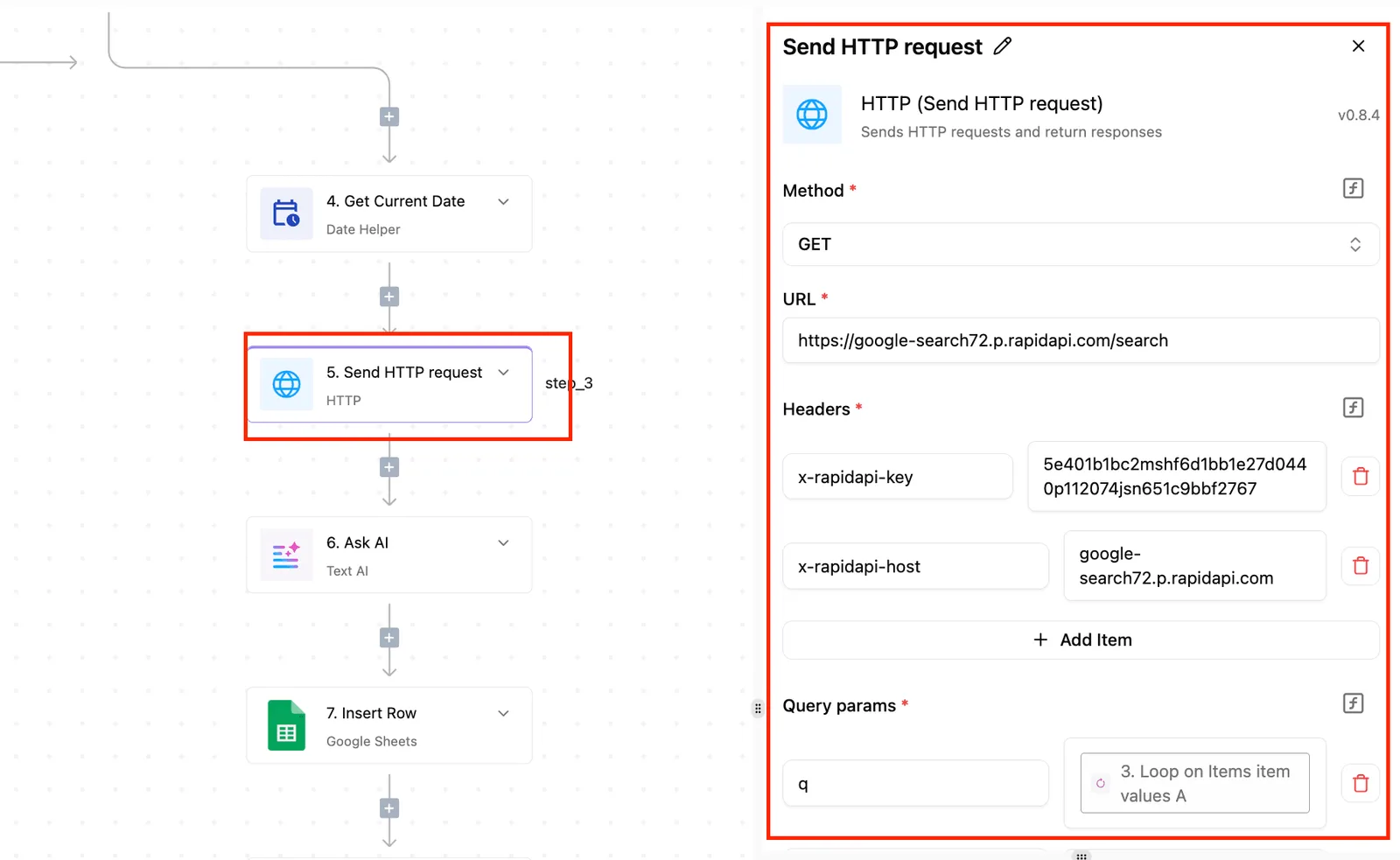
Activepieces provides 733 integrations, with roughly 60% of integrations being community-contributed, that allow these platforms to communicate with a local LLM via a standardized HTTP Request block.
The flow above demonstrates a completed security action. The green checkmarks and the 1271ms duration indicate that your local automation engine successfully communicated with the external API to invalidate credentials the moment a server went offline.
Automating prompt engineering at scale
Consistent output from Mistral Large requires standardized prompt templates. Activepieces allows you to build unlimited flows on every plan, including free, where raw data is cleaned and formatted before reaching the LLM.
Managing rate limits across self-hosted clusters
Self-hosted hardware has hard physical limits on concurrent requests. Activepieces manages this through several mechanisms. MoneyGram, Moneypenny, Alan and FundingSocieties run this in production today to coordinate complex workflows across their infrastructure. Wait steps introduce intentional delays between high-volume requests to prevent VRAM overflow.

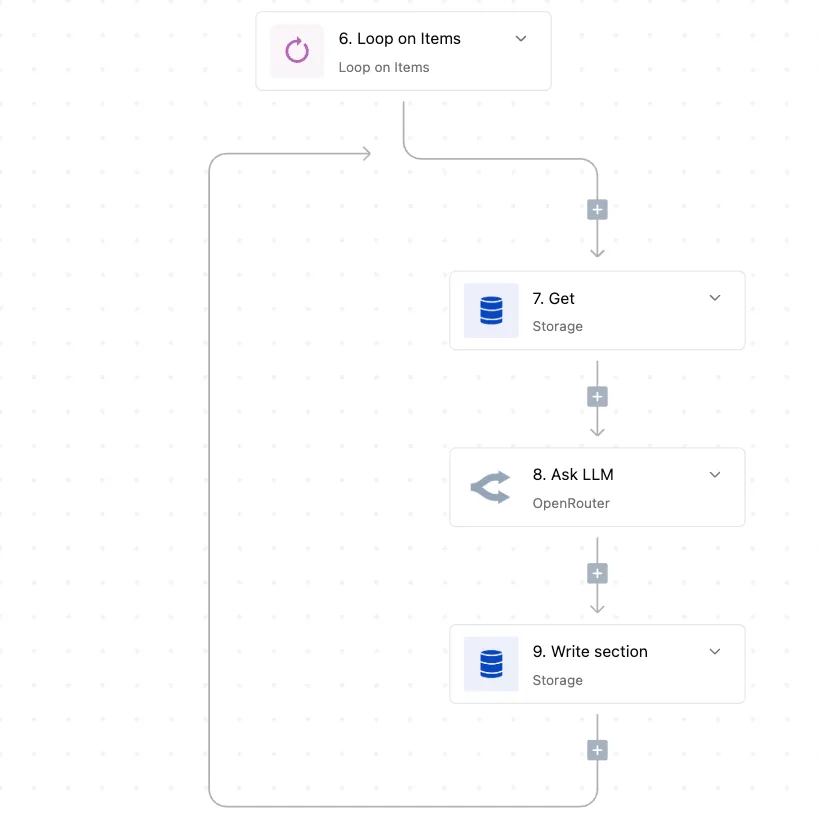
Looping controls process batches of data sequentially to keep the GPU at optimal utilization. Finally, error branches automatically reroute traffic to a secondary node if the primary Mistral instance reports a timeout.
The Monday morning hardware procurement checklist
Self-hosting Mistral Large requires a specific tier of high-memory silicon to avoid the latency penalties of offloading model weights to system RAM.
The Hardware Procurement Sequence:
- Secure 80GB VRAM minimum cards (H100/H200);
- Verify 7kW+ rack power capacity;
- Install Ubuntu 22.04 and NVIDIA Container Toolkit;
- Deploy vLLM or TGI for inference.
This sequence ensures that the underlying compute can handle the massive memory pressure of Mistral’s architecture. Performance requirements dictate the choice of orchestration tools:
- The vLLM engine utilizes PagedAttention to manage memory efficiently, allowing for higher batch sizes.
- The NVIDIA Container Toolkit exposes GPUs to containerized workloads, ensuring the model environment remains portable.
- The Hugging Face Text Generation Inference (TGI) server provides built-in support for continuous batching, reducing the time a user waits for the first token.
By finalizing this checklist, you transition from theoretical planning to a functional private cloud environment.
Frequently asked questions
Can i run Mistral Large on consumer RTX 4090s?
Mistral Large requires multi-GPU configurations or aggressive quantization to fit within the memory limits of consumer hardware. A single card can't host the model at full precision.
While the NVIDIA RTX 4090 offers high compute throughput, its onboard memory capacity falls short of the model's total parameter weight. You must link multiple cards via PCIe or use 4-bit quantization to prevent the system from crashing during the initial load.
What is the minimum RAM needed alongside the GPU?
System RAM must exceed the total size of the model weights. This ensures the Linux kernel can successfully map the files into memory before transferring them to the GPU.
If your system memory is lower than the model's footprint, the operating system will trigger the OOM (Out of Memory) killer. This halts the deployment process before the first inference request is even processed.
Does Mistral Large support CPU offloading?
CPU offloading is supported through inference engines like llama.cpp, but it introduces a significant performance penalty that makes real-time chat applications feel unresponsive.
Spilling layers from the GPU to system RAM forces the data to travel across the PCIe bus for every token generated. A process that takes milliseconds on a dedicated accelerator will take seconds when shared with the processor.

Which Linux distribution is best for Mistral hosting?
Ubuntu LTS (Long Term Support) is the preferred distribution. Its widespread adoption ensures that NVIDIA drivers and the CUDA toolkit are always tested against its specific kernel versions first.
Using a stable base reduces the risk of a broken dependency during a security update. Your inference endpoint remains reachable even after a scheduled maintenance window.