
Self-Host Mistral AI for Private Automation (2026)

Sep 29, 202612 min read
Self-hosting Mistral AI refers to the deployment of open-weight large language models on private infrastructure to ensure that sensitive enterprise data remains within a secure, sovereign environment during automated processing.
Self-hosting Mistral AI for private enterprise automation
When your security team pulls the network cable on a private cluster, they ensure that sensitive operational data like proprietary code or customer PII never leaves your corporate perimeter.
Deploying open-weight models such as Mistral Large 3 or Mistral Small 4 on your internal hardware or a Virtual Private Cloud (VPC) eliminates the risk of third-party data retention.
By moving inference inside your firewall, you ensure that all your automated workflows remain compliant with your strict internal security protocols.
Why open weights matter for data residency
Open weights provide the specific legal and technical assurance that the model’s logic and the data it processes stay within a managed environment. This prevents the "data leakage by design" that's inherent in public API calls.
44% of firms cite data privacy as the top barrier to enterprise AI adoption, according to Forbes, which means nearly half of the market is currently stalling implementation due to security concerns.
Along with high API costs (cited by 72% of companies increasing budgets) and a lack of data sovereignty, these figures indicate that the risk of data transit outweighs the utility of the model for nearly half of all large-scale deployments, suggesting that many organizations are hesitant to adopt these tools at scale.
By adopting a self-hosted stance, you can bypass these blockers entirely.
The shift from API dependency to local inference
The need for predictable latency and fixed infrastructure costs drives the transition from consuming models as a service to hosting them locally.
Standardizing hardware requirements for Ministral 3 8B is one way to ensure consistent sub-second response times for your edge applications.
Often orchestrated through Activepieces to automate your internal business logic, you can achieve specific goals. You can eliminate per-token billing to cap your monthly AI expenditures regardless of request volume.
While some vendors gate governance behind cloud subscriptions, Activepieces provides the same enterprise feature set (including SSO, SCIM, custom RBAC, and audit logs) in its air-gapped build as it does in its SOC 2 Type II managed cloud.
This parity allows regulated organizations like Alan and Moneypenny to maintain full administrative control over their automation logic without sacrificing the security features required for production.
Finally, you can implement local auditing of every prompt and completion to satisfy regulatory compliance without exposing logs to the public internet.
This takes minutes, not a project: automate it in Activepieces free.
Hardware requirements for private Mistral deployments
Self-hosting Mistral involves executing open-weight models on your private hardware or Virtual Private Clouds (VPCs) to ensure that sensitive organizational data never exits your internal network.
VRAM requirements for Mistral models by quantization
The primary bottleneck for your local deployment is Video Random Access Memory (VRAM). Selecting a quantization level allows you to fit larger models onto standard data center cards like the NVIDIA A100 or H100.

4.3 GB is required for Mistral 7B v0.3 at Q4 quantization, compared to 8.79 GB for Q8_0 quantization, meaning users must choose between memory efficiency and higher precision. These figures demonstrate that a Q4 quantization effectively halves your hardware footprint.
Mistral quantization trade-offs for speed and accuracy
Quantization is a calculated compromise. Lower-bit quantization (such as Q4) increases the tokens-per-second throughput, which reduces the latency for your real-time customer-facing applications. Higher-bit quantization (such as Q8 or FP16) minimizes "perplexity" increases.
Quantization is a calculated compromise.
Reliability for complex reasoning tasks in Mistral Small 4 is maintained this way for your legal or technical documentation.
Managing context window limits on private hardware
Context window management on your private hardware requires a strict allocation of VRAM to the Key-Value (KV) cache.
Unlike cloud providers that abstract this, your private instance of Mistral Medium 3.5 has a hard ceiling defined by the physical memory of your installed GPUs.
When the KV cache exceeds available VRAM, the system will either crash or offload to system RAM, which drops performance by an order of magnitude.
Infrastructure options for Mistral inference engines
Selecting the correct inference engine determines whether your self-hosted Mistral instance functions as a responsive internal tool or a bottlenecked failure point.
Running Mistral locally with Ollama
Ollama is the primary entry point for your local development because it abstracts the complexity of model quantization and driver management into a single binary.
Selecting the correct inference engine determines whether your self-hosted Mistral instance functions as a responsive internal tool or a bottlenecked failure point.
This abstraction allows you to verify prompt logic against Mistral Large 3 without configuring a full Kubernetes stack.
The engine lacks the sophisticated batching logic found in production-grade alternatives, meaning it'll struggle to maintain low latency if more than a few concurrent requests hit your API.
Running Mistral in production with vLLM
vLLM is the standard choice for production environments where PagedAttention is required to manage memory fragmentation during long-horizon agentic workflows.
By dynamically managing the KV cache, this engine allows for significantly higher throughput on the same GPU hardware compared to naive implementations.
| Engine | Best for | Ease of Maintenance |
|---|---|---|
| Ollama | Rapid Prototyping | High |
| vLLM | High-throughput Production | Moderate |
| NVIDIA NIM | Enterprise Stacks | High (within ecosystem) |
Prices and plan limits checked against docs.claude.com and openai.com and gemini.google on September 27, 2026.
Scaling Mistral with NVIDIA NIM microservices
NVIDIA NIM provides a pre-packaged inference container that includes optimized CUDA kernels and TensorRT-LLM engines specifically tuned for Mistral architectures. Using these microservices ensures that the model utilizes the maximum available memory bandwidth of your H100 or A100 GPUs.
You can follow the rest of this with the builder open. Start free, no card.
Securing the Mistral API endpoint within the VPC
A secure Mistral deployment requires a hardened network perimeter that treats the inference server as a protected internal resource.
Authenticating access to your self-hosted Mistral API
Standardizing access through a centralized authentication layer prevents unauthorized internal actors from consuming your GPU resources.
Deploy an API Gateway to act as the single entry point. The gateway validates all requests against your corporate identity providers.
Restricting access to Mistral Large 3 to approved researchers while allowing general developers to use Mistral Small 4 is achieved by mapping user roles to specific models.
Monitoring Mistral inference costs and GPU health
Effective oversight requires real-time telemetry of both the physical hardware and the logical throughput of your API to prevent silent failures.
| Metric Category | Primary Indicator | Operational Consequence |
|---|---|---|
| Hardware | GPU Memory (VRAM) Utilization | Predicts Out-of-Memory (OOM) errors that crash active inference tasks. |
| Throughput | Tokens Per Second (TPS) | Identifies bottlenecks where model quantization or hardware upgrades are required. |
| Latency | Time to First Token (TTFT) | Measures the responsiveness of agentic workflows and interactive chat applications. |
Isolating the inference server from the public web
Total network isolation is the most effective method for guaranteeing that your proprietary data remains within your corporate boundary.
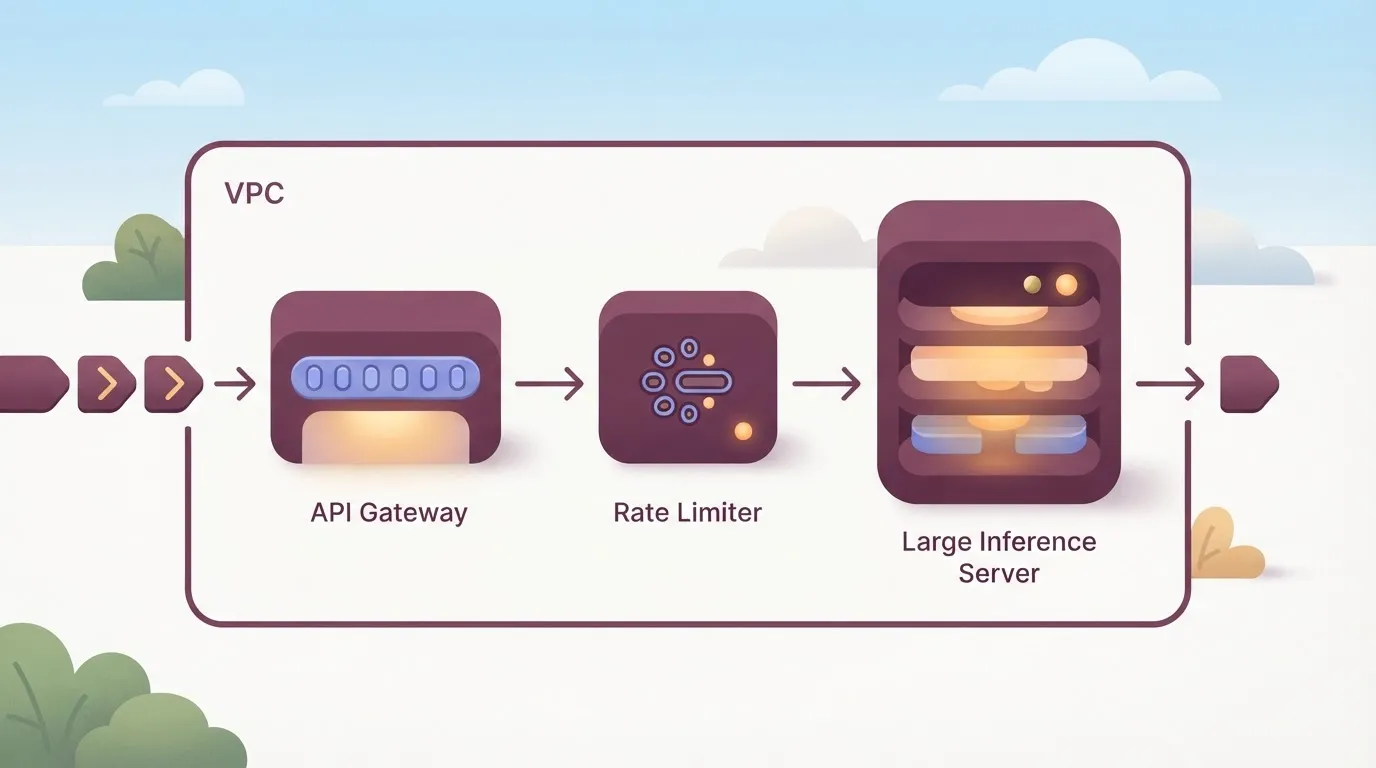
A secure VPC architecture for Mistral contains an outer VPC boundary. This boundary holds an API Gateway, a Rate Limiter, and the Mistral Inference Server, with only the Gateway exposed to your internal corporate network.

Connecting Mistral to business apps with Activepieces
Activepieces routes sensitive data between your enterprise applications and self-hosted Mistral models without requiring a single outbound request to a third-party cloud, utilizing an MIT-licensed core to maintain transparency.
To prevent third-party exposure, Activepieces allows you to route every API key and OAuth token to your own secret manager rather than the platform database. This ensures that even as you connect internal apps to Mistral, no vendor holds the credentials your business runs on.
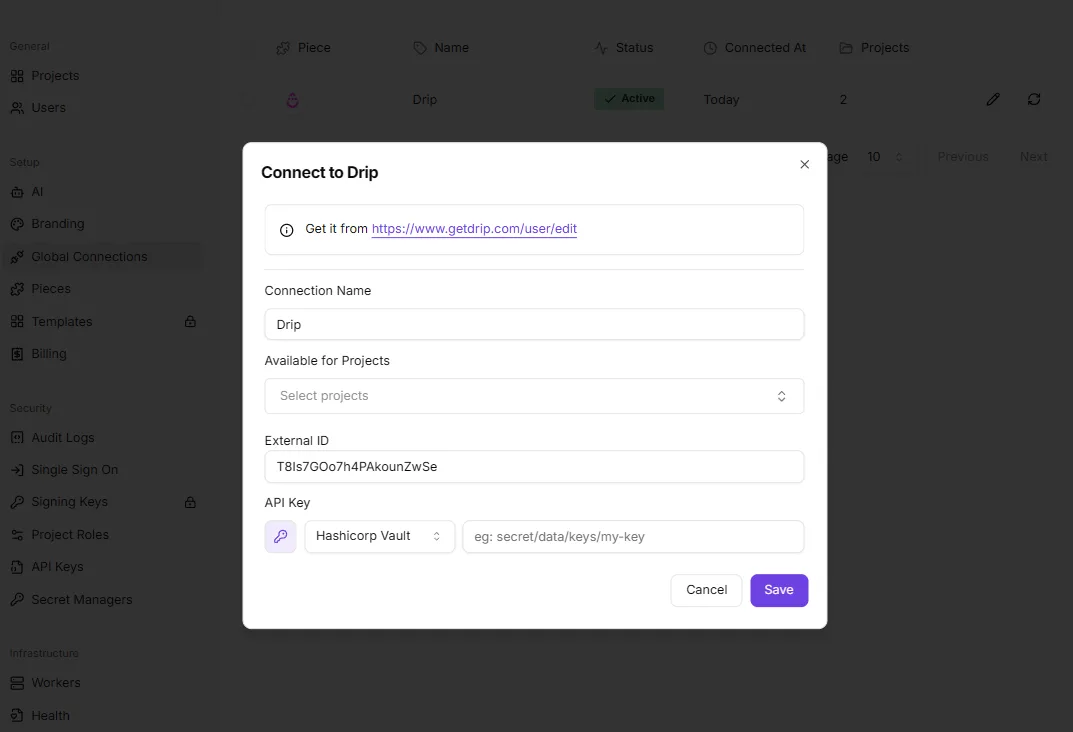
Organizations like MoneyGram and FundingSocieties use this architecture to maintain absolute sovereignty over the secrets powering their automated workflows.
Building private RAG pipelines without external APIs
Constructing a Retrieval-Augmented Generation (RAG) pipeline inside a locked-down network requires a workflow engine that can interface with local vector databases like Qdrant or Milvus.
Activepieces provides the logic to extract text from your internal repositories, send it to a local Mistral Embed endpoint for vectorization, and store the resulting embeddings in a local instance.
Automating document classification on local hardware
High-volume document sorting tasks that involve Personally Identifiable Information (PII) must be handled by models that don't log prompts for training purposes.
Activepieces can be configured to watch a local file share, passing the content of new PDFs to Ministral 3 8B for rapid classification. This setup allows you to identify document types such as invoices, medical records, or NDAs and route files to specific encrypted directories.
Triggering local inference from CRM or ERP events
Activepieces catches events from a local ERP or a self-hosted CRM to trigger a Mistral Small 4 reasoning chain, drawing from a library of 735+ integrations to keep the entire process within your infrastructure.
Because the workflow engine supports custom HTTP actions, it can communicate directly with your local inference API. This summarizes and prioritizes customer support tickets without exposing your underlying business logic to the public internet.
The Monday morning Mistral deployment checklist
Deploying Mistral on-premises requires a systematic validation of hardware and software layers.
- Validate GPU VRAM and CUDA drivers.
- Select the quantization level (Q4/Q8).
- Pull model weights via vLLM or Ollama.
- Execute the first internal curl test.
Checking CUDA and GPU driver compatibility for Mistral
Your infrastructure teams must verify that the NVIDIA Container Toolkit is correctly mapped to your host's CUDA kernels.
According to willitrunai.com, Mistral 7B requires between 4.3 GB and 8.8 GB of VRAM. For larger enterprise workloads, Mistral Small requires 17.3 GB to 28.5 GB.
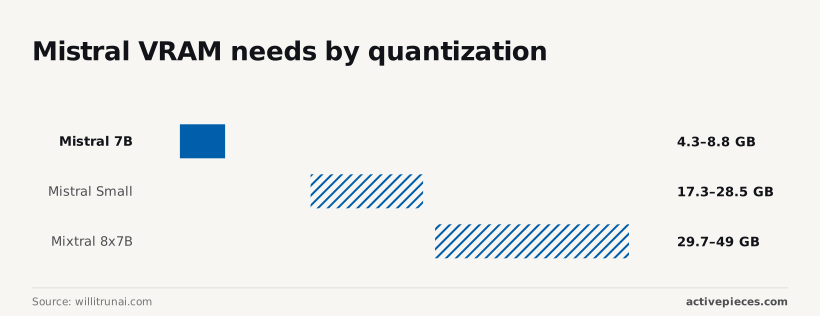
Finally, Mixtral 8x7B demands 29.7 GB to 49 GB, which effectively disqualifies most consumer-grade hardware from running the model, forcing users to rely on expensive enterprise-grade infrastructure.
Selecting the optimal quantization level (4-bit vs 8-bit)
4-bit (Q4) quantization allows Mistral Small to run on a single 24 GB card, making the model accessible to developers using standard desktop GPUs. 8-bit (Q8) quantization provides near-native precision for Mistral 7B at 8.8 GB, so high-fidelity inference is achievable on relatively modest hardware.
This ensures that your edge devices can handle complex summarization without the degradation found in lower-bit variants.
Testing the OpenAI-compatible API response
The final step is verifying your local inference server by executing a standard POST request.
Once weights are pulled via vLLM or Ollama, you should execute a curl test against the /v1/chat/completions endpoint. A successful JSON response containing a generated string confirms that the model is ready for integration.
Frequently asked questions about self-hosting Mistral
Self-hosting Mistral involves deploying open-weight models like Mistral Large 3 or Mistral Small 4 on your private physical hardware or within a Virtual Private Cloud (VPC).
This ensures all inference occurs behind your corporate firewall. This architecture eliminates the need to transmit sensitive telemetry or proprietary datasets to third-party API providers, effectively closing your outbound data loop.
Can I run Mistral on consumer-grade GPUs?
Deployment of Mistral models on consumer-grade hardware is possible provided the VRAM capacity meets the specific memory requirements of the model's parameter count and quantization level.
While high-end consumer cards can host smaller models, enterprise-grade inference for Mistral Large 3 typically requires data-center hardware to handle concurrent user requests without significant latency spikes.
How do I update the model weights without downtime?
Maintaining continuous availability during a model transition requires a structured deployment pipeline that separates the inference engine from the storage volume.
- Deploy the new model weights, such as a new iteration of Mistral Medium 3.5, to a secondary, isolated storage volume or container image.
- Spin up a parallel inference instance using the new weights to verify that your internal health checks pass and the model responds to test queries.
- Update your load balancer or internal service mesh to shift traffic from the legacy instance to the new instance.
- Decommission the old container only after the new model has stabilized under production load.
Does self-hosting satisfy GDPR and HIPAA requirements?
Self-hosting Mistral provides the technical foundation for GDPR and HIPAA compliance by keeping Protected Health Information (PHI) and Personally Identifiable Information (PII) within an audited environment.
Because the data never leaves your organization’s controlled infrastructure, you avoid the legal complexities of Data Processing Agreements (DPAs) with external AI vendors.
Compliance isn't granted by the model itself, but by the fact that you retain exclusive custody of the logs, weights, and input buffers.
This satisfies the "Right to be Forgotten" and data residency mandates that cloud-based APIs often struggle to guarantee.
Related reading
References
Build it
Set this up in minutes.
No code required. Connect your accounts, and Activepieces runs it from there.
Start free Talk to sales