
LangSmith Pricing Guide 2026: Plans and Trace Costs

Oct 20, 202613 min read
Compare LangSmith pricing across plans
How the LangSmith bill works
LangSmith's bill is a base fee plus usage: the plan sets your seats and a starting trace allowance, and every trace past that, kept for longer, costs more, which is why teams that also run Activepieces automations around their agents often watch trace volume more closely than seat counts.

LangSmith is LangChain's tool for recording and inspecting what an AI application does, step by step, and each recorded run is called a trace.
Developer, Plus and Enterprise. They were checked against the vendor's pricing page and documentation in July 2026.
Read the included-traces and retention columns before the base price, because they tell you how soon you outgrow the plan you picked. Enterprise is contact sales, so there's no public price to compare.
Have LangSmith plan allowances changed since July 2026
Once you have the allowances in front of you, the next question is whether any of them have moved.
I can't confirm a before-and-after for this revision, so I won't guess at one. Treat the July 2026 check date as the edge of what this page knows.
A usage-billed product changes its allowances more often than its headline fee, so reopen the vendor's pricing page before you commit.
Start with trace allowance and retention, since those move your total more than the base price does. Count every source of traces too, because a trace you didn't plan for is still billed.
LangSmith seat costs versus trace costs
When more people log in, the seat charge grows. When your application gets used more, the trace charge grows. A small team running a busy product pays mostly for traces, and a large team watching a quiet product pays mostly for seats.

If you size the plan by headcount alone, you're guessing at the larger of the two costs. Estimate your monthly traces and how long you must keep them, then choose the plan that covers that volume.
If you are running this arithmetic for your own team, see what the same workload costs on Activepieces.
What each LangSmith plan costs at realistic usage
It comes down to volume. A prototype costs next to nothing, a five-person team at 100,000 traces a month pays about $420, and an agent workload at a million traces pays well over $2,500, so costs scale steeply with trace volume.

The five-seat figures below come from inference.net, and they work out to roughly $2.50 per thousand traces on top of a fixed base of about $170.
At 5,000 traces a month, one developer pays a trace charge of about $12.50 at that rate, plus one seat. Nothing here is worth optimizing, so spend your time elsewhere.
Five-person production team
At 10,000 traces, five Plus seats cost $195 a month, so most of that bill is the base.
By 100,000 traces the bill is $420, and the traces now cost more than the seats do, so trace volume is now your dominant cost factor.
If your product is live and each user session creates several traces, this is the range you'll probably land in first.
High-volume agent workload
When an agent calls tools in loops, it makes many traces per task, and the count climbs fast.
At 500,000 traces the same five-seat team pays $1,420, making this a substantial commitment for a small team. At 1 million it pays $2,670, which represents material operational expense at that scale. At 5 million it pays $12,670.
Ten seats would add to those totals, so treat them as a floor for a larger team. Doing nothing about volume here means a bill that grows faster than your user count.
Look at the five-seat Plus bill at each of those trace volumes in the chart, and study the climb after 100,000.
Seat count barely moves the line; trace count does. So the next question is how long you must keep those traces, because retention multiplies exactly this cost.
LangSmith trace retention and usage limits explained
You will meet three limits, probably in this order: the seat cap, then the retention window, and last the rate limits. Each one costs you in a different way if you ignore it.
LangSmith base versus extended trace retention
Every trace is stored under one of two retention tiers. Base keeps it for a short window, and extended keeps it far longer at a higher price per trace.
If you do nothing, your traces simply expire, and the day someone asks why an answer went wrong last quarter, the evidence is gone.
To keep that evidence, upgrade a trace to extended. It's billed per trace, so it multiplies with volume. Keep extended for the traces you may need to explain later, such as flagged or failed runs, and let routine ones age out.
LangSmith rate and ingestion limits by plan
Each plan caps how fast you can send traces and how much you can ingest. A quiet pilot never notices.
A busy launch hour does, and the cost of ignoring it is dropped or delayed traces, which means gaps in the very period you most wanted to watch. Check the documented limits for your tier against your busiest hour, not your monthly average.
The moment a second teammate needs to read traces, you're shopping for a paid tier anyway, because the free developer tier allows a single seat.
That suits one person experimenting. Seat caps are the cheapest limit to plan for, because you can count your people today.
Hidden LangSmith costs beyond the plan price
The seats are the small line on the bill. For a five-seat team at one million traces, seats cost $195 a month and trace overage costs $2,475.
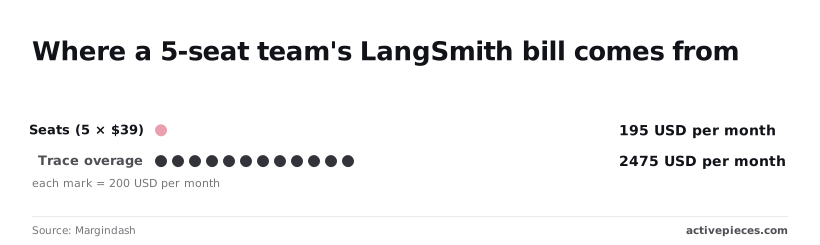
That makes overage about 93% of the total, so the part you can count is the part that matters least.
When one customer question enters an agent, it rarely produces just one trace. A trace is one recorded run of your software. The diagram shows a single user query entering an agent and producing seven billable traces:
- the agent's own run
- three LLM calls
- two tool executions
- one evaluator run

At that ratio, 100,000 questions a month is 700,000 traces.
Evaluators, the automated checks that grade your answers, add runs of their own. They also send requests to a model provider, which bills you separately from LangSmith. Skip this arithmetic and your estimate can miss by a factor of seven.
If you run agents on LangSmith's own hosting instead of your servers, expect a separate charge on top of the trace bill. Treat it as its own line in your budget, not something the plan price already covers.
Extended retention works the same way: keeping traces longer than the default window is an upgrade you pay for per trace. A team that must keep records for audits should price that before choosing a plan.
If your data can't leave your network, you're shopping on enterprise terms from the start, because running LangSmith on your own infrastructure is an enterprise feature, not something a smaller plan offers.
Those terms come from a sales conversation, so ask for the trace and retention numbers in writing before you commit.
Worth checking against a plan that does not meter every step: one credit covers a whole run on Activepieces.
Compare LangSmith vs Langfuse, Helicone, Braintrust, Phoenix
Once you have your trace and retention numbers in hand, the ranking turns on volume. At small volumes the free tiers make these tools nearly equal, and at large volumes the open-source options cost least in fees while LangSmith costs least in setup effort.
I've left vendor dollar amounts out because they change, so confirm each against the vendor's own pricing page before you decide.
Read the table for how each tool counts usage and whether you can run it yourself. Take from it that the tools don't meter the same thing, so a price per trace from one vendor can't be set directly against another's.
| Free Tier Limit | Price per 1M Traces | Self-Hosting (Open Source vs Paid) | Key Metering Metric | |
|---|---|---|---|---|
| LangSmith | Monthly trace allowance on a single-seat plan | Per-trace rate that rises with longer retention | Paid, enterprise arrangement | Traces, split by retention length |
| Langfuse | Monthly allowance of usage units | Per-unit rate that falls as volume grows | Open source, with paid cloud and enterprise add-ons | Units (traces, observations, scores) |
| Helicone | Monthly request allowance | Priced per request, not per trace | Open source, with paid cloud | Requests |
| Braintrust | Monthly allowance of processed data | Not priced per trace | Paid, hybrid for enterprise | Data processed and scores |
Phoenix, from Arize, is open source and self-hosted, so it has no per-trace fee. You pay for the servers and the person who keeps them running.
Once an agent calls tools and retries, one user request often produces several traces. A tool that bills per trace therefore grows faster than your user count, which is where LangSmith gets expensive first. Langfuse's unit counting can grow the same way.
If you already build on LangChain and want tracing working in an afternoon, LangSmith wins. Hosted rivals charge for the same convenience, and Phoenix charges in your own labor.
Self-hosting trades a vendor bill for an engineer's time. Langfuse, Helicone and Phoenix give you that choice for free. With LangSmith and Braintrust, running it yourself is an enterprise negotiation, so settle the price in writing first.
Self-hosting trades a vendor bill for an engineer's time.
Run this in Activepieces to watch LangSmith usage
Once the price is in writing, a daily check in Activepieces warns you before trace volume pushes you past what you agreed to pay for.
- Start with a schedule trigger set to run once a day, so a spike shows up within a day instead of on the invoice.
- Add an HTTP request step that asks LangSmith's API for your trace usage. There's no confirmed LangSmith integration, so this step uses the API directly.
- Add a condition that compares that usage with your plan's trace allowance.
- If usage is over the line, send a notification to whoever owns the bill.
You tune only where the line sits.
On a solo prototype, set the line near the allowance itself. One forgotten test loop can burn through a small plan, and an early alert costs you nothing.
If you run a five-person production team, set it lower, so the alert lands while there's still room to trim what you log or shorten retention before the overage starts.
With a high-volume agent workload, set it lower still, and send the alert to a shared channel. Here a bad day is expensive, and it shouldn't depend on one person noticing.
The free plan on Activepieces Cloud costs $0 with no card, and it includes 1,000 credits a month, unlimited flows and up to 5 users, which means anyone can try it without spending.
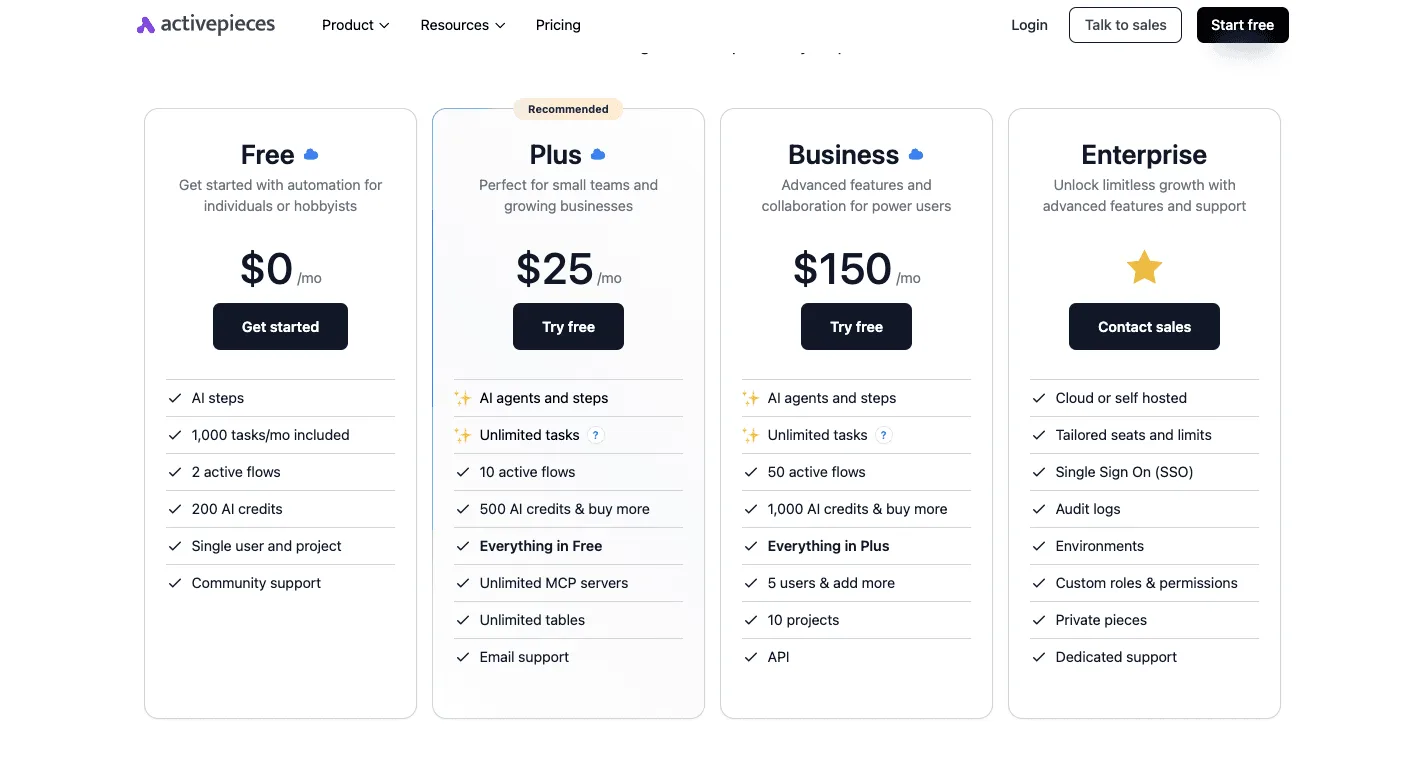
Activepieces allows unlimited flows on every plan, and credits meter AI usage, so a plain scheduled check that calls no model doesn't depend on a per-step charge.
So a flow that runs once a day uses about 30 of those credits a month even with all four steps above, and this one fits with room to spare.
The Monday checklist for choosing a LangSmith plan
Count last month's traces from your own logs, decide how many days you must keep them, set a sampling rate for production, and set a spend alert. Re-read the pricing page before you pay.
Skip any of these and the invoice makes the decision for you.
Leave a default untouched and someone else has made the choice for you.
This project settings dialog shows a cap field, Max Concurrent Jobs, still on its default, with a line of text explaining it limits how many flows run at once.
Your sampling rate and spend alert are the same kind of dial, and leaving them alone costs more than setting them.
Here's the order to work in:
- Pull last month's request logs and count how many produced a trace.
- Write down the retention your auditors, customers or debugging habits require.
- Pick a production sampling rate, keeping every failed run.
- Set a spend alert below the number that would hurt.
- Check the pricing page the day you buy.
Build a five-column comparison from the pricing page, one row per plan. Seats and support are the columns people read first. Included traces and retention are the ones that move your bill, so compare those first.
Limits get revised more often than headline prices, and vendors do it quietly.
If you have a quote or screenshot in your files, compare the page today against it, and look at included traces and retention before the sticker price. A quiet change there is a bill change.
You can predict a seat charge, because it's a fixed cost. A trace charge grows with your traffic, so it's the one that surprises you. Multiply your counted traces by your sampling rate, then price that against each plan's included amount.
Frequently asked questions
Free tier and billing model
Is LangSmith free for small projects?
Yes, there's a free tier, and a hobby project or early prototype can often live on it.
The catch is that it caps how many traces you can send and how long they're kept, so the day your app gets real traffic, you hit the ceiling. Estimate your monthly traces before you build on it, not after.
Does LangSmith charge per user or per trace?
Both, but the trace side is the part that grows. Seats are a fixed cost you can count on one hand and plan around.
Trace volume and retention move with your traffic, so they're what surprises people on the invoice. Doing nothing about that means the bill drifts upward with every new customer.
Self-hosting and LangChain
Can I self-host LangSmith without an enterprise contract?
Generally no. Self-hosting has been sold as part of the enterprise tier, which means talking to sales. If data residency is your reason for asking, confirm the current terms with LangSmith directly, because plan details change and a wrong assumption here is expensive to unwind.
Do I need LangChain to use LangSmith?
No. LangSmith can trace code that never touches LangChain, using its own SDKs or standard tracing formats. LangChain users get the quickest setup, but a plain script calling a model directly can send traces too. You just add the tracing calls yourself.
Discounts
Does LangSmith offer discounts for startups or nonprofits?
LangChain has run startup-oriented programs, but I can't confirm current terms, and I won't guess at nonprofit pricing.
Ask their sales team, and bring your estimated trace volume and retention needs. That gives them what they need to quote you, and gives you something to compare against the listed plans.
Related reading
References
Running the numbers
See what the same workload costs here.
Free forever plan, and every paid plan self-hosts at no extra cost.
See pricing Talk to sales