
LLM Parameter Count Explained: Does Size Matter in 2026?
Model parameter counts provide limited insight into reasoning capabilities compared to architectural design and training data quality.

Covers replacing WhatsApp and spreadsheet chaos with chat-based automation for resource-constrained small businesses, and why the fixes actually stick.
ContributorSeptember 13, 202614 min read
This article was researched and fact-checked by an advanced research system.
Parameter count has long served as the primary shorthand for a large language model's intelligence, yet it is increasingly clear that raw scale is only one part of the equation.
While massive models often exhibit superior reasoning capabilities, the efficiency of the underlying architecture and the quality of the training data play equally critical roles in determining real-world utility.
As developers look to integrate these models into automated workflows, perhaps by using Activepieces to connect various AI services, they often find that a smaller, well-optimized model can outperform a larger one on specific tasks.
Ultimately, understanding performance requires looking beyond the billions of parameters to evaluate how effectively a model processes information and follows complex instructions.
At 2,000 tokens per second, a 7B dense model transforms a customer support ticket into a coherent response with instantaneous speed, according to Promptquorum.
These internal variables, comprising weights and biases, act as adjustable dials that developers refine during training to store the patterns the model uses to predict the next token.
LLM weights vs biases explained
While weights represent the strength of the connection between neurons, biases allow the model to shift the activation function to better fit the data.
How weights and biases process input signals
Weights function as multipliers that determine how much influence an input signal has on the next layer of the network. When a model encounters a specific word, the weights amplify or dampen that signal based on how relevant it was during training.
This allows the architecture to prioritize certain relationships, such as linking the word "capital" to "finance" or "geography" depending on the surrounding context.
Biases act as an additional constant added to the weighted sum of inputs, serving as a threshold for activation. They ensure that a neuron only fires when the combined signal is strong enough to be meaningful.
By adjusting these biases, the model can account for general trends in the data that exist independently of specific input strengths, providing the flexibility needed to handle diverse linguistic patterns without losing accuracy.
Every connector is an agent tool. In Activepieces, registering a integration once allows it to function simultaneously as a structured flow step and a tool schema on a per-project MCP server.
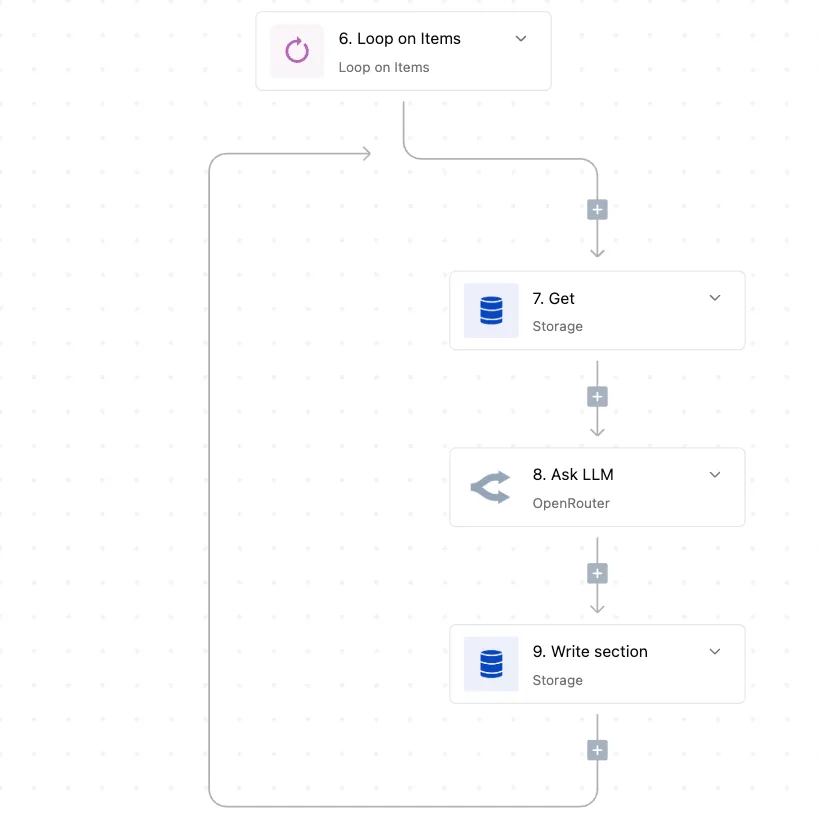
This means 734+ integrations are immediately reachable from any MCP client, such as Claude or Cursor, without the friction of a second migration or a separate catalog export.
Typically requiring two bytes per parameter in standard 16-bit precision, every parameter requires physical space in the Graphics Processing Unit (GPU) VRAM. A 70-billion parameter model requires roughly 140GB of VRAM just to load the weights.
Why more parameters do not always mean more knowledge
Raw size is a poor predictor of intelligence because high-quality training data can allow smaller models to punch significantly above their weight class.
According to benchmarks from LLMRun, the Llama 3.3 70B model scores 86.3%, yet the much smaller Microsoft Phi 4, with only 14.7B parameters, achieves a nearly identical 84.8%.
Because this 1.5% gap is negligible in practice, you'll achieve enterprise-grade reasoning at a fraction of the compute cost.
Even the Phi 3 Small, at a tiny 7B parameters, maintains a 75.7% score on the same benchmark, which means it achieves high performance despite its compact size.
Balance reasoning and speed with parameters
A model’s parameter count dictates the ceiling of its logical depth at the direct expense of its response time.
The correlation between size and zero-shot performance
High parameter counts allow a model to internalize a broader range of patterns. This means it can handle "zero-shot" tasks without needing a library of examples.
When a 70B model grasps a sarcastic tone or industry jargon in one go, a smaller model might require several clarifying prompts. A larger model reduces the time spent engineering complex prompts but forces a reliance on expensive, high-memory hardware.
Latency penalties of high-parameter architectures
Every additional parameter adds a mathematical operation the system must complete before it generates a token.
According to throughput data from Zero Entropy, a 7B dense model can reach speeds of 2,000 tokens per second. The following data visualizes how increasing the "brain size" of the model forces the hardware to work harder for every word produced.
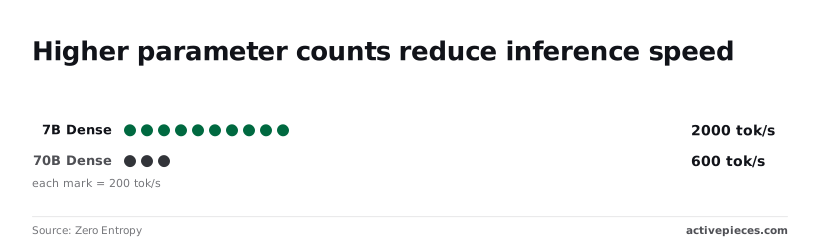
Why 70B models process fewer tokens per second than 7B models
Because the GPU's memory bandwidth becomes a bottleneck, a 70B dense model typically tops out at 600 tokens per second according to Zero Entropy, meaning it's more than three times slower than its 7B counterpart.
The chip spends more time waiting for the 70 billion weights to load than it does calculating the answer. 70% of the throughput disappears, meaning you either accept a sluggish interface or you triple your spend on H100 clusters.

Everything below works on Activepieces' free plan. Start without code or a credit card.
Quantization and MoE make raw parameter counts misleading
Modern compression techniques like quantization and architectural shifts toward Mixture-of-Experts (MoE) allow smaller models to match the reasoning capabilities of giants.
4-bit quantization saves RAM without hurting performance
Quantization shrinks the memory footprint of a model by reducing the numerical precision of its weights.
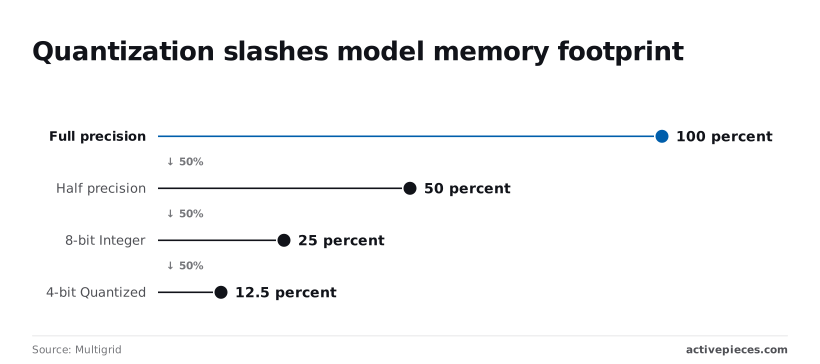
While a model in Full precision (FP32) consumes 100 percent of its theoretical memory requirement, moving to Half precision (BF16) cuts that to 50 percent, so developers can run the model on hardware with significantly less VRAM.
Pushing further to an 8-bit Integer format drops the footprint to 25 percent, and 4-bit Quantized versions reach 12.5 percent of the original size, allowing these models to fit onto consumer-grade devices, which means users can run sophisticated AI locally without needing expensive server hardware.
Selecting the correct compressed model format
Quantization is not a toggle switch in a software menu; it is a permanent transformation applied to the model file itself. To achieve these memory savings, you cannot simply load a standard 70B model and expect it to shrink.
Quantization is not a toggle switch in a software menu; it is a permanent transformation applied to the model file itself.
You must specifically download a pre-quantized file format, such as a GGUF or EXL2 file, which has already had its weights mathematically compressed.
These specialized files are built to run on specific inference engines that understand how to unpack the 4-bit data during the generation process.
If you attempt to load a standard 16-bit model on a consumer GPU, the system will attempt to allocate the full VRAM amount and fail before you can apply any settings.
Choosing the right quantized version at the point of download is the only way to bypass these hardware limitations.
Accuracy tradeoffs of lower quantization precision
Reducing numerical precision is not a free lunch for memory efficiency. Moving from 16-bit to 4-bit typically results in a slight loss of accuracy or an increase in perplexity, meaning the model may become less certain or slightly less coherent in its outputs.
While this trade-off is often acceptable for general tasks, it can impact performance in highly technical domains where every bit of mathematical nuance matters.
The MMLU benchmark records a 75.7% score for Phi 3 Small (under 10B), indicating that smaller models are becoming increasingly capable at complex reasoning tasks, so developers can deploy high-performance intelligence in resource-constrained environments.
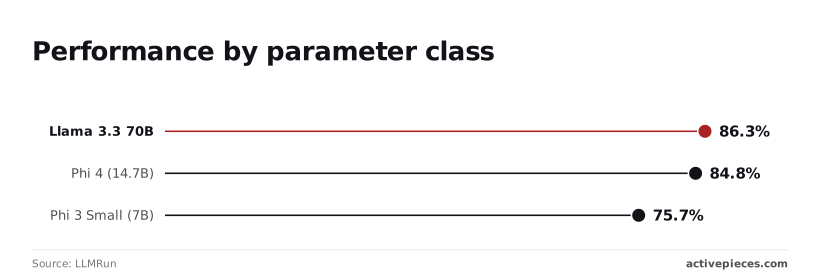
Phi 4 (10B-50B) records an 84.8% score, demonstrating a clear improvement in accuracy as the parameter count increases, meaning that scaling up remains a reliable path for achieving higher precision in model outputs. Llama 3.3 70B (50B-100B) shows a marginal climb to 86.3%.
This 1.5% gain proves that paying for 20 billion extra parameters often buys negligible reasoning improvements.
Distillation: Shrinking large models into efficient student versions
Knowledge distillation allows a "student" model to learn the specific decision-making patterns of a "teacher" model.
By training a 7B parameter model to mimic the outputs of a 400B giant, developers create a specialized asset that retains nuance while eliminating the latency of a massive network.
Training data density often outweighs total parameter volume
Model performance scales primarily through the synergy of data volume and compute budget. When you feed a smaller model a more diverse dataset, you increase its information density, allowing it to match the reasoning of bloated models trained on "noisy" data.
The Chinchilla Scaling Laws explained
The research team at DeepMind developed the Chinchilla Scaling Laws. These principles prove that most modern models are significantly undertrained relative to their size.
For every doubling of a model’s parameter count, the training tokens must also double to maintain efficiency. Otherwise, you're paying for the electricity to run a massive engine without enough fuel to reach top speed.
For every doubling of a model’s parameter count, the training tokens must also double to maintain efficiency.
Why a well-trained 14B model rivals a 70B model
A compact model trained on a massive, curated dataset can achieve a higher degree of "feature saturation," meaning it has learned more useful patterns per parameter.
The following table compares total parameters against active parameters to show how Mixture-of-Experts (MoE) architectures allow large models to run with the efficiency of smaller ones.
| Model | Total Parameters | Active Parameters | Impact on Inference |
|---|---|---|---|
| Mixtral 8x7B (MoE) | 47B | 13B | Runs at the speed of a 13B model while retaining 47B-level knowledge. |
| Grok-1 (MoE) | 314B | 86B | Reduces VRAM requirements during generation compared to a dense 314B model. |
| Llama 4 Scout (Dense) | 17B | 17B | Uses all parameters for every token, ensuring predictable, low-latency responses. |
The impact of high-quality synthetic data on small models
Synthetic data is information generated by a larger "teacher" model to train a smaller "student". This allows small models to learn complex logic without the "noise" found in raw internet scrapes.
By focusing on data quality, a developer can build a specialized tool that fits on a single consumer-grade GPU.
Matching model size to specific business use cases
Selecting an AI model requires matching the architectural complexity to the specific cognitive load of the task.
| Task Complexity | Recommended Parameter Range | Business Application |
|---|---|---|
| Structured Extraction | 1B - 8B parameters | Converting raw emails into database entries |
| Customer Support Chat | 8B - 70B parameters | Handling multi-turn product troubleshooting |
| Strategic Reasoning / Coding | 70B+ parameters | Generating complex software or legal briefs |
When to use 7B-8B models for high-volume tasks
Small models excel at pattern matching and data transformation where the output format is strictly defined. When a model only needs to identify a phone number or a date, the extra layers of a larger model are redundant.
The case for 70B+ models in legal and logical analysis
Large-scale models are necessary when the output requires "world knowledge" or the ability to follow a long chain of contradictory logic. This allows them to catch subtle legal inconsistencies in a forty-page contract that a smaller model would overlook.
Hybrid strategies: Routing queries by complexity
A hybrid approach uses a "router" to categorize incoming requests and send them to the cheapest model capable of handling them.
Implementing a router means a company can use a tiny model for 90% of basic inquiries while automatically escalating the 10% of complex technical complaints to a 70B+ model.
Optimizing model selection within Activepieces automation workflows
Reselling you a model is deciding your AI strategy for you. Activepieces connects to any major provider using your own API key, which ensures that the resulting model spend lands directly on your own account at your negotiated rates.
Organizations like MoneyGram and FundingSocieties use this approach to maintain control over their AI costs, reaching their chosen models from any MCP client without a platform markup dictating their architectural choices.
Routing simple extractions to low-parameter models
By assigning data-cleaning tasks to small, specialized models that excel at pattern matching, you can slash operational overhead.
In a typical workflow, the "new flavor created" trigger from a custom Ice-cream integration initiates the sequence. You can immediately hand off that specific payload to a 7B-parameter model for basic categorization.

This ensures you aren't burning credits on a high-reasoning model just to identify if a customer mentioned "chocolate" or "vanilla."
Using large models for final quality gate reviews
High-parameter models should function as the final supervisor in your sequence.
Instead of using a frontier model to draft every internal notification, you use Activepieces to funnel those drafts into a final "Branch" step where a larger model checks for brand voice and factual accuracy, a process Moneypenny uses to maintain quality across automated departments.
Switching providers without rebuilding the workflow logic
Because the tool treats the AI as just another "integration" or connector, the model-agnostic nature of Activepieces means you can replace an underperforming AI provider by changing a single dropdown menu.

This flexibility is supported by an MIT-licensed core that allows teams to swap proprietary models for cost-effective local instances without touching the surrounding data transformations.
The Monday morning model evaluation checklist
Determining if a new model fits your stack requires measuring its operational throughput against your specific latency requirements. A 7B model reaches 2,000 to 5,000 tokens per second, enabling instantaneous chat.
A 70B model drops to 600 to 1,500 tokens per second, which suits batch processing over live interaction.
Before committing to an integration, run these three specific checks:
- Test the effective context window by asking for a summary of a document that is 90% of the stated limit.
- Measure the "Time to First Token" on your specific local hardware.
- Run a cost-per-thousand-tokens simulation against your highest-volume automation.
Frequently asked questions about LLM parameters
Does a higher parameter count mean a model is smarter?
A higher parameter count indicates a model has more internal "knobs" to tune during training, but this translates to greater capacity for nuance rather than inherent intelligence.
Think of it like a warehouse: a larger building can hold more inventory, but if the shelves are filled with disorganized junk, the staff will still struggle to find the right part.
When a massive model is trained on low-quality web scrapes, it often performs worse on specialized business logic than a smaller model trained on clean, proprietary datasets.
Can I use a small model for sentiment analysis?
Small models are usually sufficient for classification. Identifying a sentiment or a category requires far less reasoning power than generating creative prose.
Using a massive generative model for a task that a compact, encoder-only model could handle results in unnecessary latency. This means your customers wait seconds for a response that should have been instantaneous.
Why does my computer crash when I try to run a 70B model?
Standard consumer laptops generally lack the dedicated Video RAM (VRAM) required to store the weights of a large model. This leads to a total system crash or "out of memory" errors.
To run these models locally, you must use quantization. This process compresses the model's precision so that the hardware can actually fit the math into its available memory.
What is the relationship between parameters and context window?
Parameters define what the model "knows" from its training. The context window defines how much new information it can "hold" in its active memory during a conversation.
Increasing the context window requires an exponential jump in computational resources. A model with a massive memory limit will cost significantly more to run per query even if its underlying parameter count remains the same.