
Make.com Self Hosted: Options and Alternatives (2026)

Oct 27, 202614 min read
As of 27 October 2026, Make publishes no self-hosted edition, so "Make.com self hosted" has no official product behind it. Make runs as a vendor-operated cloud service. Anything described as self-hosted Make is either a different tool or an unsupported claim.
Understand Make.com self-hosting reality
What 'self hosted' normally means
For software to count as self-hosted, the vendor ships it and you install and operate it on infrastructure you control, as with Activepieces or any other package you run on your own servers. Three conditions have to hold.
The workflow engine executes on your machines. The data it touches stays on your storage. And the service keeps running when the vendor's cloud is unreachable.
Choosing a region doesn't meet that test. It picks which of the vendor's data centres processes your data, but the vendor still operates the platform. I won't call any arrangement self-hosted without naming which of those three conditions it satisfies.
Nothing on Make's pages describes an edition that meets any of those conditions. The next section lists where I confirmed that absence.
Sources checked for Make self-hosting options
As of 27 October 2026, three places would have to show a self-hosted option if it existed:
- Make's public pricing page, including every plan description
- Make's enterprise plan description
- Make's help documentation on deployment and infrastructure
None of them has an installable edition, a downloadable package, or an on-premises licence. No wording lets a customer run the Make engine in their own environment.
Even so, absence from these pages isn't proof that no private arrangement exists. A buyer who needs one should ask Make's sales team to confirm it in writing, because a verbal answer isn't a contract term.
The fastest way to settle a shortlist is to try one. Activepieces is free to try, no credit card.
What Make offers instead of self-hosting
In place of self-hosting, Make gives you contractual and administrative control, not a deployment inside your network. It runs only as a hosted service on its own infrastructure.
Two zones in the US and two in the EU: that is the whole list of named locations in Make's documentation. The map below shows them as four points, with the rest of the world empty.

Outside those zones, a buyer has no published option to run or store anything.
Make's pages name the zone that holds an account, but they don't state whether execution, logs and support access all stay there.
If the zone's provider has an outage, your scenarios stop with it, and no setting on your side restarts them. That is the question the map can't answer.
On Make's Enterprise plan page you'll find SSO, audit logs and service-level commitments. I wouldn't call any of these a control satisfied until the contract names the control.
Request those details in writing: the page doesn't publish the SLA's remedy terms, the audit-log retention period, or whether logs can be exported to your own systems.
Read the on-prem agent Make documents for what it is: a connector. The scenario logic still executes in Make's cloud, and your internal system's data travels there for Make to process.

Make's pages don't describe the agent as moving execution into your environment, so the network boundary stays outside your control.
What Make's plans offer for control
None of Make's three published paid tiers has self-hosting. They run from $9 to $29 a month at the entry level, so the price buys no change to where your workflows execute.
Make plan pricing and credits compared
Per Jetadmin's breakdown of Make's pricing, Core costs $9 per month, Pro $16 and Teams $29, each with a 10k-credit allowance, so the cost differences must reflect capabilities other than credits.
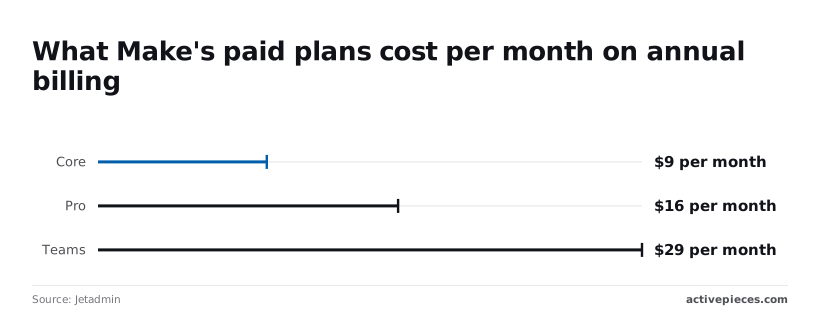
The table sets those prices beside the self-hosting position. The price rises threefold across the tiers while the hosting answer never changes, so you're paying for features on someone else's infrastructure.
| Plan | Monthly price (10k credits) | Self-hosting |
|---|---|---|
| Core | $9 | No |
| Pro | $16 | No |
| Teams | $29 | No |
Moving from Core to Teams adds $20 a month, which compounds to $240 yearly, a material cost increase that warrants assessing whether the upgrade is truly necessary. Whatever that $20 buys, it doesn't move execution into your environment.
Which plan unlocks SSO and audit logs
I won't name a plan for SSO, because the figures confirmed for this article cover price, not the tier at which it switches on. Check Make's own pricing page for the exact tier before you budget.
Across Make's plans, audit-log retention runs from no retention to 30 days, leaving users with either zero audit history or records that expire after a month. That is the clearer limit.

Even at the top of that range, an incident discovered in week six has no record in Make's log. An auditor asking what a workflow touched last quarter gets no answer from the vendor.
Self-hosting is the line none of these plans crosses. Every tier runs on Make's infrastructure, so if Make's cloud goes down, your automations go down with it, and you have no way to fail over to your own servers.
Price changes which features you get. It doesn't change who operates the machine.
Recognize five self-hosted Make buyer mistakes
Each mistake reads a label as a control. You see an installer, a licence, a region or a plan name and take it to mean the software runs inside your own boundary, when none of them says who operates the machine.
Price changes which features you get. It doesn't change who operates the machine.
If a repository or Docker image claims to be "Make on-premise", it isn't Make's own distribution. Ask for the vendor's documentation page that describes a self-hosted install.
If none exists, you can't show an auditor where the binary came from, who signs it or who patches it. Don't run it near production credentials.
Mixing up Make and n8n licensing
Where n8n publishes its source under a licence that permits you to run it yourself, Make is a service the vendor operates. A buyer who carries n8n's self-hosting terms over to Make is assuming a right that Make's terms don't grant.
Make starts at $9 and n8n runs from €50 to €667. Neither bill buys you an install.
Both tiers are hosted, so the comparison tells you what each costs to rent, not what each lets you control.
A region pin answers where data sits. It doesn't answer who runs the execution, who administers the network or what happens when the vendor's cloud is down and yours is not. Until a document names the control, don't write "region-pinned" as "compliant" in any form.
Many buyers choose a tool first and then ask what their regulator requires. Reverse that order.
Name the specific control, such as data never leaving your network or execution inside your own boundary. Then check whether the vendor's page satisfies it. That check rules out hosted tiers before any plan comparison begins.

Reading a table only gets you so far. Build the same workflow in Activepieces and compare it yourself.
Self-hosted workflow automation options compared side by side
Applied to that check, Make fails outright because it's cloud only, while n8n passes because you can self-host it under its Sustainable Use Licence.
Make versus n8n self-hosting compared
Make doesn't allow self-hosting. It ships under proprietary cloud service terms and runs only on the vendor's infrastructure. n8n allows self-hosting under the Sustainable Use Licence and runs in your environment or the vendor's cloud.
Those are the two requirements that decide the question, where the software may run and under what licence. Only n8n survives a self-hosting requirement.
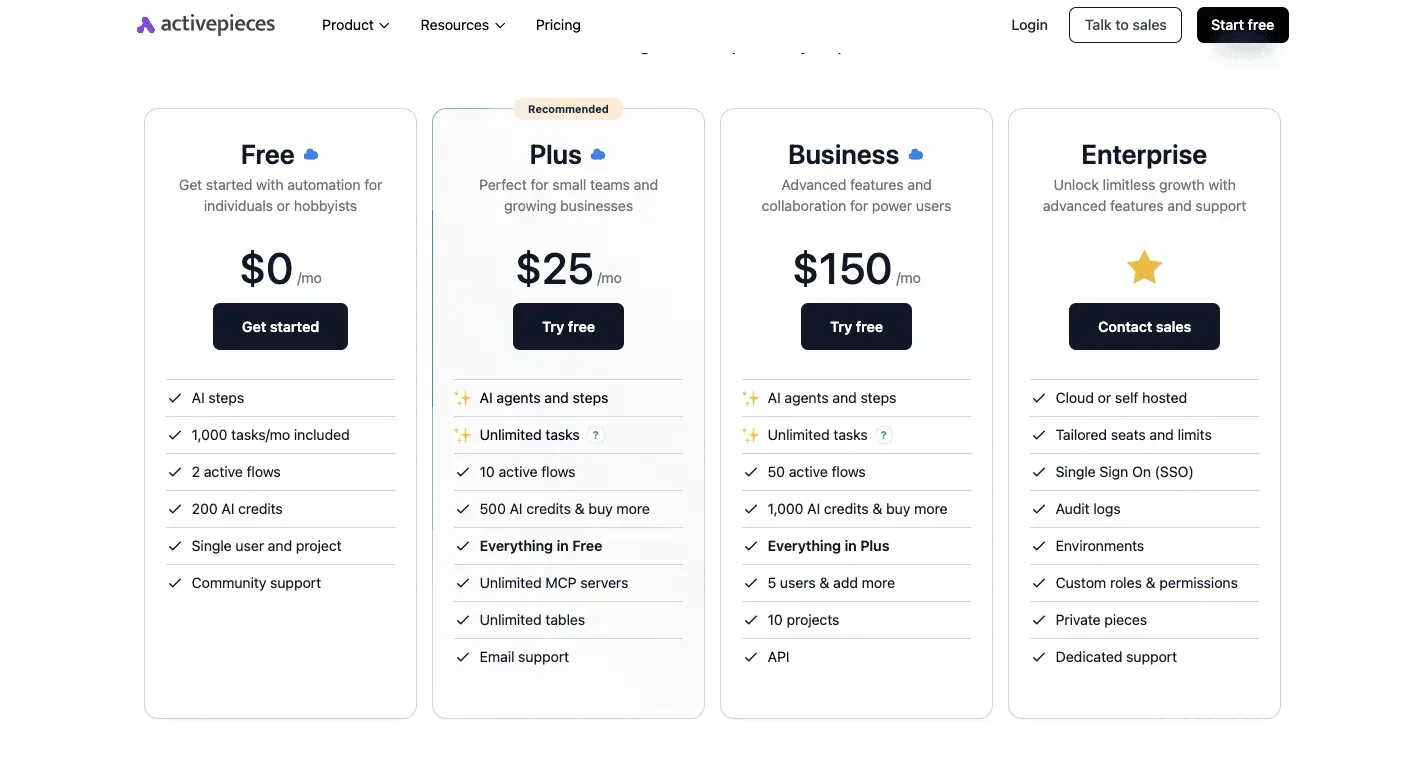
Activepieces runs workflows on your own servers under an MIT-licensed core, and it doesn't hand you a reduced product for the stricter boundary.
Single sign-on, SCIM provisioning, custom roles, audit logs, release management and secret managers are the same list in the air-gapped build as in the managed cloud, so the choice between the two comes down to who runs the machine, not which features you get.
MoneyGram, Moneypenny, Alan and FundingSocieties run Activepieces in production.
Confirm price and SSO plan placement on each vendor's own pricing page on the day you buy, because both change often. A price you copy into a report is stale the moment you write it. The licence, not the feature list, needs the closer reading.
n8n licence limits on commercial self-hosting
"Self-hosting allowed" isn't the same as "unrestricted." The Sustainable Use Licence is source-available, not open source, and it limits how you may use the software commercially. Read the licence text itself and test your use case against each clause.
Internal automation for your own business is the plainest fit. Reselling the product, or hosting it as a service for others, is where the restrictions bite. Until counsel has checked the use against the clause, call it "permitted for this use," never simply "compliant."
If no rule requires your data and execution to stay inside your own boundary, Make's cloud-only model costs you nothing on control. You also avoid patching, upgrades and uptime.
The trade is plain: when Make's cloud goes down, your workflows go down with it, and you have no environment of your own to fail over to.
How Activepieces handles self-hosting requirements
To answer the failover problem, Activepieces lets you run the platform on a server you control. The environment that stays up or goes down is yours, at the price of operating it.
n8n Community versus Enterprise edition features
The Community Edition is open source and runs from Docker on your own machine. Some governance features sit under a separate commercial licence.
Read the licence text for the exact list, and confirm that the controls you need, such as SSO or audit logs, are on the side you can use. I'm not quoting an Activepieces price here because I can't point to a page that supports one.

What you run and maintain yourself
Self-hosting moves the bill from a subscription to infrastructure. Wenboom prices a small automation server at these monthly rates:
| Option | Monthly cost |
|---|---|
| Hetzner CPX21 | $12.95 |
| DigitalOcean, 2 vCPU | $24 |
| AWS | $30.37 |
| Make Cloud | $9+ |
Of the three servers, Hetzner is the DigitalOcean costs about $11 more each month for similar capacity. The $30.37 AWS figure is more than double Hetzner's, so the provider choice changes your bill more than the software does.
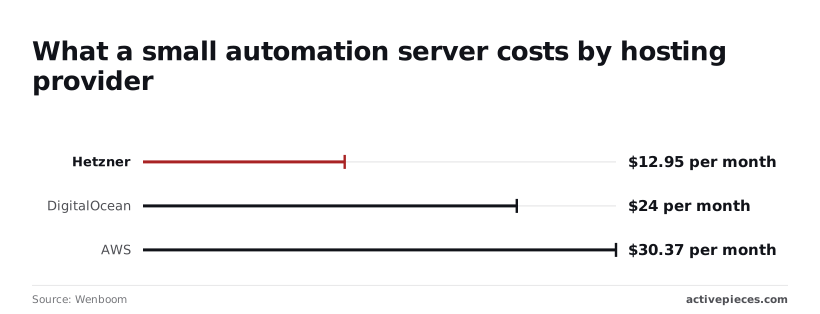
Though Make Cloud's starting price is lower than all three, it includes no server for you to fail over to.
The servers are only part of the cost. Patching, backups, upgrades and uptime become your job, and if your server fails, nobody else restores it.
Treat migration as a rebuild. Each scenario's modules map to integrations, and you recreate the triggers, field mappings and error handling by hand, then test against real payloads.
The effort grows with the number of scenarios. Move a handful of critical ones first and measure how long they take before you commit the rest.
Self-hosted Make decision checklist
Write the requirement down and ask Make sales three exact questions. Recheck the vendor pages, pilot one workflow on a self-hostable tool if hosting is mandatory, and record the decision with its date.
Define your self-hosting requirement as a control
Write the requirement as a control, not a preference. "We need self-hosting" is a preference. "Customer records must not leave our network boundary, because our data residency rule says so" is a requirement, and you can test it.
If you can't point to the clause behind it, you may be buying isolation you don't need. Name the law or contract clause and quote its wording. If you can, you know whether a region-pinned cloud satisfies it or merely sits near it.
Send these three questions to Make sales in writing, and keep the replies.
- Is private connectivity such as Private Link available on your plan, and does it cover execution as well as data in transit?
- Which infrastructure and sub-processors run my scenarios, and can any of it run inside my own environment?
- What does the SLA say, quoted line by line, when your cloud is down and mine is not?
Answer the third one first for yourself. A sales summary isn't a contract term. If the reply paraphrases, ask for the clause.
Pilot a self-hosted automation before migrating
If hosting is mandatory and the answers fall short, do this in order:
- Pick one low-risk workflow that touches real integrations.
- Rebuild it on a self-hostable tool in your own environment.
- Record what broke, what needed custom work, and how long it took.
- Compare the running cost of credits against the cost of maintaining your own servers, including staff time.
Before you file the decision, recheck Make's pricing, security and terms pages, because they change.
Record the decision with the date, the pages you read and the replies you received. The record then shows what you knew when you chose, and tells you when to ask again.
Frequently asked questions
Is there an official Make.com Docker image?
I haven't seen one, and I won't assert one exists without a vendor page that says so. Make is a hosted service, so the thing to ask for is the licence text that permits you to run its engine yourself.
If the vendor's documentation doesn't name a downloadable image and the terms that govern it, treat the answer as no, and get that statement from them in writing.
Can Make's Enterprise plan be installed on-premise?
Don't infer it from the plan name. Enterprise tiers usually add SSO, audit logs and access controls, and those are features, not a deployment model.
Ask the vendor one question and keep the reply: where does the execution engine run, and on whose infrastructure?
If the answer is the vendor's cloud, the plan is managed cloud however many controls it carries, and your data and execution stay outside your network boundary.
Does Make offer EU data hosting?
Check Make's own documentation and your contract, not a summary of them.
Region hosting, where offered, pins where data is stored. It doesn't move the service onto your infrastructure, and it doesn't tell you who operates it or what happens to your workflows when the vendor's cloud has an outage.
Ask which processing steps, logs and backups fall inside the pinned region, and have the answer attached to your order form.
Is n8n a drop-in replacement for Make?
No. Both build visual workflows, but scenarios, modules and data mappings aren't portable between them, so expect to rebuild each automation and retest it.
Licence terms also differ, and n8n's source-available licence carries conditions on commercial use that you should read in full before relying on it. Migrate a few low-risk workflows first and measure the effort.
How often do vendor plans change, and where should I recheck?
Often enough that any comparison, including this one, ages quickly. Vendors revise plan names, limits and licence wording without much notice.
Recheck the vendor's own pricing page, terms of service and security or trust page, and note the date you read each. Before signing, ask for the plan's feature list and hosting commitments in the contract itself, since the contract is what binds the vendor.
Related reading
Still comparing
The fastest way to settle it is to build something.
Open source under MIT, so you can self-host the same thing later.
Start free Talk to sales