Building Sovereign AI Agents on Private Infrastructure
Oct 13, 202614 min read
Sovereign AI agents are autonomous systems where the data, the model weights, and the execution environment remain under your total physical and legal control. This architecture ensures that sensitive logic never traverses a third-party backbone. It keeps every decision-making step within a private, auditable perimeter.
Sovereign AI agents defined by local control
The three pillars of sovereignty
True sovereignty relies on the physical containment of three distinct assets: the proprietary data store, the model weights, and the orchestration logic. When you utilize Activepieces to coordinate these elements on-premise, you'll eliminate the risk of external telemetry leaks during complex workflows.

The sovereign agent node acts as the central intelligence. It pulls from a private data store and executes via local model weights, all housed within a shielded on-premise orchestration layer. The illustration below demonstrates how these three pillars interact to form a closed-loop system.
Internalizing even the most demanding reasoning tasks is the primary benefit of this structural isolation. For example, deploying a model like Llama 3.1 405B from Meta for long-horizon agentic work once required significant local compute, but it kept the strategic thinking process off public servers.
Why 'private AI' is not always Sovereign AI
"Private AI" often refers to VPC-hosted instances where the provider still manages the underlying hardware. In contrast, sovereign AI requires managing the Thermal Design Power (TDP) and physical rack space yourself to ensure no outbound data flow.
350 watts is what an H100 PCIe card pulls at peak. A standard 15kW rack can only support a limited density of high-end reasoning agents.
If you're scaling high-volume, latency-sensitive tasks such as classification or routing using Ministral 3 3B, you must balance your local GPU availability.
| GPU Model | Power Consumption | Operational Impact |
|---|---|---|
| H100 PCIe | 350W | Requires high-density cooling for dense agent clusters. |
| A100 80GB PCIe | 300W | Offers a slightly lower power draw for steady-state inference, which translates to reduced operational costs over long-term deployment. |
| A100 40GB PCIe | 250W | Allows for more cards per circuit in older data center environments; facility managers can increase compute density without requiring expensive electrical upgrades. |
Prices and plan limits checked against docs.claude.com and openai.com and gemini.google on October 12, 2026.
For cloud vendor management layers, physical control over these units is the only way to verify that logs and model inputs aren't cached.
Everything below works on Activepieces' free plan. Start without code or a credit card.
Air-gapped AI infrastructure requirements
True AI sovereignty requires an infrastructure that physically isolates the execution environment from external telemetry. While virtual private clouds offer logical separation, they don't provide the hardware-level assurance required to prevent metadata leakage to the hypervisor provider.
Local inference engines
Before running large language models on internal hardware, you must deploy specialized serving software that does not require an outbound handshake. Ollama is a streamlined tool for local model management that simplifies the deployment of weights on workstation-class hardware.
vLLM is a high-throughput serving engine designed for enterprise-grade GPUs that uses PagedAttention to maximize concurrency. LocalAI is a self-hosted, OpenAI-compatible API framework that acts as a drop-in replacement for cloud endpoints.
This allows your existing applications to switch to local models like Mistral Large 4 without rewriting the underlying integration code.
| Feature | Air-Gapped On-Prem | Private Cloud (VPC) |
|---|---|---|
| Security | Physical isolation; no hardware-level telemetry | Shared responsibility; provider has hypervisor access |
| Latency | LAN speeds; zero jitter from internet routing | Interconnect speeds; subject to regional transit lag |
| Maintenance | High; requires manual hardware and driver updates | Moderate; provider manages physical layer and power |

By maintaining this physical control, you ensure that sensitive data processed by models like DeepSeek-V4-Pro-0813 remains within the jurisdictional boundary of your server room.
The role of Vector Databases in private RAG systems
Retrieval-Augmented Generation (RAG) requires a local indexing layer to store and query corporate knowledge without exposing the raw text to a hosted search service.
In a sovereign stack, the vector database must reside on the same local network as the inference engine to prevent unencrypted data from traversing public switches. This architecture keeps the primary knowledge base behind a physical firewall even if a model is compromised.
Securing the 'last mile' with local API gateways
Before a request ever reaches the model weights, a local API gateway acts as the enforcement point for identity and access management. By routing all internal traffic through a gateway, you can apply Role-Based Access Control (RBAC) and detailed audit logging at the network edge.
This setup prevents unauthorized departments from querying restricted models, such as Mistral Large 4. It creates a centralized record of all model interactions for your compliance auditors.
The necessity of open weights for local hosting
Proprietary models like GPT-6 Astra or Claude Opus 5.5 are closed-source SaaS products that cannot be legally or technically downloaded to run on your own hardware. To achieve true sovereignty, you must select models with open weights that permit local redistribution and execution.
These models allow your security team to inspect the architecture and ensure no hidden phone-home features exist within the model files. By hosting the weights on your own NVMe drives, you remove the dependency on a third-party API availability and pricing changes.

The infrastructure cost of total AI independence
The infrastructure cost of total AI independence stems from the shift from variable API spending to fixed, high-density physical overhead.
Moving the orchestration and inference layers behind a firewall eliminates the privacy risks of shared environments. However, you must absorb the operational burdens of power, thermal management, and specialized labor.
Calculating the power draw of local inference
Regardless of whether a model is currently processing a prompt, local inference requires a constant baseline of electricity.
Unlike a SaaS model like OpenAI, where a user might access a limited context window without concern for the underlying hardware, a sovereign stack requires powering enterprise-grade GPUs that draw significant wattage even at idle.
The persistent load of model weights
Model weights must remain loaded in VRAM to provide an instant response to incoming requests. If the GPU were powered down between prompts, the system would face a massive latency penalty while reloading gigabytes of parameters from disk to memory.
This constant state of readiness forces the hardware to maintain a high idle power draw, making the electrical cost an unavoidable baseline of the sovereign setup.
When running demanding reasoning models like DeepSeek-V4-Pro-0813, the power draw spikes during peak compute cycles. This necessitates a robust electrical infrastructure that can handle sudden loads without dropping the network.

Hidden costs of GPU power and DevOps staffing
Maintaining a private AI stack introduces ongoing expenditure that buyers often omit from initial hardware budgets. Managing local deployments of models like Mistral Large 4 or DeepSeek-V4-Pro-0813 requires specialized DevOps talent to handle driver updates and container orchestration.
$3k-$6k per dedicated engineer is the resulting monthly payroll commitment, so scaling a team requires substantial upfront capital allocation.
Utilizing high-end hardware such as the H100 for local clusters carries an effective cost of $2.75-$4.00 per hour, making continuous operation a major line item that can quickly exhaust project budgets.
Between $55 and $700 per month is the cost for dedicated interconnects for low-latency model communication, forcing architects to weigh performance gains against recurring infrastructure expenses. High-speed data transfer between nodes remains a fixed line item rather than a hidden provider cost.
Sovereignty is a trade-off where you gain total control over your data and audit logs. You must replace the convenience of a monthly subscription with the logistical complexity of a data center operator.
Sovereignty is a trade-off where you gain total control over your data and audit logs.
Easier to see it running than to read about it: set it up free, no card.
Why specialized local models outperform generic SaaS giants
Sovereign AI deployments achieve superior task accuracy by replacing the broad knowledge of frontier models with deep, domain-specific optimization that remains entirely within your physical control.
Fine-tuning local models for domain accuracy
By fine-tuning local models, you ensure that the system understands proprietary nomenclature and internal logic that generic models routinely misinterpret.
When you use the Ministral 3 3B model for internal logistics, your engineers train the model to recognize specific inventory codes rather than attempting to map them to public-web equivalents.
The scale of modern context windows allows local models to process massive internal datasets during inference. The following comparison illustrates the context window capacity of frontier models as benchmarked in 2024:
[Context window capacity in tokens: A 2024 bar chart comparing Llama 3.1 (128K), Mistral Large 2 (128K), and Mixtral 8x22B (64K) to show the scale of frontier models at the time.]
Because of this capacity, local orchestration layers can feed thousands of pages of technical documentation into the model at once. The response stays grounded in current facts rather than outdated training data.
Eliminating the 'privacy tax' on sensitive data processing
Because the data never leaves the encrypted local environment, local models remove the operational friction of scrubbing PII (Personally Identifiable Information).
In a standard SaaS workflow, your security teams must implement aggressive data masking, which often strips the context necessary for the AI to provide a useful answer.
By running models like Mistral Large 3 or Mistral Large 4 on-premise, you avoid the risk of data being used for provider training. This is a standard clause in most non-enterprise cloud tiers.
Self-hosted AI avoids rate limits and outages
Physical control over the compute stack guarantees that mission-critical agents aren't subject to the variable performance or sudden rate-limiting of shared public APIs.
When you host your own instance of a model like DeepSeek-V4-Pro-0813, the inference speed is limited only by the allocated hardware. To prevent hardware saturation, the orchestration layer manages a local queue of requests.
High-priority tasks, such as automated vulnerability research using Mistral Large 4, receive dedicated GPU cycles. Audit logs capture every local inference call, providing a complete record for compliance.
Deploying sovereign AI workflows with Activepieces
Activepieces includes SSO, SCIM, custom RBAC, and audit logs in its air-gapped build exactly as they appear in the managed cloud, ensuring that organizations requiring the most control do not receive a fraction of the product.
By keeping the logic and execution engine within your own infrastructure, you maintain physical control over the triggers and actions that drive your AI agents. Organizations like MoneyGram and FundingSocieties run Activepieces in production to maintain this level of environmental sovereignty.
Deploying workflows within your private infrastructure
Activepieces provides an MIT-licensed core that can be deployed via Docker Compose or Kubernetes, ensuring that every workflow execution remains behind the corporate firewall.
This open foundation allows you to deploy an unlimited number of automated runs on your own hardware without per-execution fees.
When security mandates are at their strictest, the platform supports air-gapped installations where the network cable is pulled.
A comparison of the enterprise feature list (including SSO, SCIM, custom RBAC, audit logs, and secret managers) in the self-hosted air-gapped documentation against the managed cloud shows the same governance capabilities are available in both environments.

Connecting local LLMs to private business apps
Every credential Activepieces touches (API keys, OAuth tokens, and connection secrets) can be routed to your own external secret manager in the self-hosted edition, ensuring that no vendor holds the credentials your business runs on.
Because the orchestrator lives on the same local network as the model weights, sensitive data never leaves the premises during the inference process.
Configure a self-hosted instance against an external secret manager and inspect the Activepieces database yourself; you will find that the credentials are not there, as the platform supports externalizing these secrets alongside its custom RBAC and audit log governance.
In the screenshot of a successful run, you can see this localized control where an "Instance Stopped" trigger immediately fires a "Revoke Token" action.
The Run Details panel confirms the specific duration and the exact JSON payload sent to the Squareup API. It provides a granular view of how the AI interacts with external services.
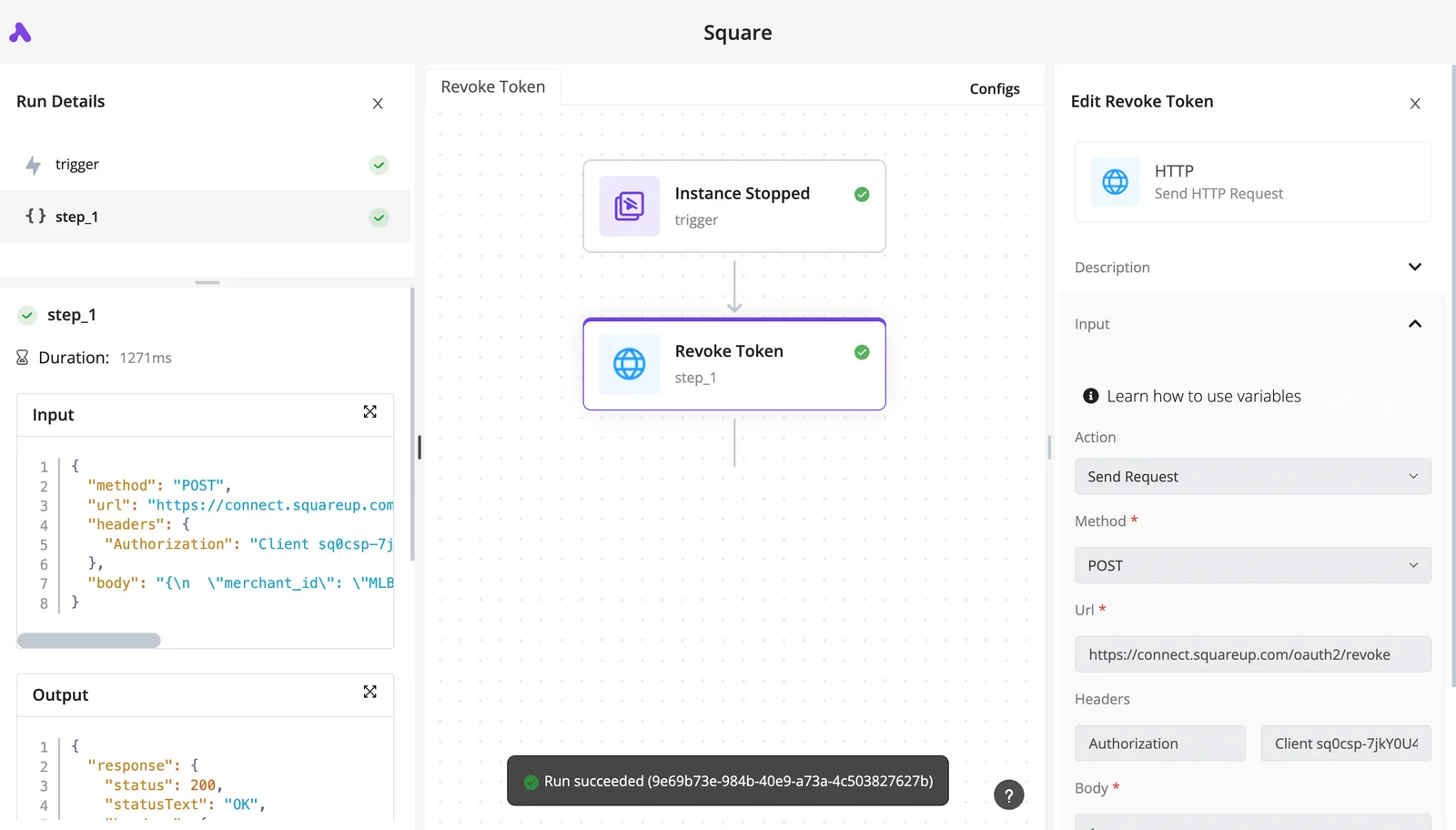
Verifying that the agent is performing only authorized actions is made possible by this visibility.
Enterprise governance: SSO, RBAC, and Audit Logs for AI
The Community edition provides the foundation for self-hosted automation. Regulated organizations require centralized control over who can build or execute AI workflows. Activepieces is equipped with enterprise-grade governance features to manage these risks at scale.
Through Single Sign-On (SSO) and SCIM, access to AI orchestration is tied to your corporate identity provider. Role-Based Access Control (RBAC) restricts the ability to modify critical flows or access sensitive API secrets to specific verified personnel.
Audit Logs record every change to a workflow and every execution attempt. They provide the necessary paper trail for your compliance officers.
If you require these governance layers or specialized support for air-gapped deployments, you can coordinate with the Activepieces sales team to align the software with your internal security architecture.
Frequently asked questions about sovereign AI agents
Can sovereign AI agents run without an internet connection?
When the orchestration layer and the underlying large language models are hosted on the same internal local area network, sovereign AI agents function entirely without outbound connectivity.
This configuration eliminates the risk of data exfiltration to third-party providers. The execution environment doesn't require access to public endpoints to process logic or generate responses.
To maintain this isolation, you must utilize open-weight models that allow for local weights to be stored on internal disks.
What hardware is required for a production-grade sovereign agent?
To prevent latency from stalling business workflows, production-grade sovereign agents require dedicated compute resources with high memory bandwidth.
The specific hardware requirements depend on the complexity of the model being served. For high-volume classification and routing using Ministral 3 3B, the environment requires sufficient VRAM to handle concurrent inference requests without queuing.
For advanced reasoning and agentic coding with Mistral Large 3, the infrastructure must support high-throughput interconnects to manage the massive context windows required for long-horizon tasks.
For flagship multimodal tasks using Mistral Large 4, a cluster of enterprise-grade GPUs is necessary to maintain acceptable tokens-per-second for your end users.
Is sovereign AI compliant with GDPR and HIPAA?
By ensuring that Protected Health Information and Personal Data never leave your physical or virtual private cloud boundary, sovereign AI provides the architectural foundation for GDPR and HIPAA compliance. You maintain exclusive possession of the audit logs and the model weights.
You can satisfy the "Right to be Forgotten" and "Data Residency" requirements that are difficult to verify in multi-tenant cloud environments.
Compliance isn't a default setting of the software. It's a result of your ability to enforce your own encryption and access policies at the infrastructure level.
How do you update local models without compromising the air-gap?
Updating models in an air-gapped environment follows a strict "Data Diode" or "Sneakernet" protocol to ensure that no bi-directional connection is ever established with the public internet.
- Download the new model weights, such as the latest files for Mistral Large 4, onto a secure, scanned transfer device in a separate networked zone.
- Perform a cryptographic hash verification on the files to ensure the model hasn't been tampered with during transit.
- Physically or logically move the files across the air-gap to the production environment.
- Update the local model server configuration to point to the new weights and restart the inference service.
Following these steps ensures that the production environment remains isolated while still benefiting from the latest model improvements.