
Manus Pricing 2026: Plans, Credits & What Tasks Cost

Nov 9, 202614 min read
$20 a month buys 4,000 credits on Manus Pro, or $40 buys 8,000, according to Notis.
The top tier we confirmed is $200 for 40,000, so there's no volume discount, which matters if you're budgeting for agent runs the way teams using tools like Activepieces budget for automation runs.
Manus pricing is a credit-based system in which each plan, from Free through Pro to Team, sells a fixed monthly allotment of credits that are spent per task rather than per month, so what a team actually pays depends on how much work its tasks consume.

Manus's the general AI agent at manus.im. Credits are spent per task, so the price you pay matters less than the credits each task burns.
The table below shows every plan as of 9 November 2026, with "not stated" wherever the figure wasn't confirmed, and only the credit counts and the paid prices are firm.
Manus plan pricing and credit limits
| Plan | Monthly price | Annual price | Credits | Concurrent tasks | Seats | Gated features |
|---|---|---|---|---|---|---|
| Free | $0 | not stated | not stated | not stated | not stated | not stated |
| Pro entry (4,000 credits) | $20 | not stated | 4,000 a month | not stated | not stated | not stated |
| Pro standard (8,000) | $40 | not stated | 8,000 a month | not stated | not stated | not stated |
| Team | not stated | not stated | not stated | not stated | not stated | not stated |
According to Aicost, divide each price by its credits and you get $0.005 a credit at $20, $40 and $200 alike. Moving up a tier buys more credits, not cheaper ones, so the next plan only pays for itself if you would otherwise run dry.

You can't budget a free trial in advance, because the size of the starter and daily credit grants isn't stated. Run one realistic task and read the balance afterward; that single number's your cost per run.
Check the pricing page on manus.im, and compare it with what you saw on 9 November. Dividing price by credits takes thirty seconds and shows whether a tier changed.
Activepieces publishes its own per-run price the same way: 1 credit a run, however many steps the run has.
If you are running this arithmetic for your own team, see what the same workload costs on Activepieces.
Five-person team's Manus credit depletion
What a credit costs and what an empty balance costs are different numbers, and the second's the larger one. This worked scenario follows a fictional five-person marketing team, Lantern Row, to find it.
What a credit costs and what an empty balance costs are different numbers, and the second's the larger one.
Manus task that exhausted the credit balance
At 14:10 the balance hit zero mid-task, and the run stopped with the deck half built. Lantern Row had been building a client research deck on Manus.
One request asked the agent to analyze survey data, pull competitor material and draft slides in a single run.
Task size varies enormously, and a single maximum-size task would take close to half the pool.
Cost of lost hours and wasted Manus credits
This is a scenario, so the cost's a method, not a measurement. Take the hours the team couldn't work on the halted tasks and multiply by a loaded hourly rate.
Add the plan price you paid for credits that delivered nothing, because the unfinished run consumed them anyway.
When the deck stopped, three tasks stopped with it. Each had a person waiting, and they rebuilt by hand what the agent should have produced.
The subscription line's the smallest term in it.
Rushed Manus plan upgrade versus a top-up
The following occurred:
- By 14:30, someone had opened the pricing page and chosen a larger plan, because it was the fastest way to restart the work
- Nobody compared it with a top-up
- Nobody asked what the next heavy task would cost
Chosen at 14:10, an upgrade solves that afternoon and says nothing about the next one.
Set a ceiling per task and a reserve the pool never drops below, and decide in advance who may approve a large run. With that rule in place, the zero-balance moment becomes a decision made on Monday, not a scramble on Tuesday.
Variable Manus task costs
Type two prompts of similar length and they can drain very different amounts, because credits follow the work a task performs, not the sentence you typed.
Credits per task are an estimate, not a quote
Manus's pricing page lists what each plan includes but gives no price per task. Complexity and length drive consumption.
A short lookup and a multi-step research job with file output draw from the same balance at very different rates.
Manus credit costs from retries and long runs
When an agent hits a dead end and tries again, it spends credits on the failed attempt as well as the one that worked.
A vague brief's the expensive one. Tight instructions and a clear finish line cost less than "keep going until it's good."
Manus credit expiry, refresh and shared pools
Read how credits renew and whether unused ones carry over, because that decides whether a quiet week subsidizes a heavy one.
On a Team plan, credits sit in a shared pool, so one person's long run draws down what everyone else was counting on.
Limits that are not credits
Credits aren't the only ceiling. Plans also cap how many tasks can run at once, so a team that starts several jobs together may find later ones waiting even with a healthy balance.
This is a throughput limit, not a spending one, and no amount of budgeting for credits will fix it.
Manus against Genspark and a chat assistant subscription
Of the three, only Manus costs more on a heavy day than on an average one. It bills per task while a chat plan bills per month, and that gap's the second constraint beside concurrency.
Read the metering column first, because it tells you whether your worst day's a surprise or a line item. The table below sets all three side by side on price, contents, metering and limit behavior.
| Entry price | What paid includes | How usage is metered | At the limit | Best job | |
|---|---|---|---|---|---|
| Manus (manus.im) | Listed on its pricing page | Monthly credit allowance | Credits per task | Tasks stop or you top up | Long, multi-step jobs |
| Genspark | Listed on its pricing page | Paid agent and search features | Credits, per its pricing page | Check its page before relying on it | Research and search-led work |
| ChatGPT | Go $8, Plus $20, Pro $200 a month | Higher tiers raise access and caps | Plan tier with usage caps | Slower or restricted access until reset | Daily drafting, analysis, questions |
Pick ChatGPT and a month costs the price of the tier. With Manus, the sticker price's a credit allowance, and your real cost's credits per task times tasks. Run one representative task, note the credits it burned, and multiply before you subscribe.
On a chat plan, hitting the cap means waiting or moving up a tier, which's an annoyance. On a credit plan, hitting it mid-project means an unfinished job or an unplanned top-up. That's the case for a spending rule set in advance.
Choosing Manus, Genspark or a chat assistant
When one request has to run unattended through many steps, such as research that ends in a built deliverable, Manus wins. It loses on small, frequent questions, where a flat chat plan costs less and never surprises you.
Genspark suits search-led research, though I wouldn't commit before reading its limits page. For a team, a chat plan covers the everyday base, and Manus's the metered line item you cap.
Worth checking against a plan that does not meter every step: one credit covers a whole run on Activepieces.
Where a general agent is the right purchase
Manus earns its metering. Judged on the criteria in the table above, it's the only one of the three that carries a long, multi-step job from request to finished deliverable without a person steering each stage.
A chat plan hands you a draft and leaves the assembly to you, and that assembly is the time you were trying to buy back.
On price, a meter suits lumpy work.
A team that needs one large deck a quarter and little else shouldn't carry a flat tier sized for its busiest month, and because every tier costs the same per credit, you never pay a premium for the privilege of buying small.
On limit behavior, a task that stops is a clear signal, where a throttled chat plan just gets slower and hides the cost.
Choose it when the work is irregular, the output is a finished artifact, and someone owns the budget. The spending rule below is what makes that choice safe; it isn't a reason to avoid it.
Activepieces for repeat steps Manus credits shouldn't buy
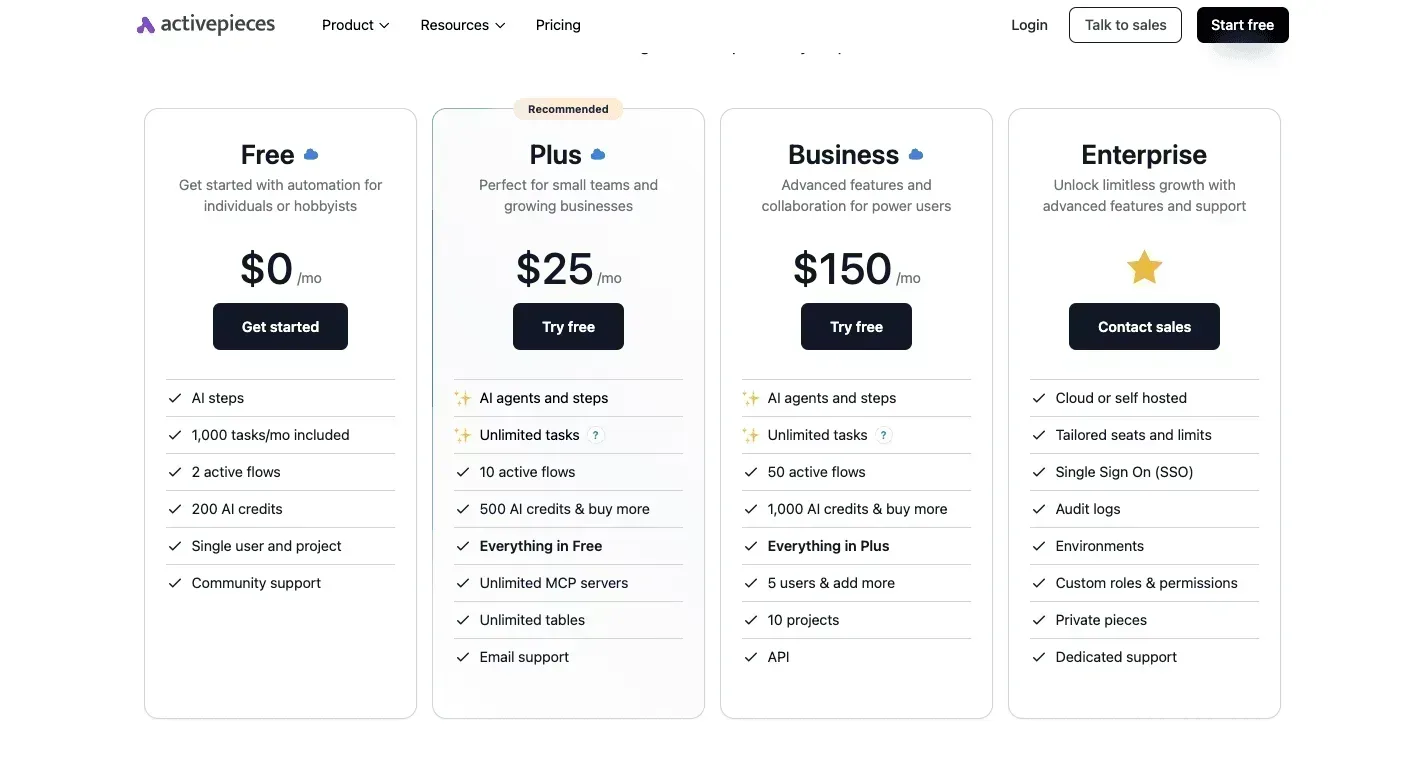
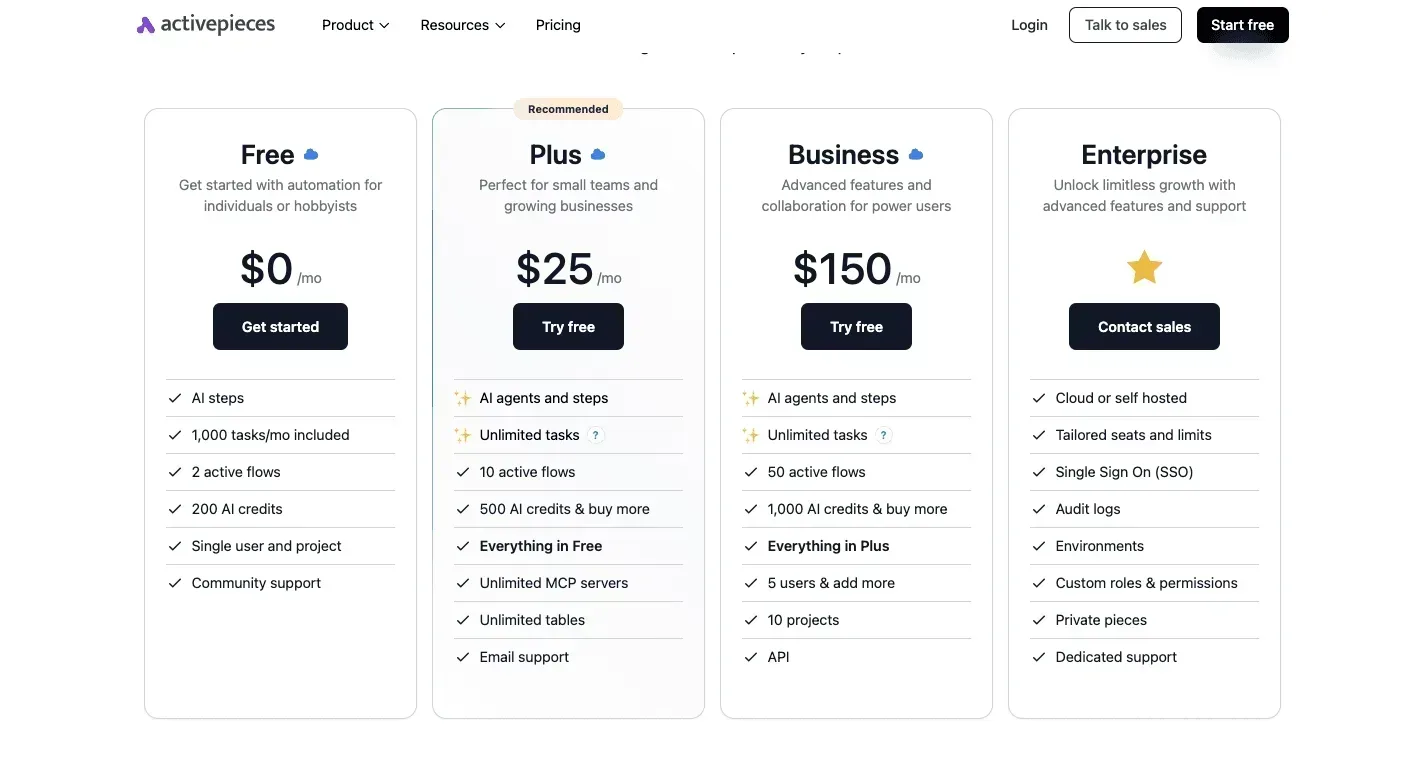
The Monday report is the kind of step that shouldn't draw on agent credits at all, and Activepieces never meters how many flows you build: the public pricing page lists unlimited flows from Free through Ultimate, and the only meter is credits per run, at 1 credit however many steps the run has.

Zapier bills a task per action and Make a credit per module, so there the tidy design, with fetching, formatting and the low-credit alert as separate small workflows, costs more each time it runs.
On Activepieces, splitting a fragile mega-automation into ten small flows adds nothing to the bill for existing.
Activepieces runs that Monday sequence on a trigger: you define the steps once, and it executes them the same way each time without re-deciding anything, with unlimited flows on the Free plan's 1,000 credits a month.
Separating fixed workflow steps from Manus agent work
Take a weekly report: pull last week's numbers, format them into a summary, post it to a team channel. Nothing in that sequence changes between runs.
Asking Manus to do it each Monday means paying for planning and tool selection that produce the same answer as the week before.
The cost per run is small, but it recurs, and a recurring cost with no variation's exactly what a fixed workflow exists to remove.
According to Activepieces, a flow is a trigger followed by a chain of steps, and it has a schedule trigger for time-based runs.
The flow below has four boxes in a line: scheduled trigger, pull data, format, send message. A branch off the line leads to a low-credit alert.
Beside it sits a separate Manus agent box, marked open-ended research. Read it as a dividing line: everything in the left-to-right chain's predictable and cheap to repeat, while the agent box's where the outcome depends on judgment.

That split's why this complements Manus rather than replacing it. A workflow cannot decide which sources matter for a question nobody has asked yet. An agent can. Put the agent on the open-ended work and keep it off the Monday report.
Manus credit alerts and spend approval
Tie the branch in that flow back to a spending rule.
A workflow can check a condition and route to a different step, so a low-credit warning can go to whoever owns the budget instead of surfacing mid-task, on your heaviest day, when the balance's already gone.
Pausing a flow to wait for a person to approve before it continues is covered in Activepieces's documentation too. Placed ahead of any step that would start a Manus run, that gives you a checkpoint: someone confirms the task's worth the credits before they're spent.
I wouldn't claim it enforces a hard cap, because the limit itself lives in Manus's plan, not in the workflow. What it gives you's a rule you can actually point at, written into the flow rather than remembered.
Team plan and spending rules
The team chose the lowest paid Manus plan whose monthly credits cover their steady weekly work, and put a cap and a weekly check on everything above it.
The arithmetic's credits per task times tasks per week, and the rule exists because the heaviest week breaks it.
Which plan covers each of the three uses
Weekly competitor research, occasional decks and daily briefings all run as predictable, repeatable tasks once the checkpoints from the previous section trim them.
The lowest paid tier on the pricing page at manus.im covers that baseline.
Because an open-ended query can burn credits that a briefing never will, research's the swing item. Decks are rare enough to absorb from the monthly allowance.
When the next plan up pays for itself
When your top-up spending in a month would exceed the price gap between the two tiers, the next plan beats top-ups.
Count it in credits: take the credits you bought on top of the base plan and compare them with the extra credits the next tier includes.
If top-ups regularly match or exceed that step, you're paying retail for what the upgrade sells wholesale. If only one month in a few overshoots, top up and stay put.
Run these five steps in order before the week's work starts:
- Review last week's credits used, task by task, and note which one ran heaviest.
- Set a credit budget for each recurring task, so research can't quietly eat the briefings' share.
- Set the alert threshold below the plan's monthly allowance, so the warning arrives while there's still room to react.
- Check the remaining balance against the plan break-even from the previous subsection.
- Decide: top up for a one-off overshoot, or upgrade if the overshoot's become the pattern.

Run it every Monday and the plan's reviewed before the work is, not after the bill.
Frequently asked questions
After the Monday review settles how much you spend, five billing questions stay open, and the answers belong in the rule before you pick a plan. Check each against the pricing page at manus.im, since terms change.
Is Manus free to use, or only free to try?
Free to try, yes; free to run a team on, no. Credits are consumed per task, so a real workload drains a free allowance fast. Run your heaviest realistic task once and see what it costs.

Can I cancel Manus or switch from monthly to annual mid-term?
Treat monthly as the plan you can leave and annual as a commitment until the billing terms say otherwise. The annual discount only pays off if your usage's steady, and usage that spikes on heavy days isn't steady.
Do unused Manus credits roll over?
Budget as if they don't. A plan that fits your average week only works if the slack carries forward, and an unused allowance that expires's money spent on nothing.
Does the Manus Team plan charge extra per seat?
With a shared credit pool on the Team plan, what matters's how seats and the pool interact. Pooling means one person running long tasks can leave colleagues short.
Check whether adding a seat adds credits, adds only access, or changes the price before buying. Set a per-person ceiling so the pool isn't drained by whoever starts first.
What monthly Manus budget suits a small team?
Set the budget at your heaviest recent week, not your average, then add a hard stop. Log what your three most common tasks cost in credits, multiply by how often your busiest week runs them, and buy the smallest plan that covers that total.
If you hit the ceiling often, the next plan's cheaper than repeated top-ups. If you never get near it, step down.
Related reading
References
Running the numbers
See what the same workload costs here.
Free forever plan, and every paid plan self-hosts at no extra cost.
See pricing Talk to sales