n8n Business Plan Pricing: What It Costs in 2026

Oct 26, 202613 min read
You pay for workflow executions on the n8n Business plan, not for seats or steps, a model that differs from per-task pricing in tools like Activepieces. n8n lists it at 667€ a month on annual billing, for self-hosting only.
It has the governance features the cheaper tiers lack.
The n8n Business plan is a self-hosted-only tier of the n8n workflow automation platform, billed by the number of workflow executions it includes each month rather than by user seats or workflow steps, and adding governance features such as those the lower tiers lack.
n8n Business plan features and pricing
n8n Business plan price and date checked
As of 26 October 2026, the figures here come from n8n's pricing page. The 667€ figure is the annual-billing monthly rate, so the cost is a commitment, not a pay-as-you-go number.
Because the plan counts executions, a workflow that fires constantly costs you more than one with many steps that fires rarely. I won't quote the allowance here, since n8n changes its tiers and a stale number in a budget is worse than none.
Read it off the page the day you buy.
Business versus Starter, Pro and Enterprise
Read the table for direction: SSO and version control are what separate Business from the cloud tiers beneath it. Treat the cells as a guide to where each tier sits, and confirm exact limits on n8n's page.
| Plan | Price | Executions | Active workflows | Projects | SSO | Version control | Support |
|---|---|---|---|---|---|---|---|
| Starter | Lowest paid tier | Small allowance | Capped | Minimal | No | No | Standard |
| Pro | Above Starter | Larger allowance | Capped higher | Limited | No | No | Standard |
| Business (self-hosted only) | $800/mo, annual | Larger again | Higher cap | Several | Yes | Yes | Standard |
| Enterprise | Custom quote | Negotiated | Negotiated | Broadest | Yes | Yes | Dedicated |
So if you need single sign-on or Git-backed environments, Starter and Pro are out regardless of how few executions you run. If you need dedicated support or negotiated limits, Business won't stretch that far.
Self-hosted Business versus cloud plans
Most people miss one detail: the listing is self-hosted only. Business is a governance tier but not n8n-run infrastructure, so you pay for the plan and also operate the servers, upgrades and backups yourself.
Without someone to own that, a team is buying a cost it hasn't priced.
**Business is a governance tier but not n8n-run infrastructure, so you pay for the plan and also operate the servers, upgrades and backups yourself.
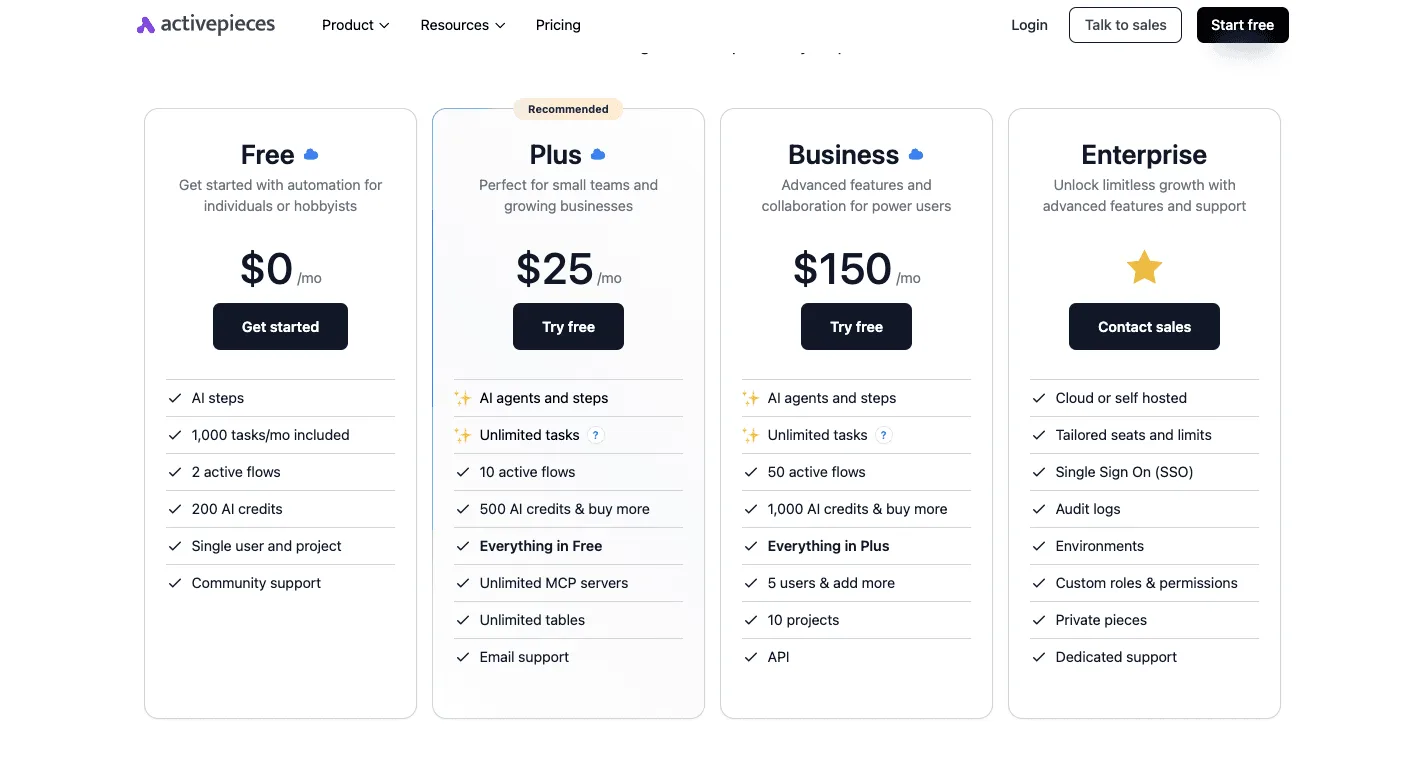
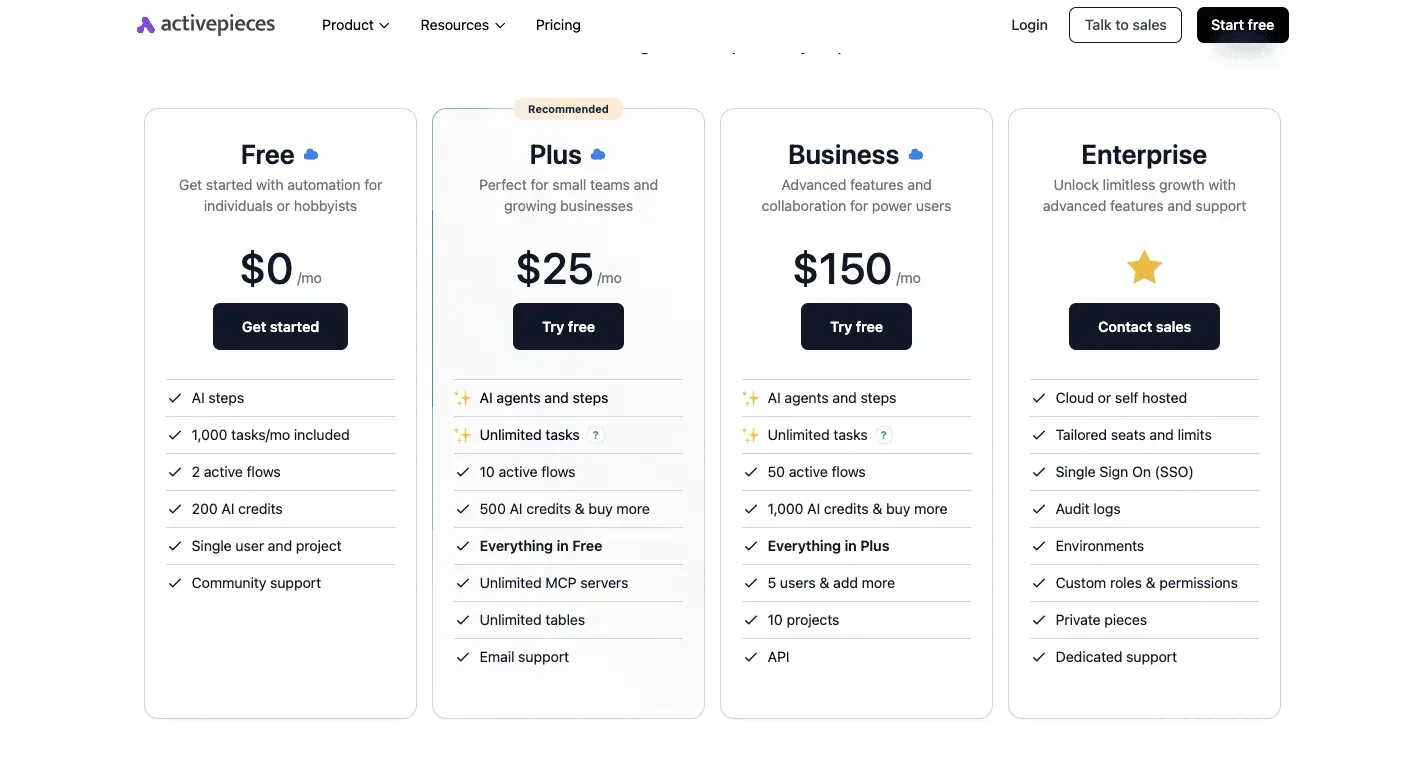
If you'd rather not run it, Activepieces Cloud's Team plan is $200 a month flat with SSO and 25 users included, so single sign-on doesn't have to mean operating your own servers.
If you are running this arithmetic for your own team, see what the same workload costs on Activepieces.
How execution counting and limits work
Three nodes or three hundred, a single run costs the same on Business, because n8n bills a whole workflow run as one execution. The thing to audit is how often your workflows start, not how long they are.
Adding nodes, branches or API calls inside that run doesn't add to the count.
Consolidate and you pay less: a long workflow is cheaper than the same logic split across several small ones, because each separate workflow that fires is its own execution.
Split a workflow, and each separate workflow that fires counts as its own execution.
Verify the "counts toward quota" column against the linked docs, because I've left the details to n8n's own wording rather than paraphrase them from memory. The table below lists the run types that matter.
| Run type | Counts toward quota | What the n8n docs say |
|---|---|---|
| Production trigger | Yes | Each triggered run is one execution |
| Schedule | Yes | Each scheduled firing is a run |
| Polling trigger | Check docs | Verify whether empty polls are billed |
| Sub-workflow call | Check docs | Verify against the executions page |
| Loop | No, within one run | Iterations stay inside the parent execution |
| Retry | Check docs | Verify how retried runs are recorded |
| Manual test | Check docs | Verify whether editor test runs are counted |
Read those "check docs" rows as a to-do list, not as answers. After you resolve them, the sections that follow explain which ones are worth designing around.
Polling triggers and retries that use n8n executions
Whether n8n records a run when nothing new turns up decides what a polling trigger costs, since it checks a service on a timer. If it does, a frequent poll quietly spends your allowance doing nothing.
Prefer webhooks where the source system supports them, and lengthen the poll interval where it doesn't.
When a workflow is set to retry on failure, one bad upstream hour can become many recorded runs. Retries carry the same risk. Look at your failure rate before you assume retries are free.
Also check the n8n changelog for any change to how these are counted. Vendors adjust counting rules.
What happens at the n8n execution limit
I couldn't confirm from n8n's pages exactly what happens at the monthly limit on Business: whether n8n blocks runs, throttles them or bills overage. Don't assume it degrades gracefully.
Ask n8n directly and read the current terms first if your workflows handle payments, customer messages or anything time-sensitive. A silent stop at the cap is an outage you scheduled yourself.

Mistakes when buying the n8n Business plan
Reading the plan name instead of the workflow design is the habit behind most of these mistakes. A silent stop at the cap is only the most visible result.
I've no confirmed figures for this section, so I give none, and I mark where the evidence is thin. Check each claim against n8n's pricing and licence pages before you rely on it.
Paying for n8n Business governance you don't use
When your team is small, one person deploys, and nobody outside engineering touches production, the governance features sit idle. Business is the tier aimed at governance: controlled environments, access controls and audit-style oversight, and the review process they support is one you don't have.
Pro may cover your case.
Write down which governance feature you'd switch on in the first month. If the list is empty, you have your answer.
I couldn't confirm exactly where n8n draws the line between tiers, so compare the feature tables yourself instead of trusting a summary, including this one.
Underestimating hosting and maintenance
Until someone owns it, self-hosting looks free. Upgrades, backups, database growth, queue workers under load, and the 2 a.m. restart all land on a person's calendar. Their salary is a real cost, and it rarely appears in the plan comparison.

For data residency especially, self-hosting can still be the right call, but price it as engineer time plus infrastructure.
The evidence here is thin: I've no published benchmark for admin hours, so use your own team's rates and be sceptical of anyone who quotes a universal number.
Misreading the n8n Sustainable Use License
Source-available is not the same as open source. n8n's source is available under the Sustainable Use License, which isn't an OSI-approved open-source licence.
In broad terms it permits internal business use but restricts selling n8n itself as a hosted service or embedding it in a commercial product.
Assume "open source" means "do anything" and you can walk into a compliance problem when you build a customer-facing product on it. I'm summarising, not interpreting legal text. If your use is anywhere near resale or embedding, read the licence and ask n8n.
A line each for two further errors. Reading unlimited steps as flat cost ignores that executions are what you pay for, so a workflow that triggers constantly costs more than one that batches.
And not budgeting for growth means the plan that fits today can hit its cap after one successful launch.
Worth checking against a plan that does not meter every step: one credit covers a whole run on Activepieces.
Where Activepieces fits next to the n8n Business plan
If a launch-driven execution cap is your real worry, or you need an MIT-licensed self-hosted option, Activepieces is worth a look; if neither applies, n8n Business is the simpler choice.
Activepieces' core is MIT-licensed and its open source monorepo holds 744 integrations; treat what follows as a way to frame the comparison, not a verdict.
Look at the table and two things separate the products: the licence and the metering unit. The price cells are yours to fill from each vendor's page on the day you budget.
| n8n Business | Activepieces | |
|---|---|---|
| Pricing metric | Workflow executions | A different unit; read it on its pricing page |
| Dated price | Take it from n8n's pricing page on the day you budget | Take it from its pricing page on the day you budget |
| Licence | Sustainable Use | MIT |
| Hosting | Check n8n's pricing and docs pages for the options on this plan | Self-hosted or vendor-hosted |
| Governance features | The reason to buy this plan | Check which controls sit in the open-source edition |
| Best fit | Teams that need governance and have predictable execution counts | Teams that need MIT licensing or a different metering model |
When n8n Business is the right call
Choose n8n Business when governance is the purchase. If an auditor or security team is asking for controls, you are paying for those controls, and a cheaper meter doesn't replace them.
It also suits you if your workflows are built so that one run does a lot of work, since per-execution pricing then works in your favour.
Unless you plan to embed or resell the software, the Sustainable Use licence is not a real constraint, and most internal automation teams never hit it.
When a different metering model matters more
The pressure to keep everything in one long workflow comes from counting each small workflow's firing as an execution.
Activepieces meters credits per run and never the number of flows, and its pricing page lists unlimited flows on every plan from Free through Ultimate, so breaking a fragile mega-workflow into ten small ones adds nothing to the bill.

Zapier charges a task per action and Make a credit per module, so on both, doing the job properly costs more with every run.
MoneyGram, Moneypenny, Alan and FundingSocieties run Activepieces in production, and the flows line on the pricing page is the thing to hold against your busiest real workflow, not an average one.
If legal review rules out Sustainable Use, or you plan to build the engine into your own product, the MIT licence matters too. The cost is that you must confirm, feature by feature, that the governance controls you need exist in the edition you'd run.
Checks before buying the n8n Business plan
Confirming feature by feature starts with six checks, and the first is one no pricing page can do for you: counting your own runs. Work through them in this order, because each one narrows the next.
- Export 30 days of run counts for every active workflow from your current instance's execution history, so any workflow behavior older than a month goes unseen. Thirty days catches a full billing cycle, including month-end jobs that a one-week sample misses.
- Sum those counts into a monthly estimate and compare it with the published execution cap. Add headroom for growth. A workflow that polls every minute may use a large number of executions a month, so check how your triggers are counted., so one badly designed trigger can use the allowance that a dozen well-built ones wouldn't.
- List the Business-only features you actually need, for example the governance controls from the previous section. Mark each as required or nice-to-have. Anything in the second group shouldn't be paying for the upgrade.
- Start a trial and run real workflows, not the demo ones, against those features. A control that works on a three-node example tells you little about your production setup.
- Read the licence. Pricing tells you what you pay, but the licence tells you what you may do with the software, including how you may embed or resell it.
- Reconfirm the price on n8n.io/pricing the day you budget, since plans and limits change.
Check the Start-up plan page too. It lists 333 € per month, a discount of 334 € per month off the Business price. That implies a Business list price of 667 € per month, so the discount is roughly half.

If your company qualifies, it changes the whole comparison. If it doesn't, you've avoided budgeting around a price you can't get.
Frequently asked questions
Is the n8n Business plan available self-hosted?
Yes, as far as n8n's pricing page shows: Business is positioned for self-hosting, with Cloud covered by separate plans. Confirm the current hosting options on that page before you budget, because n8n changes how it packages tiers.
If your answer depends on Cloud, check that Business is offered there too.
Does n8n Business charge per user?
No. The plan is priced by workflow executions, not seats. Adding a colleague doesn't raise the bill, but a badly built workflow that runs far more often than it needs to will. Measure your execution count first, because that's the number your cost follows.
Can I switch from Pro to Business later?
I can't point to a published n8n upgrade path, so I won't claim a one-click switch. Assume you'll need to plan a migration of workflows, credentials and any hosting changes.
Ask n8n's sales team, or read their documentation, before you commit to Pro as a stepping stone.
Is there a free trial of the n8n Business plan?
I can't confirm one, and a vendor's trial terms are the kind of detail that changes quietly. Look at the pricing page and the Business plan's sign-up flow. If no trial is listed, ask n8n directly whether you can test the governance features before paying.
Is the n8n Community edition enough for a small company?
It can be, if you don't need the governance features Business adds and you can run and maintain the server yourself.
On the free edition, workflows run fine. What it's missing is the access control, auditing and environment management that matter once several people touch production. If you can't name a requirement from that list, start with Community and upgrade when one appears.
Related reading
References
Running the numbers
See what the same workload costs here.
Free forever plan, and every paid plan self-hosts at no extra cost.
See pricing Talk to sales