n8n Free Plan in 2026? Community Edition vs Cloud

Oct 21, 202616 min read
What the n8n free plan actually is
Does n8n have a free cloud plan?
n8n has no free cloud plan. What it has is free software: the self-hosted Community Edition, which costs nothing to license but costs you a server and the time to keep it running.
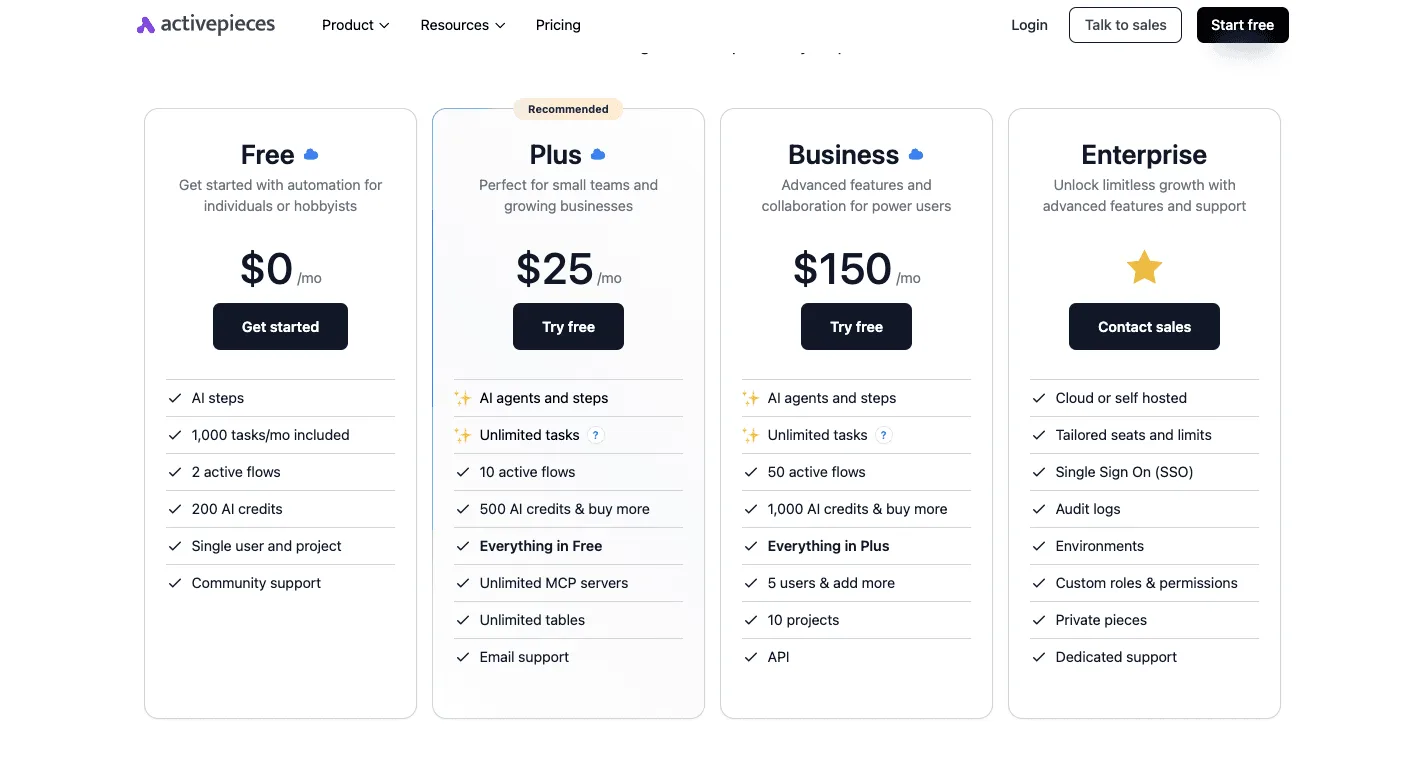
The n8n free plan is the self-hosted Community Edition, a version of n8n's workflow automation software that you can run on your own server without paying a licence fee, much like other open-source options such as Activepieces, but that leaves hosting, maintenance and updates to you.
When people sign up expecting a free tier and find a paid cloud subscription, they conclude the pricing page is hiding something. It isn't.
The free thing and the hosted thing are two different products that share a name. The question that matters is which of the two costs you less given who ends up maintaining it.
The free thing and the hosted thing are two different products that share a name.
Self-hosted Community Edition
If you run n8n yourself, you do it under the Sustainable Use License. That license lets you use and modify the source for your own internal business purposes.
It isn't an open-source license in the strict sense, so reselling n8n as a hosted product to others is off the table.
If your plan is to run your own automations, that restriction rarely bites. If you were hoping to build a service on top of it, read the license before you build.
What you give up compared with paid tiers is a short, specific list:
- Shared projects, so teams can't organise and share workflows and credentials under one project with role-based access
- Single sign-on, so logins stay local to the instance instead of going through your identity provider
- Support from n8n, so when it breaks at 1am, you're reading docs and forum threads
- Hosting, so the server, the updates, the backups and the uptime are all yours
Once more than one person touches the instance, the first two matter. The last two matter from day one, and they are where the "free" in free software turns into your own hours.
Activepieces has a free cloud plan at $0, with 1,000 credits a month, unlimited flows and no card needed, so teams that would rather not carry that weight can skip the server entirely, but the n8n question comes first.

Free trial versus free plan
A trial isn't a plan. n8n has offered trial periods on its paid cloud, and when the trial ends you either subscribe or lose the hosted instance. Nothing about that's permanent, and nothing about it's free in the way Community Edition is.
So the choice isn't "free versus paid." It's paying in money for the cloud, or paying in your own time for a server. The rest of this article works out which of those fits your team and your execution volume.
The fastest way to settle a shortlist is to try one. Activepieces is free to try, no credit card.
n8n Plans compared on price, executions and limits
Of five n8n plans, only the self-hosted Community edition costs nothing in licence fees. Every cloud tier bills monthly or annually and caps executions, so volume decides which one fits.
Plans compared on price, executions and limits
Read the table for two things: annual billing takes the same percentage off every cloud tier, and the caps, not the price, change most between tiers.
| Plan | Monthly price | Annual-billing price | Included executions | Shared projects | SSO | Support |
|---|---|---|---|---|---|---|
| Community (self-hosted) | $0 licence | $0 licence | No cap from n8n | Your own setup | No | Forum |
| Starter | $24 | $20 | 2,500 | 1 | No | Cloud support |
| Pro | $60 | $50 | 10,000 | 3 | No | Cloud support |
| Business | $960 | $800 | 40,000 | 6 | Yes | Cloud support |
| Enterprise | Custom | Custom | Custom | Custom | Yes | Dedicated |
Prices and plan limits checked against n8n.io on October 21, 2026.
Per ken.so:
- Starter runs $24 monthly or $20 annually, so annual billing saves $4 a month.
- Pro is $60 or $50, a $10 monthly saving, which means $120 a year.
- Business is $960 or $800, which saves $160 a month.

That's about 17% off each tier, so commit annually only if you're sure the plan will still fit in twelve months.
On the n8n pricing page, Starter is listed at 2.5K executions with unlimited steps and one shared project. One project means one team's workflows, so a second team needs Pro.
Business is a steep jump from Pro because it adds SSO. If you don't need single sign-on, you're paying $800 or more to get it.
How n8n counts an execution
One execution is one complete run of a workflow, however many steps it has. A 40-node workflow that fires once uses one execution, so nodes don't drain your cap.
Triggers do. A webhook receiving 100 events a day burns about 3,000 executions a month, which already exceeds Starter's 2,500. Count trigger events, not nodes, before you pick a tier.
What n8n costs at realistic usage
The bill follows from your trigger count. The licence costs nothing in every scenario; what changes is whether you pay a cloud subscription, your own server time, or both.
Read the cap marker before the bill.
The marker shows which scenarios stay on a cheap tier and which are pushed up by usage alone.
Each scenario's cap marker sits where its trigger count outgrows a plan, so that's the point to plan around.
A solo builder with a handful of scheduled and webhook workflows rarely approaches a cap, so the smallest cloud tier is usually enough. Self-hosting only wins if you already run a server and are happy to be the person paged when it dies at 1am.
Otherwise the saved subscription goes straight into your own maintenance time.
With five people sharing workflows and executions in the thousands, the cap starts to matter. Every webhook and scheduled run counts, so a busy team can cross a tier boundary without building anything new.
Here the deciding question is who owns upgrades, backups and credentials: if nobody does, cloud is cheaper than the outage.
High-volume workflows
Polling is what breaks budgets. A workflow that checks an inbox or API every minute burns executions whether or not anything changed, so a team running many of these hits the cap first and hardest.
Self-hosting removes the execution cap, but you now pay in server capacity, queue handling and someone's attention. Switching those polls to webhooks, where the source system supports them, often does more for the bill than switching plans.
Hidden costs and limits n8n users hit
On the plan page, the price is rarely the whole bill. Execution caps, licence terms and the hours you spend keeping a self-hosted server alive add the rest, and the hours are the largest part.
Because cloud plans meter workflow executions, a poll that fires every minute burns about 43,000 a month before it does any useful work.
Hit the cap and the next tier is a step, not a slope, so one chatty workflow can force you to pay for headroom you never use.
n8n is source-available under the Sustainable Use License, not an OSI open-source licence. Running it for your own business is fine.
Reselling it, or hosting it as a service for clients, is where you need a commercial agreement, so agencies should read the terms before building a client product on it.
Self-hosting n8n server and maintenance costs
Server rent is the cheap part. Automata AI lists Vultr at $2.50 a month, DigitalOcean at $4 and Hostinger KVM 1 at $19.49, so the cheapest option costs one-seventh what the priciest costs. Hetzner's CX22 is €3.79.
viz type=stackrank title="What a server to host n8n costs per month" unit="$ per month" source="Automata AI - https://www.automataai.com.au/blog/self-hosted-llm-devops-labour-cost-australia" target="1300" benchmark="Maintenance labour, low end: 1300"9.49 for Hostinger KVM 1, before any maintenance time." Vultr: 2.5 DigitalOcean: 4 Hostinger KVM 1: 19.49
Even the dearest is pocket change, so the hosting provider isn't what decides your cost.
Against maintenance time valued at $1,300 to $4,400 a month, the rent barely registers, which means labor, not infrastructure, is your dominant expense.
What you're paying for is docker compose pull going wrong at 1am: upgrades, backups you've actually restored, TLS renewals, and patching a box that holds your API credentials. If nobody owns those jobs, the free licence isn't free.
If you run an agent loop, it usually sits inside one execution, so it costs less than polling. The catch is retries, sub-workflows and one webhook per chat message, each of which counts separately.
Test an agent against real traffic before you trust a plan's cap.
Reading a table only gets you so far. Build the same workflow in Activepieces and compare it yourself.
n8n against its closest alternatives on cost
Of these four tools, n8n is the only one without a free cloud plan. A cap you hit on a free tier elsewhere becomes a server bill or a subscription here.
Free tiers side by side
Read the self-hosting and licence columns first: they decide whether "free" means software or a hosted account. The table shows what each vendor gives away and under what terms.
| Free allowance | First paid price | Metering unit | Self-hosting | Licence | |
|---|---|---|---|---|---|
| n8n | No free cloud plan | $20/month | Execution | Yes | Sustainable Use License |
| Zapier | 100 tasks/month | See vendor page | Task | No | Proprietary |
| Make | Free plan | See vendor page | Credit (formerly operation) | No | Proprietary |
| Activepieces | Free cloud plan | $16/month at mid step | Task | Yes | MIT core |

Zapier's 100 tasks disappear fast on any workflow with several steps, so treat it as a trial. Only n8n and Activepieces let you run on your own machine, and that's where your time becomes the cost.
How n8n and rivals meter usage and executions
A metering unit is what the bill counts. n8n counts a whole workflow run as one execution. Zapier counts each action step as a task, so the same ten-step workflow costs very different amounts across them.
On Activepieces' pricing page, the entry step is $20 a month on n8n against $0 on Activepieces, which means budget-constrained teams can still try Activepieces. That gap is the cost of having no free cloud tier.
At the mid step it's $50 against $16, which is a $34 monthly difference once a workflow is in production.
At the large step it's $800 against $166, so a team running high volume on cloud pays $634 more each month, a figure that would pay for a lot of server upkeep.

Those are list prices, and they don't include the hours someone spends patching a self-hosted instance.
Activepieces for the same job without n8n's caps
Licence and hosting
The Activepieces pricing page lists unlimited flows on every plan from Free through Ultimate; what it meters is credits per run, never how many flows exist. That matters because of the habit this article keeps returning to, the one fragile workflow that does everything.
Zapier charges a task for each action and Make a credit for each module, so on both, breaking it into ten maintainable integrations makes every run cost more. On Activepieces the ten flows add nothing to the bill by existing.

MoneyGram, Moneypenny, Alan and FundingSocieties run it, on an MIT-licensed core you can self-host or use on the free cloud plan.
That doesn't make the cost disappear. Self-hosting the MIT-licensed core of Activepieces still means someone patches it, watches the disk and restores it after a bad upgrade, which is the same server time the previous section priced for n8n.
What changes is the licence: MIT lets you modify and redistribute the code, where n8n's Sustainable Use License sets limits on commercial use. If you resell or embed automation, read both licences before you build on either.
Rebuilding a common job
Take a job that's common in n8n setups: pull new rows on a schedule, filter them, write the results somewhere else.
In Activepieces the trigger is the Schedule piece, and the next step can be Google Sheets, one of the 743 integrations in the open source monorepo and the destination here, so you can likely connect your scheduled workflows to the other tools in your stack.
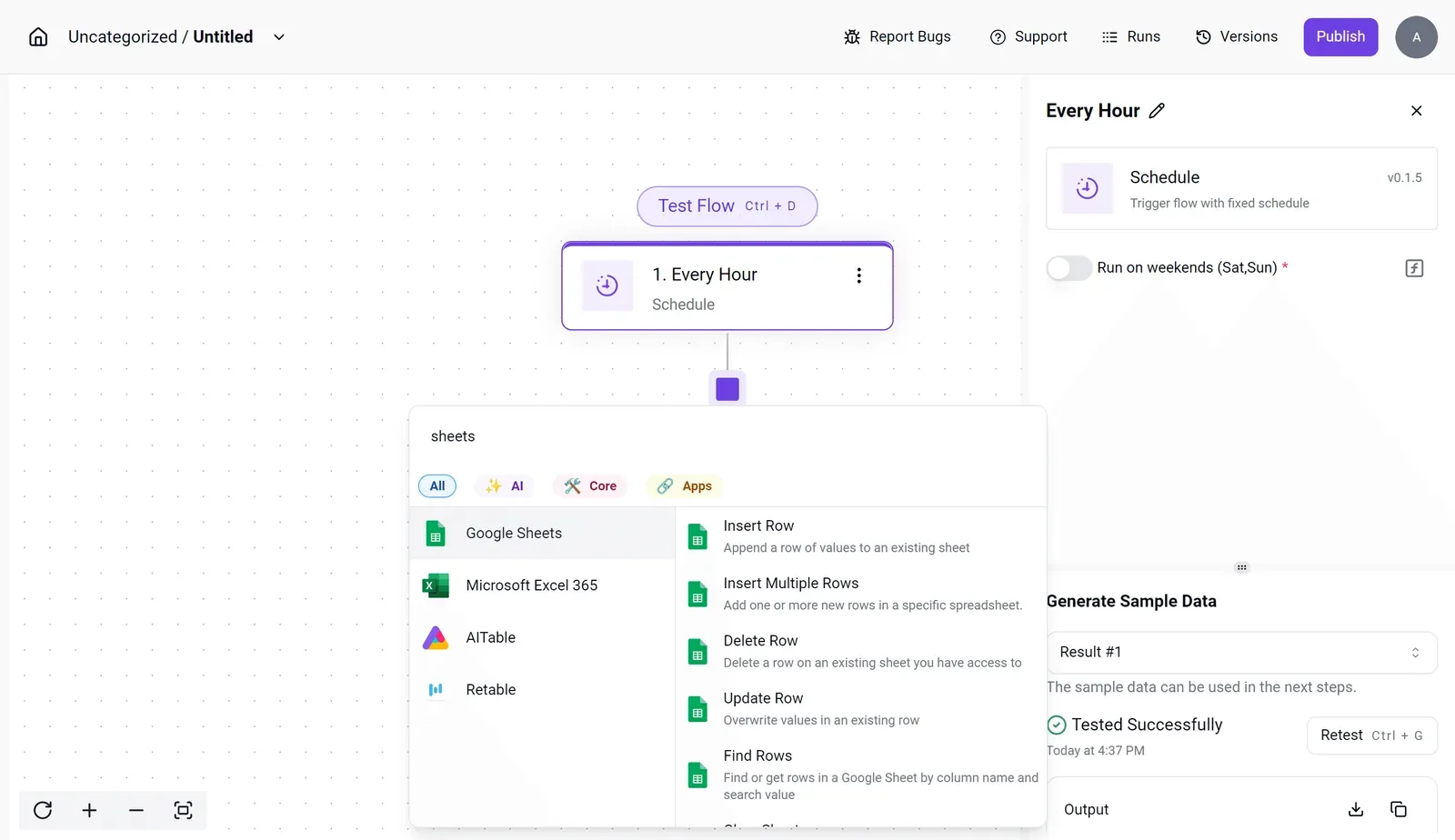
The builder below shows that start: an hourly Schedule trigger with a sample run marked as tested, and the step picker open on spreadsheet actions such as Insert Row and Find Rows.
Before you add the second step, you can test the first against real output. A broken trigger shows up at step one rather than after the whole flow is built.
For an AI step, the OpenAI piece slots in after the filter the same way as any other action.
Moving over from n8n
You rebuild this by hand.
Activepieces doesn't import or convert n8n workflows, so budget the time to recreate each flow, and treat the move as worth it only if the caps or the licence are what's hurting you, since what you get in return is an MIT-licensed core and unlimited flows on every plan.
Sign up for Activepieces on the free plan, which comes with 1,000 credits a month and no card, and rebuild one small workflow first to see how it behaves.
Choosing an n8n plan this week
I'm ready to complete sentences by adding what numbers mean for readers, but I don't see any sentences to work with yet.
Count your monthly executions, decide who maintains hosting, check licence fit, choose from the plan table, then set a usage alert and a review date.
Skip the order and you end up buying a tier based on a guess.
- Count monthly executions in the n8n execution log.
- Decide who maintains hosting.
- Check licence fit for commercial use.
- Pick the plan from the table.
- Set a usage alert and a review date.

Treat the list as the whole decision; the three subsections below cover the steps that need judgement, and the table in step four is where the answers land.
Count executions first
Open the execution log and count real runs for a full month, not the number you remember.
Failed runs and retries show up there too, and a noisy workflow that polls every minute can dwarf ten quiet ones, so a cap that looks generous on paper may disappear into one trigger.
Write the count down per workflow. That tells you which single workflow is driving the bill, and whether rewriting its trigger would change your plan.
Deciding who hosts your n8n instance
If you self-host, the licence costs nothing and your time doesn't. Someone has to apply updates, back up the database, watch disk and memory, and be awake when a workflow stalls. If that person is you and you already run servers, it's cheap.
If nobody on the team owns it, the cloud subscription is the price of not having an on-call rota for an automation tool. Name the person before you choose; "we will figure it out" is how backups never get tested.
Checking the n8n Sustainable Use License fits
Under n8n's Sustainable Use License the source is available, but it isn't an OSI-approved open source licence. Using it to automate your own business is generally fine.
Reselling it, hosting it for clients as a product, or embedding it in something you sell is where you need to read the terms or ask n8n directly.
Do this before you build, because migrating forty workflows after a licence problem is a worse week than reading one page now.
Once those three answers are in hand, the table in step four stops being a menu and becomes a lookup. Step five is what keeps it honest: set an alert before you hit the cap, and put a review date in the calendar.
Frequently asked questions
Is n8n really free forever? The software is free to self-host, but that's the licence, not a promise about your bill. You still pay for the server, the backups and the hours you spend patching it. The cloud product is a paid subscription.
Client work and licensing
Usually yes, if you're using it to run your own or your client's internal automations. The Sustainable Use License restricts selling n8n itself, such as hosting it for others as a service or charging for access to it.
Building workflows for a client on an instance the client owns is the safe pattern. If your setup is anywhere near the line, read the licence text before you ship.
Pricing, limits and trials
Does n8n charge per workflow or per execution? Per execution on the cloud plans. One full run of a workflow counts once, however many steps it has.
A tidy workflow with twenty nodes costs the same as one with three, so the number to watch is how often things trigger, not how many workflows you have. A polling trigger that fires constantly will use your allowance quietly.
What happens when I hit the n8n execution limit? Read n8n's current pricing and docs for the exact behaviour on your plan, because it's the detail most likely to change. Don't assume you get a soft landing.
Treat the cap as something that can stop production workflows, and set the alert from the earlier step so you find out from a dashboard, not from a client.
Is there an n8n free trial without a credit card? n8n offers a trial on its cloud product, but whether it asks for a card is a sign-up-page detail you should check on the day.
Self-hosting the Community Edition needs no card at all, because there's no billing relationship. Your cost there is the server you run it on.
Related reading
References
Still comparing
The fastest way to settle it is to build something.
Open source under MIT, so you can self-host the same thing later.
Start free Talk to sales