
n8n License: Fair-Code, Community, Enterprise (2026)

Oct 21, 202614 min read
The n8n license is the Sustainable Use License:
- It's source-available, not OSI open source: - It permits internal business use but not reselling, embedding or hosting n8n for others
- Files marked as enterprise sit under a separate n8n Enterprise License that needs a paid key
n8n Sustainable Use and Enterprise licenses
Is n8n open source? The short answer
If you run n8n to automate your own company's work, the license lets you. If your plan involves charging someone else for n8n itself, or putting it inside a product you sell, you're outside the plain reading and need n8n's written permission.

Teams comparing self-hosted tools, including Activepieces, tend to start with this question.
Sustainable Use License versus the Enterprise License
n8n has two licenses split by file, and only the Enterprise one needs a paid key. Most of the codebase is free to run internally, while the marked enterprise files are not.
The Sustainable Use License covers the main n8n codebase, outside files marked as enterprise. It's not OSI open source, and it needs no paid key.
The n8n Enterprise License covers files marked as enterprise (.ee. in the file name). It's not OSI open source either, and it needs a paid key.
Why n8n is called fair-code, not open source
Call it fair-code if you like, as n8n does: a label for software whose source is public but whose use carries limits. The Open Source Initiative's definition doesn't allow restrictions on how software is used or who may commercialize it.
Whatever the repository looks like, a license that restricts hosting or resale fails that test. Source-available is therefore the accurate term.
Everything below works on Activepieces' free plan. Start without code or a credit card.
What the Sustainable Use License lets you do
As written, the license permits four uses, and each one rests on the word "internal" or "non-commercial" rather than on how large you are or how much you earn.
The grant allows you to use, copy, distribute and modify the software, with conditions attached to each purpose.
The list below is the whole of what the text allows:
- Internal business use
- Personal or non-commercial use
- Free non-commercial distribution
- Consulting that builds workflows on a client's own instance
Internal business use
If you self-host n8n to automate your own operations, such as syncing records between your own systems, routing your own support tickets or generating your own reports, you sit inside the grant. The license covers using n8n for your own company's internal business purposes.

Ask whose process the workflow automates: if it serves your organization and its output isn't the product someone else pays for, you're using it internally.
Personal and non-commercial use
The license permits personal and non-commercial use on the same terms. A home automation, a hobby project or a community tool you run without charging anyone falls inside the grant.
The license also allows free distribution for non-commercial purposes, so you may share a workflow or a modified copy at no charge. The word to watch is "free": the moment money changes hands for the thing you distribute, you've left this clause.
Using n8n for client workflows and consulting
When you build workflows on a client's own instance, the license permits it as consulting. The client holds the installation; you supply the labor.
What matters is who operates the instance.
If you build on infrastructure the client runs and controls, you're a consultant. If you run it for them and they log in to your deployment, you're hosting n8n for others, and that's the restricted case the next section examines.

What the license does not let you do
You can't sell n8n, charge for access to an instance, or ship it as part of a product, and you must leave its notices intact.
Everything below is a consequence of one narrow sentence in the grant: "You may use or modify the software only for your own internal business purposes or for non-commercial or personal use."
Reselling or hosting n8n for others
Hand it to anyone else and the terms are narrow: "You may distribute the software or provide it to others only if you do so free of charge for non-commercial purposes."
Charging a client a fee to log in to your instance is not free of charge. Neither is bundling it into a paid managed-service package.
The same applies to a "free" instance that is a loss leader for a paid offering. If the customer's access is what you bill for, you're outside the grant.
Embedding n8n inside your product
Say n8n is the value your product delivers, for example a white-labelled automation builder inside your app. That is embedding.
The license states: "You may not alter, remove, or obscure any licensing, copyright, or other notices of the licensor in the software." Stripping n8n branding to make it look like yours therefore fails twice.
Because n8n's position is that embedding requires a separate commercial agreement with them, the community license can't cover it however you configure it.
Using enterprise-only features without a key
Not all of the repository sits under one license. n8n's separate Enterprise License covers code with the enterprise marking in its file names, and its features need a paid key in production. Having the source on disk doesn't entitle you to use those features.
Before you build around a capability, check whether it's enterprise-marked. If it is, the cost of the key belongs in your plan from the start.
n8n pricing for Community, Cloud and Business
On Community the key costs nothing, and on Cloud it runs €20 to €667 a month, depending on tier and billing; n8n quotes Enterprise individually, so you'll need to contact sales to know what enterprise costs.
The figures below come from the n8n pricing page, checked 21 Oct 2026.
n8n plans compared in a table
Read the table tier by tier: each step up buys a higher execution cap and more shared projects. SSO and LDAP appear only at the top two tiers, so identity control is a Business-level cost.
| Plan | Price per month (annual billing in brackets) | Executions | Shared projects | SSO/LDAP |
|---|---|---|---|---|
| Community | Free, self-hosted | Not capped by n8n | No | No |
| Cloud Starter | €24 (€20) | 2.5K | 1 | No |
| Pro | $50 | 10K | 3 | No |
| Business | $800 | 40K | 6 | Yes |
| Enterprise | Custom quote | Custom | Unlimited | Yes |
Pay annually and you save €4 a month on Starter, €10 on Pro and €133 on Business, meaning the real savings only appear if you're committing to Business. Prices change, so confirm them before you commit.
One execution is one complete run of a workflow, however many steps it contains. A twenty-node workflow therefore costs the same as a two-node one, so trigger frequency drives your bill, not workflow size.
n8n Cloud execution limits in practice
Poll every five minutes and a workflow runs 288 times a day, about 8,640 a month. That alone is more than three times Starter's 2.5K cap, and it takes roughly 86% of Pro's 10K, so a couple of such workflows exhaust Pro and push you toward Business.
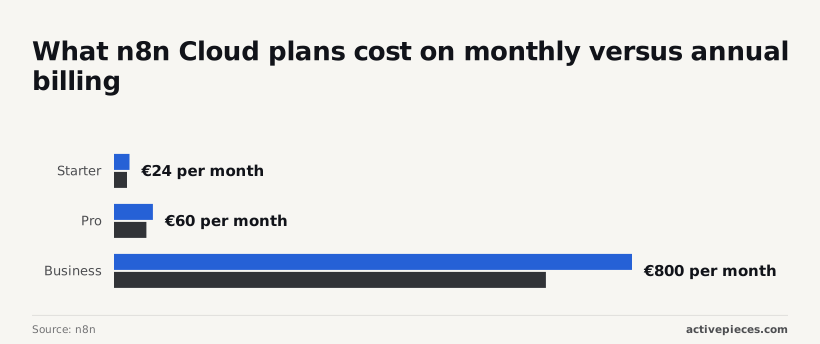
Two or three polling workflows push you toward Business at $800 a month, or toward self-hosting, so you'll be committing to significant monthly costs before scaling much.
Self-host and the execution cap goes, but the license question stays. Community has no SSO and no shared projects, and the moment those become requirements you're buying a paid tier either way.
Easier to see it running than to read about it: set it up free, no card.
Six n8n license mistakes teams make
Six mistakes come up, and every one comes from classifying the use after the build instead of before it.
Assuming fair-code equals MIT
Self-hosted doesn't mean unrestricted, because the Sustainable Use License says: "You may use or modify the software only for your own internal business purposes or for non-commercial or personal use."
The fix is to test each deployment against "internal business purposes" and write down the answer.
The same error produces the enterprise one. Features such as SSO are covered by n8n's separate enterprise terms, so enabling them on Community without a paid licence is unlicensed use. If you need them, buy the tier.
Charging customers for access to workflows
When customers log in to n8n through a paid client portal, or pay for the workflows themselves, that isn't an internal business purpose. You're selling access to the software's function.
The fix is to keep n8n behind your own service: the customer buys your outcome and never touches n8n. If that boundary is blurry, treat the case as unresolved and go to the last heading.
Shipping n8n inside a product
Bundle n8n in a SaaS product or an appliance and you're distributing it. The license permits that only "free of charge for non-commercial purposes," so a commercial bundle is outside the grant.

A fork changes nothing, and the license also forbids you to "alter, remove, or obscure any licensing, copyright, or other notices."
Obtain a commercial agreement before shipping, and keep every notice intact in any copy you do pass on.
Your reading of the license isn't a control; n8n's written answer is. When a use sits between internal and resale, ask n8n, keep the reply, and file it with the architecture decision. Asking costs one email, while a wrong guess costs a rebuild.
Your reading of the license isn't a control; n8n's written answer is.
Checking your n8n use against the license
Run four questions in order and stop at the first one that trips: each moves you from what the license plainly allows toward what needs a written agreement with n8n.
Read the list below top to bottom, and write down your answer to each before you build. It sorts a deployment by who touches it, where money flows, and what n8n's role is.
- Who uses the instance? If only your own staff run and edit workflows, you're in the license's intended territory. If customers, clients or outside parties log in, keep going.
- Who pays whom? If nobody pays you for access to n8n or for running it, the answer is clean. If a client pays for a hosted instance, or a fee depends on n8n being there, that's the line the license restricts.
- Is n8n the product or the plumbing? Automating your own invoicing is plumbing. Shipping n8n, or its editor, inside something you sell makes it part of the product.
- Do you need enterprise features? Anything n8n gates behind a paid plan needs that plan, even for internal use.
Which n8n license option fits your use
Stay on Community if only your staff use the instance, no one pays for access, n8n is plumbing and you need no gated features. Buy Cloud or Business if your internal use needs gated features, or you'd rather not run the infrastructure.
Get an Embed agreement if customers use n8n inside your product or you host it for them, and obtain it in writing before launch. Consider a different tool if the commercial terms don't fit your model, and choose software whose license matches the use.
Running the same job in Activepieces under an MIT core
Evaluating embedding reselling or hosting options
If your answer was embedding, reselling or hosting for clients, Activepieces ships its core under the MIT license, so it lets you run, fork, resell or embed that core.
Its 743 integrations sit in the same open source monorepo, and MoneyGram, Moneypenny, Alan and FundingSocieties run it in production, on a core that is MIT-licensed rather than source-available like n8n's, which means you can freely fork and modify it without vendor restrictions.
Its core is released under the MIT license, which is an open source license and permits commercial use, modification and redistribution.
Set it against n8n and the contrast is the restriction on offering the software to others, the very clause that sent you here.
Check the repository's license file for any parts that sit outside the MIT core before you build on it, since "MIT core" is a statement about the core and not about every directory.
Ways to try n8n for free
Three things are on the table. There's a free cloud plan that asks for no card, so you can classify your use by building a real flow before you commit to anything.
Self-hosting is available if the data has to stay on your infrastructure.
And the apps most automations start with have their own pages: Gmail, Slack and Google Sheets are all listed under activepieces.com/integrations, which shows what each one can do before you open the builder.
What the builder shows
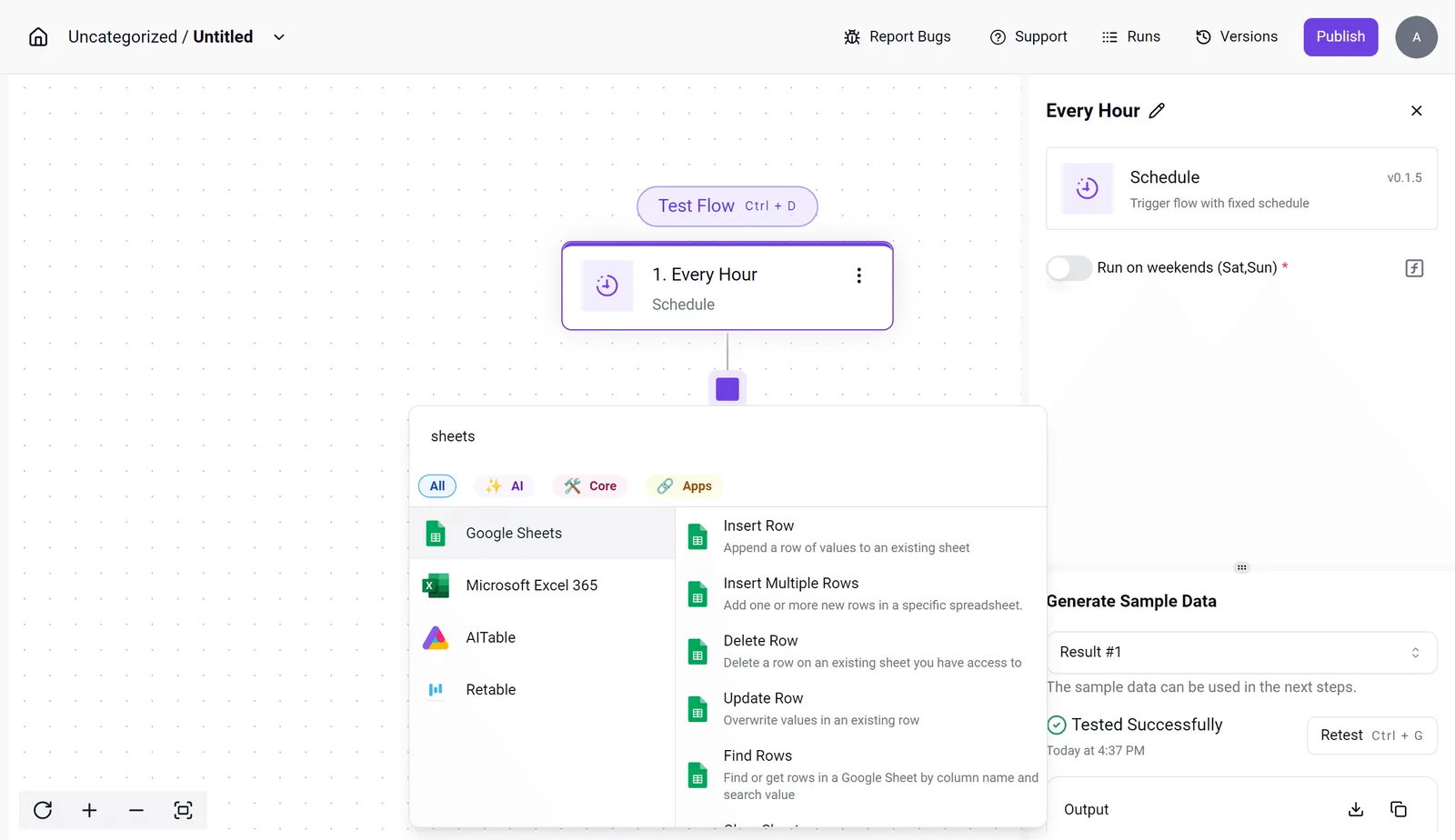
Below, the builder screen shows the scale of the job. A Schedule trigger labeled "Every Hour" is selected, and a "Run on weekends" toggle sits in its settings.
The integration selector is open on spreadsheet apps, with Google Sheets listing actions such as Insert Row, Update Row and Find Rows.
The "Generate Sample Data" panel shows a successful test result, so you see the trigger fire before you wire anything to it.
The cost of switching
Be plain about the cost of switching: your n8n workflows must be rebuilt by hand. Activepieces doesn't import or convert them, so budget for reconstruction, not migration.
When you're ready to test, create a free Activepieces account and rebuild one small workflow first.
Frequently asked questions
Licensing basics
Is n8n open source? No. n8n is source-available under its Sustainable Use License, which lets you read and modify the code but limits what you may do with it.
The Open Source Initiative's definition doesn't permit those limits, so the "open source" label doesn't apply.
Can I use n8n for my company's internal automations for free? Yes, for the self-hosted Community edition. The license permits use "only for your own internal business purposes or for non-commercial or personal use."
Connecting your own CRM to your own billing system is internal. Anything that exposes n8n to your customers as a product isn't.
Clients, hosting and commercial terms
Can a freelancer build n8n workflows for paying clients? Generally yes, when the work is building. Paid design and configuration of workflows that run on the client's own instance sits closer to the client's internal use.
The risk starts when you host n8n for the client and charge for access. Classify the arrangement before you quote.
Does the license change if I self-host on my own server? No. The license attaches to what you do with the software, not where it runs.
Self-hosting for your own business stays within the terms. Self-hosting so that others can use n8n as a paid service, or inside your product, doesn't.
Where do I get a commercial license for embedding n8n? From n8n directly. Embedding, reselling and hosting n8n for third parties fall outside the standard license, so the terms come from n8n's sales team under a separate agreement.
Don't assume a figure or scope from a forum post. Get the permitted uses in writing before you build on it.