
n8n Pricing 2026: Plans, Free Tier & Costs Explained

Oct 10, 202614 min read
Instead of charging for the complexity of your logic, n8n utilizes an execution-based model where the volume of successful workflow runs dictates your monthly costs.
This structure favors you as a technical architect, since you can consolidate multiple tasks into a single execution, effectively lowering your cost per operation compared to task-based competitors.
Ossinsight shows how n8n Cloud segments its capabilities to balance accessibility for developers with the reliability requirements of production environments.
n8n Pricing Plans and Feature Limits
| n8n Cloud Tiers 2026 | Monthly Price (Annual) | Included Executions | Active Workflows |
|---|---|---|---|
| Starter | $20 | 2,500 | 5 |
| Pro | $50 | 10,000 | 15 |
| Business | $800 | 40,000 | 40 |
Prices and plan limits checked against n8n.io on October 10, 2026.
By defining the operational ceiling for your automation stack, these tiers determine how frequently your systems can sync data before you hit hard stop limits.
n8n starter plan workflow and feature limits
When you have simple synchronization tasks, the Starter plan acts as a low-cost entry point. Its limit of 5 active workflows means you must prioritize high-value automations over comprehensive business coverage.
According to neomanex, n8n offers 400 native integrations, providing a broad ecosystem for users to connect their existing software stack without custom development. This is significantly fewer than the 9,000 offered by Zapier.

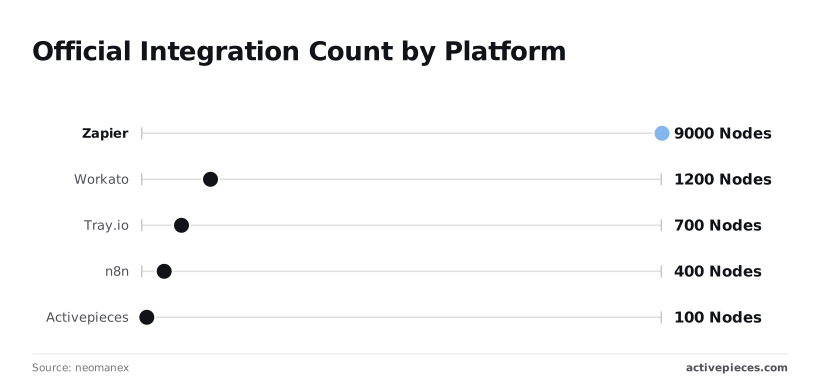
Because of this gap, you are required to frequently build custom HTTP requests for niche SaaS tools, which means you'll face a steeper learning curve to achieve basic automation parity.
This $20 price point undercuts enterprise-grade middleware like Workato, which maintains 1,200 integrations but at a much higher cost of entry, effectively positioning n8n as the budget-friendly alternative for scaling businesses.
n8n pro plan execution limits and pricing
By increasing your execution limit to 10,000 per month, the Pro plan allows for polling intervals as frequent as every four minutes for a single critical process.
With 15 active workflows, you can move beyond business-critical CRUD operations into multi-step logic involving advanced models like Claude Sonnet 5.5 for data transformation.
The run is the meter, not the steps inside it. Activepieces offers unlimited flows on every plan, including free, and meters only the underlying AI usage via credits rather than the workflow steps themselves.
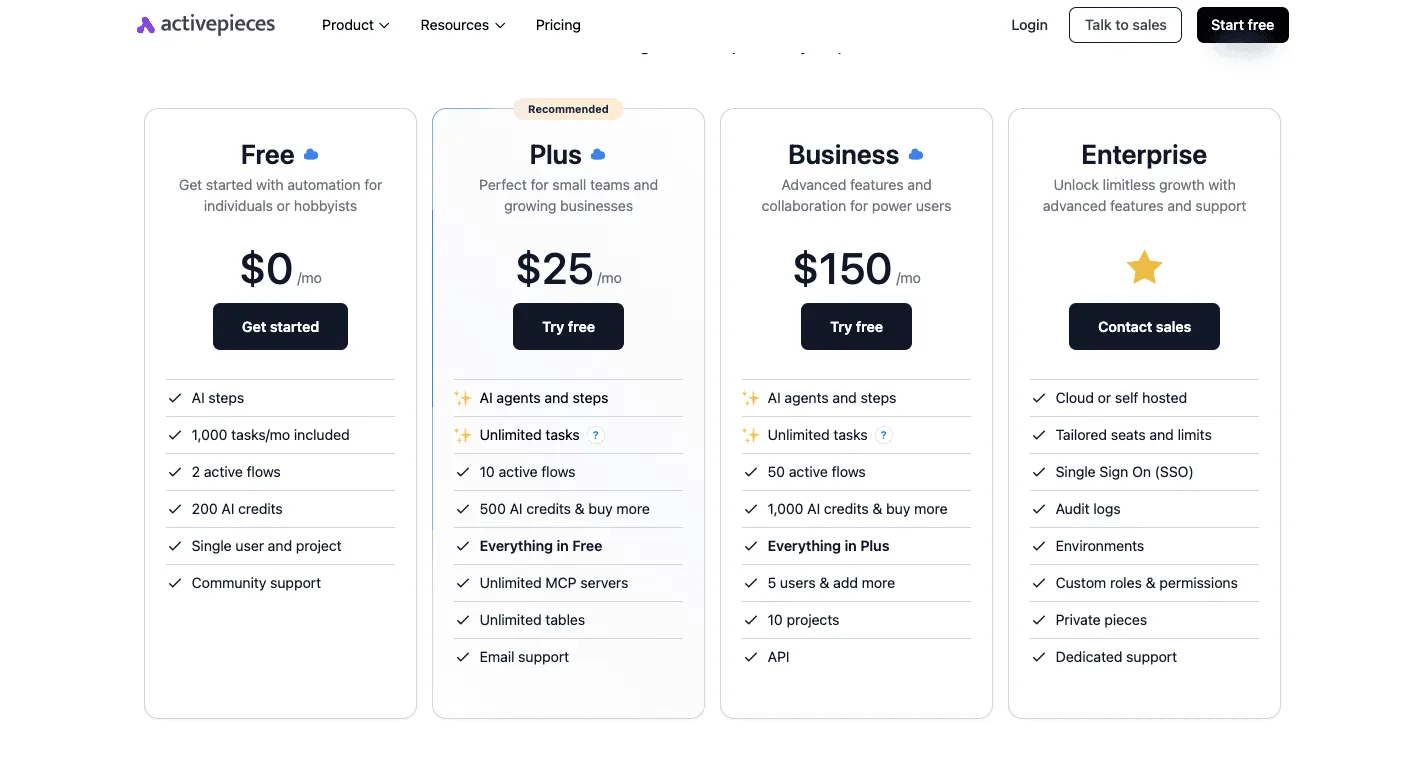
This allows teams to build reliable, multi-step processes without the per-task costs found on Zapier or Make, ensuring the meter only runs when the work starts.
n8n power plan executions and pricing
Production-grade reliability is the focus of the Business plan, which offers 40,000 executions for high-frequency webhooks and large-scale data migrations.
At this scale, n8n competes with Tray.io, which offers 700 integrations, by providing a more flexible environment for developers who prefer code-heavy nodes over rigid UI connectors.
Even complex setups can map out your entire lead-to-cash lifecycle without hitting architectural bottlenecks thanks to the 40 active workflow limit.
If you are running this arithmetic for your own team, see what the same workload costs on Activepieces.
The Real Cost of Self-Hosting n8n vs Cloud
What the free self-hosted version excludes
When you self-host n8n through its Community edition, you get the core workflow engine but lose the administrative layer required for multi-user governance.
Access to the external authentication provider (LDAP/SAML) interface is restricted by the FairCode license. The execution engine remains identical to paid tiers, but you'll have to manually manage local credentials for every contributor.
You will not find environment variables management within the UI in this version. Because of this omission, you are forced to restart the entire Docker container to update sensitive keys for services like the GitHub version control API or the Stripe payment gateway.
Using environment variables in n8n Community edition
This UI restriction is a specific limitation of the Community edition rather than a permanent barrier to secure variable usage. You can still reference keys defined in your Docker environment by using standard expressions within any node field.
By calling the environment object directly, you maintain security without needing a dedicated management interface. A practitioner simply uses the syntax to pull values like API tokens or database passwords directly into the workflow logic at runtime.
This approach ensures that sensitive data remains outside the workflow JSON itself. While the Enterprise self-hosted version provides full UI-based variable management, Community users are expected to manage these values via the CLI or a .env file.
Hardware and maintenance overhead costs
Perceived savings of a free license are often offset by the operational burden of managing the underlying infrastructure and database persistence.
Running n8n on a virtual private server requires dedicated memory for the Node.js process and a robust PostgreSQL instance to prevent execution logs from bloating the disk.
While the Community edition is free to download, the Enterprise self-hosted version requires a paid license fee to n8n despite being hosted on your own hardware.
| Feature | n8n Community | n8n Enterprise | DIY VPS Hosting |
|---|---|---|---|
| User Authentication | Local credentials only | SAML/LDAP integration | Local credentials only |
| Maintenance Path | Manual Docker pulls | Support-led upgrades | Manual OS/Docker patching |
| Scalability | Single-node limit | Multi-node worker queues | Vertical scaling only |
Unless you maintain a rigorous backup strategy for your internal database, a single disk failure can erase months of automation logic.
n8n enterprise plan pricing and features
If you require network isolation or high-availability clusters to support mission-critical production traffic, enterprise licensing is the only path.
Deployments into private clouds or restricted subnets are enabled by the Enterprise tier's use of external worker nodes.
Air-gapped means full control, not a fraction. Activepieces provides the same list of enterprise features (including SSO, SCIM, custom RBAC, and secret managers) in its self-hosted air-gapped documentation as it does in its managed cloud.
Regulated organizations like MoneyGram and FundingSocieties run this edition in production today to maintain total data sovereignty without losing administrative governance.
Hidden Costs in the n8n Credit System
Because complex logic directly increases your monthly bill, the n8n credit system shifts the financial burden from the number of active workflows to the frequency of node operations.
How n8n counts workflow executions
An execution is defined by n8n as the completion of a workflow path. Credit consumption is often non-linear because the engine handles data arrays.
One execution is counted for a simple trigger-to-action sequence. Unlike task-based platforms, n8n does not charge for every node that runs within a single workflow instance.
A loop within a single workflow run still counts as one execution. Using a Split-in-Batches node to process hundreds of items does not multiply your bill, provided the logic remains contained within that specific run.
This architecture encourages you to build comprehensive loops without fear of a credit leak. A single incoming webhook from a source like a Shopify store results in only one billed execution, even if that order contains dozens of line items requiring individual processing.

In a single afternoon of debugging with a production-scale dataset, you can test complex logic without exhausting a monthly credit quota.
The engine handles data arrays in a way that allows you to design patterns where you aggregate data into single-node operations, such as using a custom code node to batch API calls, to maintain high throughput within a single run.
The price of additional execution blocks
No immediate service shutdown occurs when you exceed the base execution limit. Instead, the system triggers the purchase of additional execution blocks.
A pricing staircase is created because these blocks are sold at a fixed rate, meaning a minor increase in traffic can force a jump into a significantly higher cost bracket.
Data retention and log storage costs
While detailed execution logs are essential for debugging asynchronous flows, n8n ties log retention duration to specific pricing tiers.
Execution data is purged quickly on lower tiers. Moving to higher enterprise tiers is required to extend this window or increase the storage limit for binary data. This effectively turns data persistence into a recurring operational tax.
Worth checking against a plan that does not meter every step: one credit covers a whole run on Activepieces.
n8n vs Zapier and Activepieces: market positioning
Activepieces addresses the scaling bottleneck by offering an MIT-licensed core that permits unrestricted self-hosting without the execution-based credit limits found in n8n’s proprietary tiers.
This architectural choice removes the financial penalty for high-frequency polling or heavy data transformation. Your infrastructure costs are decoupled from the software license.
n8n vs Zapier integration count comparison
The utility of these platforms is defined by their native connector libraries. Zapier maintains a significant lead in long-tail SaaS support.
For technical tools like the GitHub version control system or the Postgres relational database, n8n focuses on deep, node-based flexibility.
Activepieces targets a middle ground with 738+ integrations, roughly 60% of which are community-contributed. Choosing Activepieces or n8n often means trading out-of-the-box connectivity for the ability to write custom TypeScript or JavaScript functions.
Price per execution comparison
Among technical tiers, n8n provides the Task density and entry price.
This efficiency allows you to run complex, multi-step logic, such as routing leads via the Salesforce CRM or summarizing documents with the Gemini 3.8 Flash LLM, at a fraction of the cost required by Zapier’s Professional plan.
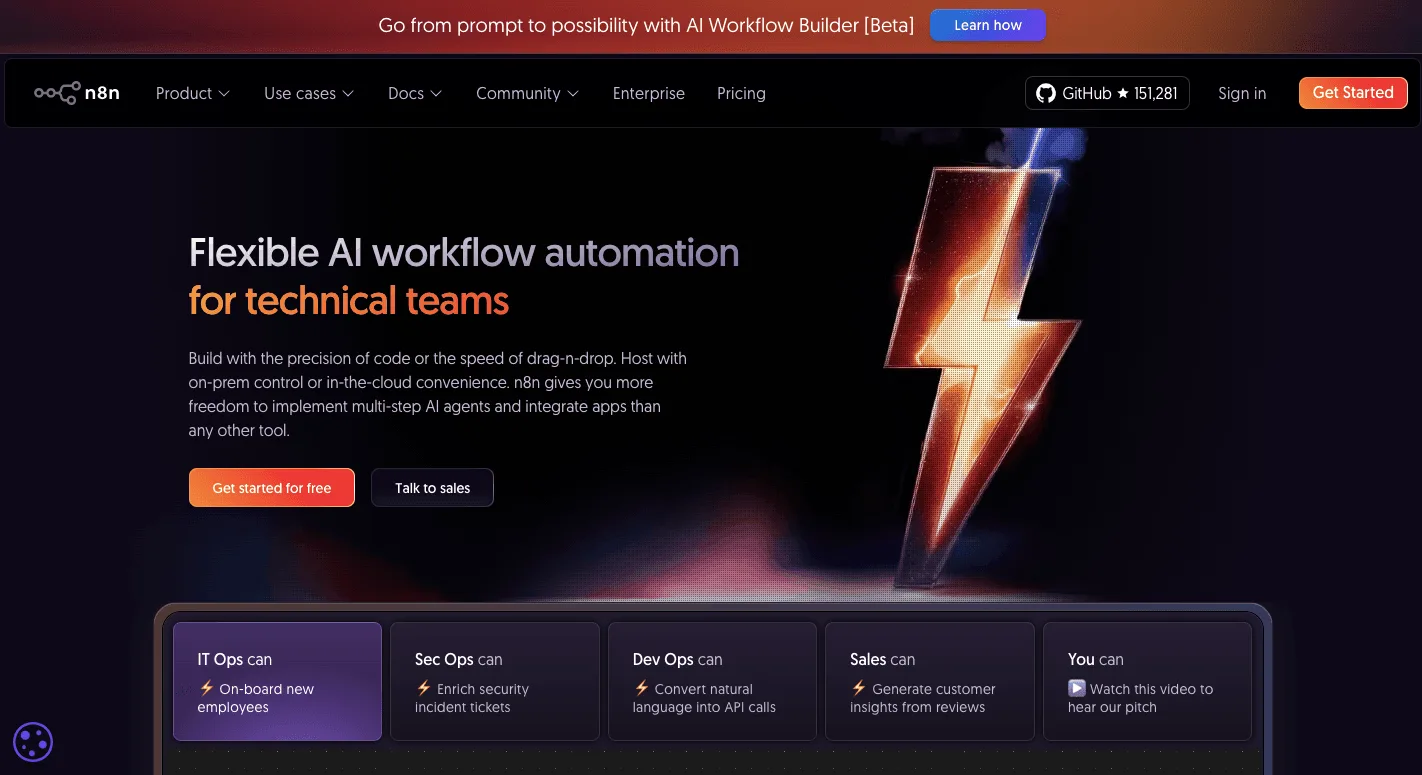
If you've outgrown the basic automation of Make but can't justify the enterprise overhead of legacy iPaaS providers, n8n remains the middle-market option.
License restrictions and data sovereignty
Your choice between these platforms is often dictated by data sovereignty requirements. n8n’s FairCode license restricts certain commercial redistribution rights that the Activepieces MIT license explicitly allows.
Sensitive PII never leaves your internal network when you air-gap an instance of Activepieces, which Alan and Moneypenny run in production to maintain strict data residency.
Conversely, n8n locks advanced features (such as external secrets management or audit logs) behind a proprietary Enterprise license, whereas the Activepieces self-hosted docs show these same features are available in air-gapped builds.
Why n8n pricing benefits technical teams
**n8n is the The execution-based model ignores the number of active workflows or connected users, allowing you to deploy logic without per-seat licensing.
Utility becomes the primary driver of cost under this structure, rather than infrastructure overhead. You only pay for the data you process rather than the potential capacity of your workspace.
Cost per 10k executions by provider
Consumption is calculated differently by n8n than by traditional automation platforms that charge per individual step or "task" within a workflow.
| Provider | Billing Metric | Impact on Complex Workflows |
|---|---|---|
| n8n | Total Execution | A workflow with fifty nodes costs the same as a workflow with two, encouraging modular and robust error-handling designs. |
| Traditional SaaS | Individual Task | Every logic branch or data transformation incurs a fee, forcing you to consolidate logic into opaque, hard-to-maintain scripts to save money. |
| Enterprise iPaaS | Data Throughput | Costs scale with payload size, penalizing you if you process high-resolution logs or large JSON objects from tools like GitHub. |
A workflow with fifty nodes costs the same as a workflow with two, encouraging modular and robust error-handling designs.
n8n execution costs for non-technical users
While the execution-based model favors efficient developers, it creates a steep learning curve for users who rely on polling instead of webhooks.
Over 40,000 executions a month will be consumed by an unoptimized workflow that checks a service like Salesforce every minute, even if no data has changed.
You can avoid this by implementing webhook listeners or utilizing Anthropic’s Claude Haiku 5.5 to conditionally trigger flows only when specific data patterns are recognized.
How to choose your n8n plan
To select an n8n plan, you must match your peak monthly execution volume to the hard credit limits imposed on the Starter, Pro, and Enterprise tiers.
Monthly execution volume by plan tier
The maximum number of automated triggers your environment can handle is dictated by the tiered structure of n8n’s cloud offering.
- Starter Tier: For basic internal tools, this entry-level plan provides a fixed execution ceiling.
- Pro Tier: By increasing your execution limit, this mid-range option allows for multiple production environments.
- Enterprise Tier: Standard execution caps are removed at this custom-quoted level, which adds advanced security features like Log Streaming.
How to audit your n8n workflow costs
By optimizing your workflow architecture, you ensure you remain within your current plan's limits. To determine if your current tier is sustainable, perform the following Monday Morning Audit:
- Export the last 30 days of execution logs to identify which workflows are consuming the highest percentage of your monthly credit quota.
- Identify 'Chatty' workflows triggered by high-frequency polling or low-value status updates.
- Consolidate sub-workflows into single executions by using the Execute Workflow node or merging logic.
- Select a plan based on the projected growth of these consolidated logs to avoid mid-month service interruptions.
Choosing between cloud and self-hosting
A baseline is provided by this audit for you to decide between vertical scaling on n8n Cloud or horizontal migration to a self-hosted instance. Once your execution overhead is stabilized, the focus shifts to the specific capabilities of the underlying models you're orchestrating.
What are common n8n pricing questions?
Because operational costs in n8n scale based on total workflow triggers, you must manage specific administrative edge cases to avoid service interruptions.
Does n8n offer a discount for non-profits?
Registered non-profit organizations are eligible for a reduced rate on annual subscriptions, which lowers the barrier if you're seeking to automate donor management or outreach.
Exclusive to the n8n Cloud tiers, this discount requires the submission of official tax-exempt status documentation to the sales team before your billing cycle begins.
What happens when you exceed n8n's execution limit
All active workflows are immediately suspended if you exceed your monthly execution quota. This means no new data will be processed until the next billing cycle or a plan upgrade occurs.
To prevent critical business failures, n8n sends automated email notifications when your workspace approaches its capacity threshold.
You'll have to manually intervene by either upgrading to a higher tier or purchasing additional execution blocks to resume service, as the platform doesn't currently offer automatic overage billing to keep workflows running uninterrupted.
Is there a free forever cloud plan?
No permanent free tier is provided by n8n for its hosted cloud service. This policy reserves server resources for paying customers who require high availability.
New users are granted a limited-time trial to evaluate node functionality and integration performance against production data. Once this trial period expires, your workspace is locked unless a paid subscription is activated, though the desktop application remains an alternative for local, non-cloud testing and development.
What changed
Figures on this page are checked against each vendor's own pricing page every week. Corrections so far:
- 2026-10-10: €20 → $20 — | Starter | $20 | 2,500 | 5 |
- 2026-10-10: €50 → $50 — | Pro | $50 | 10,000 | 15 |
- 2026-10-10: €120 → $800 — | Business | $800 | 40,000 | 40 |
- 2026-10-10: €20 → $20 — This $20 price point undercuts enterprise-grade middleware like Workato, which maintains 1,200 integrations bu…
Related reading
References
Running the numbers
See what the same workload costs here.
Free forever plan, and every paid plan self-hosts at no extra cost.
See pricing Talk to sales