
Omnara: Open-Source Claude Managed Agents Alternative

Oct 22, 202615 min read
Published in the omnara-ai/omnara GitHub repository and announced on the omnara.com blog, Omnara is an open source project from omnara-ai, joining other open source projects like Activepieces in building in public.
It's new, and it's aimed at teams who want to run Claude-style agents on their own terms instead of through a managed service. Both sources were read on 2026-10-22.
For an automation team, running agents on Omnara means the runtime is code you can read, fork and deploy yourself, not a hosted service you rent.
It is a self-hostable way to run agents, positioned as an open alternative to Claude Managed Agents. Security will ask where a job actually ran.
Discover omnara as an open source alternative
Who makes omnara and its release history
Start with the maker, omnara-ai, because the repository sits under that organization.
The main branch shows 623 commits, so this isn't a weekend prototype, and you can expect a codebase with history to read before you commit a workflow to it.
It also lists 282 branches and 162 tags, which means the project moves fast and you should pin to a specific tag instead of tracking main.
How to download and install omnara
Start at the GitHub repository, then work in this order:
- Read the README before anything else.
- Pin a tagged release.
- Run it in a test environment.
- Give one small recurring task to it first.
Until their team can see and manage it, nobody gets value from agent tooling.
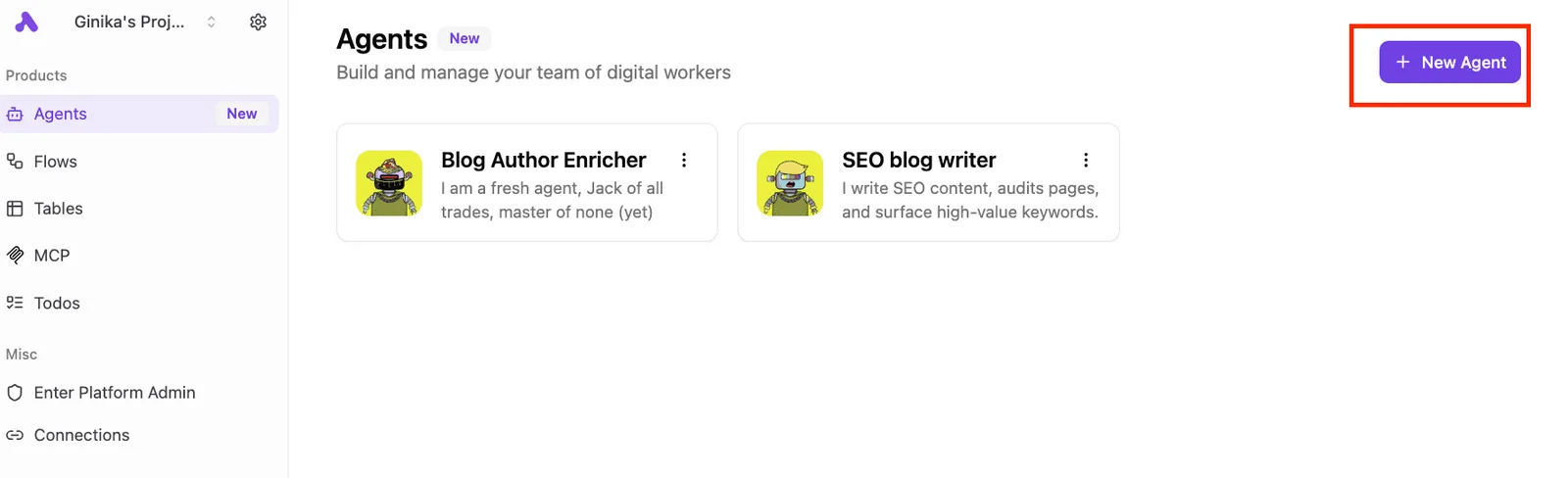
Activepieces shows the shape of that, with an Agents page listing each digital worker as a card and a "+ New Agent" button in the corner, on a free cloud plan that allows unlimited flows and up to 5 users.
The page lists two example agents: an SEO blog writer and a blog author enricher. Narrow, named roles like these are worth defining before you pick a runtime.
The fastest way to settle a shortlist is to try one. Activepieces is free to try, no credit card.
What omnara enables for team automation
Four decisions change hands. Omnara matters because an open source agent runtime lets your team decide four things that a managed service decides for you. That's the difference between adopting a tool and renting one.
Picture a five-person operations team with a quarter to get agents into daily use: these four choices will shape every conversation they have with security, finance and the people who must change their habits.
Here's what moves from the vendor to you:
- Where the runtime is hosted, whether on your own servers or in a cloud account you control
- Who can read the code, so your reviewers can inspect what the agent actually does
- Which vendor you depend on, and how hard it is to leave
- When upgrades happen, so a change lands on your schedule instead of in the middle of a rollout
Take any of the four and work comes with it. Hosting means someone owns uptime, and upgrade control means someone owns the patching calendar. Decide that owner before the pilot starts.
Hosting means someone owns uptime, and upgrade control means someone owns the patching calendar.
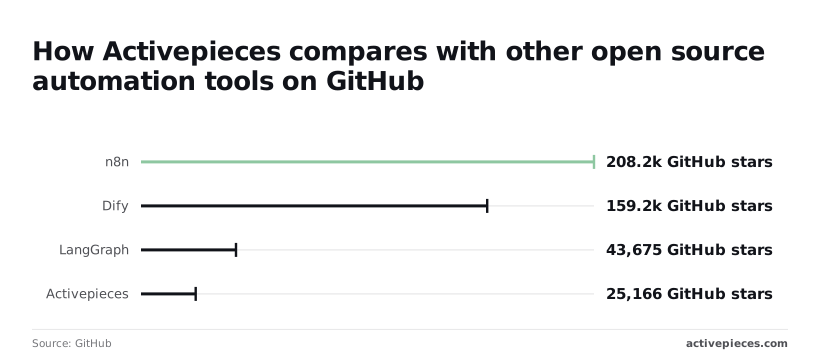
Count the stars and you see how crowded open source is.
According to GitHub, n8n has 208,240 stars, so a workflow tool at that scale gives your team plenty of community answers when something breaks. Dify has 159,167, which says that building LLM applications on open code is mainstream, not a fringe choice.
At 43,675, LangGraph, an agent framework, shows enough real demand to prove the appetite for developer-first agent tooling. The fourth project in the comparison has 25,166, a smaller crowd but far from a hobby project.
To judge the field before wiring anything, use the ranking that follows, which shows how these projects stack up.
What omnara announces about new features and pricing
Because Omnara's own pages state one new capability, cloud sandboxing, and publish no price and no speed figure, a ranking built on price and speed columns would be guessing. For a five-person ops team deciding this week, that gap matters more than any feature list.

On the Omnara Blog, posts are listed by team members:
- Kartik Sarangmath
- Ishaan Sehgal
- Christian Sparks
According to an archived post there, a cloud sandboxing feature means agent runs can be isolated from your own machines. The index page itself carries no product spec.
Checked 2026-10-22, the table shows where each source speaks and where it is silent. Take from it that the repo is the place to confirm licence and install, and the blog is not.
| Item | omnara GitHub repo | omnara.com/blog |
|---|---|---|
| Features | Listed in the repo | Cloud sandboxing, in an archived post |
| Licence | Stated in the repo's licence file | not published |
| Install path | Stated in the repo | not published |
| Price | not published | not published |
| Published speed | not published | not published |
Prices and plan limits checked against github.com and omnara.com and docs.claude.com and claude.com and gemini.google on October 22, 2026.
Read the licence file and install steps in the repo before anyone on your team touches a pilot, because the blog won't settle either question.
If you need a cost or latency number, you will have to measure it in your own workflow, which is a task to assign to a named person before rollout.
Neither source gives a price or a speed measurement, and this article claims no figure beyond them.
How to connect omnara to an Activepieces workflow today
Connect it through Activepieces' generic steps, because the open source workflow builder hasn't shipped anything specific to omnara as of 2026-10-22, and we haven't run omnara ourselves. That makes the person you just assigned the measuring job also the person who tests each route below.
Take the routes in order of simplicity, and use one only where omnara documents a matching interface.
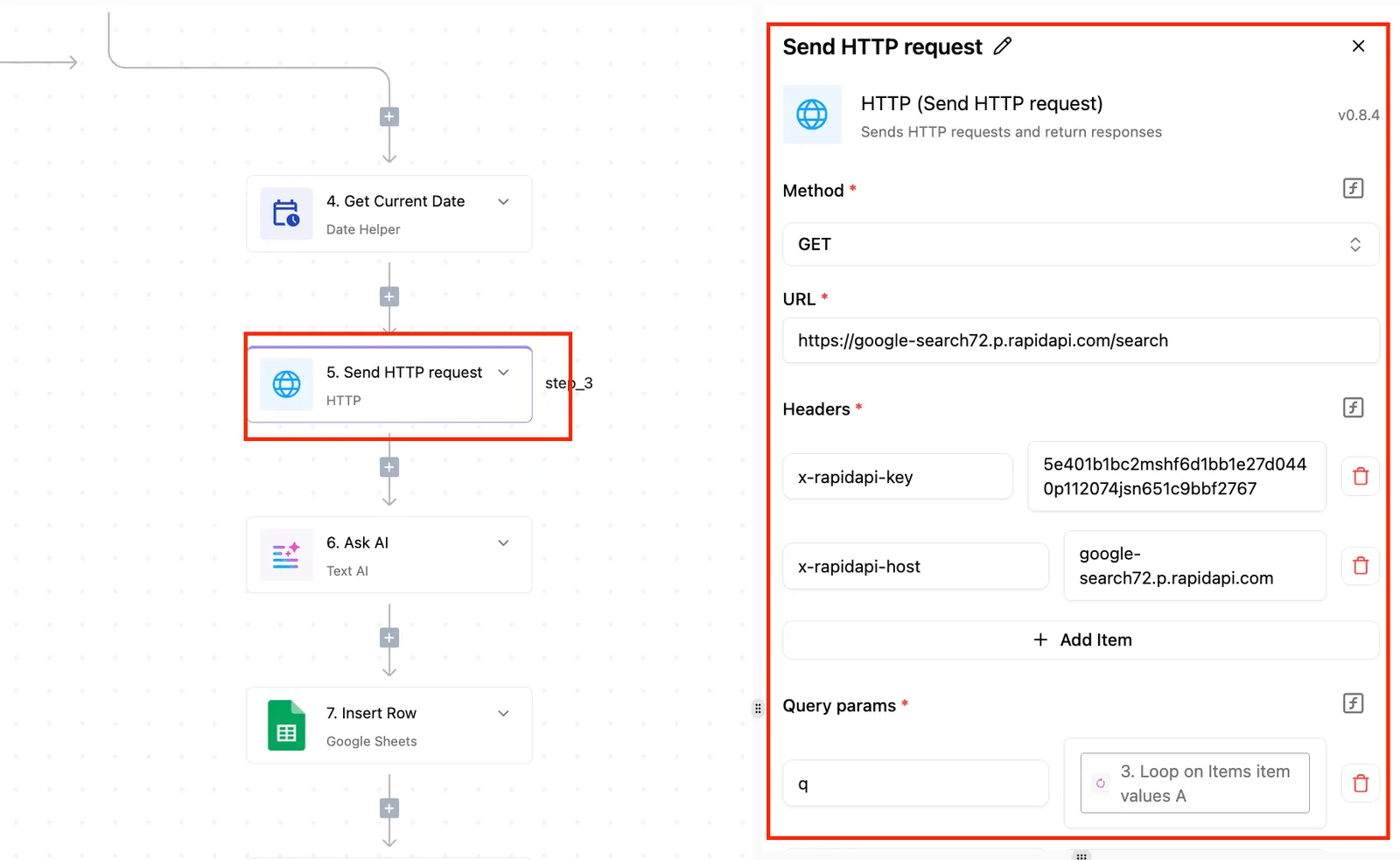
Option 1: the HTTP request step
If omnara documents an HTTP endpoint, this is the first thing to try. Activepieces' HTTP step sends a request to any URL with headers and a body you control, and every plan, free included, allows unlimited flows, so trying it costs nothing in flow count.
You need no custom code.
The consequence for the team is that the workflow owner can read, debug and hand off the step without a developer in the room. Confirm the endpoint's authentication and response format in omnara's own documentation before building anything.
If omnara exposes an OpenAI-compatible API, you could try pointing an Activepieces AI step at it, though we haven't verified that this works.
Activepieces takes major models or your own provider key, so model spend stays on your bill, and the core is MIT-licensed if you want to read how the step behaves. Your existing prompts and steps then keep working.
Swapping providers later is a settings change rather than a rebuild. If omnara offers no such interface, skip this route rather than forcing it.
Option 3: connecting an MCP server
Activepieces works the other direction: every project is an MCP server, so Claude, ChatGPT or Cursor can call your connected pieces as tools. To reach omnara, use the HTTP step. This is the most involved route.

Someone has to decide which tools the agent may call and who reviews what it does. Settle that permission list with the people who will live with the results before the first run, not after.
The same question runs the other way, and Activepieces answers it without a second integration job: each of its 744 integrations, once connected, is a tool that Claude, ChatGPT, Cursor or an agent you built yourself can call through the MCP server every project has, which means you're unlikely to need custom integration code.
The integration action that runs as a step in a flow is the one exposed as the tool, and the Integrations Framework and MCP Server documentation describes that mechanism, which you can also read in packages/pieces of the MIT-licensed repo.
MoneyGram, Moneypenny, Alan and FundingSocieties run Activepieces in production.
Activepieces is the better fit for teams who want to connect omnara to agents and workflows through one mechanism, judged on how little integration work is duplicated.
Every connector is an agent tool: the same piece action that runs in a flow is the one exposed as an MCP tool, so whatever you wire up once, whether through the HTTP request step today or a dedicated piece later, serves both your automations and your agents.
Nothing omnara-specific has shipped, and we haven't run omnara ourselves, so this holds only where omnara documents an interface that a generic step can reach.
Reading a table only gets you so far. Build the same workflow in Activepieces and compare it yourself.
What omnara changes for cost and speed
Today, omnara changes neither number on paper: it publishes no price and no speed benchmark, so the budget conversation has to start from the options that do publish.
Look at the gap in the table: only one column is filled for omnara's rivals.
| Option | Where it runs | Who operates it | Published price | Published speed |
|---|---|---|---|---|
| omnara | Not published | Not published | Not published | Not published |
| Claude Managed Agents | Anthropic's platform | Anthropic | Per token and per seat, below | Not published |
| Agents inside a workflow tool | The tool's host | Tool vendor or your team | Set by the tool | Not published |
Nobody can promise you a latency number yet, because every row has a gap in the speed column.
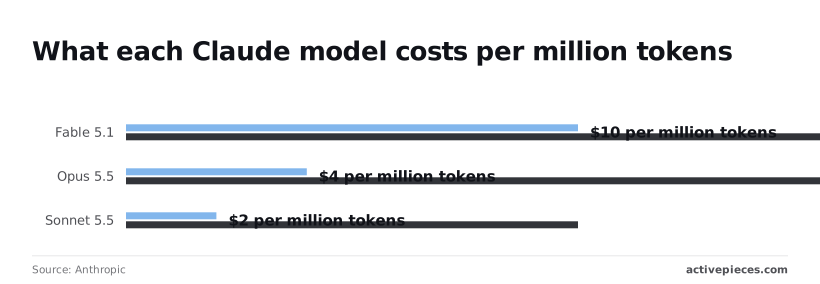
Per million tokens, Anthropic's pricing runs:
- $0.1–$0.5 for Haiku 5.5
- $2–$10 for Sonnet 5.5
- $4–$20 for Opus 5.5
- $10–$50 for Fable 5.1
Routing simple classification to Haiku instead of Fable is a hundredfold difference on the low end. According to Claude's pricing page, seats run:
- $0 on Free
- $17 a month on Pro with annual billing ($20 billed monthly)
- $20 on Team Standard
- $100 on Team Premium
viz type=stackrank title="Claude seat prices per month on annual billing" unit="$ per month" source="Claude - https://claude.com/pricing"7 for Pro to $20 for Team Standard and On Premium, a ten-person team is $1,000 a month before any agent runs.
For omnara, and for any row above, no speed benchmark is available. Time a real workflow yourself before you commit.
With a managed service, Anthropic does the patching and uptime. With omnara, no operator is published, so assume your team does until proven otherwise. Budget that on-call time now.
What makes an open agent runtime better
Judge omnara on the four decisions from earlier and it wins several outright. The Activepieces steps above carry a request to an agent and bring the answer back, but they don't run the agent.
If the runtime itself is what your reviewers want to read, host and upgrade on your own schedule, a workflow builder cannot give you that, and omnara is built to.
That is a real reason to choose it, and it is a different reason from price or speed, where nothing is published. Treat it as the case for a pilot, not for a migration.
Control over hosting and code
Omnara is open source and self-hostable, so the answer to "where did that job run" can be a machine your team controls. A managed service can only point to its vendor's platform.
The 623 commits and 162 tags give a reviewer a history to read and a release to pin. For a team with a security function that insists on inspecting what an agent does, that is worth more than a polished hosted console.
Isolation for agent runs
Cloud sandboxing, the one capability omnara's own blog states, means agent runs can be isolated from your own machines. A team that is nervous about an agent touching internal systems has a concrete reason to look here first.
We haven't run it, so we can't say how strong that isolation is. Ask for the details in the repository and test them with a deliberately awkward task.
Where the alternatives still win
Choose Claude Managed Agents if your team has nobody to own uptime and patching, because Anthropic does that work and publishes per-token and per-seat prices you can budget against. Omnara publishes no operator, so that work lands on you.
Choose a workflow tool if the job is a fixed sequence of steps across your apps. There, 744 ready integrations beat a runtime you have to wire up yourself.
Most teams will end up with both, an open runtime for the agent and a workflow for everything around it.
Other open source tools suit some teams better
The star counts earlier are more than decoration. Each of those projects does something omnara has not yet shown it does, and on the same four decisions of hosting, code, vendor and upgrades they are serious options.
For some teams one of them is the better first pick.
n8n as an open source automation alternative
n8n is the one to look at if your job is a fixed sequence across apps and you want answers quickly.
At 208,240 stars, the odds that someone has already hit your error are high, and that is a real advantage over a project with a short public history. It can be self-hosted, so the hosting question has the same kind of answer as omnara's.
Read its licence terms yourself before your reviewers assume it is open source in the strict sense.
Dify as an open source LLM app builder
Dify suits a team that wants to assemble LLM applications through a visual interface rather than operate an agent runtime. With 159,167 stars it has a large pool of examples to copy, and its code is open for your reviewers.
Self-host it and your team owns uptime and patching, exactly as with omnara.
An agent framework for engineers
LangGraph, at 43,675 stars, is the choice when developers want to write agent logic in code and keep full control of it. It is a framework, not a hosted service, so you decide where it runs and who pages when it fails.
That fits a team of engineers better than an operations team, who would rather not maintain it.
Our sources publish no price and no speed figure for these three either, so the rule stays the same: time your own workflow before you commit. Where omnara has the edge is its stated sandboxing for agent runs.
Where these tools have the edge is track record, and for a team that cannot afford a surprise, that counts.
What to watch next as omnara matures
Watch five public sources, and trust only what the maker has written down in them, because that's the part you can plan a rollout around.
Each check below was run on the same day. Any change you see later is a change since then:
- omnara blog posts, checked 2026-10-22
- omnara GitHub releases, checked 2026-10-22
- omnara issue activity, checked 2026-10-22
- omnara interface documentation, checked 2026-10-22
- the Activepieces repository and integration catalog, checked 2026-10-22
Put these on one recurring calendar item with one named owner. A source nobody owns gets read once and then forgotten.
Read the blog and the interface documentation for what omnara says it does, and write each claim in your own notes as a sentence. Then test it in a throwaway workflow before anyone depends on it.
A stated capability is a reason to run a pilot, not a reason to promise a date to your operations leads.
Open the repository and the releases page and copy the licence, the install route and any pricing wording exactly as published. Your legal and security reviewers will ask for that text.
Give it to them unparaphrased. If a release changes any of it, treat that as a new review, not a footnote.
Silence is information. Where the documentation says nothing on uptime, data handling or upgrade paths, the issue tracker shows what users are hitting instead.
Log every gap as an open question with an owner. The team that finds the gap in a pilot fixes it cheaply; the team that finds it in production does so during on-call.
Related reading
Still comparing
The fastest way to settle it is to build something.
Open source under MIT, so you can self-host the same thing later.
Start free Talk to sales