
Originality.ai Pricing: Plans and Credit Costs (2026)

Nov 5, 202615 min read
Originality.ai, the AI content and plagiarism detector, sells three plans, and teams that pipe its scans into a Activepieces workflow tend to pick whichever one fits their volume:
- Pay-as-you-go
- Pro
- Enterprise
Divide a plan's price by the scans you run and you have its real cost, so the headline number tells you little until you know your monthly volume.
Originality.AI pricing: every current plan in one table
Plan table with monthly and yearly prices
The table lists each plan against the five things that decide a bill:
- Monthly price
- The monthly rate when billed yearly
- Credits
- The per-seat add-on
- The caps
, so I left it unfilled rather than guess. Any such cell is a number you must get in writing before you can work out a cost per scan.
| Plan | Monthly price | Yearly-billed monthly price | Credits | Per-seat add-on price | Caps |
|---|---|---|---|---|---|
| Pay-as-you-go | not listed | not listed | not listed | not listed | not listed |
| Enterprise | not listed | not listed | not listed | not listed | not listed |
Table checked 2026-11-05. Re-check Originality.ai's own pricing page before you budget, because plan terms change.
There are three rows of blanks, and that is a result in itself. The comparison only works once you fill them in yourself.
What each plan caps
Credits are the first cap. Every scan spends them, so your volume decides whether a plan lasts the month or runs out on day twenty.
Seats are the second cap: an add-on charged per person multiplies with team size. The third is feature gating, where a capability you assumed was included sits on a higher tier.

If you trigger scans from a workflow tool, the connector you need may not exist yet, and in a closed catalogue you wait on the vendor's roadmap.
Activepieces lets you generate the missing integration with AI and add it privately to your own instance, and roughly 60% of its 747 integrations, counted from the open source monorepo, were built by the community, which means the integration ecosystem isn't entirely company-maintained.
Where a tier asks for a sales call before it shows a price, treat the cost as unknown. Next comes the arithmetic for three named buyers.
If you are running this arithmetic for your own team, see what the same workload costs on Activepieces.
Pricing for Solo creators, teams and enterprises
$14.95 a month is what a solo creator pays for Originality.ai's Pro plan; a 5-person team pays $54.75 and a 20-seat company $204.00, so pricing scales with organization size. Enterprise costs $179, $278.80 and $653.05.

The table below shows that Enterprise costs more at every size, in exchange for about seven and a half times the credits.
Originality assumes 1,000-word articles at 100 words per credit, so each article uses 10 credits.
| Buyer | Plan (Pro / Enterprise) | Seats | Monthly bill | Credits included | Articles covered |
|---|---|---|---|---|---|
| 5-person team | Pro / Enterprise | 5 | $54.75 / $278.80 | 2,000 / 15,000 | 200 / 1,500 |
| 20-seat publisher | Pro / Enterprise | 20 | $204.00 / $653.05 | 2,000 / 15,000 | 200 / 1,500 |
Credits are the base allowance in every row, which is what the per-credit rates below imply. Seats raise the bill, not the article count.
At $14.95, Pro works out to $0.007475 per credit, the cheapest route. A creator scanning under 200 articles a month never needs anything else.
When the Pro bill climbs to $54.75, the team still covers only 200 articles, so the effective rate worsens with every seat.
According to Originality.ai, pay-as-you-go costs $0.01 per credit, so 2,000 credits would cost $20. At this size, buying credits can beat paying for seats.
At twenty Pro seats the bill is $204.00, and it still covers 200 articles, meaning team growth doesn't reduce article coverage. Originality.ai's Enterprise at $653.05 covers 1,500, and its API rate is $0.011933 per credit, about 60% above Pro's.
You pay that premium for volume and API access, not for a cheaper scan.
Hidden costs and limits buyers hit on Originality.AI
Because every check draws credits separately, the bill grows:
- Plagiarism doubles the cost of a scan: - Each rescan repeats it
- Gated features, seat limits and API caps sit outside the list price

Budget for these:
- plagiarism scanning on top of AI detection
- rescans of edited drafts
- per-seat add-ons
- the API rate per credit
- credit expiry and top-ups
- time spent reviewing false positives
How many articles Originality.AI credits cover
Add plagiarism and the same credits cover 66 articles, which means a team publishing 100 integrations a month is already short.
Originality.AI rescans, credit expiry and top-ups
Add one rescan after an edit and coverage drops to 33 articles. That's a quarter of the AI-only figure, so a plan sized on the shallowest check will be wrong by the second week.
Expired credits and top-ups make the gap worse, because unused allowance may not carry over and extra credits cost more than the plan's own rate.
Originality.AI features locked to higher plans
Often the plan that looks cheapest has the feature you need sitting one tier above it. Check the feature list against your actual workflow before you compare prices, because an upgrade you discover mid-month replaces the saving you chose the plan for.
API calls and seats
Since API calls draw from the same credit pool, automated scanning competes with your editors for the same allowance. Seats work the same way: each added reader or editor is a per-seat cost, and a 20-seat company pays it twenty times.

Price the pool and the seats together.
False positives and reviewer time costs
When a draft gets flagged, it costs credits to rescan and staff time to judge. At 33 articles a month, every disputed flag consumes allowance you had assigned to new work.
Put a figure on reviewer minutes per flag, because that labor is often larger than the subscription.
Originality.AI against Copyleaks, GPTZero and Turnitin on price
It's the only one of these four that publishes self-serve, credit-based pricing aimed at publishers, which makes the reviewer-minutes math above easy to run.
I'm quoting no dollar figures here because I haven't confirmed them against each vendor's page, and a stale number is worse than none.
The table shows how each vendor structures its price, not what it charges. Take from it that only two of the four let you calculate a bill without talking to anyone.
| Vendor | Entry price model | What it buys | Plagiarism plus AI | API | Fit |
|---|---|---|---|---|---|
| Originality.ai | Self-serve plan or pay-as-you-go | Credits spent per scan | Yes, combined | Yes | Publishers, agencies |
| Copyleaks | Self-serve plans plus enterprise | Page or credit allowance | Yes, combined | Yes | Mixed: business and education |
| GPTZero | Self-serve plans | Word allowance per month | AI detection with plagiarism checking | Yes | Educators, individual writers |
| Turnitin | Institutional license | Per-student or per-institution access | Yes, inside its school platform | Through institutional integrations | Schools and universities |
Before you add a second reviewer, confirm the seat rules, which differ by vendor and plan.
Against GPTZero and Copyleaks, you pay for credits even when a scan finds nothing, so a team that rescans every revision burns allowance faster than the plan name suggests.
A school with a Turnitin license pays nothing extra per check, and in that setting Originality.ai is a duplicate expense.
If you are a publisher with no student roster, Turnitin's institutional model is the wrong shape, and its pricing starts with a conversation. Originality.ai's published credits let you cost a month in advance, and that predictability is worth real money when you budget per article.

Worth checking against a plan that does not meter every step: one credit covers a whole run on Activepieces.
Which Originality.AI plan fits which volume of content
Whichever plan covers your monthly credit need without leaving credits to expire or forcing top-ups is the right Originality.ai plan.
Work that need out by multiplying scans per month by 15 credits per AI-only 1,500-word article. The table shows where each band lands and what should push you up a tier.
| Scans per month | Best plan | Why | Step-up trigger |
|---|---|---|---|
| Under 20 | Pay-as-you-go credits | A subscription would sit mostly unused | Buying credits most months |
| 20-60 | Entry subscription | Recurring credits beat repeated top-ups | Running dry before month end, or a second user |
| 60-130 | Mid-tier subscription, billed yearly | Steady volume justifies the annual commitment | A feature locked to a higher plan |
| 130+ | Highest self-serve tier, then a quote | The cheapest headline plan runs out early | Needing a pool shared across many writers |
Treat the triggers as the decision, not the bands. Volume tells you where to start, and the first shortfall tells you when to move.
Under 20 articles a month, buy credits as you need them. A subscription charges for capacity you won't use, and at this volume the unused portion is the real price.
If you only check a handful of freelancer drafts, a free alternative or no detector at all may be the better spend.
Originality.AI pricing at 20 to 200 articles
Here, headline pricing misleads. At the low end, an entry subscription wins because its monthly credits cost less per scan than top-ups.
Higher up, the cheapest plan exhausts its credits and you pay the top-up rate on the overflow, which erases the saving. Once usage is steady for several months, yearly billing pays. If usage swings, stay monthly.
Past the top self-serve tier, price per scan matters more than the plan name. Several writers drawing on one credit pool, plus the gated features that team workflows need, are what justify moving up.
If the next step requires a sales call, ask for a per-scan figure in writing, and compare it with the self-serve rate before you agree.
Automating Originality.AI checks with Activepieces
Once you scan often enough that manual pasting costs more than the setup, Activepieces can watch for a new draft, send it to Originality.ai's API, and ask a human to approve the result in Slack.
The flow below shows the path from draft to approval; it also shows that the scan itself still spends Originality.ai credits exactly as a manual one does.
What the workflow does
When a new or updated Google Docs draft appears, the flow triggers. An HTTP step then posts the text to Originality.ai's API (confirm the endpoint and request format in their API docs before building).
A Slack message returns the score with Approve and Review buttons, so an editor decides on flagged items instead of reading every report.
The automation saves clicks, not credits. Each scan draws from your Originality.ai balance at the same rate as a scan you run by hand.
A workflow that scans every revision of a draft will burn through your plan cap faster than a person who scans once at the end. Trigger on "ready for review," not on every save.
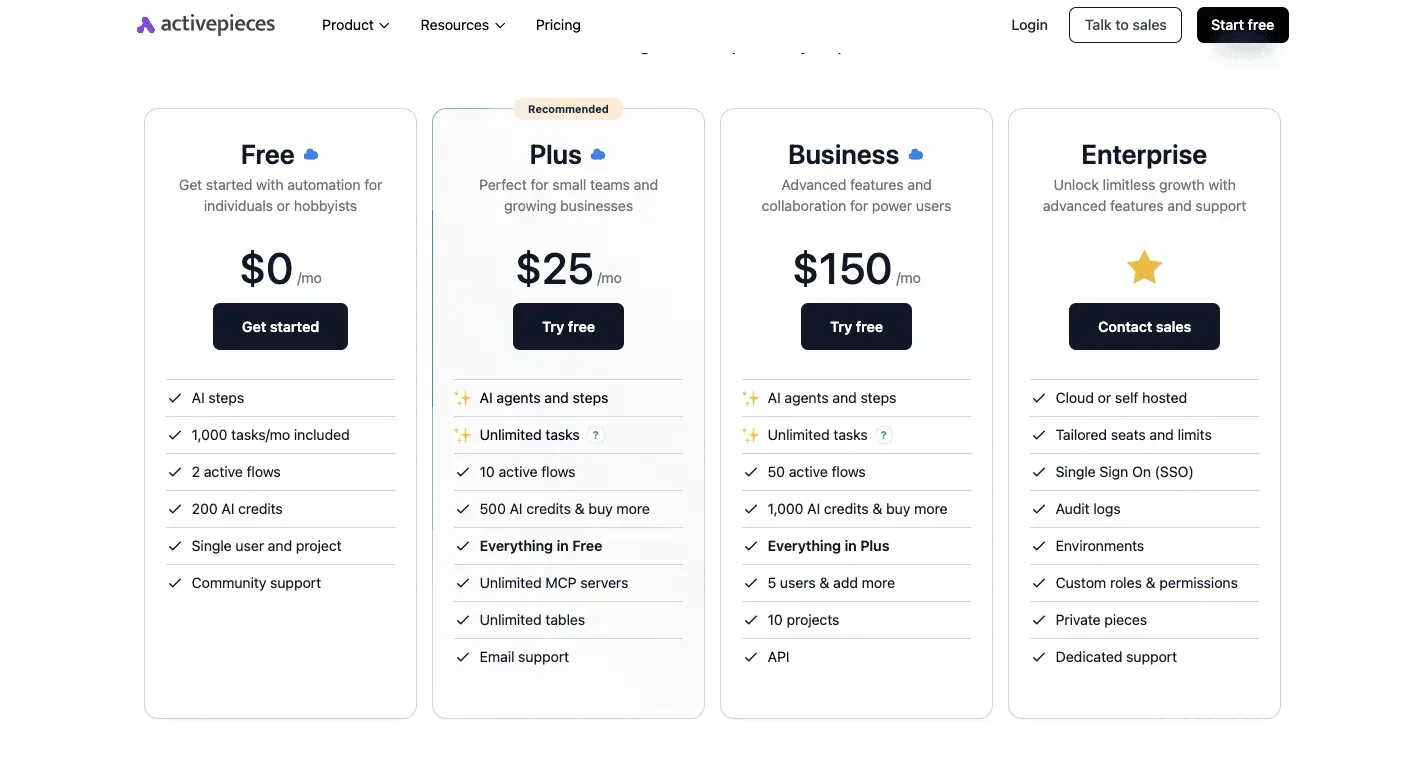
Activepieces has its own meter. On Activepieces Cloud, the Free plan ($0) includes 1,000 credits a month, which means developers can experiment without payment. Plus ($20) includes 10,000, and Team ($200) includes 50,000.

Each step in a run, trigger included, counts against that allowance, so a four-step flow costs roughly four credits per draft. On Free, that's around 250 drafts a month before the automation itself stops.
Plus gives you 2,500, and Team 12,500, which is more than most editorial teams will ever scan.
Because the steps are credit-priced, keep the flow short: one trigger, one HTTP call, one Slack message, no loops.
When Originality.AI automation is not worth building
At low volume, skip it. Someone scanning 20 drafts a month spends maybe an hour on the manual routine. Building, testing and maintaining a flow costs more than that hour saves, and you'll still pay Originality.ai per scan either way.
It starts to earn its place when several people submit drafts, when an approval step is a policy requirement, or when scans run past a few hundred a month.
Even then, the Free plan covers the workflow's own cost. Pay for Plus only if you add steps or run more drafts than the Free allowance supports. The Team tier at $200 is hard to justify for this job alone.

Choosing your plan by scan count
Choose from your own scan count, not the sticker price, because that count is what makes a tier like Team look wrong for a small job. Six steps turn it into a plan:
- Count last month's published articles and their average length.
- Convert that into credits, allowing for rescans after edits.
- Pick the plan from the pricing table that covers those credits with room to spare.
- Set a monthly scan budget and name one person who owns it.
- Test the free option on a sample batch before paying.
- Diary a date to re-check pricing.
Count your real scan volume
Pull the number from your publishing log, not from memory. Multiply articles by average length, then add the rescans your editors actually run.
Credits are consumed by words, so a team of long-form writers burns through a plan that a short-post shop would barely touch. Skipping the rescans is the usual mistake: it makes the cheap plan look sufficient until the second week.
Pick the plan and set a cap
Match your credit total to the cheapest plan that covers it without regular top-ups. If you need a feature that sits behind a higher tier, price that tier honestly rather than assuming you can live without it.
Then give one person the budget. A shared login with no owner is how scans multiply unnoticed, so that person should see usage weekly and decide who may rescan.
Run the free option on a sample of real articles first. If its results and limits fit your workflow, you may not need a paid plan yet. If they don't, you'll know exactly what you're paying for.
Put a recurring calendar entry on the owner's diary. Prices, caps and gated features change, and a plan chosen today can be wrong after the next revision.
At each check, recount volume and compare it to the plan, so the bill follows your output rather than last quarter's guess.
Frequently asked questions
Which billing rules change the math?
Recounting volume only works if the billing rules are clear, so these are the questions that change the math, answered without figures because Originality.ai's numbers can change.
Does Originality.ai have a free trial or free plan? Check the current signup page, because trial terms are the part vendors change most often.
Whatever is offered, a free allowance tests accuracy on a few documents. It doesn't tell you your monthly cost, so run a representative batch before committing.
Can I cancel Originality.ai or get a refund? Treat cancellation and refunds as separate questions. Stopping a subscription ends future charges, but it doesn't necessarily return money for a period already billed or credits already used.
Read the refund terms before paying, especially on a yearly plan, where a mistake costs the most.
Do unused Originality.ai credits roll over? Don't assume they do. Credits are the unit you spend, and how long they stay valid depends on how you bought them, as a subscription allowance or a separate credit purchase.
If you scan unevenly month to month, this decides whether you pay for capacity you can't use. Confirm the expiry rule for your plan type first.
Is Originality.ai cheaper billed yearly? Annual billing usually lowers the monthly equivalent, but it commits you to twelve months of volume you've only estimated.
Compare the discount against the cost of being on the wrong plan for a year. If your output is still shifting, monthly billing is the cheaper way to be wrong.
Does Originality.AI charge separately for API use?
Find out whether API calls draw from the same credit pool as dashboard scans or are billed on their own. If you automate scanning, that determines whether your real volume is the one you counted by hand.
Ask before wiring it into a workflow, because a plan sized for manual use can run out fast once a script is scanning.
Related reading
References
Running the numbers
See what the same workload costs here.
Free forever plan, and every paid plan self-hosts at no extra cost.
See pricing Talk to sales