
Otter.ai Pricing 2026: Free, Pro & Business Plans

Oct 10, 202614 min read
Otter.ai functions as an automated meeting assistant that joins video calls to transcribe dialogue and generate summaries in real time.
While the service automates note-taking, the cost scales based on the number of users connected to a workspace rather than the total volume of meetings recorded.
Otter.AI pricing plans for 2026 explained
| Tier | Price (Billed Annually) | Monthly Minute Limit |
|---|---|---|
| Basic | Free | 300 mins/mo |
| Pro | $8.33/user/mo | 1200 mins/mo |
| Business | $19.99/user/mo | Unlimited mins |
| Enterprise | Custom pricing | Advanced security |
Prices and plan limits checked against otter.ai on October 10, 2026.
Because the Business tier charges for every seat, many organizations use automation to move transcripts into a shared database. This allows them to keep the paid user count low without losing access to historical meeting data.
Otter.AI Basic plan features explained
The Basic plan is for individuals to test the transcription engine on a limited number of calls each month.
Because this tier enforces a strict monthly minute ceiling, a user who reaches the limit mid-meeting will see the recording stop, resulting in a partial transcript that misses the end of the conversation.
It includes the ability to record live meetings and playback audio at different speeds. However, it lacks the administrative controls necessary to manage data sharing across a larger company.
The Pro individual plan costs
The Pro plan is for power users who require a higher monthly allowance than the free version provides.
By increasing the minute cap, this tier ensures that a consultant or freelancer can record multiple hour-long sessions every week without running out of credits before the month resets.
The Pro plan also expands the duration of individual recordings. Each conversation can last up to 90 minutes, which accommodates standard workshops and deep-dive interviews that the free tier would cut off.
It also introduces the ability to import pre-recorded audio files. This means a user can generate text from a memo recorded on a phone or a downloaded webinar.
The Business team plan limits
The Business plan removes the monthly minute restrictions for all members, but it introduces a per-user cost that can quickly exceed a department's budget if the company invites every employee.
This tier is the entry point for organizations that need centralized billing and shared folders, so a manager can review notes from a meeting they didn't attend.
For long-form events, the Business plan allows for a single conversation to last up to 4 hours, ensuring that even the most extensive seminars or multi-part discussions can be captured in their entirety.
This extended limit is designed for half-day seminars or executive retreats where continuous recording is essential for a complete record.
Alan and Funding Societies run production automation on Activepieces, where the credit-based structure makes headcount irrelevant to the total cost.
By metering consumption instead of seats and providing unlimited flows on every plan, the platform allows a company to scale its transcription syncs to every department without the bill increasing for every new employee who needs access to the data.
Enterprise and custom scale pricing
On the Enterprise tier, organization-wide security features like Single Sign-On (SSO) and domain capture are the only options. By using SSO, an IT department ensures that a terminated employee immediately loses access to sensitive meeting transcripts, preventing data leaks during offboarding.
This plan requires a direct consultation with the sales team to negotiate rates based on total headcount and specific compliance needs. These needs include HIPAA or advanced data retention policies that aren't available on the standard retail plans.
If you are running this arithmetic for your own team, see what the same workload costs on Activepieces.
Is Otter.AI's free plan worth it
The free tier is for individuals who need occasional transcription rather than a ticking clock designed to force an immediate upgrade.
While many software companies use free versions as a brief window to test features, this plan remains open indefinitely. It allows users to capture notes for short syncs or personal memos without a monthly subscription fee.
Otter.AI's 30-minute recording limit
The most significant restriction on the free tier is the cap on the length of any single recorded session. This cap prevents the tool from capturing full-length board meetings or long-form lectures.
Because the software stops processing audio once it reaches this threshold, a user attempting to record a standard one-hour webinar will lose the entire second half of the discussion. This happens unless they manually stop and restart the recording.
This creates a manual overhead for the user: they must keep a close watch on the timer to ensure the transition between two separate files drops no critical dialogue.
While the plan works for quick status updates, it doesn't capture the continuous flow of deep-dive workshops or lengthy interviews where interruptions would break the speaker's concentration.
How Otter.AI's monthly minute reset works
Users receive a fresh allocation of recording time at the start of every billing cycle. This means the utility of the tool doesn't expire even if the total capacity is exhausted one month.
This reset allows a light user to treat the service as a reliable fallback for busy weeks without committing to a permanent overhead cost.
However, because there's a ceiling on how much total audio can be stored in the cloud history, a user who reaches this limit must delete older transcripts to make room for new ones.

Without an automated way to move these files to a permanent home, the burden of data preservation falls on the user. The user must export text manually to avoid losing historical meeting records when the storage bucket fills up.
How Otter.AI free tier compares industry standards
Otter.ai provides a more generous entry point for individual users than most professional transcription services. It offers a recurring monthly allowance of recording minutes at no cost.
This baseline allows a single user to capture meetings without an immediate financial commitment. Many competitors require a credit card upfront or limit the free experience to a one-time trial of just a few conversations.
While the free tier allows for testing the software's accuracy, the transition to a team environment introduces a steep price jump that changes the value proposition entirely.
Openai's analysis puts the cost of Otter Business for a department of 50 people at $12,000 annually. This is the same price as a ChatGPT Business Standard deployment but double the $6,000 required for a Fireflies.ai Pro plan.
This comparison shows that while Otter is affordable for a solo contractor, it scales into a premium enterprise expense that matches the cost of full-suite generative AI platforms.
Organizations must decide if a specialized transcription tool is worth the same budget as a general-purpose AI assistant.
To manage these costs, teams often look toward integrating specific AI models into their own workflows rather than paying for per-user licenses. Current options for these custom builds include:
- GPT-Transcribe for high-accuracy speech-to-text.
- Gemini 3.5 Transcribe for low-latency diarization.
- Voxtral Mini Transcribe 2 for efficient audio processing.
According to Otter, choosing the Otter Business tier costs $19.99 per user each month when billed annually, which means a company with ten employees faces a recurring commitment of two hundred dollars.
This represents a 33% savings over the month-to-month rate but requires a total upfront payment of $239.88 per seat.
This commitment means a manager must be certain of every team member's need for the tool before the yearly billing cycle locks in the headcount. Failure to audit these seats results in paying for dormant accounts that contribute nothing to the company’s documentation.
Worth checking against a plan that does not meter every step: one credit covers a whole run on Activepieces.
Why per-user pricing fails high-growth teams
Per-user pricing models force companies to pay for the potential capacity of every employee rather than the actual volume of transcription work performed.
This structure becomes a financial liability for high-growth teams where only a few members attend the bulk of recorded meetings, yet the entire department is billed at the same premium rate.
Per-user pricing models force companies to pay for the potential capacity of every employee rather than the actual volume of transcription work performed.
Otter.AI's three-seat minimum cost
Otter’s business tier requires a three-seat minimum. This means a small startup pays for 3,600 minutes of processing time even if they only have one founder using the tool.
While the platform offers 300 minutes for free to individuals, the jump to a paid team account immediately triples the base cost regardless of actual usage, so small teams may pay for capacity they never utilize.
Teams face an instant price hike even if their volume stays low.
This creates a steep "entry tax" for small teams who aren't yet recording dozens of hours of video calls per week.
When comparing the generous free allotments of top-tier engines, the market shows a wide gap in how much "trial" time a developer or manager gets before the bill arrives:
| Provider | Free Transcription Minutes |
|---|---|
| Azure AI | 300 minutes |
| AWS Transcribe | 60 minutes |
| ElevenLabs | 12 minutes |
The chart illustrates that:
- Azure AI provides 300 minutes for free, matching Otter’s entry-level generosity so that teams can test complex diarization without an upfront invoice.
- In contrast, AWS Transcribe has only 60 minutes, which restricts a user to testing just one or two meetings before incurring costs, forcing a quick decision on whether the service is worth the investment.
- The most restrictive is ElevenLabs at 12 minutes, a limit so low that a single long-winded sales pitch will exhaust the entire monthly allowance, effectively rendering the free tier useless for professional workflows.

Managing guest collaborators without adding seats
By using a single "recorder" bot, a company can capture every meeting while the rest of the staff accesses the data through their existing communication tools.
This prevents the "guest seat creep" where a project manager invites a contractor to view one transcript. The contractor then occupies a paid seat on the monthly bill.
Moving the data out of the platform via API or manual export ensures that information remains accessible to the whole team without the $20-per-head penalty, allowing organizations to avoid paying for seats just to view historical records. This effectively bypasses the platform's restrictive pricing model.
Scaling transcription workflows with automation
An automation platform reaches across 738+ integrations to move meeting data from Otter.ai to your internal databases, ensuring that your team stays informed without adding more paid seats to the transcription platform.
A majority of these workflow integrations are community-contributed, which allows teams to sync these summaries to specialized project management databases that lack native Otter support.
The MIT-licensed core enables anyone to build and merge a new integration, ensuring that even custom internal CRMs can be reached by the automation layer without waiting for a vendor's roadmap.
The following process moves your meeting notes into a shared company folder or project management tool automatically:
- Set Otter to auto-share transcripts to a specific email address.
- Configure a workflow to watch the Gmail inbox for new incoming Otter emails.
- Parse the transcript text to strip out the headers and timestamps.
- Upload the clean text to your company’s shared storage or documentation hub.
Automating summaries for team access
This setup prevents the "data silo" problem where important decisions are locked behind a single user’s login. Once the text is out of the inbox, you can use a high-intelligence model like Claude Sonnet 5.5 to summarize the raw notes.
Building this pipeline effectively ends the need for the platform's expensive enterprise sync features. Instead of paying a monthly premium for a direct connection to a single CRM, you use a one-time automation to broadcast that data wherever it is needed most.
This shift moves the transcription service from a collaborative hub you have to rent for every employee into a simple utility that feeds your existing company infrastructure.
What Activepieces does about this
Activepieces addresses the ballooning costs of per-user pricing by allowing teams to decouple their data access from their seat count.
Instead of paying $20 per month for every employee who needs to read a transcript, you can use the platform to automatically bridge the gap between a single Otter.ai recorder and your entire team's existing workspace, which means you can eliminate redundant subscription costs across your organization.
By setting up a flow that triggers whenever a new transcript is generated, you can push that data into a shared Notion database, a Slack channel, or a custom internal dashboard.
This ensures that the information is democratized across the company without the financial penalty of adding dozens of viewers to the transcription workspace.
The platform is built on an MIT-licensed core, which provides a level of transparency and flexibility that proprietary integration tools cannot match.
For high-growth teams like those at Alan or Funding Societies, this means the automation infrastructure remains a reliable utility rather than another scaling expense.
Because Activepieces allows for unlimited flows and focuses on execution credits rather than a per-head tax, a department can scale its meeting documentation to hundreds of employees while only maintaining the minimum required seats on the transcription service itself.
Beyond simple data movement, Activepieces enables you to add a layer of intelligence to your transcripts before they reach your team.
You can insert a step in your automation to send the raw Otter.ai text to a large language model for custom formatting, action item extraction, or sentiment analysis. This transforms a raw transcript into a structured business asset that lives in your own environment.
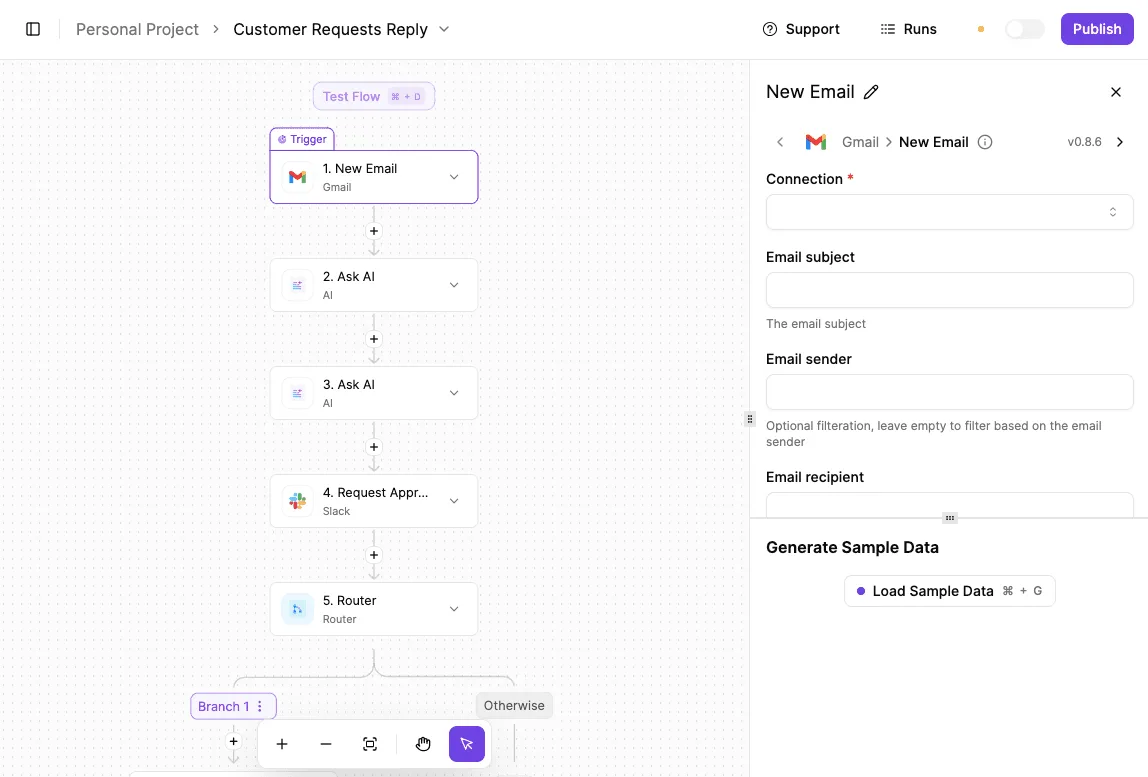
By owning the workflow that handles the data, you eliminate the need for the expensive administrative and sharing features found in higher-tier plans, effectively turning a solo transcription tool into a company-wide knowledge base.
Frequently asked questions
Does Otter.AI offer a student discount?
Otter.ai has a discounted rate for students and educators who register with a verified school email address.
This reduction lowers the barrier to entry for individuals using the service for lectures and research, though it is restricted to the Pro tier rather than the Business plan. The discount helps students manage academic transcription needs on a budget.
Can I pay for Otter.AI monthly instead of annually?
Monthly billing is available for both Pro and Business tiers, giving you the flexibility to stop payments at the end of any thirty-day cycle.
While choosing the monthly option prevents you from being locked into a long-term commitment, it results in a higher cost per month compared to the discounted lump-sum annual payment.
This choice depends on your current cash flow and project duration.
What happens to my transcripts if I cancel my Pro plan?
Your existing transcripts remain accessible in your account after you cancel a paid plan, but the service reverts your workspace to the limitations of the free version. This means you lose the ability to export files in specialized formats like PDF or SRT.
You must download your data before the billing cycle ends to avoid losing access to those specific file types.
Is there a limit on how many meetings I can record daily?
The service doesn't impose a hard cap on the number of individual meetings you can record in a single day. This is true provided you stay within your total monthly transcription minute allowance.
Because the system tracks usage by the minute rather than by the event, a team recording ten short check-ins will consume their balance at the same rate. A team recording one long strategy session will see the same result.
Related reading
References
Running the numbers
See what the same workload costs here.
Free forever plan, and every paid plan self-hosts at no extra cost.
See pricing Talk to sales