Play HT Pricing 2026: Plans, Free Tier and Limits

Nov 11, 202616 min read
Read each number off Play HT's own page before you budget on it, because I haven't confirmed current figures.
Play HT, a text-to-speech and voice-cloning service that you might wire into an automation tool such as Activepieces later on, sells tiered plans where the monthly price buys a character allowance, a voice set, API access and commercial rights.
Play HT pricing is the set of tiered subscription plans through which the service sells text-to-speech and voice cloning, where what you actually pay depends on each plan's character cap, concurrency limit and commercial-use terms rather than the monthly price alone.
Play HT pricing plans at a glance
The plan table and the date it was checked
Take from the table below that the sticker price is only one column of several. It shows how each plan is priced and which limit to read first.
I've left out dollar amounts and a check date because I don't have confirmed figures to put there.
| Plan | How the price is set | Limits that decide the real cost |
|---|---|---|
| Creator | Self-serve monthly price | Character allowance, voice access, commercial rights |
| Studio | Self-serve monthly price | Character allowance, API access, concurrency |
| Hacker/Pro | Developer-facing tier | API access, concurrency, commercial rights |
| Startup | Tier for early-stage teams | Character allowance, concurrency, commercial rights |
| Enterprise | Quoted by sales | Negotiated caps, concurrency, support terms |
Because Play HT was acquired in 2025, the status of each row comes before everything else. A plan that's no longer sold can't be budgeted at any price, so confirm it's still on the live pricing page before you build on it.

Count characters, not minutes, because that's the unit metered; a free allowance buys less audio than it looks like.
Check three things on the page:
- the character cap
- whether commercial use is permitted
- which voices are included
If the tier carries no commercial rights, nothing it generates can go into a shipped product. Whether you test from a script or from a workflow builder, every call draws on the same cap.
Play HT monthly versus annual billing prices
Divide the annual total by twelve and compare it with the monthly price, then ask whether you'd still want the plan in month eleven. Annual billing is a price per month with a twelve-month commitment attached.
If you prepay a year on a vendor whose plans may have changed since its acquisition, you add exposure. Monthly billing costs more per character, but it lets you leave if the plan is withdrawn or repriced.

If you are running this arithmetic for your own team, see what the same workload costs on Activepieces.
Play HT costs at three usage volumes
Convert minutes to characters before you read any plan price, including the monthly one you just weighed against annual billing. Each volume costs its character total multiplied by the per-character rate of the plan that clears your limits.
You will not see minutes on the invoice, because Play HT meters characters; the minutes you plan for have to become that unit.
The conversion below shows the character total each volume puts on the meter, and those totals are what you set against a plan's character cap:
- Assumption: about 900 to 1,000 characters per spoken minute, so a script that reads slowly lands nearer the low end and a dense one nearer the high end. 1,000 minutes is roughly 0.9 to 1 million characters a month, so you can estimate character consumption from any minute projection. 10,000 minutes is roughly 9 to 10 million characters a month, which means you can predict character costs at any usage level.
- 100,000 minutes is roughly 90 to 100 million characters a month.
I don't have confirmed per-character rates or enterprise thresholds to give you, so I'm not putting one in the calculation. Take the rate from the vendor's current pricing page and multiply it by each total above.
If the plan's cap covers your total, the effective per-minute cost is just that plan's price divided by the minutes you deliver. If you use only part of the cap, you pay for unused characters and the per-minute cost rises.
Play HT upgrade costs at higher volume
Once the volume is ten times higher, the cap decides which plan you're on, and overage or an upgrade enters the sum.
Price both routes: the next plan up, and the same plan plus per-character overage.
Check concurrency too. If several users trigger speech at once, a low concurrent-request limit forces the upgrade even when the cap would hold.
At around 90 to 100 million characters, you're likely past what a published self-serve plan is built for, which usually means a sales conversation.
Treat any quote as the number to compare against, and ask whether commercial-use terms and concurrency are written into it. Then confirm the plan is still on sale before you build around it.
Hidden limits forcing a higher Play HT tier
Once you know the plan is on sale, the limits inside it set your real bill. The character cap comes first, then concurrency, voice access and licensing, each of which can push you up a tier before price matters.
Play HT character caps and rollover
Do not budget in minutes: Play HT meters characters. At roughly 1,000 characters per minute of speech (my estimate, so test it with your own scripts), the Free plan's 12,500 characters a month is about twelve minutes of audio.

That's enough to prototype and not to pilot.
Creator's 1,000,000 characters covers around 1,000 minutes, so a 1,000-minute build fits. Studio's 3,500,000 characters tops out near 3,500 minutes.
Nearly three times Studio's cap is what a 10,000-minute build needs, about 10 million characters, so you're negotiating a custom deal. Ask whether unused characters roll over; if they don't, a quiet month is money lost.
Play HT concurrency, voices and licensing limits
If your app serves parallel callers, the concurrency cap binds before the character cap does. Concurrency is how many audio requests can run at once. Check the limit for your tier, and load-test at your peak, not your average.
Check that the voice and language you need are on the plan you're pricing, because a missing one forces an upgrade regardless of volume.
Voice models and languages can vary by tier. The same applies to cloned voices: confirm how many your tier allows, since a per-customer voice design multiplies that count.
Before you ship, read the terms for your tier, because audio you can't legally publish is worth nothing however cheap. Free plans commonly restrict commercial use.
Also confirm whether regenerated audio burns characters again. If it does, every re-take of a line is billed twice, and your effective cap shrinks with each revision.
Activepieces treats the run as the meter, not the steps inside it: a run is 1 credit, so a ten-step flow that requests the audio, polls the job, retries and logs the character count costs what a two-step shortcut would, where Zapier bills per task and Make per module.
Splitting the work into small steps costs nothing extra, and the free plan carries 1,000 credits a month and unlimited flows.
Play HT versus ElevenLabs, Cartesia, OpenAI and Polly
On confirmed figures, Amazon Polly has the largest free allowance and Gepard and Cartesia the fastest first audio. Every per-minute price has to be read off each vendor's pricing page on the day you buy.
Price per minute at three volumes
Convert before comparing, because the meter on all five vendors is characters.
Speech runs at roughly 900 to 1,000 characters per minute, which puts 10,000 minutes near 10 million characters and 100,000 minutes near 100 million. Multiply each vendor's price per 1 million characters by 10 or 100, then subtract any free allowance.
I haven't confirmed current rates for Play HT, ElevenLabs, Cartesia or OpenAI, so I give none. A rate copied from a stale page would misprice a 100,000-minute build by a wide margin.
Free tiers and commercial rights
The better the voice, the smaller Polly's free allowance, which is set per voice type. The table below shows the monthly allowance from AWS and what it buys in minutes, so you can see how much of a test build it covers.
| Polly voice type | Free characters per month | Approx. minutes covered |
|---|---|---|
| Standard | 5,000,000 | 5,000 |
| Neural | 1,000,000 | 1,000 |
| Long-Form | 500,000 | 500 |
| Generative | 100,000 | 100 |
Run a prototype on Standard voices and it can go thousands of minutes free, while the same prototype on Generative voices is out of allowance in about 100 minutes, meaning voice model selection becomes your primary budget constraint.

Check each vendor's terms for commercial use on free plans before shipping anything customer-facing.
Play HT latency and language support compared
Only on latency do I have comparable measurements. In a Nineninesix WebSocket benchmark, time to first audio was:

For a live voice agent that gap is paid on every reply. For batch narration it barely matters, so pay for latency only where a person is waiting.
I don't have verified concurrency or language counts for these vendors. Get them from each plan page, since concurrency is the limit that most often forces an upgrade at volume.
Worth checking against a plan that does not meter every step: one credit covers a whole run on Activepieces.
The strongest case against comparing on price
Against all of that, the best objection to budgeting on those limits is that a voice product is judged by how it sounds, so a few dollars of difference shouldn't pick the vendor.
The objection, stated at full strength
Within seconds, listeners notice a flat or slightly wrong voice, and no one notices a cheaper invoice. If cloning fidelity on your own speaker is better at one vendor, that gap shows up in every call or video you ship.
On top of that, switching costs more than the rate card suggests. Cloned voices, pronunciation fixes and prompt tuning are built against one vendor's output, and moving means redoing that work and re-approving every voice.
If the plan is flat and monthly, it is easy to forecast, while metered billing isn't. And Play HT's future after its acquisition is uncertain, so a cheaper rival with a clearer roadmap could be the safer purchase.
This holds only if the quality gap is real. That's a listening test, not a pricing question. Run blind comparisons on your own voice and your own scripts, with listeners who don't know which vendor made which clip, before you accept or reject the premium.
Why the cost-per-delivered-minute view still holds
The takeaway is that the gap between vendors is a large multiple of one another, so small and large volumes behave differently. At low volume that multiple is pocket change and quality should decide.
At 100,000 minutes a month it's the largest line in your budget, because at that scale voice infrastructure demands active management.
If your plan allows too few simultaneous requests, users wait or calls fail, however good the voice sounds. Concurrency breaks a product before price does.
That limit pushes you onto a pricier tier, so the real cost of the "cheap" plan is the one you end up on.
Concurrency breaks a product before price does.
Count continuity as a cost too, and put it in the same arithmetic. Price in the work of a migration, then ask whether the vendor still sells the plan you're budgeting on.
A plan that's withdrawn or repriced turns a predictable bill into an unpredictable one.
Taken together, the objection sets the order of the work: listen first to rule out vendors that sound wrong, then compare the survivors on cost per delivered minute after their limits.
Calling a text-to-speech API from an Activepieces workflow
One HTTP request step is all a text-to-speech call takes in Activepieces, an open-source workflow builder. So moving from Play HT to a rival changes a single step rather than the whole automation.
That matters here because the metered unit differs by vendor (characters, minutes or calls), and the workflow is where you can count the unit you're actually billed on.
Trigger, request, store: the basic workflow
Start with a trigger that carries the text: a webhook from your app, a new row in a sheet, or a new support ticket.
Add an HTTP request step that sends the text and your API key in the Authorization header, with the voice and output format in the body.
Handling the text-to-speech API response
Check what comes back, because vendors differ. Some return audio directly. Others return a job ID that you poll until it finishes.
If yours is the second kind, add a loop with a delay and a status check. Stop it after a fixed number of tries so a stuck job can't run up your task count.
Reading the run panel
Look at the screenshot below: it shows the same shape on a different API. Its trigger is "Instance Stopped" and its second step is an HTTP request that POSTs to a revoke endpoint with an Authorization header and a body.
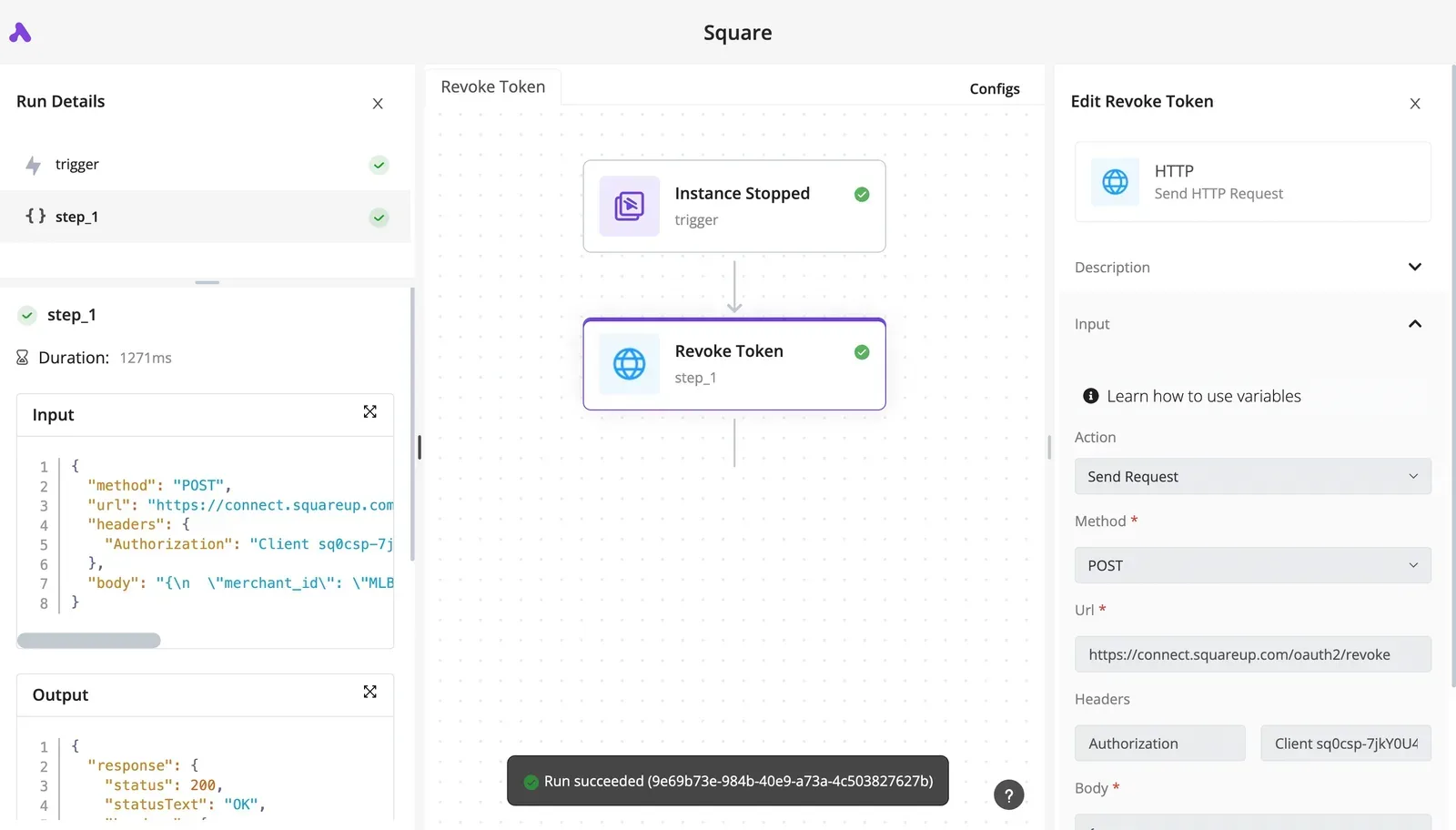
In the run panel on the left, both steps show as passed, with input and output JSON for each.
Read that panel the same way for speech: the output of the HTTP step is where you see whether you got audio, a URL or a job ID.
Storing the audio and logging cost
Once audio arrives, write it to storage (an S3-compatible bucket or Drive folder). Pass the file link to the next step, whether that's an email, a CRM note or a video render.
Log the character count of each request beside the file link. That log is the raw material for your cost per delivered minute.
Keeping your text-to-speech vendor swappable
Put the vendor-specific parts in one place: the URL, the auth header, the voice ID and the body shape. Everything after that step should read from a fixed set of fields you define, such as the audio link and the character count.
If a downstream step reads a vendor's own response field, swapping vendors means editing several steps. If it reads your fields, you edit one. Store the API key in a connection, not in the step, so a swap doesn't leave the old key lying around.
Play HT pricing checklist for Monday
Do these in order:
- Reopen each vendor's pricing page and write down the date you read it, plus whether the plan you want is still sold.
- Measure real characters per minute of audio from your own scripts, not a rule of thumb.
- Run a concurrency test by firing several requests at once and noting where they queue or fail.
Then audition two alternatives through the same workflow, changing only the request step.
Frequently asked questions
The moment you consider swapping vendors, most of these questions come up, because the answers decide whether you can swap at all.
Does Play HT have a free plan, and can I use it commercially?
Treat any free allowance as a trial until the vendor's terms say otherwise. Free tiers on voice APIs commonly restrict commercial use, and Play HT's terms are the only authority on whether this one does.
Read the licence clause on the pricing page before you ship audio to customers. If the clause is silent, assume you need a paid plan.
Is Play HT still available after the Meta acquisition?
Check before you build, because I couldn't confirm from the vendor's own pages that the plan you want is still on sale. An acquisition can end new signups, freeze plans or retire the API without much notice.
Open the pricing page and your account dashboard, and if the plan is missing, treat the product as unavailable for budgeting.
Export your reference audio and consent records now, because the same uncertainty covers cloned voices: you can't assume a cloned voice survives a shutdown or moves to another vendor.
Do unused Play HT characters roll over?
I found no rollover terms I can quote, so assume they don't. Most metered plans reset the allowance each billing period, which means unused characters are money spent on nothing.
Ask support to confirm in writing, and size your plan to a normal month rather than your best one. Ask too whether changing plans mid-month resets the counter.
Is Play HT cheaper than ElevenLabs?
Not necessarily. The monthly price is the wrong comparison. Compare cost per delivered minute after the character cap, concurrency limit and commercial-use terms apply at your volume.
To convert characters to minutes, run a sample of your real scripts through the API, time the audio, and divide characters by minutes.
Your own text, with its numbers, pauses and punctuation, will beat any vendor's rule of thumb. Then price both vendors on that ratio.
Can I use the Play HT API without a paid plan?
Only if the vendor currently issues keys to free accounts, which you should verify rather than assume. Check the signup flow and the API docs for any mention of a key before you write code against it.
Amazon Polly is the useful contrast: it has a free tier, but whether that tier permits commercial use is something I couldn't confirm. Read the service terms before you rely on it for anything customer-facing.
Related reading
References
Running the numbers
See what the same workload costs here.
Free forever plan, and every paid plan self-hosts at no extra cost.
See pricing Talk to sales