
Submagic Pricing: Plans, Costs and Limits (2026)

Nov 12, 202614 min read
Submagic Plans, Prices and Limits Compared
The direct answer
Submagic prices its three plans, Starter, Pro and Business, by how many videos you export and how long each one runs, meaning you need to estimate your usage to find the right plan, much as you would when sizing up any workflow you might later automate with a tool like Activepieces.
The monthly figure alone won't tell you your bill.
Submagic pricing is the tiered subscription structure, split into Starter, Pro and Business plans, under which the AI video-captioning tool charges according to how many videos you export each month and how long each one runs, rather than by a flat monthly fee.

Submagic is the AI captions and short-video editor. Count your videos and caption minutes first, then pick the plan that covers them.
If you skip that count, you pay twice: once for a plan too small, when exports run out mid-month, and again for the upgrade you make in a hurry.
Every plan in one table
I couldn't confirm Submagic's current monthly price, annual price or video allowance. Nor could I confirm the maximum video length or export resolution for each plan as of 2026-11-12.
If you skip that count, you pay twice: once for a plan too small, when exports run out mid-month, and again for the upgrade you make in a hurry.
If I put guessed numbers in a table, you'd budget against them, and that would be worse than no table.
Trust only the vendor's own page, submagic.co/pricing. When you open it, write down five things for each of the three plans:
- The monthly price per member.
- The annual price per member, which is usually a lower rate billed up front.
- The number of videos you can export each month.
- The longest single video the plan accepts.
- The highest export resolution it allows.
Then multiply the per-member price by the number of people who will actually edit. A team of three pays three times the listed figure, and that's the line people tend to miss.

What the credits, minutes and export limits count
You hit one limit first, and that one decides your plan. Two do most of the work: how many videos you export and how long each can be.
A creator posting short clips rarely hits the length cap, but a long interview cut into integrations can hit it on the first upload.
Fix a typo in a caption and export again, and that second export may count against your monthly allowance like a new video. That is the quiet cost of re-exports.
Activepieces charges 1 credit per flow run however many steps the flow holds, whereas Zapier bills per task and Make per module, so a ten-step hand-off around your exports costs the same as a two-step one.

Submagic's meter is the export, so check how its pricing page defines one before you assume a retry is free.
If you are running this arithmetic for your own team, see what the same workload costs on Activepieces.
What Each Submagic Plan Costs at Realistic Usage
If a retry counts as an export, it is a video you pay for twice, and at full quota on monthly billing, Submagic's pricing page works out to:
- $1.27 per video on Starter: - 97.5 cents on Pro
- 69 cents on Business
Submagic Cost Per Video for Three Typical Users
Those are the best prices each plan can deliver, and you only get them by using every export.
Only someone who actually fills the quota sees each plan up lower the cost of a video. Here's how that plays out for three kinds of user.
Take a solo creator posting weekly shorts. One short a week is four or five videos a month, perhaps eight with re-exports. Starter's 15 exports cover that with room to spare.
Even so, you're paying $19 for about five videos, so your real cost is nearer $4 each than $1.27. Pro would push that past $7, so it only wastes money here.
Take a small agency doing client captions. Five clients at eight videos each is 40 videos a month, which is exactly Pro's quota.
At $39 that's the 97.5-cent rate, and Starter can't hold the work at all, so you'd need to upgrade. With no spare exports, though, one round of client revisions can push you past the cap.
Take a podcast repurposing a long source into many clips. One episode can yield ten or more clips, so a weekly show lands at 40 or more exports.
Pro fits one show. A second show or heavier clipping belongs on Business, at 69 cents per video. Check the pricing page for minute limits on long source files before you commit.

Where the next plan up pays for itself
$20 more than Starter buys 25 extra exports on Pro, 80 cents each, so it pays once you need more than 15 videos.
Business adds 60 exports for $30 over Pro, 50 cents each, so you can estimate what you'll actually pay based on your export volume. It pays once you pass 40.
When you underuse a plan, this reverses: Business at 50 videos costs $1.38 each, worse than a full Pro, which means Pro becomes the economical choice at low volumes.
Hidden Costs and Limits Submagic Users Hit
Pro's economy at low volumes holds only until a limit you didn't price in pushes you up a plan, and five limits can do it.
The list below shows what to check against your own footage before you buy, and I have marked anything I couldn't tie to a specific plan as unverified.
- Plans cap videos at 2, 5 or 30 minutes (I couldn't verify which plan has which cap), so a 12-minute recording fits only under the 30-minute cap.
- Export resolution runs 1080p, 2K or 4K by plan (also unverified by plan), so a 1080p-only plan gives you softer output on large screens.
- Submagic charges per member, so a three-person team pays three times, not once (the per-seat price is unverified).
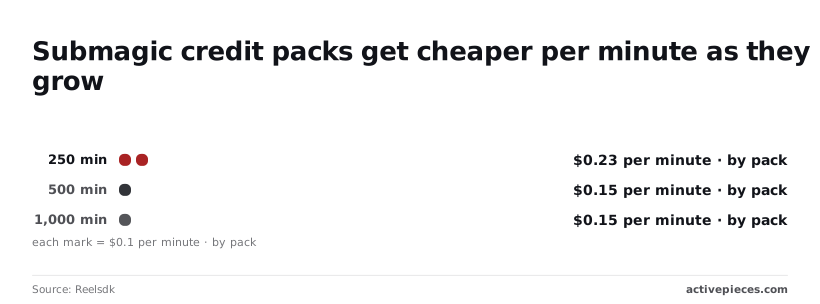
- The 250-minute credit pack costs $57, about $0.23 a minute, according to Reelsdk, so small top-ups are the priciest minutes you can buy.
- The 500-minute pack costs $75, or $0.15 a minute, so $18 more buys double the minutes at roughly a third off each one.
Measure your longest video first. A clip over your plan's cap won't process, and the fix is a higher plan. I couldn't verify that the watermark comes off on every paid plan, so check before delivering client work with a logo you didn't intend.
Assume a re-export after a caption fix counts against your quota until you've tested it, because that error costs you minutes you thought were free. Whether it does is unverified.
Submagic Seats, Extra Minutes and Renewal Terms
Count everyone who will touch a project, since each member is a seat.
For extra minutes, Reelsdk lists the 1,000-minute pack at $0.15 a minute, the same rate as the 500-minute pack. Doubling your purchase saves nothing per minute, so buy 500 and top up.
| Credit pack | Cost per minute |
|---|---|
| 250-minute pack | about $0.23 a minute |
| 500-minute pack | $0.15 a minute |
| 1,000-minute pack | $0.15 a minute |
| 10,000-minute pack | $0.10 a minute |
Only the 5,000-minute and 10,000-minute packs drop to $0.10 a minute, which matters only at agency volume.

Read the renewal terms at checkout, including whether annual plans renew automatically, because they are unverified.
Worth checking against a plan that does not meter every step: one credit covers a whole run on Activepieces.
Submagic Against Its Closest Alternatives on Price
If you start with footage you have already shot and need captions on it, Submagic is the better buy than Pictory. If you start with a script and need a video built for you, it's the worse buy.
These prices come from Submagic's own pricing pages., and the comparison rests on what each tool is for and where its limits bite.
Submagic versus Pictory
These are different jobs, and paying for the wrong one is the real cost: you end up doing by hand what the other tool would have done for you.
Submagic is an AI captions and short-video editor. Pictory is an AI video maker that assembles footage from text.
Put each vendor's own pricing page side by side on the day you buy. Compare four lines: entry monthly price, annual price, the cap on exports or video minutes, and whether exported videos carry a watermark.
If the clips go to clients, a watermark matters most, because it makes a free or entry plan unusable for paid work. Submagic wins when you post many short clips a month. Pictory wins when the video doesn't exist yet.
Captions-Only Tools Versus Full Editors on Price
Cheaper to learn and quicker per clip, a captions-only tool still stops where the captions stop.
If you also need to trim, add b-roll, or restructure a long recording, you'll pay for a second tool anyway, and the two bills together can exceed one full editor.
Count that second bill before you decide the first one is cheap.
When a free editor is enough
If you post only a few short videos a month and are happy to correct captions by hand, a free editor will do. Any paid plan is money spent on speed you don't need.
The paid tier earns its place when correcting captions costs you more hours than the subscription costs in dollars. Check that point against your own monthly video count rather than any plan's headline price.
Automating the Hand-Offs Around Submagic with Activepieces
If you want the chores before and after a Submagic edit taken off your hands, Activepieces, an automation tool with 747 integrations that moves files and messages between apps without code, can take them over.
It doesn't change what Submagic charges or how many exports and minutes your plan allows.
If you run out of exports, no workflow adds more. A workflow only saves the time you'd spend dragging files around by hand.
What can be automated and what cannot
Automate what happens on either side of the edit and leave the edit itself alone; that is the safe rule.
Before it, Activepieces can watch a folder for new recordings and start a job when one lands. After it, it can collect the finished clip, file it in storage, tell a reviewer it's ready, and queue it for posting.
The free plan allows unlimited flows and 1,000 credits a month, and a run is 1 credit, so a small channel's hand-offs fit inside it.
I can't promise that the editing step itself can be triggered from outside. Whether Submagic lets another tool start an edit depends on what its documentation exposes, so confirm that on Submagic's own site before you build around it.
Until you've, treat the edit as a manual step you do inside Submagic.
Because each clip you export in Submagic still counts against your plan, an automated flow that exports more than you need costs you real allowance.
A simple clip-to-review workflow
You operate one box yourself, the edit; everything around it runs on its own.
- A new recording lands in the source folder, and Activepieces notes it and tells you it's waiting.
- You edit and export in Submagic.
- The exported clip goes into your storage folder, where Activepieces picks it up.
- A review request goes to whoever approves clips.
- Once approved, the clip is queued for posting.
Start with steps 1 and 4. They are the two hand-offs most likely to stall a clip, and the work involved is small.
A Monday Plan for Choosing a Submagic Plan
You need one Monday morning: count what you made last month, test on the free option, match the count to a plan, and set a reminder. Follow the steps in this order.
- Count last month's finished videos and their total minutes.
- Try Submagic on its free option or trial with a real clip.
- Match your count to a plan's export quota and length cap.
- Start on monthly billing.
- Switch to annual after two steady months.
- Set a renewal reminder.
Skip to annual billing before you know your real volume and you end up paying upfront for a plan that doesn't fit. That is why the order matters more than any single step, and why the list is short.
Count your videos and minutes
Open your export folder or your posting history and count the videos you finished last month, then add up their running time. Count the ones you redid, too, because every re-export uses up quota just like the first one.

Leave the count out and you'll be choosing a plan by its headline price, which is the number that matters least.
Testing Submagic Free Before You Pay
Run one of your usual clips through the free option or trial, with your real length and your real caption style.
You're checking two things: whether the output needs less cleanup than your current method, and whether your longest videos fit under the plan's length cap.
Read the quota and cap on Submagic's own pricing page, not in a comparison article, since limits change. If your longest clip doesn't fit, a plan with a roomier export count won't help you.
Start monthly. A monthly plan lets you cancel if your volume turns out lower than you counted.
Once two steady months show you staying within the quota, annual billing is a safe saving. Two months is enough to see whether last month was typical or a one-off.
Put a reminder in your calendar a week before the renewal date. An annual plan that renews unnoticed can lock in a tier you've outgrown or no longer use.
At the reminder, repeat the count from step one and see whether your plan still matches it.
Frequently asked questions
Each of these questions decides what a missed reminder costs you, and Submagic's own help pages, not this article, are the final word on every one.
I haven't confirmed the current wording of any of them, so treat the answers below as what to check and why it matters.
Does Submagic have a free plan?
Read Submagic's pricing page before you enter a card; whether there's a free plan or trial is stated there, and it can change.
If one exists, use it as a test of your own numbers: caption a typical month's worth of videos at your usual length. Otherwise you're guessing at your plan from a headline figure, which is the mistake this article warns against.
Cancellation, billing and rights
Can I cancel Submagic or get a refund? Cancellation and refund terms are in Submagic's help pages, and you should read them before paying, not after.
The cost of skipping this is a renewal you didn't want and may not get back. Put the renewal date in your calendar the day you sign up.
Is annual billing cheaper than monthly? Expect annual billing to be priced below monthly; the pricing page shows the exact difference for each plan.
The saving only helps if your video count holds steady all year. If your output swings, a lower annual rate on the wrong plan costs more than paying monthly on the right one.
Can I use Submagic videos commercially? Check Submagic's terms if you caption for clients or run ads, because they set the commercial-use rights.
Read the terms for your plan, not just the general ones. Doing nothing here risks a problem after the videos are already published.
Can I switch Submagic plans mid-month? Read the help pages before you switch, since how upgrades, downgrades and billing are handled mid-month tells you whether you pay twice for the overlap or lose unused exports.
If your count outgrows your plan partway through a month, this is the answer you'll want already in hand.
Related reading
Running the numbers
See what the same workload costs here.
Free forever plan, and every paid plan self-hosts at no extra cost.
See pricing Talk to sales