
Understanding OpenRouter Pricing 2026 and Fees

Oct 12, 202613 min read
By functioning as a unified gateway, OpenRouter allows you to pay a single balance to access 80+ independent AI providers through one standardized API.
This architecture, which integrates seamlessly with automation tools like Activepieces to streamline workflows, eliminates the overhead of managing multiple API keys and separate billing cycles for every new model release.
OpenRouter Pricing Plans and Tiered Usage Limits
The Unified API Fee Structure
The cost of using OpenRouter is determined by the provider's base price plus a transparent platform margin. According to OpenRouter, when you purchase 100 USD in inference credits, the system allocates 5.5 USD as a platform fee.

5.5% is the margin that covers the infrastructure costs of routing your requests to the most responsive provider available.
OpenRouter's analysis notes that because these fees are deducted at the point of credit purchase rather than per request, your API calls reflect the raw provider rates. High-volume tasks like classification using Claude Haiku 5.5 remain cost-effective at scale.
Credit allocation and balance management
The platform fee is applied as a one-time deduction when you deposit funds into your account. If you add $100 to your balance, you will see $94.50 available for inference tasks, assuming the standard 5.5% rate.
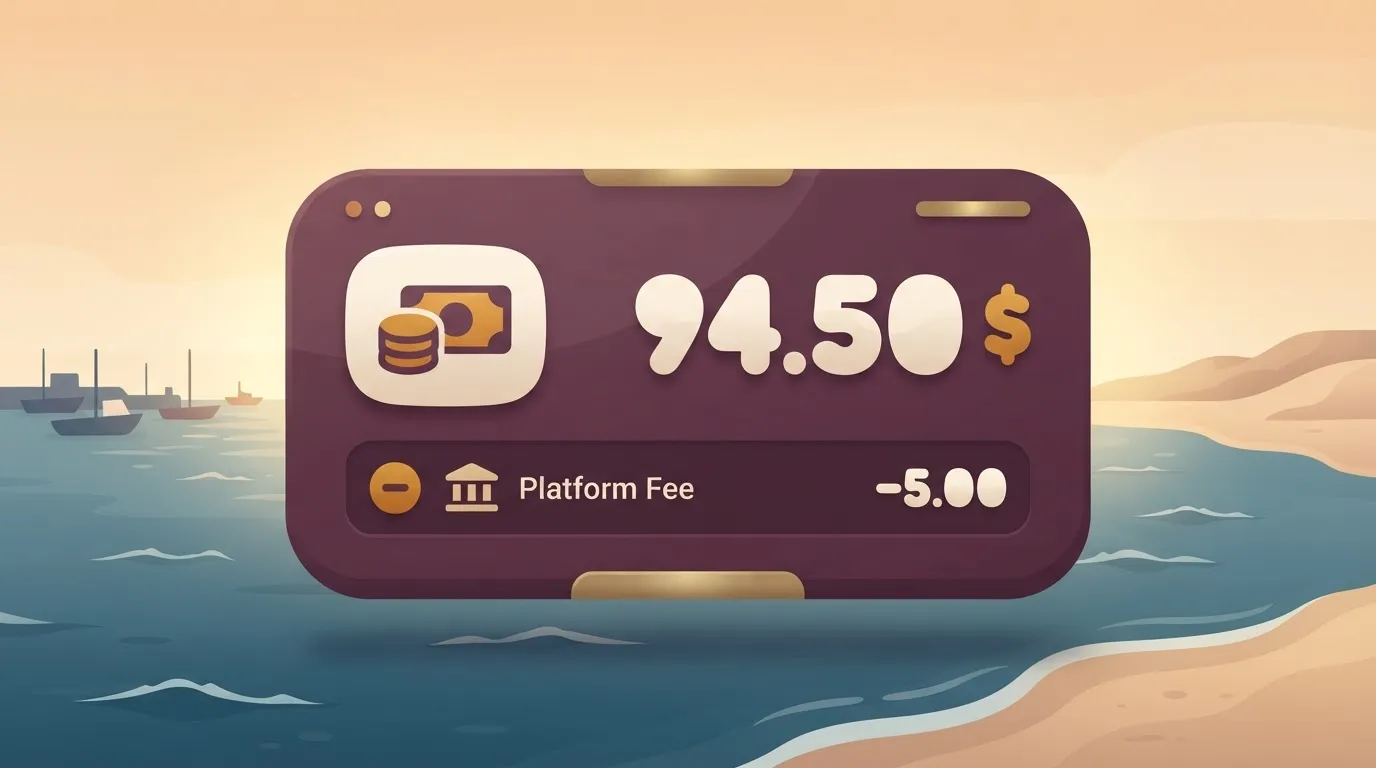
This upfront deduction ensures that every subsequent token you consume is billed at the exact market rate listed in the model directory.
By moving the platform fee to the point of deposit, OpenRouter allows developers to calculate their exact token runway without doing complex math on every API call. This transparency supports the marketplace model by showing you the true, uninflated cost of intelligence from each provider.
You are paying for the maintenance of the gateway at the door, rather than paying a hidden tax on every thought the AI generates.
What paid OpenRouter tiers unlock
When you transition from free usage to paid tiers, you unlock full model access and remove the restrictive daily caps that prevent production deployment.
You are paying for the maintenance of the gateway at the door, rather than paying a hidden tax on every thought the AI generates.
While the Free tier allows for rapid prototyping, moving to a Pay-As-You-Go model is necessary for any application requiring frontier intelligence like GPT-6 Astra.
| Dimension | Free | Pay-As-You-Go | Business |
|---|---|---|---|
| Platform Fee | 0% | 5.5% | 8% |
| Rate Limits | 50 requests / day | Unlimited | Unlimited |
| Model Access | 25+ free models | 500+ models | 500+ models |
| Support | Community | Standard | Priority |
Prices and plan limits checked against openrouter.ai on October 12, 2026.
Activepieces uses a credit-based system where a single credit covers an entire flow run regardless of how many steps are inside it.
Because the meter doesn't charge per task, builders can implement granular cost caps per team to ensure that complex logic chains don't lead to runaway API spend.
This billing structure, detailed on the published pricing page, encourages breaking work into reliable segments without increasing the cost of the automation itself.
OpenRouter verification and rate limits
Verification on OpenRouter is the primary mechanism for increasing concurrency limits, which dictates how many parallel threads your application can run.
By moving to the Business tier with its 8% platform fee, organizations gain priority support and higher throughput, which means they can scale operations more reliably during peak demand.
Without this tier, a sudden spike in traffic could result in 429 rate-limit errors, causing your application to drop user requests during peak hours. This throughput is essential for low-latency voice agents running on Gemini 3.8 Live.
If you are running this arithmetic for your own team, see what the same workload costs on Activepieces.
The economics of the OpenRouter marketplace
OpenRouter functions as a transparent clearinghouse where you pay for raw compute at the provider’s market rate plus a standardized platform fee. This structure ensures that your costs reflect the actual resource consumption of the specific models you invoke rather than a flat, obscured average.
How OpenRouter credits are spent
Every credit added to an account acts as a pass-through payment to the underlying hardware providers that host the models.
When you send a request to a flagship model like GPT-6 Astra or Claude Opus 5.5, OpenRouter settles the cost with the specific provider that fulfilled the inference.
Dynamic routing is made possible by this mechanism. If one provider for Gemini 3.1 Pro suffers from high latency, the system can automatically shift your request to a more responsive host without you needing to manage multiple billing accounts or API keys.

Understanding the 5% platform margin
The platform sustains its operations by adding a small, fixed percentage to the raw cost of every token processed. This margin covers the infrastructure required to maintain high-availability endpoints, unified logging, and the routing logic that selects the most efficient path for your data.
This percentage is not a separate surcharge added to your monthly bill. Instead, it represents the exact same fee settled during your initial credit deposit, ensuring that your per-token consumption matches the provider's wholesale price.
By collecting this margin upfront, the marketplace maintains price parity with direct provider APIs while funding the routing layer.
OpenRouter avoids the incentive to steer users toward higher-margin models by decoupling the platform fee from the model cost. The recommendation for a low-latency model like Claude Haiku 5.5 or GPT-6 Luna is based on performance requirements rather than profit optimization.
Why OpenRouter doesn't use a subscription model
Subscription models force light users to subsidize heavy users, a dynamic that fails when scaling enterprise-grade agentic workflows. Instead, OpenRouter utilizes a consumption-based approach where expenses scale linearly with your actual usage.
This pay-as-you-go transparency means your monthly bill represents the exact sum of your intelligence needs, preventing the "shelfware" waste common in flat-rate software-as-a-service tiers.
Tokens for Gemini 3.8 Flash requests cost exactly what the provider charges for high-volume extraction.
Mistral Large 4 reasoning tasks consume credits proportional to the complexity of the prompt and the length of the generation, so users must carefully optimize their inputs to manage overall costs.

Grok 4.7 coding sessions draw from the same pool of credits, which eliminates the need for separate monthly seats for different vendors.
Token Rates for Leading Models on OpenRouter
OpenRouter functions as a pass-through exchange where you pay the specific wholesale rate set by the underlying provider for every million tokens processed.
This architectural choice eliminates the "middleman tax" typically found in aggregated AI services. As competition between labs drives down operational costs, your overhead decreases immediately without waiting for a subscription tier to update.
Top-tier Frontier Model Costs
Because they require the most significant compute clusters to execute complex reasoning, frontier models represent the highest unit cost on the exchange.
When you call GPT-6 Astra for architectural coding or Claude Opus 5.5 for long-horizon agentic workflows, you're paying a premium for the density of logic per token.
- GPT-6 Astra is used for maximum reasoning depth where logic accuracy is the primary constraint.
- Claude Opus 5.5 is deployed for high-context agentic work that exceeds the reliability of smaller models.
- Gemini 3.1 Pro is chosen for deep research tasks requiring massive context windows.
Budget-friendly Open Source Options
Commodity intelligence is priced to move, allowing for high-volume classification and summarization at a fraction of frontier costs. Models like Mistral Large 4 or Llama-based variants hosted by competitive providers create a race to the bottom in pricing.
Millions of background operations can run for the price of a single high-tier reasoning session.
Mistral Large 4 handles general-purpose multimodal tasks. Claude Haiku 5.5 handles high-velocity classification. Gemini 3.5 Flash-Lite is the most budget-friendly option for simple, repetitive logic chains.
Input versus output token pricing
Every model on the platform distinguishes between the cost of reading your prompt and the cost of generating a response.
Output tokens are consistently more expensive than input tokens because the GPU must perform a full inference pass for every single word it generates, whereas input tokens can be processed in parallel.

A "cheap" model with expensive output is a poor choice for long-form content generation under this pricing structure. A model with high input costs but low output costs is better suited for summarizing massive documents.
Worth checking against a plan that does not meter every step: one credit covers a whole run on Activepieces.
Total Monthly Cost for Realistic Business Workloads
OpenRouter’s marketplace pricing ensures that your total monthly bill reflects the actual market rate of intelligence rather than a static, marked-up subscription fee.
By aggregating multiple providers for models like Gemini 3.5 Flash-Lite or GPT-6 Luna, the platform allows you to arbitrage costs across different infrastructures to maintain the lowest possible overhead.
The following data represents the total monthly expenditure for three common business personas, factoring in the 5.5% platform fee which covers the cost of unified API maintenance and routing logic, ensuring that the final bill reflects all operational overheads, so users can accurately forecast their total software costs without hidden surcharges.
Users are shielded from direct infrastructure management overhead.
| Persona | Monthly Cost | Token Volume | Primary Use Case |
|---|---|---|---|
| Support Bot | $12 | 1M tokens | Automated customer triaging |
| Content Engine | $110 | 10M tokens | High-volume marketing and editorial copy |
| Data Processor | $950 | 100M tokens | Large-scale document extraction and analysis |
As your token volume increases, these figures demonstrate that the efficiency of the marketplace prevents the exponential cost creep typically seen with single-vendor lock-in.
Budgeting $50 a month for small teams
A $50 monthly budget on OpenRouter provides enough headroom for a small team to deploy highly capable models like Claude Haiku 5.5 for internal Slack bots or ticket routing.
Because you aren't locked into a $20-per-user monthly seat, you only pay for the specific queries your team executes. A quiet week in development results in a lower bill under this consumption-based model, preserving capital for other operational needs.
Scale-up: Managing $500 in API Spend
At the $500 threshold, a company is likely running production-grade workflows using flagship models such as Gemini 3.1 Pro or Mistral Large 4 for complex reasoning, indicating a significant reliance on advanced AI for core business processes, which means these operations are now mission-critical to the organization's bottom line.
This indicates a reliance on high-tier performance for critical business operations.
If a specific provider raises prices or suffers from latency spikes, OpenRouter’s dynamic routing becomes a financial safeguard by automatically shifting traffic.
This ensures that your $500 budget buys the maximum possible intelligence units without requiring a manual audit of every provider's latest pricing sheet, saving administrators hours of labor each billing cycle, so the team can focus on strategic deployment rather than administrative overhead.
The platform handles the complexity of market fluctuations automatically.
Enterprise discounts for high-volume usage
Enterprises exceeding 100M tokens per month benefit from the competitive pressure between providers like DeepSeek and Google on the OpenRouter exchange. When processing at this scale, a difference of $0.01 per million tokens translates to thousands of dollars in annual savings.
Enterprises can swap to the most cost-effective frontier model, such as Gemini 3.8 Flash, the moment it becomes the price-performance leader by using a single interface to access the entire market. The bottom line isn't tied to an unoptimized legacy contract.
Regulated organizations like MoneyGram and FundingSocieties maintain this control by running the air-gapped edition in production.
The enterprise feature list (including custom RBAC, audit logs, and secret manager integration) is identical across the managed cloud and self-hosted builds, ensuring that maximum governance doesn't require sacrificing the platform's full capability.
Automate Model Switching with Activepieces
Activepieces, an MIT-licensed AI automation platform, allows you to programmatically shift workloads between providers to capture the lowest market rates without manual oversight.
By connecting OpenRouter to your operational stack, you ensure that every request for a model like Gemini 3.8 Flash or Claude Haiku 5.5 is routed through the most economical path currently available on the exchange.
Vendor lock-in is prevented and the overhead of managing multiple API keys for different inference providers is eliminated.
Automate cost aware task routing
The following workflow establishes a cost-aware pipeline that routes tasks to the cheapest available provider for a specific model tier:
- Create an Activepieces 'Schedule' trigger to initiate periodic batch processing or data extraction tasks.
- Add an OpenRouter step with 'Provider Preferences' set to 'Lowest Price' to force the system to select the most affordable route for your chosen model.
- Add a Log step to record token usage and final cost, providing the audit trail necessary for internal billing.
Even as model prices fluctuate across the marketplace, this sequence ensures that your automation remains profitable. With 739 integrations available to connect OpenRouter to the rest of your stack, you can build this cost-tracking flow for free in Activepieces.
Frequently asked questions
Does OpenRouter charge a monthly platform fee?
OpenRouter operates on a pay-as-you-go model rather than a recurring subscription, which means you only incur costs for the specific tokens your application consumes.
This structure eliminates the risk of paying for a tier you don't fully utilize. A developer can maintain an active API key for months of testing without a single charge appearing on their statement.
How do I set hard spend limits on my account?
By configuring a credit balance limit within your account settings, you can control your financial exposure. This prevents your application from making further requests once your pre-paid funds are exhausted.
Setting this limit acts as a circuit breaker against recursive loops or unexpected traffic spikes. A bug in your routing logic can't result in a bill that exceeds your intentional budget.
Are there discounts for high-volume enterprise users?
Direct discounts are rare because OpenRouter functions as a pass-through marketplace where providers like Together AI or DeepInfra compete on price. This often results in rates that are already lower than the list prices found on primary vendor dashboards.
You receive the benefit of high-volume pricing without having to negotiate individual contracts with every model lab because the platform aggregates demand to secure lower wholesale margins from these providers.
What happens to my credits if a provider goes offline?
If a specific provider hosting a model like Gemini 3.5 Flash-Lite or GPT-6 Astra experiences downtime, OpenRouter automatically routes your request to an alternative provider hosting the same model. This ensures your application remains functional.
Only when a request is successfully fulfilled are your credits deducted from your central balance. A regional outage at a single data center doesn't lock away your capital or require you to manage multiple refund requests across different vendors.
Related reading
References
Running the numbers
See what the same workload costs here.
Free forever plan, and every paid plan self-hosts at no extra cost.
See pricing Talk to sales