
Windmill License Explained: AGPLv3 vs Enterprise in 2026

Oct 27, 202613 min read
You have to read two licences, not one, and decide which features you'll rely on, because Windmill is an open-core platform: the community code is AGPLv3, and enterprise features such as SSO need a paid licence key.
Windmill's AGPLv3 and Enterprise licensing
What AGPLv3 means in plain terms
If you modify the code and let users interact with it over a network, you must offer them the corresponding source. That is AGPLv3: copyleft with a network-use clause. Unmodified internal use triggers far less, but your legal team must still confirm that.
Compare this with the wider ecosystem. According to Tencent Cloud Developer, MIT covers 45% of licensed GitHub projects, so most open-source policies are written around it. GPL v2 and v3 together cover 22%, meaning copyleft review is routine but a minority concern.
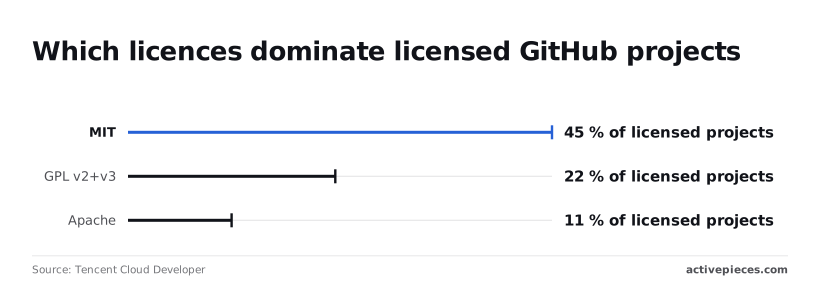
Apache covers 11%, a permissive option with a patent grant. Windmill's core is on the copyleft side, which is why it needs its own review, unlike the MIT-core Activepieces.
To see how the licences divide by directory, look at the repository's LICENSE file:
| Directory | Licence |
|---|---|
backend/ |
AGPLv3, with proprietary enterprise snippets |
frontend/ |
AGPLv3 |
python-client/ and other clients |
Apache 2.0 |
Read this as a boundary map. The server is where copyleft and proprietary code meet, while the client libraries you embed in your own code are permissive. What follows is that the enterprise code lives inside the backend, not in a separate product.

Without a key, those paths do nothing. The key switches on the proprietary snippets in the backend, and Windmill's pricing page says which features they gate, SSO among them. Treat any SSO requirement as a purchase decision, not a configuration option.
The licence-share figures come from the Tencent Cloud Developer article above.
**Treat any SSO requirement as a purchase decision, not a configuration option.
The fastest way to settle a shortlist is to try one. Activepieces is free to try, no credit card.
The open-source case for Windmill
Take the plain case. Windmill's core is ordinary open source: the code is public, AGPLv3 is OSI-approved, and the AGPL is common enough that no one can call it exotic.
On that view, the Enterprise split is the standard open-core pattern. Windmill's licensing page and the repo's LICENSE file say which directories are under which licence.
28.9% of projects use MIT and 26.1% use AGPL, according to the OpenReplace catalogue, so AGPL is within three points of the most popular licence. GPL holds 17.9%, Apache 17% and everything else 10.1%, which means MIT is the largest single licensing choice.
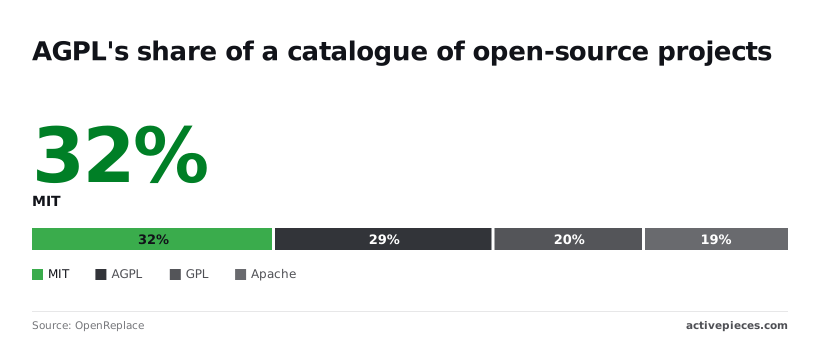
Add GPL's share to AGPL's and strong-copyleft licences cover 44% of the catalogue, more than MIT, so anyone integrating from this repository will encounter copyleft obligations more often than permissive terms.
A buyer who rejects AGPL on principle is rejecting a large part of the open-source world.
Internal use rarely triggers AGPL obligations
When you modify the program, section 13, the AGPL's network clause, applies. It says: "your modified version must prominently offer all users interacting with it remotely through a computer network … an opportunity to receive the Corresponding Source."
Two conditions have to hold: you changed the code, and outside users interact with it.
Run Windmill unmodified for your own staff and neither condition is likely to be met, though your legal team must still confirm that. Employees aren't outside users, so there's no source-sharing duty. Only a company that forks the core and exposes the fork to customers has something to publish.
Free self-hosting of Windmill's AGPL core
You can run the AGPL core on your own infrastructure at no licence cost, and that is the believers' strongest point. You can read it and audit it. Your workflows keep running if the vendor's cloud goes down, because the control plane is yours.
To fund development, open-core vendors keep SSO and other enterprise features under a commercial licence. On this account, the AGPL part of the repo stays open and the paid part is labelled as paid.
Licence split's impact on buyers
Although the open part stays open, the obligations attach to what you do with Windmill, not to whether you run it. Running it internally unchanged triggers little, while modifying it, reselling it or needing gated features triggers real duties.
Where AGPL obligations actually apply
Modification decides it.
Section 13 of the AGPLv3 says: "if you modify the Program, your modified version must prominently offer all users interacting with it remotely through a computer network (if your version supports such interaction) an opportunity to receive the Corresponding Source of your version."
It takes both modification and network access. An unmodified internal deployment doesn't meet it. A patched fork that outside users reach through a browser or API does, so you must publish your changes.

Situations where obligations bite:
- Offering Windmill as a service to third parties
- Modifying it and exposing the modified version over a network
- Embedding it in a product you distribute or host for customers
- Needing SSO for more than a handful of users
- Needing audit logs or vendor support
Split that list and you get two kinds of question. The first three are copyleft questions. The last two are licence questions, and a self-hosted deployment can't answer them with a configuration flag.
Check which directories of the repo are under which licence before deciding which applies to you.
Features gated behind the Enterprise licence
If you need SSO, audit logs or support, you are under the commercial licence, not the AGPL. The repo's LICENSE file shows the boundary, and it's labelled.
I won't call a deployment compliant until you can name the licence covering each directory you ship. Windmill's own pricing page is the source for what each tier includes and costs, and I'm not restating those terms here.
Three assumptions recur:
- Embedding Windmill inside your own product is treated as "internal use". If your customers interact with it over a network, it isn't.
- A hosted reseller offering is assumed to need only attribution. Under section 13, a modified version also carries a source-offer duty.
- SSO is assumed to ship with the open edition because the login screen exists. Having the screen doesn't mean the licence covers its use at your user count.
Each is cheap to settle before launch and expensive to settle after a customer asks.
Reading a table only gets you so far. Build the same workflow in Activepieces and compare it yourself.
Windmill's licensing prices and terms
Windmill's core is free under AGPLv3, and its enterprise features, SSO among them, need a paid commercial licence.
Whether a given directory in the repository is under AGPLv3 or the commercial licence is stated in the repository's LICENSE file. Read that file before you assume a feature is free.
Plan names, the pricing basis (per seat, per usage or by quote), the cloud-versus-self-hosted split and the free-tier limits all belong on Windmill's pricing page.
Anything the page doesn't publish, such as a custom quote, you should treat as unpublished and ask the vendor for in writing.
For the test, go to section 13 of the licence. It reads: "if you modify the Program, your modified version must prominently offer all users interacting with it remotely through a computer network … an opportunity to receive the Corresponding Source of your version."
Running unmodified Windmill internally triggers nothing under that sentence. Modifying it and exposing it to users over a network does, because you must then offer them your source.
If your product embeds or alters the core, get counsel to confirm which side of that line you're on. "Compliant" means nothing until you name the clause it satisfies.
What the Enterprise licence key unlocks
Behind the key sit the features kept under the commercial licence, SSO being the one that matters for most buying checks. I haven't confirmed the full feature list, how the key is applied to a self-hosted instance, or whether cloud and self-hosted keys differ.

Ask the vendor two questions: what happens to those features if the key lapses, and what happens if Windmill's licence service is unreachable while your instance is running.
For this draft I didn't verify the sources, Windmill's pricing page and the LICENSE files in its repository, against a live copy, and I give no figures. Read the pricing page on the day you buy, and record that date next to whatever you find.
Windmill and Activepieces licences compared on SSO and self-hosting
Because both tools keep SSO behind a commercial licence, the dated price you recorded is the cost of the feature. The open-source licence on the core only decides what you may do with the rest.
Windmill's core is AGPLv3, which is copyleft with a network-use clause. Activepieces' core is MIT, which carries no copyleft obligation.
Side-by-side table
Read the licence column first, because it's one of the rows where the two products diverge. The table shows that they differ on the core licence and not on where SSO is.
Check each repo's LICENSE file to see which directories are under which licence before relying on it.
| Windmill | Activepieces | |
|---|---|---|
| Licence type | AGPLv3 core | MIT core |
| Self-hosting cost | Core is free to run; SSO needs a paid plan | Core is free to run; SSO needs a paid plan |
| SSO | Enterprise feature, commercial licence | Enterprise feature, commercial licence |
| Enterprise terms | Commercial licence covers the enterprise directories | Commercial licence covers the enterprise directories |
| SSO entry price | $120 per month | Read from Activepieces' pricing page on the day you buy |

Treat the $120 as a claim to confirm on Windmill's pricing page, since pricing pages update. The price row comes from Activepieces' own self-hosted pricing article, a competitor writing about Windmill.
When Windmill's licence is the better fit
$120 per month is what that article gives as Windmill's self-hosted SSO entry, against $0 for Budibase, $667 for n8n and $2,500 for Appsmith. Budibase's $0 means that, on this source's figures, SSO costs nothing there.
At $667, n8n costs roughly five and a half times Windmill's price. Appsmith's $2,500 is roughly twenty-one times it, so a small team would pay more for login than for much of its infrastructure.
If AGPLv3 suits you, Windmill is the cheaper paid route among those three.
For teams that can't accept AGPLv3's network-use clause, Activepieces keeps its core under the MIT licence, so that obligation doesn't attach to the core, and it has 772 integrations in the open source monorepo.
Its SSO, though, is still a paid enterprise feature, so the licence choice doesn't remove that cost.
Pre-adoption checks for Windmill
Start by establishing whether you'll modify Windmill or expose it to people outside your organisation, because that one fact decides which licence obligations reach you. SSO being paid doesn't settle the question.
The AGPLv3 network-use clause can still apply to your deployment, and an enterprise feature can still be outside it.
I wouldn't call any deployment "compliant" until you can name the clause it satisfies. The checks below are ordered so each one narrows the next, and the checklist is here because the order matters more than any single item:
- Note whether you modify or expose Windmill: running it unmodified for internal staff is a different position from patching its source or offering it to customers.
- Read the licence text in the repository's LICENSE file, not a summary of it. If you modify the code and users interact with it over a network, the network-use clause is the provision to test your plan against.
- Open the LICENSE file again and see which directories are under the commercial licence. If the feature you need, SSO or otherwise, is in those directories, AGPL compliance doesn't cover it. It needs a paid agreement.
- If Windmill will be inside a product you ship or host for others, have counsel confirm in writing which obligations attach. A verbal "it should be fine" isn't evidence for an audit.
- Ask for the price and the terms in a document, including what happens to the feature if the agreement lapses. Pricing pages describe intent. A quote is the thing you can hold the vendor to.
- Licences and feature lists change. Put a date in the calendar to re-read both files and the vendor's pricing page, and record what they said on the day you decided.
Frequently asked questions
Is Windmill free for commercial use? Yes for the AGPLv3 core, which carries no fee for commercial use. Enterprise features are under a separate commercial licence and need a paid agreement.
Check the repository's LICENSE file to see which directories are under which terms before you assume a feature is free.
Does AGPLv3 force me to publish my scripts?
No, running Windmill internally doesn't by itself oblige you to share your scripts. The trigger is section 13, which applies if you modify the program and offer it to users "interacting with it remotely through a computer network."
Your own scripts are workflow content, not a modified version of Windmill.
If you patch the Windmill source and expose that build to outside users, you must offer them that modified source. Have counsel confirm where your deployment is on that line.
Can I self-host Windmill with SSO without paying?
Partly. The Community edition allows SSO only for a small capped number of users, so a larger team will hit the limit and need Enterprise.
The cap is on Windmill's pricing page, which is the document to check, not this article. Guest access and the number of workspaces you may run, including whether forks count toward that limit, are also set there.
What happens if my Enterprise licence expires?
I haven't confirmed this from Windmill's published terms, so I won't state what stops working.
Ask Windmill for the expiry clause in writing and get answers to three things: which features are disabled, whether existing data stays readable, and whether the instance keeps running on the core.

Until you have that, an expiry date is an unmitigated outage risk.
Is Windmill still open source in 2026? The core is, and the whole product isn't. AGPLv3 is an OSI-approved open source licence, so the core qualifies.
Enterprise features under the commercial licence don't. "Open core" describes the arrangement accurately, and the LICENSE file is the evidence for it.
Related reading
References
Still comparing
The fastest way to settle it is to build something.
Open source under MIT, so you can self-host the same thing later.
Start free Talk to sales