Workflow Automation with Python: Best Tools for 2026

Nov 14, 202614 min read
When logic moves from a local script to a production environment, it marks the hallmark of modern automation excellence. This transition must happen without losing the visibility needed to debug failures in real-time.
Workflow automation with Python refers to the practice of using programmable frameworks and orchestration engines to coordinate complex sequences of tasks while maintaining operational transparency across distributed systems.
Gitstarclub reports that organizations choosing between Apache Airflow, Prefect, Activepieces, and Dagster must prioritize how these tools handle state and infrastructure.
The cost of "hidden" failures in 2026 often exceeds the initial development time.
Best workflow automation with python tools 2026
| Tool | Deployment Complexity | Primary Logic Style | Ideal User |
|---|---|---|---|
| Apache Airflow | High | DAG (Python) | Data Engineer |
| Prefect | Low | Native Python | Developer |
| Activepieces | Low | Visual / Typescript | Hybrid |
| Dagster | High | Asset-Oriented | Data Engineer |
**The cost of "hidden" failures in 2026 often exceeds the initial development time.
Operational bottlenecks at scale are prevented by the architecture chosen based on the following criteria. While some platforms demand dedicated DevOps resources to maintain a scheduler, others allow developers to focus entirely on the execution of the code.
Observability and Error Handling
To prevent silent logic errors in 2026, teams require deep inspection of the data payloads passed between steps. Apache Airflow often separates logs from the task UI.
This forces users to hunt through external storage like Amazon S3 to find the trace of a failed operator.
By treating the flow as a first-class citizen, Prefect provides a centralized dashboard that tracks state changes automatically.
This visibility ensures that when a model like Claude Opus 5.5 fails to return a valid JSON object during an agentic workflow, the developer sees the exact raw input that triggered the schema violation.
Airflow and Dagster infrastructure overhead
The hidden cost of automation is the infrastructure tax paid to keep the orchestrator alive. Apache Airflow requires a persistent web server and a database.
A team must manage version upgrades even when no tasks are running. Dagster similarly demands a robust deployment of its "Daemon" and "Webserver" components to track asset lineage.
Lightweight or cloud-native options reduce this burden by abstracting the worker nodes. This allows teams to trigger complex logic via webhooks or schedules without maintaining the underlying virtual machines.
Python-native vs. DSL Logic
Friction in an automation tool often lies in its Domain Specific Language (DSL). This can restrict the use of standard Python libraries.
Apache Airflow forces logic into specific "Operators," which creates a learning curve for developers who simply want to run a standard script.
More Python-native code is possible with Prefect and Dagster. Decorators turn standard functions into observable tasks.
This allows a developer to integrate a frontier model like Gemini 4 Carbon using standard SDKs. The automation framework then is a wrapper rather than a constraint on the code’s flexibility.
Everything below works on Activepieces' free plan. Start without code or a credit card.
1. Activepieces platform
Activepieces runs custom Python code within a visual environment that provides 748+ integrations for teams that require both rapid prototyping and strict logic control.
Zapier is for non-technical users with rigid templates. Activepieces allows developers to write precise scripts within a drag-and-drop interface.
This ensures technical debt doesn't accumulate when a native integration lacks a specific function.
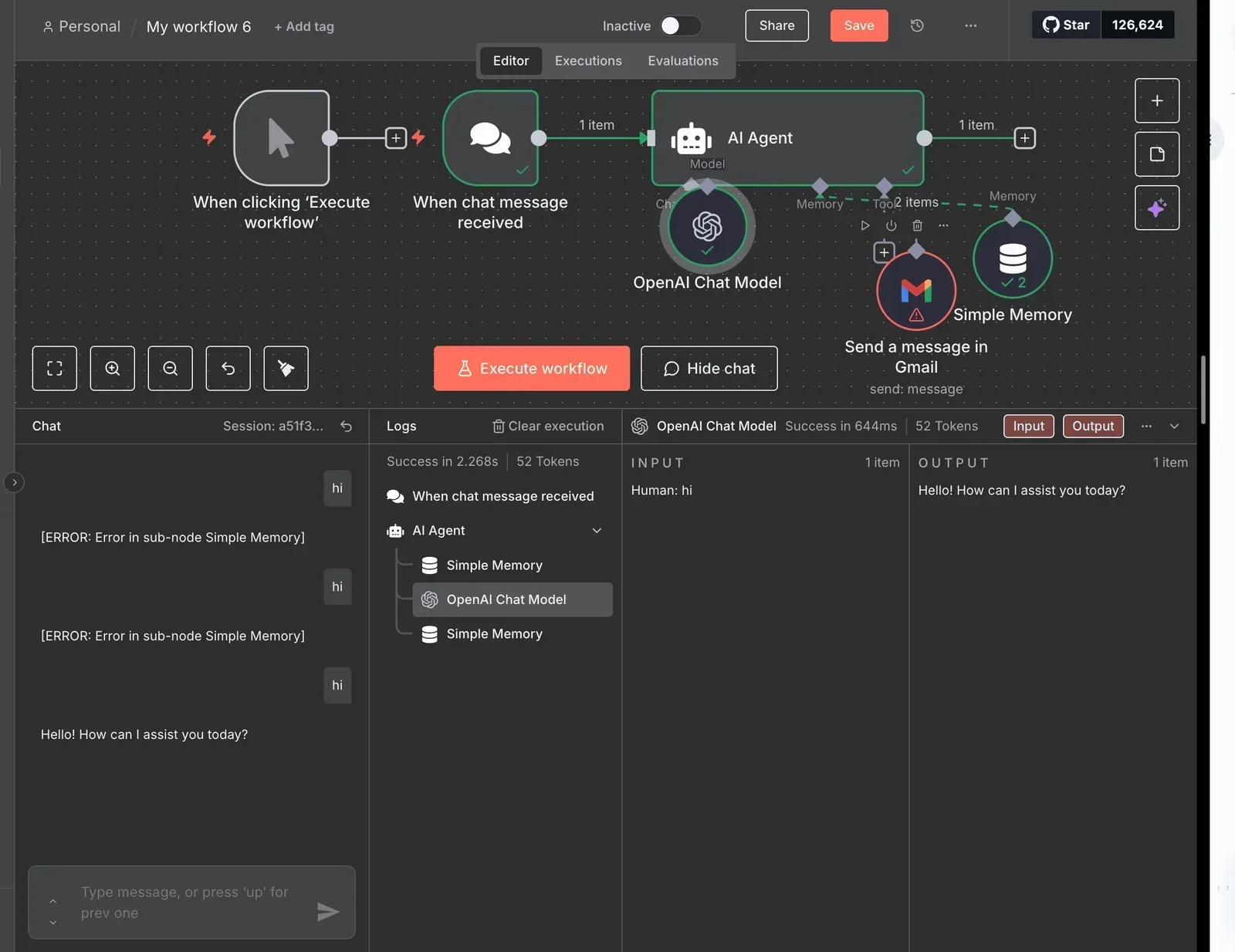
Directly in the builder, the platform manages this balance by exposing the underlying execution logic. The following workflow illustrates an agentic customer support flow that utilizes high-reasoning models alongside traditional business tools.
Visual logic and debugging
Three steps appear in the visual builder: a manual "Execute workflow" trigger for testing, a "When chat message received" trigger for production, and a central "AI Agent" node, which allows developers to toggle between sandbox and live environments seamlessly, so testing changes requires no complex reconfiguration.
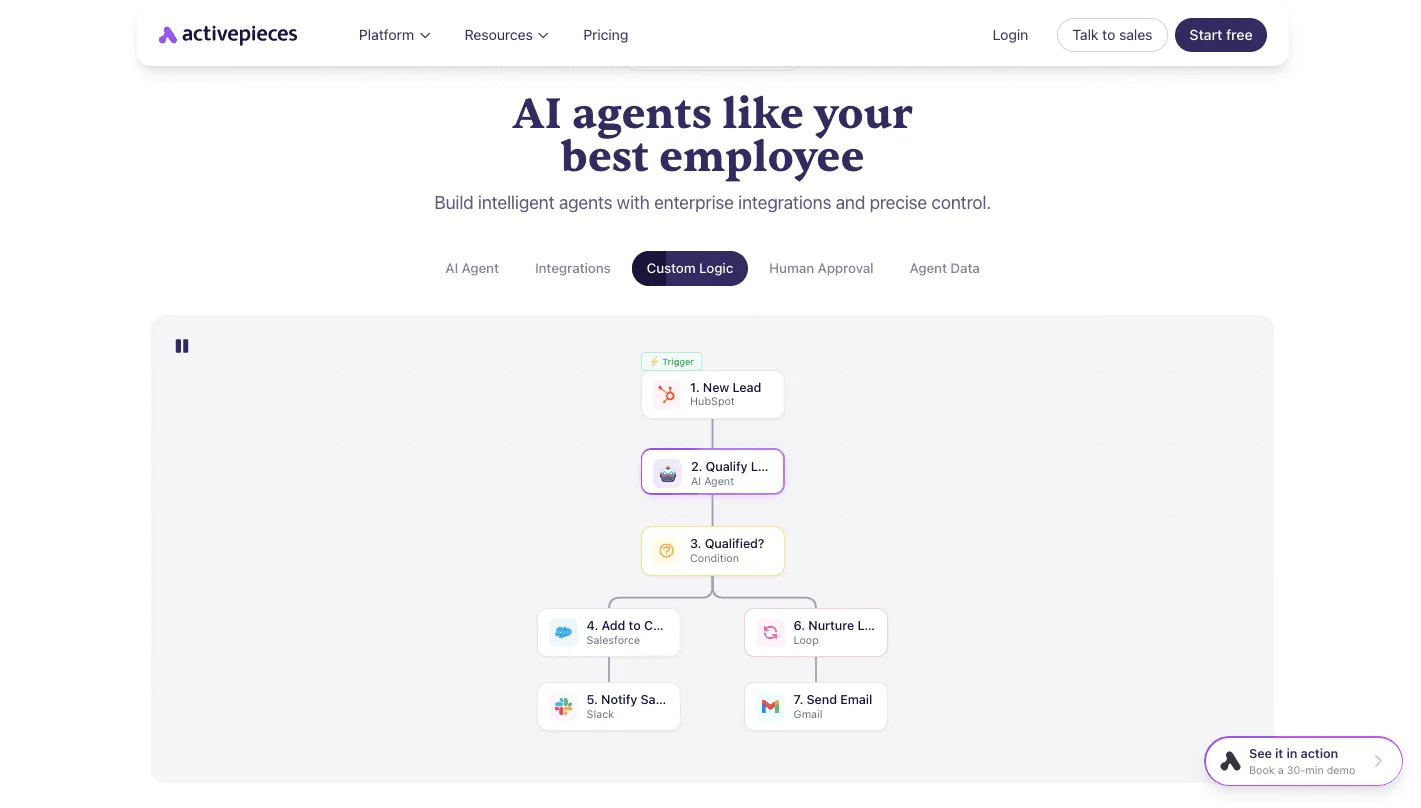
The developer configures this AI Agent to use the OpenAI Chat Model for reasoning and a Simple Memory database icon for context persistence, eventually outputting to a "Send a message in Gmail" component.
Monitoring execution and errors
At the bottom, the execution panel reveals the operational reality of these flows. While it successfully processed a "hi" from a human, it also flagged an "[ERROR: Error in sub-node Simple Memory]" message.
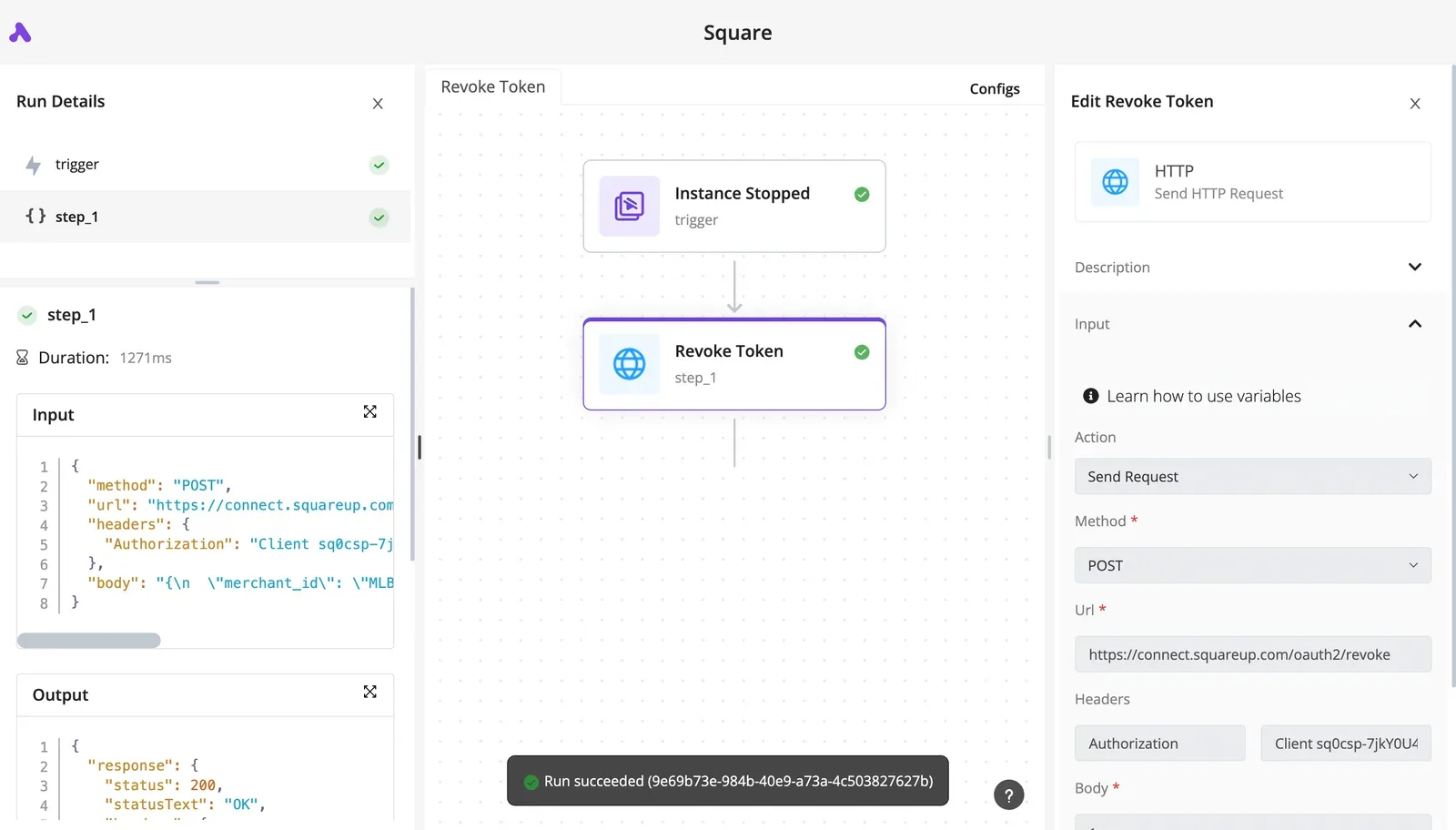
This immediate visibility means a developer can see exactly where a database retrieval failed without digging through external cloud logs.
Tracking AI agent token usage
Unexpected billing spikes can be prevented by administrators during the debugging phase because the workflow is currently "Inactive" and shows exactly 52 Tokens used.
This transparency ensures that as flows grow more complex, the handoff between a designer and a coder remains fluid.
Custom integrations and deployment
Activepieces syncs flows to Git and promotes them through Release Management, ensuring that logic moves from test to production as a versioned deployment rather than a simple save in a UI.
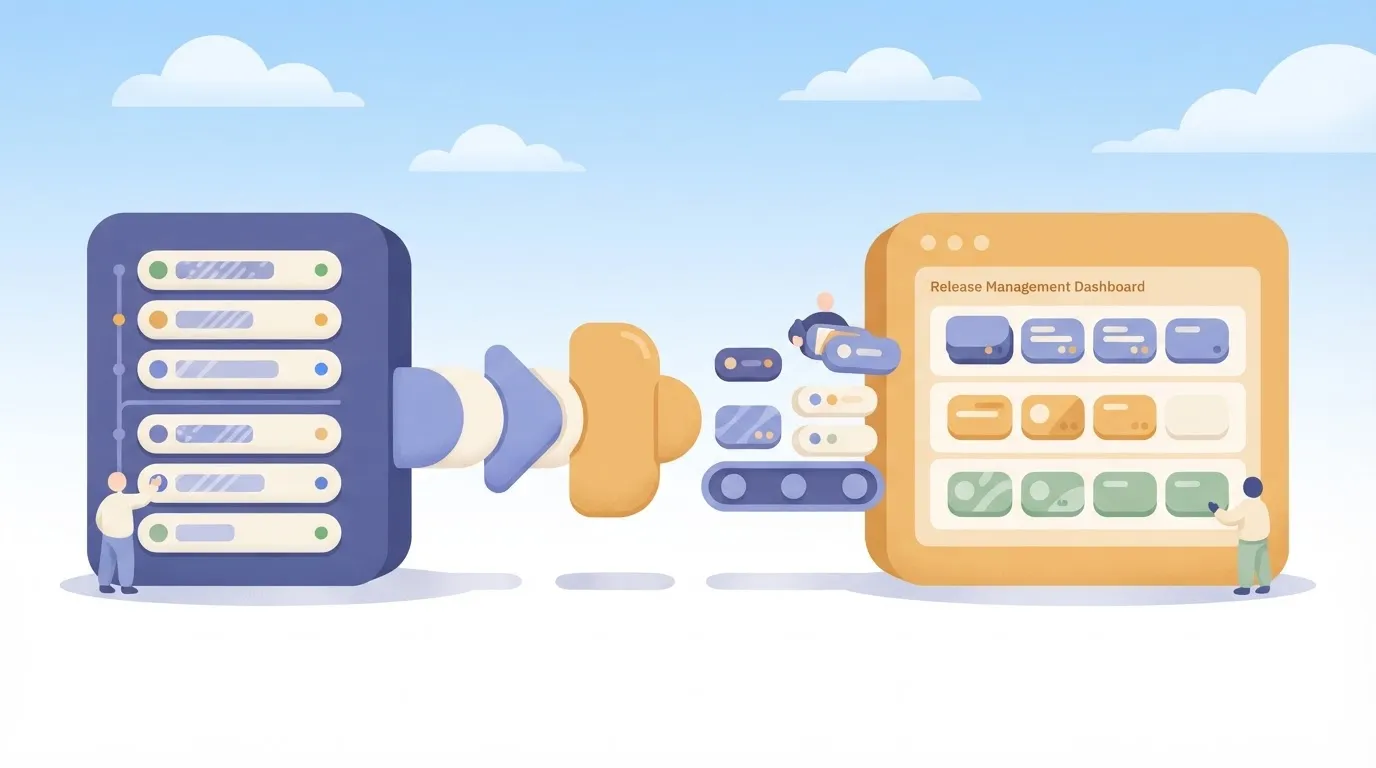
This allows teams at MoneyGram and Alan to treat automation as software, using separate environments to review changes before they go live. Check the Git Sync documentation for how these features work across the same MIT-licensed core, whether self-hosted or on cloud.
To see the full library of existing integrations or to start building for free, visit https://www.activepieces.com/pieces.
By treating automation as code that can be synchronized with Git and managed through formal release cycles, this platform ensures that workflows are subject to the same rigorous peer review as any other production software.
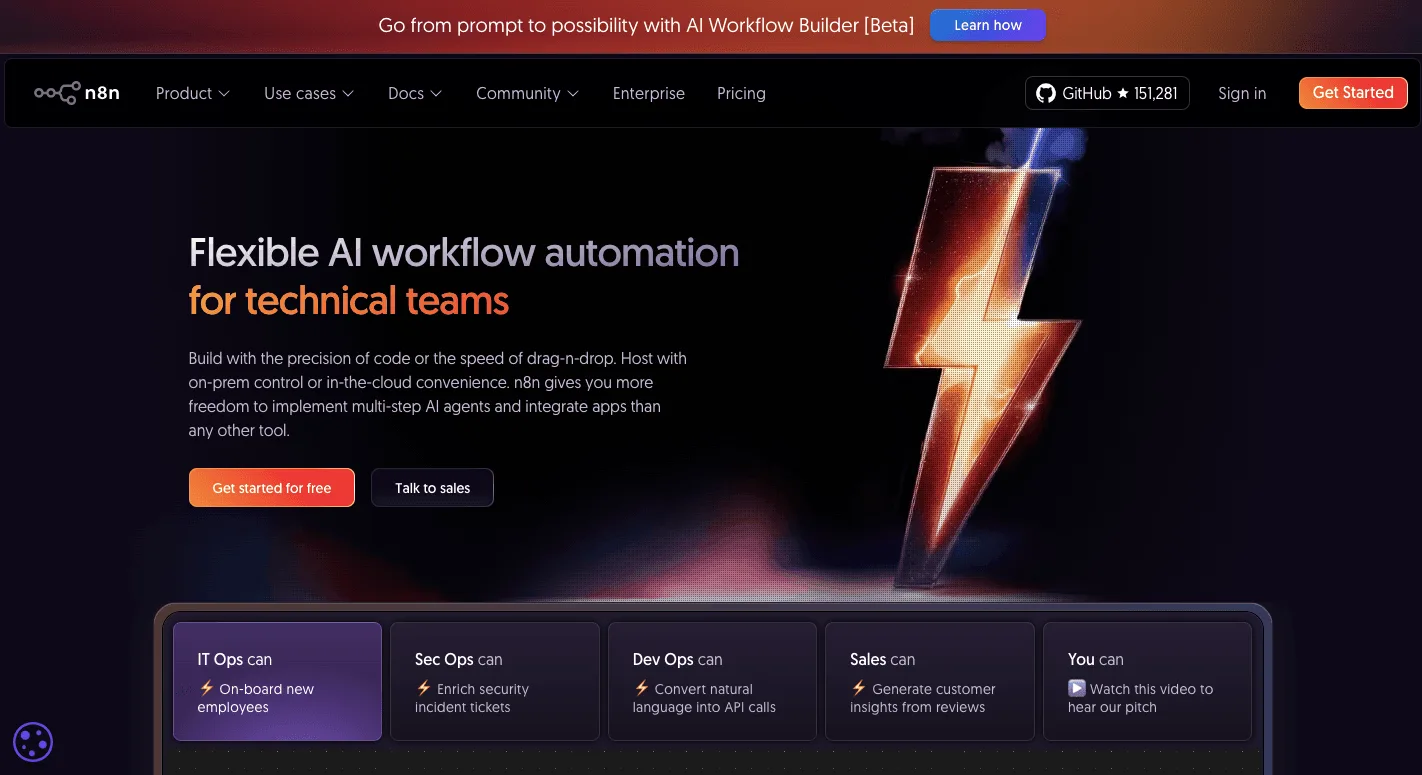
Activepieces is the better choice for engineering teams who require full visibility into their execution logic and refuse to let critical business processes live exclusively within a vendor's opaque UI.
Use Apache Airflow for complex workflows
Apache Airflow is the standard choice for teams requiring a Python-first orchestration engine that prioritizes complex dependency management and auditability.
Airflow is the industrial scaffold that ensures these scripts execute in the correct sequence across distributed infrastructure while a framework like Gemini 4 Carbon provides the reasoning logic.
Directed Acyclic Graphs (DAGs) form the foundation of the platform. These are Python files that define the relationship between tasks.
Storing every pipeline version in a version control system like GitHub ensures that the "configuration as code" approach remains reliable.
This allows a DevOps lead to roll back a failing production flow to a previous state instantly. However, this flexibility carries an operational tax: Airflow requires a dedicated worker environment, such as a Kubernetes cluster, to manage the execution of tasks.
The maturity of the ecosystem is visible in its community health metrics:
- 47,200 GitHub Stars
- 18,100 Forks
- 2,300+ Total contributors
A massive library of pre-built "Operators" is represented by these figures. These are integration blocks for services like Amazon S3 or Snowflake.
A data engineer rarely has to write raw API authentication logic from scratch. This density of support ensures that even obscure enterprise bugs have documented workarounds.
Several managed providers offer Airflow as a service with varying price floors for teams that don't want to manage the underlying infrastructure:
| Provider | Entry Price | Primary Benefit |
|---|---|---|
| Astronomer | $0.30/Astro Unit-hour | Includes a CLI for local development that mirrors the cloud environment. |
| Amazon MWAA | ~$0.49/hour (Small) | Integrates with AWS IAM for native permission management without extra tokens. |
| Google Cloud Composer | ~$0.35/hour (Small) | Automates environment scaling so a pipeline doesn't stall during peak data loads. |
Where data integrity is more important than sub-second latency, Airflow excels. It's designed for batch processing rather than real-time event triggers.
This makes it the logical choice for high-compliance environments. Every task retry and failure is logged for a permanent audit trail.
Easier to see it running than to read about it: set it up free, no card.
Deploy prefect for observable python scripts
Prefect is the high-visibility orchestration layer for Python-heavy teams who need to turn local scripts into resilient production workflows. It treats "code as the workflow."
A developer adds a simple @flow decorator to an existing function to gain instant logging and a centralized dashboard.
This approach eliminates the "black box" problem of cron jobs where a script might fail silently on a server. Prefect is a unified view of every execution state across the entire infrastructure.
The platform handles the unpredictability of modern data stacks by supporting dynamic inputs and asynchronous execution. While traditional tools require a predefined Directed Acyclic Graph (DAG), Prefect allows the workflow to change shape at runtime based on the data it encounters.

Dynamic execution and cost savings
For teams using high-reasoning models like Claude Opus 5.5 for long-running agentic coding tasks, this flexibility is essential.
The number of steps depends on the complexity of the code being analyzed. By offloading the "plumbing" of automation, such as queue management and state tracking, teams reduce the overhead of maintaining their own internal tooling.
80% of the ideas might not survive the pilot, but 70% infrastructure savings were reported by Rent The Runway, proving that the model remains financially viable even with a high failure rate, which means the company can afford to experiment aggressively.
This allowed the team to reallocate engineering hours from maintenance to feature development.
This allows the company to accelerate its product roadmap without increasing headcount.
By optimizing how resources are provisioned during task execution, Endpoint achieved a 73.78% reduction in infrastructure costs, significantly lowering the overhead required to maintain their operational scale, meaning more capital is now available for core product development.
The business retains significantly more capital for core operational investments.
Organizations switching to this orchestration model typically see 70%+ savings in infrastructure management, so they can reallocate those funds toward core product innovation. IT budgets are freed up to support broader strategic initiatives.
The "Hybrid Model" is the source of these efficiencies, where Prefect Cloud (the hosted management platform) tracks the state of the work.
The actual execution happens behind the user's firewall. This separation ensures that sensitive data never leaves the local environment, satisfying the security requirements of enterprise DevOps teams while providing the operational clarity needed to scale.
Implement dagster for asset-based data pipelines
Dagster is a Python-native orchestration layer that treats data pipelines as a collection of software-defined assets rather than a sequence of independent tasks.
This shift in perspective allows teams to define the desired state of their data. This might be a cleaned customer table or a financial summary.
The orchestrator manages the underlying execution logic and dependencies.
While traditional tools focus on the success of a job, Dagster tracks the health and lineage of the data itself.
A lineage graph of three interconnected Software-Defined Assets shows Raw Data flowing into Cleaned Data and finally into a Final Report.
Each node displays real-time status indicators and metadata tags like row counts or schema versions.
Dagster asset health monitoring
When the cleaning step fails, this visualization ensures that the system marks the report as stale to prevent downstream users from consuming inaccurate information.
The framework then uses these metadata tags to trigger targeted retries or alerts based on the specific asset that failed.
The platform is designed to mirror a standard software development lifecycle through the following features.
- Dagster+: is a fully managed cloud offering that provides serverless execution, branch deployments for testing code changes in isolation, and enterprise-grade SSO.
- Asset Observation: is a mechanism to monitor external data sources that are not managed by Dagster. This ensures the lineage remains complete even when third-party tools modify the data.
- Declarative Scheduling: is an approach where sensors and schedules start runs based on the state of the data assets rather than simple time intervals.
Dagster integrates with modern models to automate complex data transformations for teams leveraging frontier AI. You can use Gemini 4 Carbon for high-reasoning coding tasks within your assets, or deploy GPT-6 Astra to handle complex reasoning for data validation steps.
Claude Haiku 5.5 can be embedded directly into a functional op to keep latency low if your pipeline requires processing high volumes of text for classification before it hits the warehouse.

Selecting Your Python Orchestrator
Matching the complexity of your deployment environment to your team’s ability to manage infrastructure is the key to choosing a Python orchestrator.
While bare scripts offer maximum control, they lack the centralized logging and error recovery required to prevent silent failures in production workflows.
Matching orchestrator to team skills
Whether your maintainers are software engineers who prefer local development or operations teams who need visual clarity determines the ideal platform.
If your team relies on custom libraries and complex logic, a code-first orchestrator like Prefect or Dagster allows them to treat workflows as standard Python packages.
This means they can use existing version control and CI/CD pipelines.
For teams where non-developers must adjust parameters or monitor runs, n8n provides a visual interface that wraps Python nodes.
As an open-source, node-based tool, n8n allows users to build complex logic by connecting visual blocks while still injecting custom Python scripts where native nodes fall short. Its self-hosted version requires manual Docker management to ensure the execution environment remains stable.
Pipedream is a middle ground by managing the serverless environment entirely. It functions as a serverless integration platform where developers can write and execute Python functions in response to HTTP requests or app events without managing servers.
Users can write functional code without configuring virtual machines, which simplifies the handoff from developers to analysts.
Comparing automation platform infrastructure costs
When scaling Python automation, costs that extend beyond the monthly subscription are introduced, specifically regarding memory allocation and data egress.
In a cloud-hosted environment like Make, high-volume data processing is limited by strict execution time windows. A script that takes minutes to run will be killed before completion.
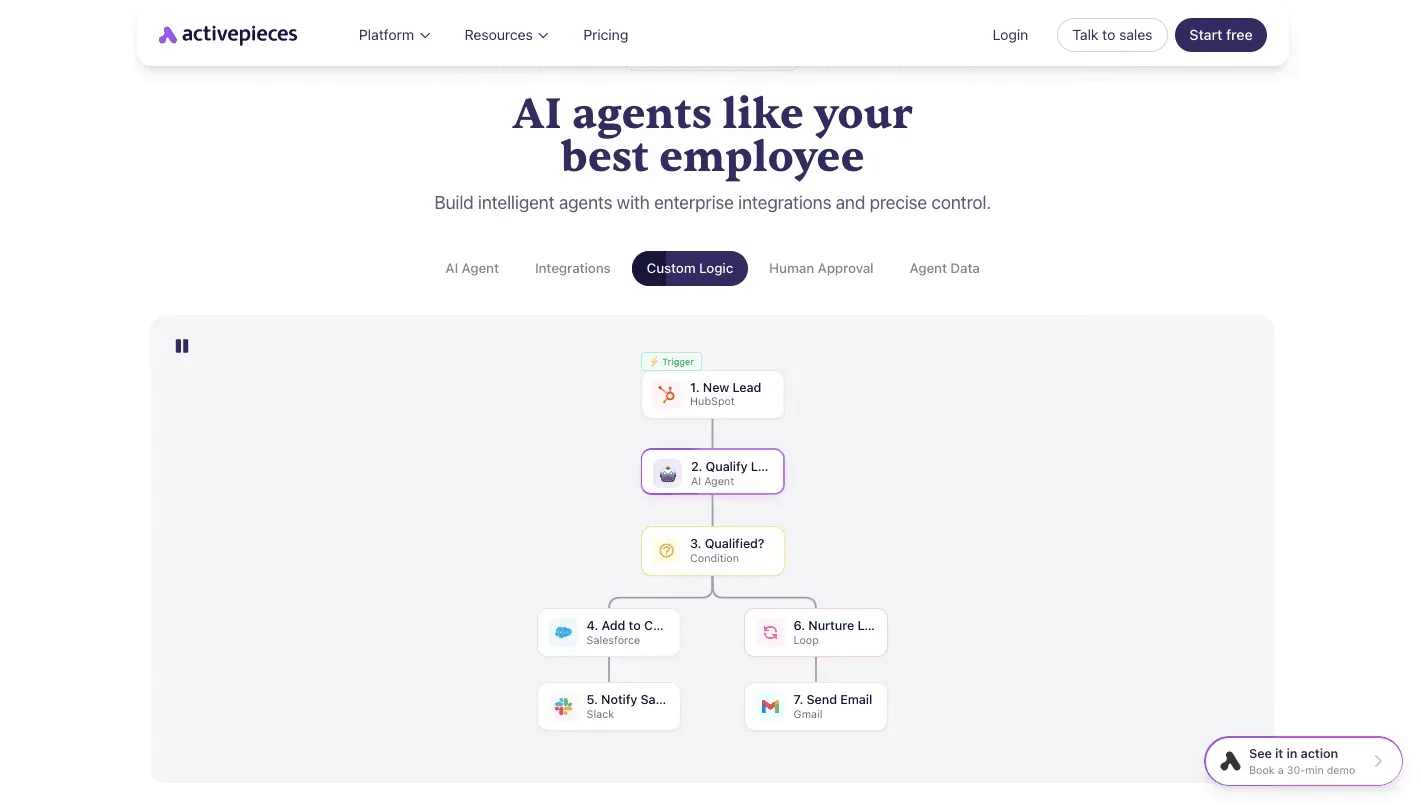
Make operates as a visual iPaaS that connects apps through a drag-and-drop interface, allowing users to insert Python code via a "Run Script" module.
It is designed for cloud-to-cloud synchronization where the primary logic is visual, but small snippets of Python are needed for data transformation or custom calculations.
Retries, memory, and tool-calls for agents sit in the open, MIT-licensed core of Activepieces, which provides 748+ integrations without per-task surcharges.
Every tool call an agent makes appears in the run trace, and the logic that produced it stays in the public monorepo for anyone to read.
Enterprise-grade tools like Workato include governance features such as Role-Based Access Control (RBAC) in their higher tiers. A large organization is paying for the security of the execution rather than just the code itself.
Migrating cron jobs to orchestrators
To ensure that environment variables and library versions don't break during the move, a structured approach is required when transitioning from local cron jobs to a managed orchestrator.
This process ensures that the logic you built in a local IDE functions identically when triggered by a cloud event or a webhook.
The migration path:
- Audit existing scripts for hidden dependencies to ensure all local file paths and environment secrets are mapped to the new platform.
- Select orchestrator based on team RAM/infra constraints so that the chosen tool doesn't crash when processing large datasets.
- Wrap scripts in tool-native decorators to enable the orchestrator to track retries and state.
- Configure error handling and alerts to notify the team immediately if a third-party API returns a failure code.