
Activepieces vs Celigo: Pricing & Features (2026)

Oct 30, 202614 min read
If your problem is keeping finance and ecommerce back-office systems in sync with someone else running the platform, Celigo fits.
If your problem is control over where automation runs, what code it runs on, or putting automation inside your own product, Activepieces fits, since its MIT-licensed core runs on your own infrastructure as well as on the vendor's cloud.
If you are a finance or operations team that wants a managed platform to connect your ERP, storefront and billing systems without running infrastructure, Celigo is built for you.
An open-source automation platform is for teams who want an MIT-licensed core and 746 integrations, meaning they can connect to most platforms without custom code, that they can self-host, extend and embed, and who accept owning more of the operation in exchange.
Open-source and Celigo automation compared
The comparison table
The table below puts both tools side by side on the eight points that most often decide this purchase.
| Activepieces | Celigo | |
|---|---|---|
| Built for | MIT-licensed core with 746 integrations; self-host, extend and embed | Managed integration of finance and ecommerce back-office systems |
| Hosting | Cloud or self-hosted on your own infrastructure | Vendor-managed cloud |
| Licence | Open-source core, with commercial licensing for enterprise features | Proprietary |
| Pricing and entry price | Self-serve plans on the public pricing page; self-hosted enterprise is sales-quoted | Sales-quoted, no public entry price |
| SSO and admin | SSO and admin controls on paid tiers; SSO beyond Team is sales-quoted | Enterprise-style admin controls on the managed platform; terms sales-quoted |
| AI agents | AI agents and AI steps available inside flows | AI features within the managed integration platform |
| Integration count | Open library of community and vendor-maintained pieces | Prebuilt connectors weighted toward finance and commerce apps |
| Embedding | Designed to be embedded in your own product; terms sales-quoted | Aimed at running your own back office, not embedding; confirm with sales |
Where these figures come from
Checked on 30 October 2026, every cell comes from each vendor's own site and documentation. We didn't use third-party reviews, so a cell reflects what the vendor says, not how it performs in your environment.
The open-source platform's SOC 2 programme is in progress, and nothing here claims certification. Treat any sales-quoted cell as unknown until you have a written quote.
If you are running this arithmetic for your own team, see what the same workload costs on Activepieces.
Five decision factors for managed and open-source
Price is only one of five questions that decide this.
- What system are you connecting: a finance or ecommerce back-office stack, or a broad mix of apps?
- Where must data run: a vendor's cloud, or infrastructure you control?
- Who builds and maintains the workflows: an integration specialist, or whoever has the problem?
- What does cost do as volume grows?
- Do you ship automation to your own customers inside your product?
What an iPaaS is and where Celigo fits
When a vendor runs the servers and upgrades and you only configure the flows, you are using an iPaaS, an integration platform as a service: a hosted platform that connects business systems for you.
Celigo sits here and focuses on back-office systems: moving orders and invoices between an ERP (the system holding your accounting and stock records), a storefront, and the tools around them.
You get managed operations and prebuilt integrations for those systems, and you accept that the vendor decides where it runs and how it's priced.
What open-source workflow automation is
If you can read the source code, run it on your own servers, and often modify it, you are looking at open-source workflow automation. You build triggers and steps that call APIs and move data.
Because you can host it yourself, data can stay inside your network. You also take on the work a managed vendor would do: deployment and uptime. Some of these tools can also be embedded, so your customers build automations inside your product.

Why category matters more than feature counts
If the tools solve different problems, a longer feature list tells you little.
A managed back-office integration platform answers "keep our ERP and storefront in sync without us running anything." A self-hostable, embeddable platform answers "automate across many apps under our control, or offer automation to our customers."
If the tools solve different problems, a longer feature list tells you little.
Answer the five questions first, and the shortlist usually shrinks before you open a demo.
Integrations compared: breadth against back-office depth
If your fifth answer was "we mostly move orders, invoices and inventory between an ERP and a storefront," connector depth matters more than connector count. The two platforms are built around opposite ideas of that.
Treat them as marketing numbers: they count different things, so the gap tells you less than what each connector does once you've connected it.
Celigo's prebuilt integration apps
Celigo packages common back-office flows as prebuilt integration apps and templates, covering pairings such as NetSuite with Shopify, plus order-to-cash and other finance processes.
In practice, field mappings, error handling and sync schedules arrive already designed, so you adjust a working flow instead of drawing one. That cuts the build time, and it moves the upkeep to the vendor when an API changes.
When the template fits your process, that's real money saved. When your process differs, you work within what the template exposes.
Community-built integrations and custom connectors
About 60% of the 746 integrations in an open-source catalogue like this were written by contributors outside the company, which speaks to the maintenance worry directly: the catalogue doesn't wait on one vendor's engineering headcount.
The MIT-licensed core is the reason, since anyone can build an integration and submit it for merge. If a connector is missing, you write one in TypeScript and keep it in your own repository, so nobody can retire it on you.

Code steps let you reach any API directly.
Ownership is the trade-off: a custom integration is code your team reviews, versions and fixes when the upstream API shifts. The reach is wide, but the ERP-specific depth is something you build yourself rather than receive.
For deep ERP and ecommerce syncs, Celigo's prebuilt apps are the stronger fit, because the hard mapping work is already done.
For breadth across many tools, and for anything needing custom code or your own connectors, an open-source platform with 746 integrations fits better.
Worth checking against a plan that does not meter every step: one credit covers a whole run on Activepieces.
Pricing compared: what Celigo and open-source automation cost
Maintenance has a price, and the two tools show it differently.
One vendor publishes its plans starting at free ($0, with 1,000 credits a month), with unlimited flows on every plan, while Celigo quotes every tier through sales, so you can only compare a published number with an estimate.

On the same five measures, the table sets both side by side.
What to take from it: the open-source vendor tells you the cost of growth up front, from $0 on Free to $200 a month flat on Team and from $36,000 a year for Embed, and with Celigo you learn it in a sales call.
| Activepieces | Celigo | |
|---|---|---|
| Pricing model | Tiered plans: Free, Plus, Team, Embed | Sales-quoted, all tiers |
| Billing unit | Plan with users and monthly credits | Set in your quote |
| Entry price | Plus $16/mo annual; Team $166/mo annual; Embed from $36k/yr | Quoted by sales |
| Growth effect | Move up a published tier | Renegotiated per quote |
| Free tier | Free plan | None published |
Activepieces plans and entry price
$192 a year buys Plus, and Team is $1,992, so a small team can start for less than one month of many enterprise tools.
Monthly credits climb with each plan. The Free plan gives 5 users 1,000 credits, Plus gives 5 users 10,000, and Team gives 25 users 50,000, so upgrading to Plus multiplies per-user capacity tenfold. Moving up buys fifty times the free allowance.

A credit is the unit of metered usage: work your flows do draws credits down, and the allowance resets each month.
Running steps and calling AI features are what consume them, so a long flow or an AI-heavy one costs more per run than a short one.
As a rough guide, a simple flow with a trigger and a few steps that spends a handful of credits per run would get you a few hundred runs from the Free allowance, which suits a pilot but not a busy storefront.
Check the pricing page for exactly how each action is counted before you size a plan.
Embed is the tier for putting the builder inside your own product. It adds the right to offer automation to your customers under your branding, which the other plans are not priced for, and its terms are sales-quoted.
Billed monthly, Plus cloud is $20 and Team cloud is $200, which means you're choosing between $240 and $2,400 annually. A self-host server runs about $6.70 a month, meaning about $80 per year. With ops time counted it comes to $121.
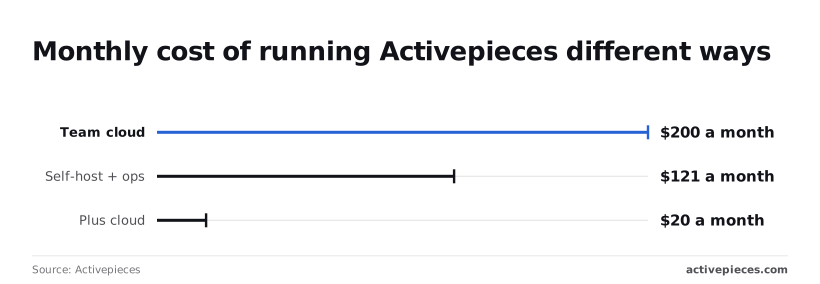
That's above Plus cloud, so self-hosting pays only if you need control of the infrastructure, not to save money.
You will not find a Celigo tier price published, and its billing unit is unpublished too: what you are charged for is set in your quote.
The comparison chart puts Activepieces' entry at $7,200 a year, against $10,000 for Workato and $24,000 each for Boomi and MuleSoft.

Treat that as a starting estimate, since your quote depends on scope.
- Comparing a quoted price with a list price and calling the gap savings.
- Leaving ops time out of a self-hosted figure, which turns $6.70 into $121.
- Pricing today's connections, not the ones you'll add in two years.
Hosting, security and admin controls compared
If your data must stay inside infrastructure you run, hosting decides this for you: Celigo is a managed service, and an open-source platform can be self-hosted, either as the MIT-licensed core or as the enterprise build run fully air-gapped on your own servers.
If it need not, the choice moves to admin controls and compliance evidence.
- Self-hosting
- Licence
- SSO (on the open-source platform, beyond the Team plan it goes through sales)
- Admin roles
- Compliance (the open-source platform's SOC 2 is in progress; Celigo's is as stated on its trust page)
Self-hosting and licence
There's no server to patch with Celigo, because it runs the platform for you, but your integration data passes through their cloud. A self-hostable platform lets you run an MIT-licensed core on your own infrastructure, which means you own the upgrades and uptime.
If you're bootstrapped, the licence line decides what you can fork, embed or resell without a contract. The community edition is open source under the MIT licence, and enterprise features sit under a commercial licence.

SSO comes with the $200-a-month Team plan; budget a conversation rather than a checkout for anything beyond it, such as SCIM and custom RBAC, which the open-source vendor handles through the sales form.
For Celigo, confirm in its documentation which plan includes SSO and which roles you can assign.
Ask both vendors whether a contractor can be limited to one flow, because that's the control you'll miss first.
You can't hand an auditor the open-source platform's SOC 2 today, because the programme is in progress and it's not a certification.
For Celigo, rely only on what its trust page states, and read the scope and dates there yourself.
AI agents and embedding compared across both tools
Apply the same rule to feature pages. A vendor's description of its agents is a claim to test in a trial, and the two platforms point their AI and embedding at different jobs.
Celigo's sit inside managed back-office integrations, while the open-source platform's are built for teams shipping automation inside their own product.
AI agents on each platform
Celigo adds AI to integration flows between finance and ecommerce systems. That suits a team that wants the integration to run and the vendor to carry its upkeep.
Where the job is keeping an order-to-cash flow healthy, Celigo is the stronger fit, because its prebuilt connectors and managed operation mean you maintain less.
On the open-source side, an agent is another step in a flow you design, so you decide the model, the tools it can call and where it runs. You get control, but you also own the prompts and the failure handling.
Embedding automation in your product
If you want a workflow builder in front of your customers, Celigo isn't mainly designed for that. It is built for the company running its own integrations.
The open-source platform is built for that customer-facing case, which I cover next.
| Activepieces | Celigo | |
|---|---|---|
| AI agent features | Agents as steps in flows you control | AI inside managed integration flows |
| Embedding in a customer-facing product | Designed for it | Not its main purpose |
| Best suited to | Product teams shipping automation to users | Finance and ecommerce operations teams |
| Verdict | Stronger if customers will build or run automations | Stronger for managed back-office integration |
One place holds your logic, your tool calls and your run history, because agents run inside the same flow builder as everything else.
Embedding lets you place that builder inside your own application under your branding. Self-hosting keeps the runtime in your infrastructure, which is the part you should check against your own compliance needs.
Verdict between Celigo and open-source automation
The verdict and its condition
If your problem is keeping an ERP and your ecommerce stores in sync with a vendor running the pipes, Celigo fits. If you need open source, self-hosting or automation embedded in your own product, an open-source platform fits.
Your compliance answer from the self-hosting check should settle which side you start on.
Who holds the pager is the condition. A managed platform means someone else maintains the connectors. An open-source one means you can inspect, host and extend them, and you carry the upkeep.

- Comparing integration counts instead of checking whether your specific systems are covered, in the depth you need.
- Treating "self-hostable" as a compliance answer without confirming what your auditors require.
- Budgeting for the subscription and forgetting the person who will own the flows afterward.
- Buying an automation tool when the real need is a product feature your customers see, which is an embedding decision.
The steps below run in the order that narrows the decision fastest.
- Name the system you must connect first, whether that's your ERP, your storefront or something else. If it's a finance or ecommerce back-office pairing, note that now.
- Decide where data must run: your infrastructure, a vendor's cloud, or either.
- List who builds and maintains the flows. If nobody technical owns them, a managed service carries real weight.
- Check the open-source vendor's self-serve plans on its public pricing page.
- If you need self-hosted enterprise, SSO beyond the Team plan, or embedding, use the vendor's sales form. If the managed ERP route fits, request a quote from Celigo and compare it with step four.
Related reading
References
Running the numbers
See what the same workload costs here.
Free forever plan, and every paid plan self-hosts at no extra cost.
See pricing Talk to sales