
Agentforce Alternatives in 2026: Options Compared

Oct 17, 202615 min read
Choose the alternative that lives inside the system where your agent has to act. That system may be a CRM, an office suite, a service desk or a spread of separate apps, Activepieces being one example of a tool built for that last case.
Teams leave mainly over the Salesforce lock-in and the cost that comes with it.
Which Agentforce alternative fits your setup
What Agentforce's
Think of Agentforce as Salesforce's AI agent platform, the layer that lets software agents read and update records, answer customers and run tasks inside Salesforce's own products. Its strength's that the agent sits next to the data it uses.
That same fact sets the limit: an agent built there's shaped around Salesforce's data, permissions and billing. Work in other tools has to be pulled back toward that center.
No single replacement fits all four. The pairings below show how the choice changes with the system of record.
- Salesforce CRM, where the agent works on accounts, leads and cases, pairs with n8n, which reaches Salesforce through its integration while keeping the agent logic outside the CRM.
- Microsoft 365, where the work's mail, calendars, documents and Teams, pairs with Microsoft Copilot Studio, built by the vendor of that suite.
- An IT or HR service desk, where the work's tickets and requests, pairs with ServiceNow's AI agents, which run on the platform that holds the tickets. Many apps at once, where no single system owns the work, pairs with Activepieces, an MIT-licensed core with 741 integrations (enough that you probably won't need custom connectors) whose agents aren't tied to one vendor's data, so you can migrate to a different orchestration platform.
Every product fact was checked on 17 October 2026 against the vendor's own documentation, pricing or product page.
The fastest way to settle a shortlist is to try one. Activepieces is free to try, no credit card.
Why teams leave Agentforce
Two things push teams out: the bill grows with every agent run, and the agent's reach stops at the edge of Salesforce, the customer-relationship platform Agentforce's built on.
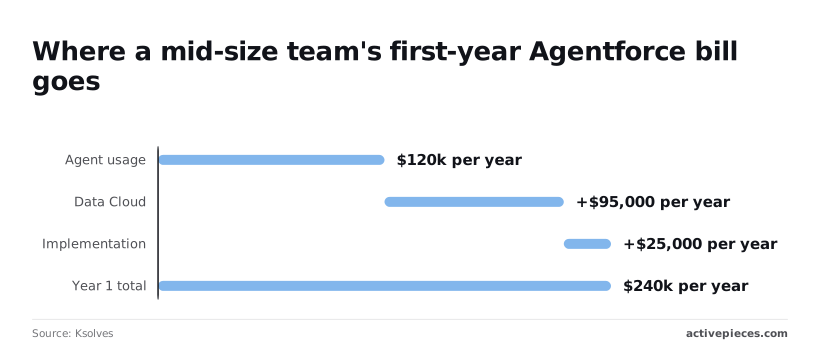
Ksolves puts a mid-size team's first-year total at $240,000, which means a six-figure capital commitment before the agent handles its first task.
Agentforce alternatives with usage-based pricing
Split out, that $240,000 is $120,000 of agent usage, $95,000 for Data Cloud (Salesforce's data-unification layer) and $25,000 of implementation.
Usage's half the bill, so doubling agent volume moves the total far more than any licence negotiation. Data Cloud's about 40%, a cost paid before the agent answers anything, so roughly $96,000 is committed before the system demonstrates any return.
Even the unit has changed. The chart shows three list prices:
- $2 per conversation at launch in September 2024
- $0.10 per action under Flex Credits from May 2025
- $550 per user per month for the top edition

Take a conversation that runs 20 actions: it costs $2 either way. One that takes 40 now costs $4, so a forecast built on one unit doesn't carry over to the next.
Lock-in to the Salesforce data model
Look at Data Cloud's $95,000 for the clearest sign of dependence. The agent works best on records held in Salesforce, so the data has to be modelled, mapped and kept in sync there first.
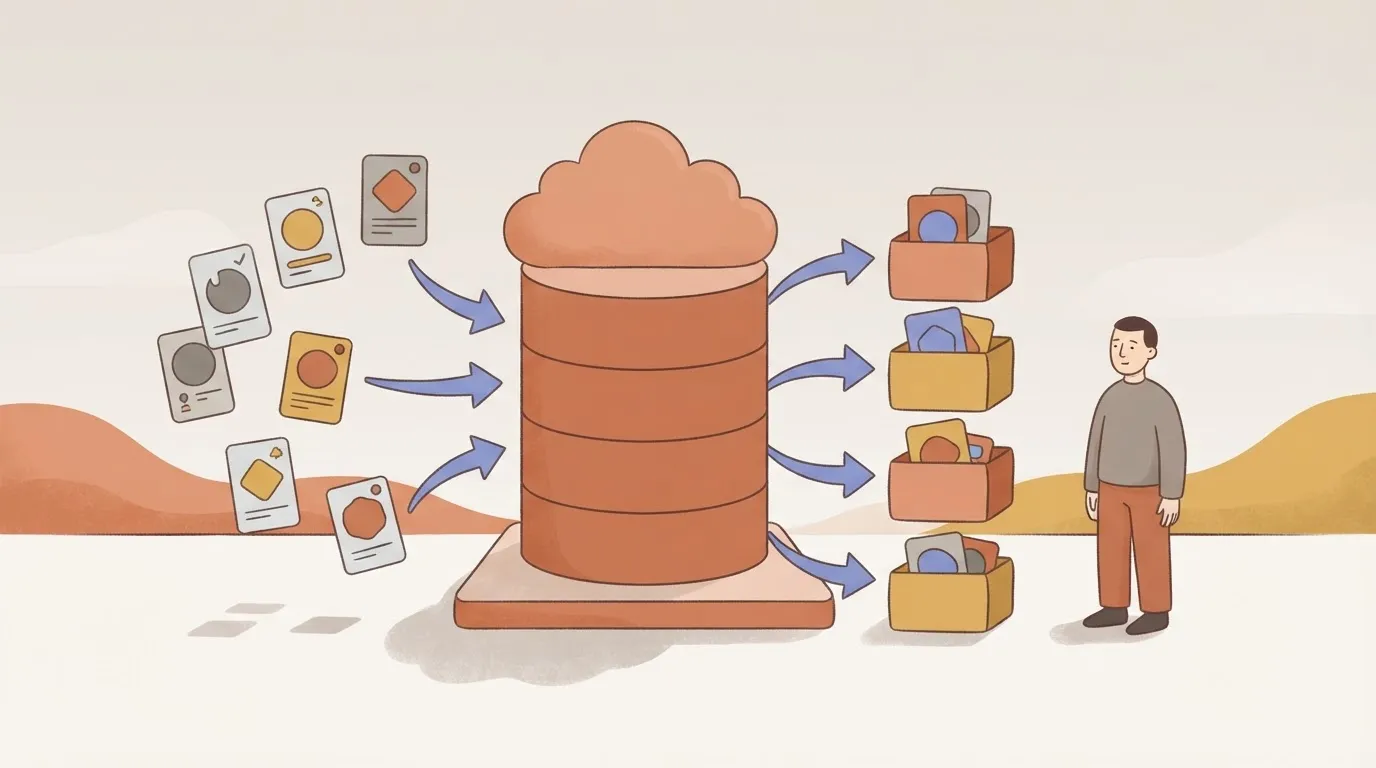
The $25,000 implementation line's the one-time cost of that work,, which means platform and infrastructure investments must compete for those funds.
Leaving later means paying again to move the logic and the data it relies on.
Reach into apps outside Salesforce
If an agent must update a billing system, a ticketing tool or a code repository, each one needs a connector or custom integration. That work isn't covered by the figures above.

Staying's the right call when your customer records, cases and approvals already live in Salesforce and the agent rarely leaves them. In that situation the usage meter buys you something, and a replacement would mostly re-create the data model you already pay for.
Criteria that decide an AI agent platform
Five checks separate one agent platform from another:
- which apps the agent can act in
- whether a person approves before it acts
- whether you can self-host
- how the price grows with runs
- how much setup it takes
Apps the agent can act in
Without write access to your system of record, an agent's a chat window. Open the vendor's integrations page and look for the specific apps where your work happens, such as your CRM, ticketing tool, billing system and database.
Without write access to your system of record, an agent's a chat window.
Then check whether the agent can take actions there (create, update, send) or only read from them.
When a long logo wall lists only triggers, you'll build the write step yourself. Also look for a generic HTTP or custom-connector option, because it decides whether an app missing from the list blocks you or costs you an afternoon.
Human approval steps in AI agent platforms
Ask what a wrong action would cost, because that sets how much approval you need. Refunds, outbound email and record deletions deserve a pause; so a summary written to a note doesn't.
On the vendor page, look for a documented approval step that halts a run and waits for a named person. Check where that person answers: email, chat or the platform's own inbox.
If approval's described only as a prompt instruction to the model, it's a suggestion, not a control.
If customer records pass through the agent, where it runs becomes a compliance question. Check whether the vendor publishes a self-hosted option, under what license, and whether it's the full product or a reduced edition.
Then confirm which model providers you can connect, since that determines where prompts and data are sent.
How Agentforce alternatives price agent runs
Write the formula before you compare plans: cost per run times monthly runs, plus any seat fee. Find the billing unit on the pricing page.
It might be a task, a step, a conversation or a credit, and one agent run can consume several of them.
On a plan priced per step, a ten-step agent is punished far more than on one priced per run, so multiply your longest workflow by your expected volume before trusting a headline rate.
Setup effort is the fifth check, and it's the one vendor pages state least directly, so look for template libraries and documented onboarding steps.
Agentforce alternatives compared in one table
Judge the six platforms below by where their agents can act, not by how long their feature lists run; the table shows that split on the criteria set earlier.
Agentforce alternatives comparison table columns explained
Read the Apps and Self-host columns first. They show whether an agent reaches the system you already run or only the vendor's own records, and whether it can run on infrastructure you control.
| Platform | Price | Strength | Limit | Suits | Apps | Approval | Self-host |
|---|---|---|---|---|---|---|---|
| Copilot Studio | Usage-based | Microsoft 365 and Power Platform data | Centred on a Microsoft tenant | Microsoft-centred firms | Microsoft apps plus connectors | not published | No |
| ServiceNow AI Agents | not published | IT and service workflows | Needs the ServiceNow platform | Existing ServiceNow customers | ServiceNow records plus integrations | not published | No |
| HubSpot Breeze | Credit-based | CRM, marketing and service | Centred on HubSpot data | HubSpot teams | HubSpot objects | not published | No |
| Zendesk | Per automated resolution | Support conversations | Scoped to support | Support teams | Zendesk plus integrations | not published | No |
| Zapier Agents | Usage-based | Broad app catalog | Hosted only | Cross-app tasks | Large catalog | not published | No |
| n8n | Execution-based | Node-based workflow control | Needs technical staff | Technical teams | Many nodes plus HTTP calls | not published | Yes |
| Activepieces | Free plan $0; Plus $20 a month; Team $200 a month; Ultimate through sales | Open source, MIT-licensed core with 741 integrations | Enterprise directories (packages/ee/) are under a separate commercial licence |
Teams running their chosen AI models, agents and automations across their own apps and data under central governance | 741 integrations | — | Yes |
Look at the price model before the list price. A per-resolution charge rises with ticket volume, while an execution charge rises with every workflow run, so the same agent can cost very different amounts at the same workload.
Start with the first four rows, which are suite agents. They work best inside their own vendor's data, so the system of record that vendor owns largely decides the choice.
The last two are workflow-based. Their agents call many apps, so they suit a business whose records are spread across several tools, at the cost of more setup.
Where a vendor's own pages give no rate or no approval behaviour, the cell says "not published". Treat that as a question to put to the vendor before you commit.
Reading a table only gets you so far. Build the same workflow in Activepieces and compare it yourself.
Which alternative fits which team
Pick the option that sits closest to the system of record, because that's where the agent has to read, write and be held to account.
The table pairs each task group with the option built around that record, so you can see what you gain and what you pay for it.
| Task group | Best-fit option | What it does well | What it does poorly |
|---|---|---|---|
| CRM-native service | The CRM vendor's own agent, such as Agentforce or HubSpot's Breeze agents | Reads and updates customer records without a connector layer | Reaches little beyond that CRM unless you build the integrations |
| Microsoft-centred | Microsoft Copilot Studio | Acts inside Microsoft 365 and Dynamics under existing identity and permissions | Value falls once key systems sit outside the Microsoft estate |
| IT and HR desks | ServiceNow | Runs tickets, requests and approvals where the service record already lives | Weaker where the employee data sits in other tools |
| Cross-app operations | n8n or Zapier | Chains actions across many unrelated apps | Each leaves approval design and run-cost control to you |
| Cross-app AI automation | Activepieces | Runs your chosen AI models, agents and automations across your own apps, with 741 integrations and unlimited flows on every plan, including free | Enterprise directories (packages/ee/) sit under a separate commercial licence from the MIT-licensed core |
An agent that can't reach a system forces a second tool, and a second tool means a second bill.
If your records live in one vendor's suite, that vendor's agent removes the integration work. The price is the lock-in this article started with: the agent acts well on one stack and awkwardly on everything else.
Next to the ticket is where support and service-desk agents belong. ServiceNow covers IT and HR requests on its own platform, and help-desk products work the same way for customer tickets.
Their limit is scope: once the answer needs data from a billing or inventory system, you're paying to bridge it.
When one task crosses several unrelated apps, no suite owns the record. Zapier's hosted only, while n8n can be self-hosted, which matters if data must stay on your infrastructure.
Where Activepieces fits among Agentforce alternatives
When the agent has to work across several apps you already pay for, not inside Salesforce, Activepieces's the pick, with 741 integrations to work across.
It also suits you when you want the run bill to depend on what you build rather than on a per-conversation charge.
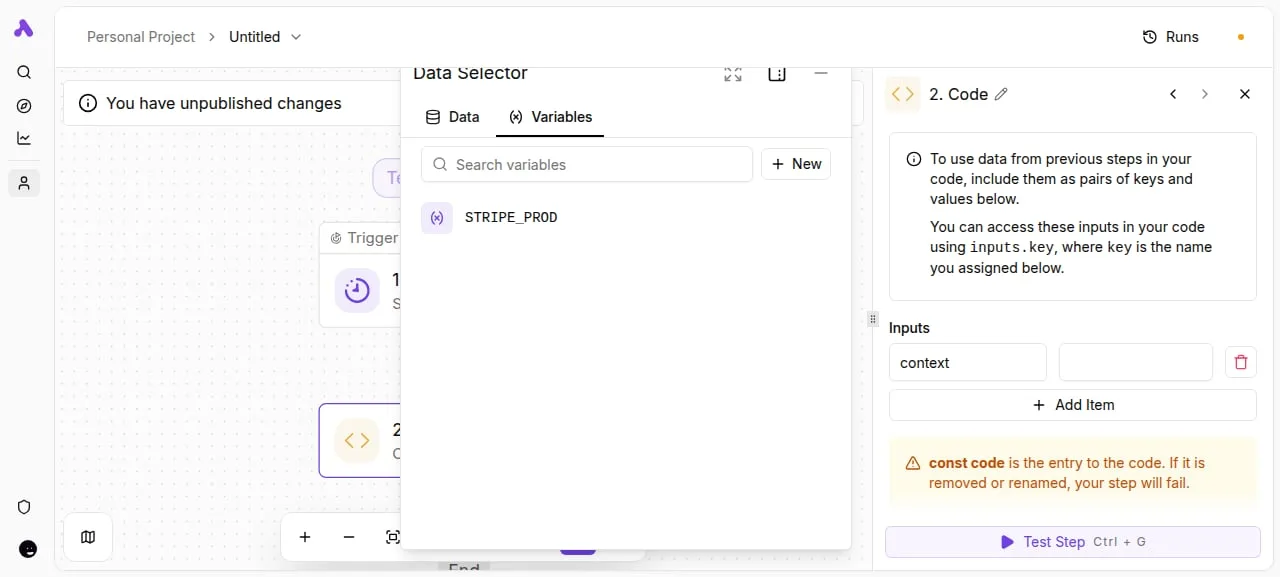
Under the hood, Activepieces's an open source automation platform with an AI agent step and an MIT-licensed core. That step can call the tools in its library of integrations, which it calls pieces, listed at https://www.activepieces.com/integrations. Roughly 60% of those integrations are community-contributed.
What it suits
Look first at the unit economics, because they are the reason to consider it. In an Agentforce-style model, each action the agent takes is a line item.
In a flow builder, the agent's one step among others, so you can see which steps are cheap deterministic work and which ones call a model. You spend model cost only where judgment is needed, and the rest of the flow stays plain automation.
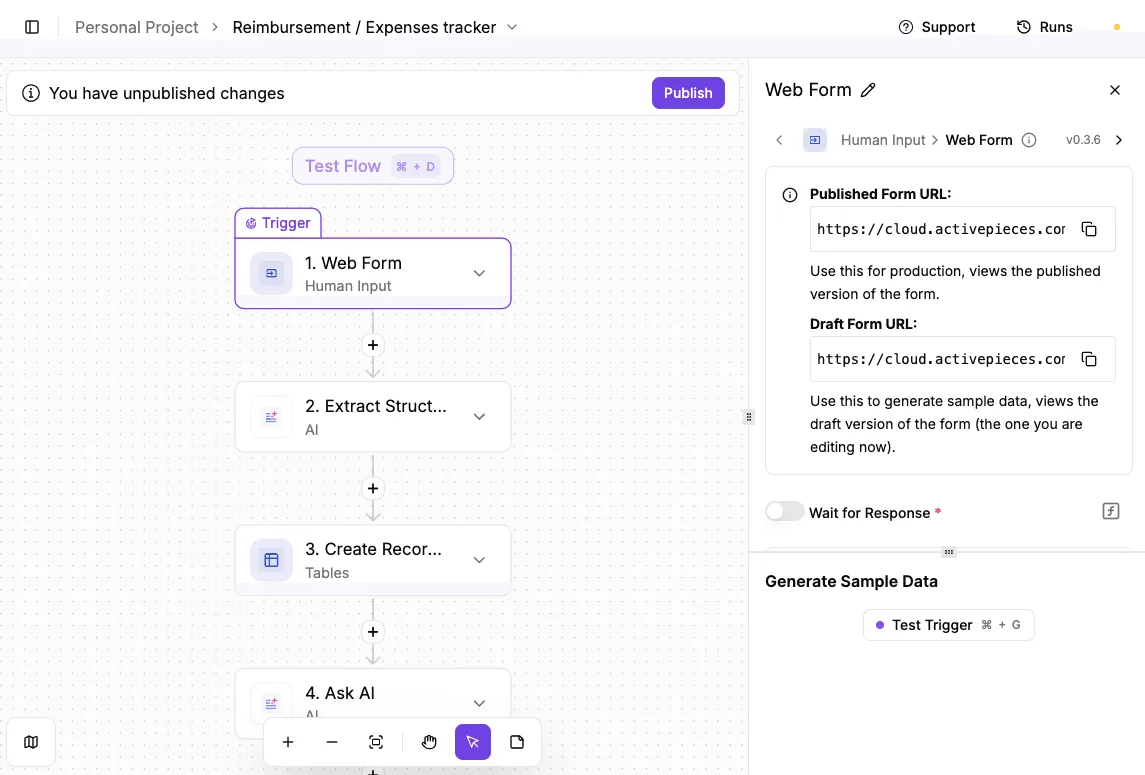
In the screenshot, the Data Selector is open over a flow with a trigger and a selected code step, and the Variables tab lists a stored value named STRIPE_PROD.
Read it as an example of configuration living in one named place: a billing product identifier is set once and referenced by any step.
The code step's inputs therefore point to a variable instead of a pasted constant. That's how you keep a multi-app flow auditable when several people edit it.
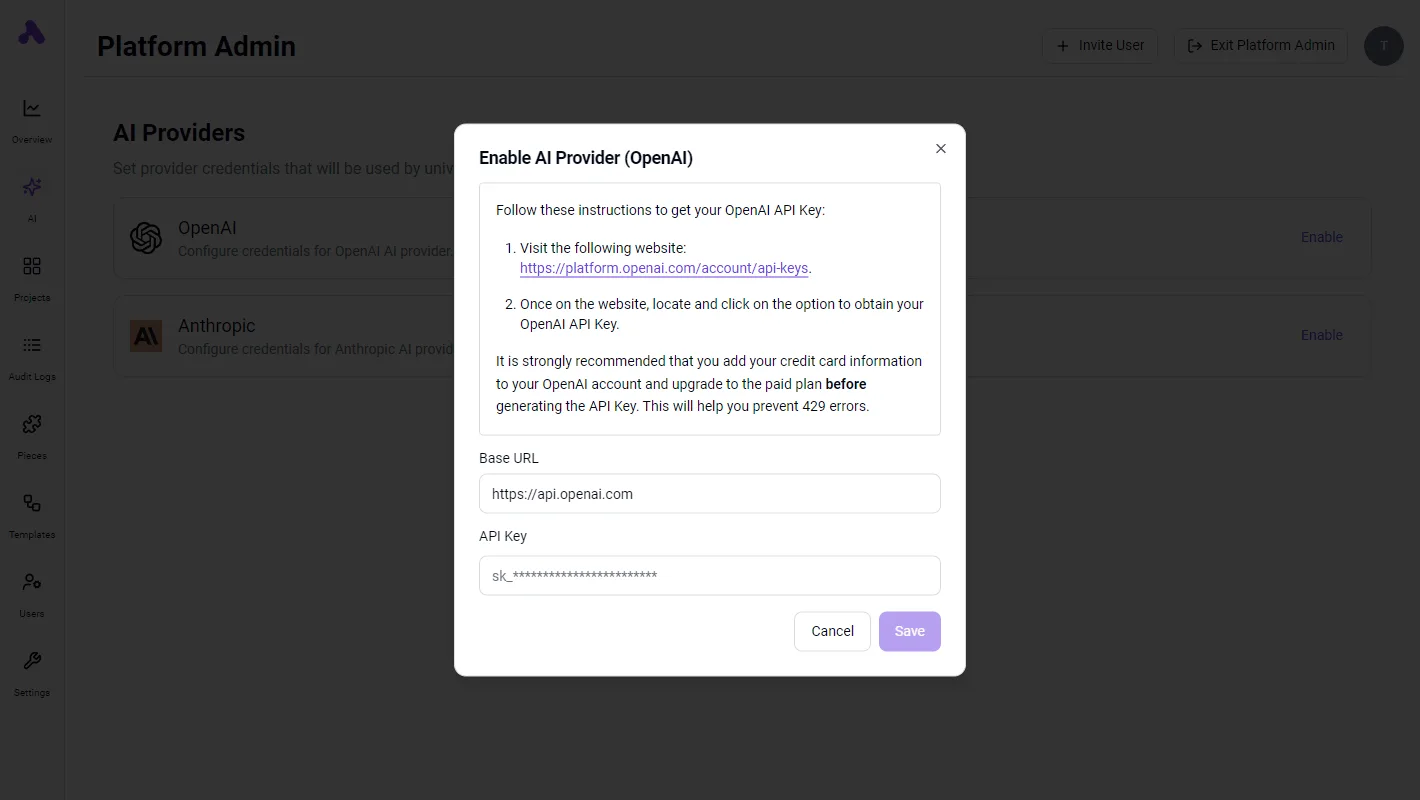
Two other properties matter for buyers who care about control. The product documents approval steps, so a person can sign off before the agent writes to a customer record or sends a message.
The lock-in that hurts most when leaving Agentforce has nothing to do with how good your agent is: it runs only in Salesforce's cloud, so where it lives was settled before you built anything.
Activepieces treats deployment as a setting, and MoneyGram, Moneypenny, Alan and FundingSocieties run it in production.
Managed cloud and self-hosted (Docker, Compose or Kubernetes) run one codebase, so a flow built on either can be moved to the other through Git Sync and Releases, which is in the docs.
RBAC, SSO, SCIM and audit logs are in both editions, so choosing where to run never costs you a control.
What it does not do
It's not a Salesforce-native service agent. If the work's answering cases inside Service Cloud, grounded in Salesforce data models and permissions with no integration layer, Agentforce's built for exactly that.
Activepieces would reach Salesforce from outside, as one connection among many in a library of 741 integrations.
With Activepieces you also assemble and maintain the flows yourself, and flows are unlimited on every plan, including free, so the savings come with an engineering and monitoring duty that a bundled product absorbs for you.

Activepieces is the better fit for teams whose agents must work across several apps they already pay for, and who weigh exit freedom above all else.
Git Sync and Releases is a documented feature, and self-hosting via Docker, Compose or Kubernetes runs on the same codebase as the managed cloud, so where a flow runs never decides whether you can leave.
For buyers inside a Salesforce-centred stack, Agentforce keeps the tighter native fit, but on portability and on a bill that follows what you build rather than each action the agent takes, Activepieces comes out ahead.
Frequently asked questions
Is Agentforce worth it for a small business?
It's worth it when most of the work the agent does already sits inside Salesforce, the customer relationship management system Agentforce's built on.
In that case the bundled product saves you engineering time. If your records live elsewhere, you pay for a stack you barely use.
Price the decision per run: divide what you would pay for a month of agent activity by the number of tasks it completes. Then compare that with the labor each task replaces.
Can I run an AI agent on my own servers?
Yes, with some platforms. Agentforce runs in Salesforce's cloud, so self-hosting isn't part of that product. Open source automation tools can be deployed on your own infrastructure, which keeps data inside your network and lets you control what the agent can reach.
One of them is Activepieces, and its AI agent step works across its integrations. If you want to see how that behaves before committing to a server, you can try it free at https://cloud.activepieces.com/sign-up.
Can I keep Salesforce and add another agent platform?
Yes. Salesforce can stay as your system of record while a separate agent reads and writes to it through its API. This works best when you decide which system owns each record, so two tools never update the same field.
Require human approval on any write back into Salesforce, because a mistaken update there reaches every report that depends on it.
How do I trial an alternative before switching?
Start with a single workflow, not the whole deployment. Then work through it in this order:
- Name the system of record it touches.
- Require approval before any write action.
- Run it on test records.
- Track what each run costs.
- Set that figure beside what the same workflow costs on your current Agentforce bill.
If the per-run cost holds as volume grows and the approvals catch real mistakes, you have grounds to expand. If not, you've lost very little.
Related reading
References
Still comparing
The fastest way to settle it is to build something.
Open source under MIT, so you can self-host the same thing later.
Start free Talk to sales