
Agentforce Pricing 2026: Plans and Costs Explained

Oct 17, 202614 min read
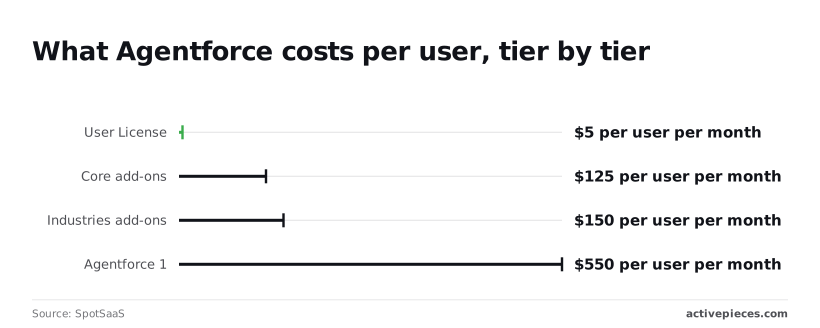
According to SpotSaaS, Agentforce pricing starts at $5 per user per month and reaches $550 per user per month, depending on the plan, so the tier you choose creates a 110-fold swing in per-user costs.
Agentforce is Salesforce's platform for AI agents that answer customers and take actions inside its CRM, a scope that teams comparing it with workflow tools such as Activepieces often weigh first.
Agentforce pricing is the set of models Salesforce uses to charge for its AI agents, including per-user licences, per-conversation fees and credit-based charges for each action an agent takes, plus the CRM licences and data products those agents depend on.
$5 per user per month is the User License in the SpotSaaS breakdown. That's the entry price per seat, and it says nothing about how many conversations or actions the agents run. The figures below were last checked on 2026-10-17.
Every current plan in one table
In the table, each plan has its price, inclusions, usage limits and check date. Read the "not published" cells as the work you still have to do: a missing usage limit means you can't size the bill from the list price alone.
| Plan | Price | Inclusions | Usage limits | Check date |
|---|---|---|---|---|
| User License | $5 per user per month | Not published | Not published | 2026-10-17 |
| Flex Credits | Not published | Not published | Not published | 2026-10-17 |
| Core add-ons | $125 per user per month | Not published | Not published | 2026-10-17 |
| Industries add-ons | $150 per user per month | Not published | Not published | 2026-10-17 |
| Agentforce 1 | $550 per user per month | Not published | Not published | 2026-10-17 |
If you buy by the seat, the bill follows headcount, not work done. At 100 users, per LinkedIn, the $125 core add-on is $12,500 a month, and the $150 Industries add-on is $15,000, so add-ons cost 25-30 times more than all the base licenses combined.

For the same 100 seats, Agentforce 1 at $550 is $55,000 a month, according to SpotSaaS. The jump from $5 to $550 is a factor of 110, so the plan you choose matters far more than the seat count.
What the list price does not include
Because the table has no usage limit for any plan, the metered unit is unclear, and a missing connector is the same kind of gap in another form: you wait on Salesforce's priorities, not yours.
Activepieces lets you have AI generate the integration you need and keep it private to your own instance, without waiting on a vendor release, and roughly 60% of its 741 integrations were built by the community, counted directly from the open source monorepo, which means most integration needs are likely already available without custom development.
Before you budget, get three answers from Salesforce in writing:
- What counts as one billable conversation or action.
- Which base Salesforce licences each add-on requires.
- Whether the data products underneath carry their own charges.
Agentforce cost at realistic monthly usage
Across 1,000 to 20,000 conversations, Agentforce costs roughly $300 to $40,000 a month, so conversation volume forecasting errors can swing your monthly bill by tens of thousands.

Salesforce meters the conversation, so volume sets the bill and the pricing model sets where in the range you land. The table multiplies the published monthly ranges by 12.
| Scenario | Conversations a month | Monthly cost | Annual cost (×12) |
|---|---|---|---|
| 5-person team | 1,000 | $300 – $2,000 | $3,600 – $24,000 |
| Mid-size desk | 5,000 | $1,500 – $10,000 | $18,000 – $120,000 |
| High volume | 20,000 | $6,000 – $40,000 | $72,000 – $480,000 |
At any volume, the pricing model you choose can multiply the bill by more than six, because each row implies $0.30 to $2.00 per conversation.
At 1,000 conversations, Macha's breakdown of Salesforce's pricing puts the bill at $300 to $2,000 a month. That's $3,600 to $24,000 a year, so a five-person team can spend either a rounding error or a full salary on the same workload.
Agentforce pricing for a mid-size service desk
At 5,000 conversations the range becomes $1,500 to $10,000 a month, or $18,000 to $120,000 a year, so the plan tier you choose drives a six-figure annual cost difference.
High volume, where pricing models diverge
At 20,000 conversations the monthly bill runs from $6,000 to $40,000, or $72,000 to $480,000 a year.
The $34,000 monthly gap is larger than the entire top-end bill for the 1,000-conversation team. At this scale, a few cents of difference per conversation outweighs any other line item.
Do not read these ranges as the whole bill: they cover conversations only, not the Salesforce licences and data products underneath.
If you are running this arithmetic for your own team, see what the same workload costs on Activepieces.
Hidden costs and limits Agentforce buyers hit
Three of the six costs the headline price leaves out have no published figure from Salesforce. The list tags each one, so you know which to price from a rate card and which to put to your account executive.
- Base edition licence, $25 to $550 per user per month: documented
- Data Cloud credits: documented
- Billable action: documented
- Credit expiry: unpublished
- Sandbox limits: unpublished
- Implementation: unpublished
Before the agent answers anything, every seat pays its edition price, because Agentforce sits on a Sales or Service Cloud edition. Across 100 seats, the gap between the $25 and $550 editions is $52,500 a month.
Data Cloud, the data layer that grounds the agent in customer records, draws its own credits, which makes it a second meter beside the agent's.

Agentforce billable actions, conversations and Flex Credits
The metered unit is the Flex Credit, and the Salesforce rate card prices each action type differently.
A voice action costs 30 credits per use and a standard action 20, so a voice-heavy agent burns credits at 1.5 times the rate of a text agent doing the same work.

Prompts are cheaper: advanced is 16, standard is 4 and starter is 2. One voice action therefore equals fifteen starter prompts, and the mix of action types shifts the bill within the range that conversation volume sets.
Agentforce credit expiry, overage and sandbox limits
You will not find expiry terms, overage rates or sandbox allowances published. They sit in the order form, so ask in writing.
Ask also whether test runs in a sandbox consume the same credits as live ones, because a team that tests heavily may pay for it.
There is no published price for implementation. Connecting Data Cloud, writing the actions and tuning the agent take partner fees or internal admin hours. Budget them as a separate line, because neither appears on the rate card.
Agentforce costs and control versus alternatives
Compare the five platforms by unit multiplied by your volume, not by headline price, because they meter different things.
The table shows what each vendor counts as one billable event and where the 10,000-run bill comes from.
| Platform | Pricing unit | Where the agent acts | Human approval | Self-hosting | Cost at 10,000 runs a month |
|---|---|---|---|---|---|
| Agentforce | Conversations or actions, depending on the model bought | Salesforce data and connected systems | Configurable in the agent's design | Vendor-hosted only | 10,000 × your contracted unit rate, plus the licences underneath |
| Copilot Studio | Messages or credits consumed by the agent | Microsoft 365, Power Platform connectors | Configurable in flows | Vendor-hosted only | 10,000 × credits per run × credit price |
| ServiceNow | Packs tied to its workflow platform | ServiceNow workflows and integrations | Configurable in workflows | Vendor-hosted only | Quote-based, set by the pack you sign |
| Zendesk | Automated resolutions | Zendesk support and linked tools | Handoff to human agents | Vendor-hosted only | Resolved cases × resolution rate, not 10,000 flat |
| Intercom Fin | Resolutions | Intercom inbox and linked tools | Handoff to human agents | Vendor-hosted only | Resolved cases × per-resolution rate |
Each agent acts most freely inside its owner's platform, so your existing stack decides most of the choice. Agentforce and ServiceNow reach outward through connectors, but the work is easiest where the records already live.
Zendesk and Intercom are built around a support inbox, so they fit support jobs and stretch awkwardly beyond them.
Agentforce approval steps and self-hosting versus alternatives
Zendesk and Intercom lean on handing a conversation to a person, which isn't the same as a person approving an action before it runs. Agentforce, Copilot Studio and ServiceNow let you build approval steps, but you configure and pay for them.
All five run on the vendor's infrastructure, so lock-in is a cost to model: leaving means rebuilding the agents elsewhere.
Worth checking against a plan that does not meter every step: one credit covers a whole run on Activepieces.
Activepieces for agents that work across non-Salesforce apps
Activepieces fits when the agent's job spans apps outside Salesforce, because its core is MIT-licensed and you can self-host it, which limits the rebuild cost that vendor-hosted agents carry.
When the job lives outside Salesforce
Take an agent that reads a support email, checks an order in a billing tool, drafts a reply and logs the result in a spreadsheet.
Nothing in that job touches Salesforce data, so paying for Agentforce's conversation or action metering and the licences underneath it buys capability you never use.
Activepieces builds this as a flow with an AI agent step, and that step can call any of its 741 integrations, which the project calls pieces.
The agent's reach is therefore the connector list, not one vendor's data model, so check that your apps are on it before you commit.
Where Agentforce counts conversations or actions, Activepieces meters usage in credits, and its free plan includes 1,000 credits a month with unlimited flows. That's a different unit, so you can't compare sticker prices.
Take your expected runs per month, multiply by the steps each run triggers, and set that against the free plan's 1,000 monthly credits and the $20-a-month Plus plan, as listed on Activepieces' own pricing page on 2026-10-12, rather than trusting a figure quoted second-hand.

If you want to test the model on a real workflow, you can try it free.
Agentforce approval steps and self-hosting options
Before the agent acts, a flow can pause for a human to approve. For anything that sends money, email or customer-facing text, that pause turns a runaway agent into a queued request, and it keeps a person accountable for the action.

Self-hosting is the lock-in answer. Because the code is open source and runs on your infrastructure, no vendor's servers hold your flows.
The trade-off is that you now carry the hosting, upgrades and uptime, which is a staffing cost to put in the same spreadsheet as the licence line.
If the agent's work is mostly Salesforce-native, such as reading and updating cases, opportunities or Data Cloud records under your existing permission model, Agentforce sits closest to that data.
Activepieces would reach it through its Salesforce connector, with access governed by RBAC, centrally held credentials and project isolation, and audit logs recording what the agent did (RBAC and audit logs are Enterprise Edition features).
In that case a licence premium, such as the $12,500 a month the 100-seat core add-on costs, may be cheaper than the integration work.
Steps to price an Agentforce pilot before signing
Price the pilot from your own volume, not the list price: six steps, in order, turn last month's activity into a number you can defend before you sign.
- Count last month's conversations or actions.
- Pick the pricing model that fits that volume.
- Ask the rep for the Data Cloud, credit expiry and overage lines.
- Cap pilot spend in writing.
- Set a review date.
- Judge the pilot on cost per resolved case.
Count your real volume for Agentforce pricing
Pull last month's numbers from the system that handles the work today. For a service agent that means chats, emails and tickets; for an action-based agent, the discrete tasks a person performed.
Then separate the work an agent could plausibly take from the work that needs a human, because the vendor bills you on what the agent runs, not on what arrives.
A queue of short, single-step questions usually favours metering by conversation. A workflow where one request triggers many lookups and updates can make metering by action the more expensive choice, so count the steps per request, not just the requests.
Ask the questions the pricing page does not answer
Ask for three things in writing. First, whether the agent needs Data Cloud, Salesforce's data layer, and what that is billed on, since the agent may be useless without it and its meter is separate.
Second, whether prepaid credits expire, and when, because unused credits that lapse raise your effective rate.
Third, the overage rate once you pass the committed amount, which tells you how steeply a good pilot becomes a costly one. If the rep can't state a line, treat it as unpriced, not free.
Set a spend cap and a review date
Agree a hard ceiling for the pilot, and ask how it's enforced, whether by a stop or by an invoice afterward. Put a review date on the calendar before launch.
At that date, divide total spend, including the data and licence lines, by the cases the agent resolved without a human.
That cost per resolved case is the number to compare against your current cost per case, and it decides whether the pilot becomes a contract.
Frequently asked questions
Each answer below rests on Salesforce's own Agentforce pricing and product pages. Pricing pages change, so confirm anything that affects a contract against the live page and your order form on the day you sign.
Trials and Data Cloud
Is there a free Agentforce plan or trial? Salesforce has offered free developer and trial orgs for trying Agentforce, but a trial org isn't a production plan.
Anything you build there tells you about behaviour, not about what a resolved conversation will cost once billing meters conversations or actions.
Do I need Data Cloud to use Agentforce? Not for every agent, but agents that answer from data beyond your core CRM records lean on Data Cloud, Salesforce's data unification product.
If your use case needs that grounding, price Data Cloud as part of the Agentforce bill, because it's metered separately from the agent.
Contract terms and changes
Can I switch Agentforce pricing models mid-contract? Treat it as a negotiation, not a setting. What you bought is whatever your order form says.
Changing the metered unit, whether conversations, actions or per-user licences, normally means amending that order or waiting for renewal. Ask for the switching terms before signing, not after.
Does Agentforce pricing change often? It's changed since launch, including how usage is metered and packaged.
That's the reason to write the unit, the rate and the renewal terms into the contract itself. A price you read on a web page isn't a price you're guaranteed.
Reaching outside Salesforce
Can Agentforce agents act in apps outside Salesforce? Yes, through actions that call out to other systems, for example via APIs, Flow automations or Salesforce's integration tooling.
Each outside step is still an action your agent runs, so a workflow touching several external apps can multiply the metered units per conversation.
Related reading
References
Running the numbers
See what the same workload costs here.
Free forever plan, and every paid plan self-hosts at no extra cost.
See pricing Talk to sales