
AI Agent Competitor Tracking: Tools and Costs (2026)

Nov 22, 202615 min read
An AI competitor tracking agent watches rivals' pages, pricing and news, summarises what changed, and sends it to your team. You either buy that as a vendor-run service or build it yourself on a workflow tool.
AI agent competitor tracking: the short answer
What an AI competitor tracking agent does
It runs on a trigger, usually a schedule or a detected page change. It reads the new content, and a model writes a short summary of the difference. The summary lands in a channel or a battlecard.
You want two answers from the fine print: whether a person approves the message before it reaches sales, and whether you can see afterwards what the agent did. If a summary goes out wrong, unreviewed and unlogged, you can't trace it back to anything.
- Klue: battlecards, vendor-run; for teams that want finished cards without maintaining anything.
- Crayon: change tracking; for teams that want to see what moved on rivals' sites and decide for themselves what it means.
- Visualping: a few pages on a small budget; for one person watching a handful of URLs.
- Activepieces: build your own agent; for teams willing to assemble the monitoring flow themselves from 750 integrations, so your existing tools will almost certainly be available.
**If a summary goes out wrong, unreviewed and unlogged, you can't trace it back to anything.
I compare each pick on the same five criteria: price, main strength, main limit, best-for team, and whether it needs code.
How we checked competitor tracking tool prices
I read every price and limit from the vendor's own pricing or documentation page on 22 November 2026. I didn't use third-party reviews as a source.
Where a vendor publishes no price and routes you to a sales call, this article treats the price as unpublished rather than estimating it. A quote you can't see can't be compared. Vendors change plans without notice, so check the page again before you sign.

The fastest way to settle a shortlist is to try one. Activepieces is free to try, no credit card.
Compare the tools on price, strength, and limit
Two of the four won't show you a price: Klue and Crayon expect a sales call, while Visualping and Activepieces publish plans. The table below is dated 2026-11-22 and needs rechecking before you sign.
| Tool | List price | Main strength | Main limit | Best-for team | Code needed | Check date |
|---|---|---|---|---|---|---|
| Klue | Contact sales | Battlecards and a vendor-run service | No price to compare before a call | Sales team wanting finished cards | None | 2026-11-22 |
| Crayon | Contact sales | Tracks competitor changes across many sources | No price to compare before a call | Product marketing team | None | 2026-11-22 |
| Visualping | Public tiers on vendor page | Watches a single web page for changes | Reports a change, does not write the analysis | Team watching a few known pages | None | 2026-11-22 |
| Activepieces | Plus plan, $240 per year | You build the monitoring agent yourself | You own the design and upkeep | Team that wants its own agent | Optional | 2026-11-22 |
Prices and plan limits checked against docs.claude.com and claude.com and openai.com and gemini.google on November 22, 2026.
Entry prices across monitoring tools
Line up entry prices for other monitoring tools and the range turns out to be wide. According to Claude, the Activepieces Plus plan is $240 per year, about $20 a month.

Per Activepieces, Kompyte, a competitor-tracking platform, starts at $300 a year, only $60 more, so the entry cost barely separates them.
At $1,500 a year, Similarweb, a web-traffic analytics service, costs over six times the Plus price, which means most will choose Plus instead. Semrush .Trends, a market-data product, starts at $3,468 a year, more than fourteen times as much, or $289 a month.
Klue for competitive enablement teams
Klue is a dedicated competitive-intelligence platform that gathers competitor signals and turns them into battlecards for sales. The team buys finished output and a vendor-run process rather than a build.
What Klue does for competitor tracking
Klue collects what competitors publish, such as site changes, announcements and reviews, and organizes it into battlecards. A battlecard is a short page telling a seller how to respond when a rival comes up on a call.

Klue pricing and usage limits
When the vendor's pages confirmed no price and no usage cap at the 2026-11-22 check, this article had nothing to state.
Get the quote in writing and ask what it covers: how many users, how many competitors can be tracked, and what the renewal terms are. Those three answers decide whether the price you were quoted is the price you pay in the second year.

Best for
The trade is control. Klue fits a competitive-enablement or product marketing team that wants cards delivered to sellers and doesn't want to own the machinery behind them.
With Klue the steps aren't yours to open. If your requirement is an audit trail of what the agent did, or a say in where the model runs, check what the vendor will document before signing.
Crayon for tracking competitor changes
For changes on competitors' websites, pricing pages and review sites, Crayon does the watching, and it turns what it finds into alerts and battlecards that sales teams can use.
None of the monitoring is yours to run. You name the competitors, and Crayon records changes to their public pages, including pricing and positioning copy, and tracks new reviews. Those changes land in a feed and feed the battlecards your sellers open.
You don't own a trigger, a scraper or a prompt, so there's nothing to maintain when a competitor redesigns a page. The trade-off is that you see only what the platform's documented sources cover.
No confirmed price or limit figure is quoted here, so none is given.
Ask Crayon to put three things in writing. They are how many competitors you may track, how many users may see the output, and what happens to your tracked pages and battlecards if you cancel.
If no one on your team can be spared for building and repairing a monitor, Crayon suits you: it offers finished battlecards and a vendor-run service.
Visualping for small teams on a budget
If you need to watch a handful of competitor pages and be told when one changes, Visualping suits you; it doesn't produce battlecards, so the interpreting stays with you.
Visualping is a page-change monitor. You give it a URL, it checks the page on a schedule, and it alerts you when something differs.
Instead of comparing two screenshots, you read a sentence, because an AI summary describes the change in plain words.
It stops there. It doesn't collect sources into a profile, and it doesn't turn a pricing change into a talking point for sales. That work is yours.
Visualping free plan and paid tiers
Three things are capped: pages, checks per month and how often a page can be checked.
| Plan | Pages | Checks per month | Shortest check interval |
|---|---|---|---|
| Free | 5 | 150 | 60 min |
| Personal 1K | 10 | 1,000 | 15 min |
| Personal 5K | 20 | 5,000 | 5 min |
Read the checks column first, because it caps the interval column. On Howpremium's Free tier, 150 checks is about six days of hourly checking on a single page, so five pages at the fastest rate run dry within days and then stop watching.
Higher up, the same arithmetic holds, according to Howpremium's calculations.
The allowance of 1,000 checks lasts about ten days of one page checked every 15 minutes, and 5,000 about seventeen days at every 5 minutes, so anyone checking every five minutes cannot sustain month-long continuous monitoring.
You can use the shortest interval on a few pages, not on all of them. Choose a slower interval for most pages and the monthly allowance covers the month.
If you want to watch five to twenty pages, such as a rival's pricing page or changelog, Visualping fits a small team. It needs someone to read each alert and decide what it means.
Reading a table only gets you so far. Build the same workflow in Activepieces and compare it yourself.
When dedicated competitor tracking tools beat a build
Judged on the same five criteria, the dedicated platforms win more than the build does, and a fair verdict says so. On price, a flow you build shows its cost in public, but that cost excludes the hours someone spends designing it and repairing it.
A vendor quote hides the figure and absorbs that work.
On strength, Klue and Crayon deliver what a build only promises: finished battlecards, monitoring across many sources, and nothing to code. When a competitor redesigns a page or a source breaks, the vendor's team deals with it, not yours.
If sellers are waiting for cards, nobody can be spared to maintain a monitor, and a sales call is an acceptable way to buy, choose a platform and hold the vendor to the written quote.
The build earns its place only when you want control of the sources, the steps and where the model runs. That is the case the next section makes.
Where dedicated competitor tracking platforms do better
On price, a build's bill is scattered: a plan, a credit allowance, a separate model bill and someone's hours.
A written annual quote is a single figure that finance can approve and forecast, which matters to a team that can't predict how much monitoring it will need. The cost is that you must pull that figure out of a sales call first.
On strength, the platforms are built around the moment a seller has a rival on the line. Klue's cards are written for that moment, and Crayon's feed spans sources that a single flow would only cover if someone wired each one in.
A build watches what you connect and nothing more.
On limits and code, the platforms' weakness is opacity: a hidden price and a vendor's own idea of what a card contains. Their answer is that nothing is left for you to code or repair.
Visualping makes the same trade at the small end, and for a few known pages it is the simplest honest answer, with no building and a published free plan.
Activepieces for building your own tracking agent
If your team would rather build its own monitoring agent than buy finished battlecards, Activepieces suits it, and it swaps a page ceiling for a monthly credit allowance you spend yourself: 1,000 credits a month on the free plan.

When building your own tracking agent wins
Activepieces ships no battlecards and no curated competitor data. You get a workflow builder with unlimited flows on every plan, including free, and everything the agent watches, summarizes and sends is something you assemble.

That suits a team with a defined list of sources and an opinion about the output. It doesn't suit a team that wants a vendor to decide what matters.
Activepieces can also be self-hosted, and its core is MIT-licensed, so the agent can run on infrastructure you control.
The web fetch you build into that flow isn't locked inside it.
Each integration is registered once, as a integration, and runs both as a flow step and as a tool on the project's MCP server, so Claude, ChatGPT or Cursor can call the same fetch on demand.
The MIT-licensed repo counts 750 integrations under packages/integrations/community, and the Integrations Framework and MCP Server documentation cover how a single registration serves both a flow step and an MCP tool, so there is no second catalog to publish your fetch into.
MoneyGram, Moneypenny, Alan and FundingSocieties run Activepieces in production.
The build order, as I'd run it:
- Set the schedule trigger, so the agent runs daily or weekly without anyone starting it.
- Add the web or news integration that fetches the competitor pages or headlines.
- Add the AI summary step, which turns raw pages into a short change note.
- Add the human approval step, so nothing reaches the sales team unread.
- Check run history, which is where a failed fetch or an empty summary shows up.
That sequence puts a person between the model and the reader. Step five matters most in the first week, because it shows how fast credits are being consumed.
Limits and cost
1,000 credits a month is what the Activepieces pricing page lists on Free ($0), enough to prove one workflow works, not to run several. Plus ($20) gives 10,000 credits, ten times the room, so your team's experiments don't throttle mid-sprint.
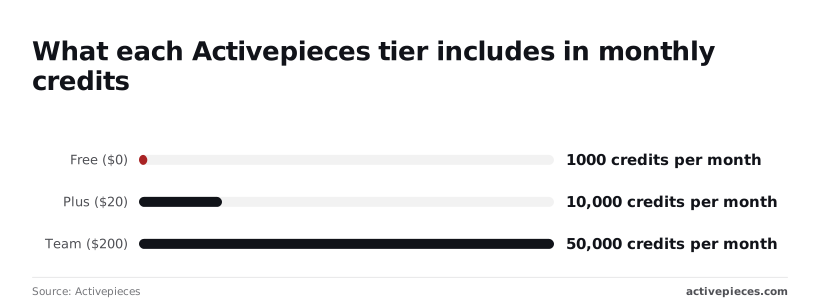
If many competitors each need their own run, Team ($200) is the tier to price. It gives 50,000 credits, letting each comparison run with independent budget allocation.
Then there is the second bill the AI step adds, paid to the model provider. By Anthropic and OpenAI pricing via StockAnalysis, Claude Haiku 5.5 and GPT-6 Luna cost $0.1–0.5 per million tokens, so summaries cost almost nothing.
Step up to Claude Sonnet 5.5 and GPT-6.2 Sol and the cost is $2–10, and Claude Fable 5.2 and GPT-6.2 Astra cost $8–40, meaning model choice can drive up to a twenty-fold cost variance.
Activepieces is the better fit for teams that want to build their own competitor-tracking agent and care most about how much of the tooling they can reuse.
Because every connector is an agent tool, the same piece action that runs in a flow is the one exposed as an MCP tool, so the sources and destinations a team wires into a workflow are available to the agent without being rebuilt.
The trade-off is that it ships no battlecards or curated competitor data, so teams that want a vendor to decide what matters will be better served by a finished product.
Frequently asked questions
Is there a free AI agent for competitor tracking?
Yes, several workflow tools offer a free plan, but each caps runs or tasks, so read the vendor's pricing page for the current limit before building on it.
Where this article's table doesn't confirm a free option, treat it as unconfirmed.
How often should an agent check competitor pages?
Check as often as the page actually changes and as fast as someone would act on the news. Pricing and press pages change rarely, so a daily check usually catches everything a person would act on.
Checking more often mostly spends your run allowance on identical pages (Visualping's Free plan, at 150 checks a month, is about six days of hourly checking on one page) and floods reviewers with summaries of nothing.

Can a small team track competitors without engineers?
Yes, if the platform has a visual builder and the job stays narrow. A schedule triggers the agent, it fetches a page, compares it with the last copy, summarizes the difference and sends it to a person.
For pages behind a login or an app with no ready-made connector, code becomes necessary. A team that wants none of this building can buy a vendor-run service and receive finished battlecards instead.
What should a human review before an agent's summary is shared?
Before the summary reaches anyone outside the review step, a human should confirm five things.
Each check catches a quiet failure, such as a summary of a page that has moved or a price the model rounded, so the reviewer needs the source link and the old and new text side by side.
- The source page is real, and the link opens it.
- The change is the one the summary describes, not a layout shift or a rotating banner.
- Every figure in the summary matches the page.
- Nothing confidential has entered the summary, such as internal notes passed in with the prompt.
- The claim isn't overstated: "announced" isn't "launched", and "listed" isn't "available".
If any check fails, the summary goes back to the agent rather than forward. The audit trail of the run shows which version of the page the agent read, which settles any later dispute about what it saw.
Related reading
Still comparing
The fastest way to settle it is to build something.
Open source under MIT, so you can self-host the same thing later.
Start free Talk to sales