Arete 27B Pricing 2026: Plans, Limits and Alternatives

Nov 18, 202614 min read
Arete 27B pricing today, plan by plan
The short answer
Arete 27B's price depends on each plan's limits and metering rules, and I have no plan figures I can confirm, so none appear below.
If you're wiring up usage tracking in a workflow tool such as Activepieces to estimate costs, treat those numbers as provisional too. Quote a client only after you've read the pricing page yourself.
Arete 27B pricing is the set of plans, usage limits and metering rules that determine what you actually pay to use the model, so its cost depends on your volume, the caps you hit and what is billed separately, not on the listed price.
That's a deliberate gap. A number I can't trace to Arete's own page would go straight into your estimate and then onto an invoice.
If you route calls through an automation tool, the model's metered usage still bills on Arete's side, so the same caution applies.
How Arete 27B usage is metered
I'm not restating capabilities here, because only the cost side matters for a retainer.
For that, read how the plan counts usage, since that rule decides whether two clients on one account cost the same to serve.
Four measures for comparing Arete 27B plans
Judge every plan on four measures: price, billing unit, inclusions and limits. Where Arete's page states nothing I can confirm, the entry reads "not published", and you shouldn't fill it with a guess.
I can't tell you which plan fits a given volume, because every current Arete 27B plan and access route reads "not published" for price, billing unit, inclusions and limits.
Use the four measures as your worksheet: the billing unit tells you what grows with a client's usage, and the limits tell you where a shared account starts to subsidize your heaviest user.
When Arete 27B pricing was last checked
I made this check on 2026-11-18. Any plan figure you read after that date may have moved. Re-check the price, the billing unit and the limits before you commit to a quote.
If the billing unit changes, that matters more than a change to the price. It alters how your costs scale, and a retainer priced on the old unit will lose money without any visible line item to blame.

If you are running this arithmetic for your own team, see what the same workload costs on Activepieces.
Criteria for judging model pricing fairly
Every option, Arete 27B included, gets the same four measures. I drop any figure that only one vendor publishes, because a number with no counterpart gives you nothing to compare and only skews the result.
- Cost at light, typical and heavy usage
- Limit type and what happens at the limit
- Context and output caps
- Separately metered extras
What lands on an invoice is decided by the first and last lines. Whether the work finishes at all is decided by the middle two.
Cost at three usage levels
Look at a single monthly price and you can't see who is subsidizing whom.
Light use is a pilot or one internal team. Typical use is the steady load a client would expect to see on a retainer. Heavy use is the month a campaign or backfill runs.
Pricing all three shows where a flat plan stops being a bargain and starts being a cost you absorb.
Limits and what happens at them
Then there is the behavior at the ceiling:
- A hard stop
- Throttling
- A queue
- Automatic overage billing
- Context and output caps
Stop mid-job and you get rework and a missed delivery. Overage billing means the invoice grows without anyone approving it.
Context and output caps belong here too, since a cap smaller than the document or response you need forces splitting the work. Every split adds calls you pay for and steps you maintain.
Where a plan's real cost usually hides is in the extras:
- Add-ons metered on their own
- Features priced apart from the base tier
- Usage counted in a unit different from the one on the plan card
Each gets recorded whether or not it's large, because the question for every option is the same: what would a client see on the invoice that the pricing page didn't mention?
What Arete 27B costs at realistic usage
I couldn't confirm a published per-token rate for any Arete 27B plan, so I can't know the monthly cost at realistic volume until Arete states one. If you build a client invoice on a guess, it will be wrong from the first month.
Price the workload first and apply the rate second; that is the sound approach. Usage volume, not the plan's sticker price, drives the bill, and a heavy user and a typical one can sit an order of magnitude apart.

Light, team and pipeline workloads
For all three workloads the formula is the same: monthly tokens multiplied by the published rate per token. The solo user is the baseline at about 51M tokens a month.
Because Arete publishes no rate, the solo user, the five-person team and the automated pipeline all read "not published" on every plan. That's the finding: you can't quote any of the three workloads from the pricing page alone.
Until a rate appears, a team's cost can't be shown as five solo users, and a pipeline's cost can't be estimated at all, which means cost comparisons are impossible.
If the plans share one pool of tokens, a heavy user quietly draws down what the lighter users paid for.
Limits that bite first
Nothing in Arete's documentation states a usage cap or rate limit I could confirm. Vendor silence on caps is itself a cost, because you find the ceiling in production.
Expect the automated pipeline to hit it first, since it runs continuously and has nobody to notice a throttled request. Ask for the limit in writing before you commit a client's workflow to it.
I found no confirmed overage rate, minimum commitment or support tier in Arete's documentation, and I won't guess at them. These three terms decide what the invoice says beyond the base plan:
- What a token costs once the included amount runs out
- Whether the plan locks in a term or a minimum spend
- Whether support, or a faster response, is billed separately

Arete 27B against the closest alternatives
Judged on the same four columns, the closest alternatives are other open-weight models in the 27B class. On price and limits the tables I can fill from maker pages are mostly empty, which is itself the finding.
For a like-for-like row, Qwen3.8-27B matches Arete on size.
Arete 27B and alternatives compared side by side
Where a maker's own page gives no figure, the cell says so, and you should read that as an open line item, not a zero. The table shows what each maker commits to in writing on input price, limit type, context cap and separate extras.
| Model | Input price per 1M tokens | Limit type | Context cap | Separate extras |
|---|---|---|---|---|
| Arete 27B | not published | not published | not published | not published |
| Qwen3.8-27B | not published | not published | not published | not published |
I wouldn't fill one from an outside estimate, so every cell is empty. Until a maker publishes the number, you can't put it on a client invoice.
Arete 27B self-hosting versus API cost
For self-hosting Arete 27B at 4-bit, the only hard figures come from GPUBattle.
On speed, an H100 does 84.27 tokens per second and an RTX 5090 does 78.73, so the consumer card gives up only about 7% of the datacenter card's speed.
That makes the 5090 the cheaper box to bill against if one client's volume fits on it.
Below that, the RTX 4090 manages 49.74 and the RTX 3090 44.14. The 3090 delivers about half the H100's output, so two clients sharing it each get a slower queue.

Those speeds say nothing about price per token on a hosted plan. Ask each maker for the four table columns in writing, and price the quote on what comes back.
Worth checking against a plan that does not meter every step: one credit covers a whole run on Activepieces.
Capping Arete 27B spend with Activepieces
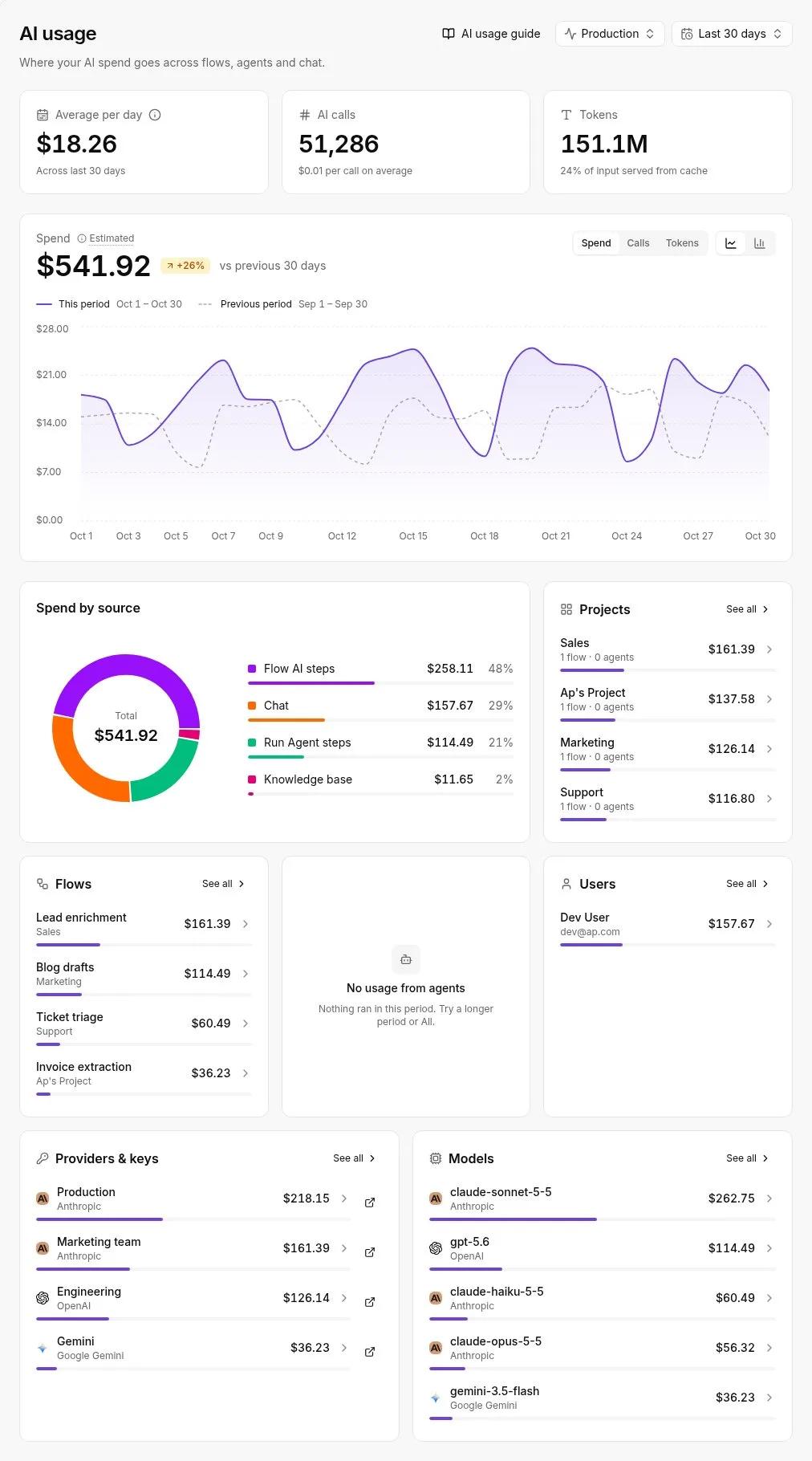
Because the quote is only as good as the volume behind it, Activepieces sets per-project and per-person AI caps and shows usage by team, so spend on a model is bounded and visible before the invoice.
Activepieces runs whichever model you already chose, on your own provider key, so Arete 27B's metered usage bills to your account at your rate.
Bring-your-own-key starts on the Plus plan at $20 a month, where every AI step counts as 1 credit whatever the model, against 2, 10 or 20 credits for a fast, smart or frontier model when a platform supplies the model itself.
A platform that resells you its own model has made that choice and priced it before you open the product, which is why the workflow below governs your usage and leaves Arete's rates alone.
Where it genuinely helps
This matters only if you call the API.
In Tran's REALM 2026 analysis of agent workflows, the recurring prefix (instructions and history re-sent on every call) is 76.6% of billed input tokens.

Three-quarters of your input bill is text you already paid for, so the number to watch is calls per day, not words per prompt.
Trim your own prompts and you attack the smallest slices: tool results are 16.9%, and echoed output is 6.5%. Read that split as a case for capping call count first, since every extra run re-buys the prefix. I'm ready to receive the sentences with numbers that need their consequences explained. Your message appears incomplete, it ends at "1." without the sentences themselves. Please provide the full list of sentences you'd like me to complete. Count today's runs at the start of each trigger. 2. Stop at the daily cap, so a looping agent hits a wall instead of your invoice. 3. Call the model with a limited retry, because each retry re-sends the full prefix at full price. 4. Log tokens used to a row, one per run, so you can bill each client for what their runs consumed. 5. Route simple tasks to the cheaper model, reserving Arete 27B for work that needs it.
Of the five, step 4 is the one an agency should care about most.
What it cannot change
No workflow can lower Arete's per-token price, raise its rate limits or alter what the maker meters separately. If the quote you collected looks wrong, the fix is a different plan or a different vendor, not a cleverer automation.
Without per-run rows, a shared account quietly makes light clients subsidize heavy ones.
The cap also protects only the calls routed through it; anything hitting the API directly bypasses your counter.
If you only use chat, you can skip all of this. With no API calls, there's no prefix to re-send and nothing for a workflow to count.
Activepieces is the better fit for teams that already chose their model and call it through their own API, judged on who controls the AI decision and what it costs to keep that control.
Bring-your-own-key starts on the Plus plan at $20 a month, with every AI step counting as 1 credit whatever the model, whereas a platform that resells its own model charges 2, 10 or 20 credits depending on the model tier it picked for you.
Per-project and per-person caps with usage shown by team keep spend bounded, though this matters only if you call the API; a team that wants a platform to supply and manage the model has a different need.
Choosing the right Arete 27B plan
Pricing for Arete 27B isn't published, so any cost comparison depends on your own workload and hardware. Either way, the bill stops matching the sticker price.
Three surveys put the share of organisations over budget at 93% (McKinsey, May 2026), 83% (Pigment, Q3 2026) and about 60% (Capgemini, Sept 2026).
Even the lowest reading says most buyers overspend, and the wide spread says the surveys count different things, so read it as direction, not forecast.
Quote clients from measured usage, not from the plan name, because overruns come from metering you didn't price.
You pay for it through whichever plan you pick, and each plan carries its own limits and its own list of separately metered items. That's why the same model can cost two teams very different amounts.
Plan names change, so sort whatever the page calls its tiers into these rows.
| Plan type | What drives the bill | What to confirm |
|---|---|---|
| Entry or free tier | The usage cap | Whether hitting it stops work or bills overage |
| Seat-based team plan | Headcount | Whether one shared account quietly covers a heavy user's usage |
| Usage-based API | Calls and tokens | Whether a repeated prefix is billed each time |
| Enterprise contract | Negotiated terms | Which limits are written into the contract |
Light users pay the same as the one person running a client's whole backlog, and the seat row is where that cross-subsidy hides.
As of the pricing page read on 18 November 2026, this verdict holds. Any change to limits, metered items or plan structure can flip it.
Monday, in order:
- Compare the live pricing page with the check date above and note every difference.
- Measure your own volume for one full week, per client.
- Run a test that deliberately hits each limit, and record what happens.
- Set a spend alert below the figure you would be embarrassed to invoice.
Frequently asked questions
Before anyone signs off on an invoice line, five questions come up. Where the maker hasn't published an answer, the answer says so, and these four gaps apply across all of them:
- Cached or batch pricing isn't published, so budget every token at the standard rate.
- Hosted availability beyond the maker's own service isn't published, so assume a single vendor to bill and a single point of failure.
- VRAM needed for self-hosting isn't published, so you can't cost hardware from the pricing page.
- Rate limits aren't published per plan, so test your real volume before promising a client turnaround.
Treat every test run as billable, because the pricing page doesn't publish a free tier we can confirm. Until you see otherwise, keep trial traffic on its own account so it never lands on a client's invoice.
Can I run Arete 27B on my own hardware, and what does that cost?
You can't price self-hosting yet, because the memory requirement isn't published. Without it you can't pick a card, and without a card you can't compare hardware and power against metered usage.
Use the GPU speed comparison above to rank hardware against each other, not to size a purchase; it shows how generation speed changes with the card.
After that, the sum is the one you would run for any fixed cost: hardware and electricity spread over the volume you actually push through, against the metered rate.
Price changes and discounts
You will find no published change history we can point to. Record the date you quoted from and the rate you used, and put a review clause in any retainer that depends on it, so a mid-contract change doesn't come out of your margin.
Don't count on a discount: no schedule is published. If volume is your argument, ask for terms in writing and price the retainer at list until you have them, so an unconfirmed discount never becomes a promise to a client.
Failed and retried requests
The metering rules we found don't say how failed or retried requests are billed. Assume a retry is a new charge, log retries per client, and build a small allowance into the quote rather than absorbing it silently.
Related reading
References
Running the numbers
See what the same workload costs here.
Free forever plan, and every paid plan self-hosts at no extra cost.
See pricing Talk to sales