What Is Arete 27B, the New Nous Research Model?

Nov 10, 202612 min read
Arete 27B is a model from Nous Research, published on Hugging Face and built on Alibaba's Qwen3.8-27B.
According to Hugging Face, it's new, and everything here rests on its model card, checked on 2026-11-10, much as anyone wiring models into an automation tool like Activepieces would start from the card. Details the card doesn't state aren't filled in below.
Arete 27B defined by its maker's model page
Arete 27B as a post-trained Qwen model
Treat Arete 27B as a post-trained variant of an existing open model, not a new architecture. The card describes it in the maker's words: "We post-trained over Alibaba's Qwen3.8-27B to reinforce western values on a Chinese-trained model."

So its behaviour is a Qwen3.8 base with an added layer of tuning, and what that layer changes for your task is the open question.
For the release date, go to the model page on Hugging Face, since Nous Research developed it and that page is the primary source. I haven't restated the date here, because a secondhand date is the sort of detail that drifts from the original.
How this Arete 27B overview was researched
I read only the maker's own page, on 2026-11-10. I didn't use benchmarks, third-party evaluations or independent reproductions, and I claim none. Little published material is a reason to run your own comparison against an established model before switching.
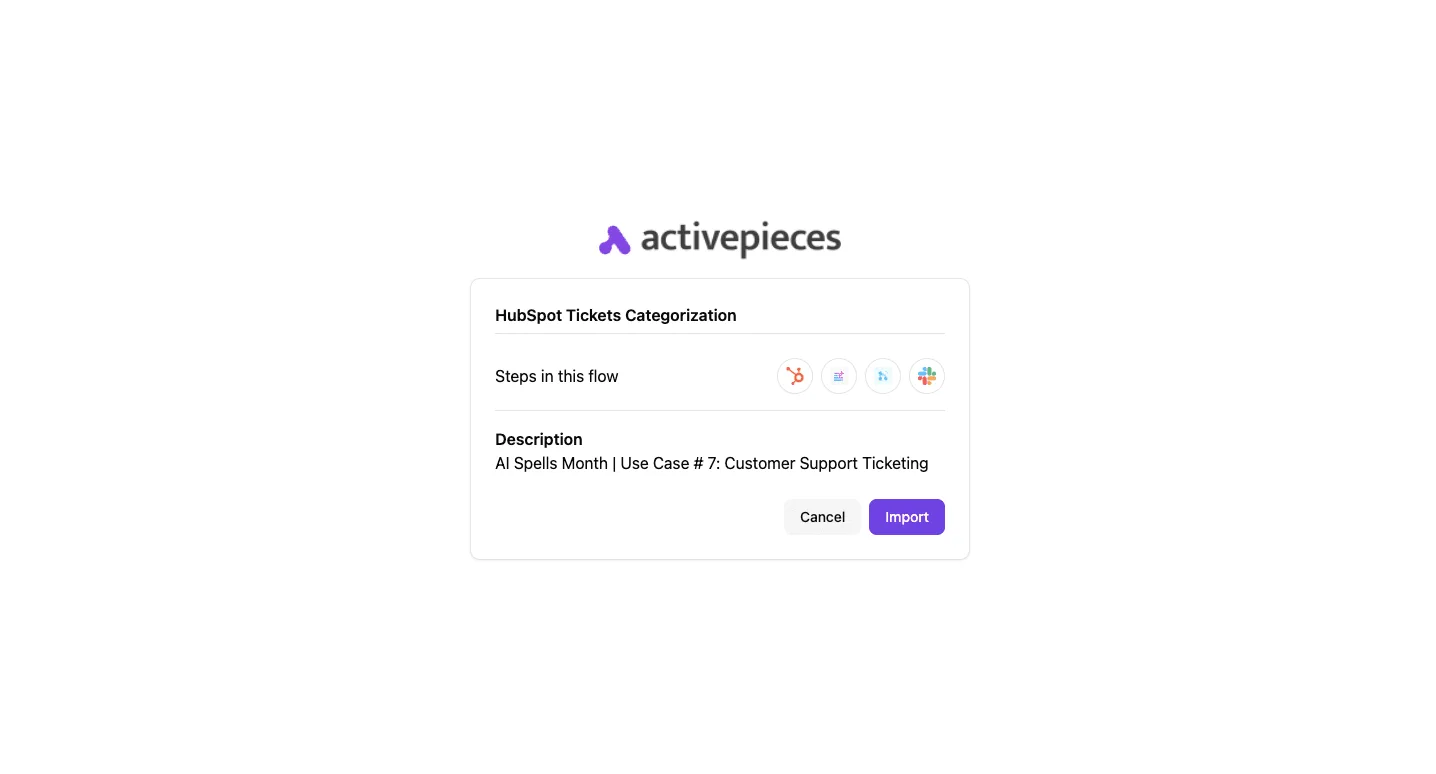
You can build that comparison from ordinary integration parts in Activepieces. The page below shows the building blocks that a trial would plug into:
- webhooks
- spreadsheets
- HTTP requests
Everything below works on Activepieces' free plan. Start without code or a credit card.
What Arete 27B does, according to Nous Research
Beyond a Qwen3.8-27B base with post-training aimed at western values, the card says little. Each item below comes from the card, with what it means for a buyer.
- The card names Qwen3.8-27B as the base, so most of Arete's raw capability comes from that model. The card doesn't say how much the post-training changed it.
- The card states western-values post-training as the purpose. The target is behaviour and tone, not a claimed gain in coding or reasoning.
- The card gives 27B parameters, a mid-size class. Size alone says nothing about quality on your task.
- The card reports supervised fine-tuning (SFT) totalling 52.8M tokens. That's a small dataset by pretraining standards, which suggests an adjustment to style and stance more than new knowledge.
- The card lists a 64k training context, so long documents in one request go beyond what it states. Whether quality holds across longer inputs is not published.
Size alone says nothing about quality on your task.
The card does give maker-run capability results (Hermes Bench 65.77% to 65.60%, Terminal-Bench-2.1 67% to 70%), but no independent head-to-head comparison against the Qwen base. Those gaps are why the testing described next matters.
Ways to get access to Arete 27B
There're three routes:
- download the weights from Hugging Face
- run a community GGUF build locally
Only the last removes the hardware question, and testing on your own task needs one of them to work. The table sets them side by side, so you can see which route costs you hardware and which costs you someone else's terms.
| Route | Who runs hardware | Setup effort | Licence as stated | Cost |
|---|---|---|---|---|
| Download weights from Hugging Face | You | Highest: you build the serving stack | Model card | Free to download, plus your GPUs |
| Run locally from community GGUF | You | Moderate: one file, common local tools | Model card, plus the repackager's own terms | Free to download, plus your machine |
| Hosted endpoint | The provider | Lowest: an API key | Model card, plus provider terms | The provider's pricing |

Prices and plan limits checked against huggingface.co on November 10, 2026.
A 27B model needs real GPU memory unless you accept heavy quantisation and its quality loss.
For teams that want full control, this maker's own release is the only route where the weights come straight from Nous Research. It suits a team that already serves models and wants full control.
They're not published by Nous Research, so check the repackager's card before you trust a benchmark taken on one.
The weights are on Hugging Face, and no Inference Provider deploys the model, so a hosted endpoint is not an option from there. Use only the providers the model card names, and compare their terms with the card's licence.
What Arete 27B costs to use
You pay for the hardware you provision or the rate of a third-party host, because Nous Research sets no price here.
This article quotes no price because none is among the figures we can source. The next chart shows 27B-class weight file size by precision, which is memory you must provision rather than money, so read it as the floor for any hardware or rented-instance quote.

To see the spread, look at the Arete 27B files published by UraionLabs. The full BF16 file needs a multi-GPU setup or a large-memory server.
Q2_K is the most compressed file, so check its quality on your task before trusting it.

To estimate cost without inventing numbers:
- Pick the smallest file whose quality passes your own test, and add headroom above its size for context.
- If you buy or rent hardware, price a machine with that much memory from the vendor's own listing.
- If you use a host, take its published per-token rate from a provider the model card names, multiply by your monthly volume, and compare against the model you would replace.
Easier to see it running than to read about it: set it up free, no card.
Arete 27B's strengths and limits
Apply the same discipline to quality: Arete 27B's strengths and limits are known only from Nous's own evaluation, and independent testing is thin.
On Nous's evaluation, Qwen3.8-27B gave propaganda answers 22% of the time against 0.9% for Arete-27B, and Arete's fact score was 2.98 against 2.32 out of 5. Both are maker's figures, so they show what Nous chose to measure, not a verdict.

Neither number tells you how Arete behaves on coding, tool use or long inputs.
What the maker says or leaves unsaid about limits
If you open the evaluation dataset on Hugging Face, it leans toward politics and policy. Its largest categories are state ideology, state vs market, free expression, education policy, data privacy and environment.
A good score therefore says little about invoices, support tickets or code. Nous's published material, as far as I can find, gives no results for tool use, long context or non-English languages.
Before committing, run a small test:
- Run 50 real prompts from your own task through Arete and your current model, and compare the outputs side by side.
- Give it one tool-calling workflow and check whether the arguments come back valid.
- Feed it your longest realistic input and check whether it drops details from the middle.
- Repeat a handful of prompts in each language your users write in.
If Arete matches your current model on all four, you have evidence of your own. If not, you've saved a migration.
Arete 27B against established open-weight and hosted models
Set beside its peers, Arete 27B is the least documented of the four, which is the practical reason to treat it as a trial rather than a replacement.
The table below shows what each vendor says about its own model; the Arete row is mostly blank because Nous Research hasn't filled those fields in, and the blanks are the finding.
| Model | Maker | Size | Licence | Access route | Listed price | What is documented |
|---|---|---|---|---|---|---|
| Arete-27B | Nous Research | 27B | Unpublished | Weights on Hugging Face; no Inference Provider deploys it | Unpublished | Name, maker and size |
| Qwen3.8-27B | Qwen team, Alibaba | 27B | On the model card | Downloadable weights | Free to download; hosting is your cost | Model card from its maker |
| Mistral Large 4 | Mistral | On Mistral's model page | Open-weight terms on its page | Mistral's API and weights | On Mistral's pricing page | Vendor documentation, multimodal flagship |
| Claude Sonnet 5.5 | Anthropic | Not disclosed | Commercial terms | Anthropic's API | On Anthropic's pricing page | Vendor documentation, speed-and-intelligence positioning |
Adopt early, the argument goes, because a 27B model is cheap to host and a small test costs little. That's true, but it only helps if you know the licence permits your use, and today you can't.
If your use is customer-facing, regulated, or needs a licence your lawyer can sign off, wait until Nous publishes terms and an access route.
If you have a bounded internal task, a test set of your own, and the Qwen model as a baseline, try it now.
Connecting Arete 27B to a workflow in Activepieces
As of 2026-11-10, Activepieces, the workflow automation tool, has shipped nothing specific to Arete 27B, and we haven't run the model, so it is untested here.
Activepieces works with any major model or your own provider key (bring-your-own-key from Plus up), and for an API that has no integration you can generate a integration with AI and add it privately to your instance.
Take from it that the plan you start on limits how large a trial you can run.
Activepieces monthly credits by pricing tier
1,000 credits a month is what the Activepieces pricing page lists on Free ($0), so a small test set fits but a repeated evaluation may not. Plus ($20) gives 10,000, enough for several passes, so any developer can afford multiple attempts.

Team ($200) gives 50,000, which only matters if the pilot becomes a standing workflow, so plan for scale before committing to this tier. Work in this order:
- Get the model answering at a URL you can reach, through a major model or a provider key you already hold, or through a private integration generated for its API.
- Test it with a curl call to the chat completions path before touching Activepieces.
- Add an HTTP request step using the same call.
- Switch to an AI step with a custom provider.
- Wrap it as an MCP server, last.
Because the HTTP request step sends the curl call you already proved, a failure points at the workflow, not the model. It's also the most transparent way to see exactly what goes in and out.
For the AI step, point a custom provider at your endpoint and model name. Whether to trust an unproven model is your decision, and a platform that resells you its own model has made that call and set the price before you start.
Activepieces leaves it with you: on Plus ($20) you bring your own AI keys, every AI step costs 1 credit whichever model sits behind it, and the model spend for Arete or your Qwen baseline lands on your own provider account.
Any MCP client, including Claude, ChatGPT or Cursor, can reach the same workflow, so the strategy stays yours to set.
Wrapping it as an MCP server comes last. It exposes the workflow as a tool for other agents, which spreads an unproven model's output further, so wait until your own test set justifies it.
Frequently asked questions
Most of these questions bear on whether a test is worth running, and on several of them Nous Research has published nothing yet.
Licence and openness
Commercial use is not stated: Nous hasn't published a licence for Arete 27B that we can cite. Until it does, assume nothing about commercial terms, and read the licence text itself before you put the model in a product.
Whether it's open source or just open weights is not published. The answer turns on the licence and on whether Nous releases training code and data, and neither is documented. Until then, "open source" is an unsupported label for this model.
Hardware and tool support
Running on a single consumer GPU is not documented. Nous has given no hardware requirements or quantised builds.
Memory needs depend on numeric precision, so a model of this size may fit on one card in compressed form, but that's an inference, not a Nous claim. Test it on your own hardware.
Tool calling support is not published either. Nous hasn't said whether the model was trained for tool calling or what format it expects. If your workflow depends on structured tool calls, make that your first test case and score it before anything else.
Staying current
For updates, Nous Research's own model card and announcements are the primary source. This article rests on what they said as of 2026-11-10, so recheck them before you decide. Treat third-party summaries, including this one, as secondary.