Brave Search API x402 for Autonomous AI Agent Payments

Nov 13, 202612 min read
Brave Search API x402 is a machine-to-machine payment protocol that enables AI agents to autonomously purchase search data on a per-query basis using the HTTP 402 Payment Required status code.
Implement x402 for instant agent payments
When a token expires on the Saturday of a long weekend, nothing alerts anyone until the Monday invoice run. Brave Search API’s x402 update solves this by enabling your AI agents to pay for individual data requests instantly using USDC on the Base blockchain.
This transition from monthly billing to per-query settlement allows your autonomous systems to manage their own operational expenses without human intervention in the payment loop.
Brave launches x402 payment protocol
On November 13, 2024, Brave launched the x402 protocol. This provides a machine-native alternative to traditional API key management.
The moment a connector is configured in Activepieces, an agent can call it immediately. Registering an integration once allows it to function as both a flow step and a tool schema on a per-project MCP server, accessible by Claude, ChatGPT, or custom agents.
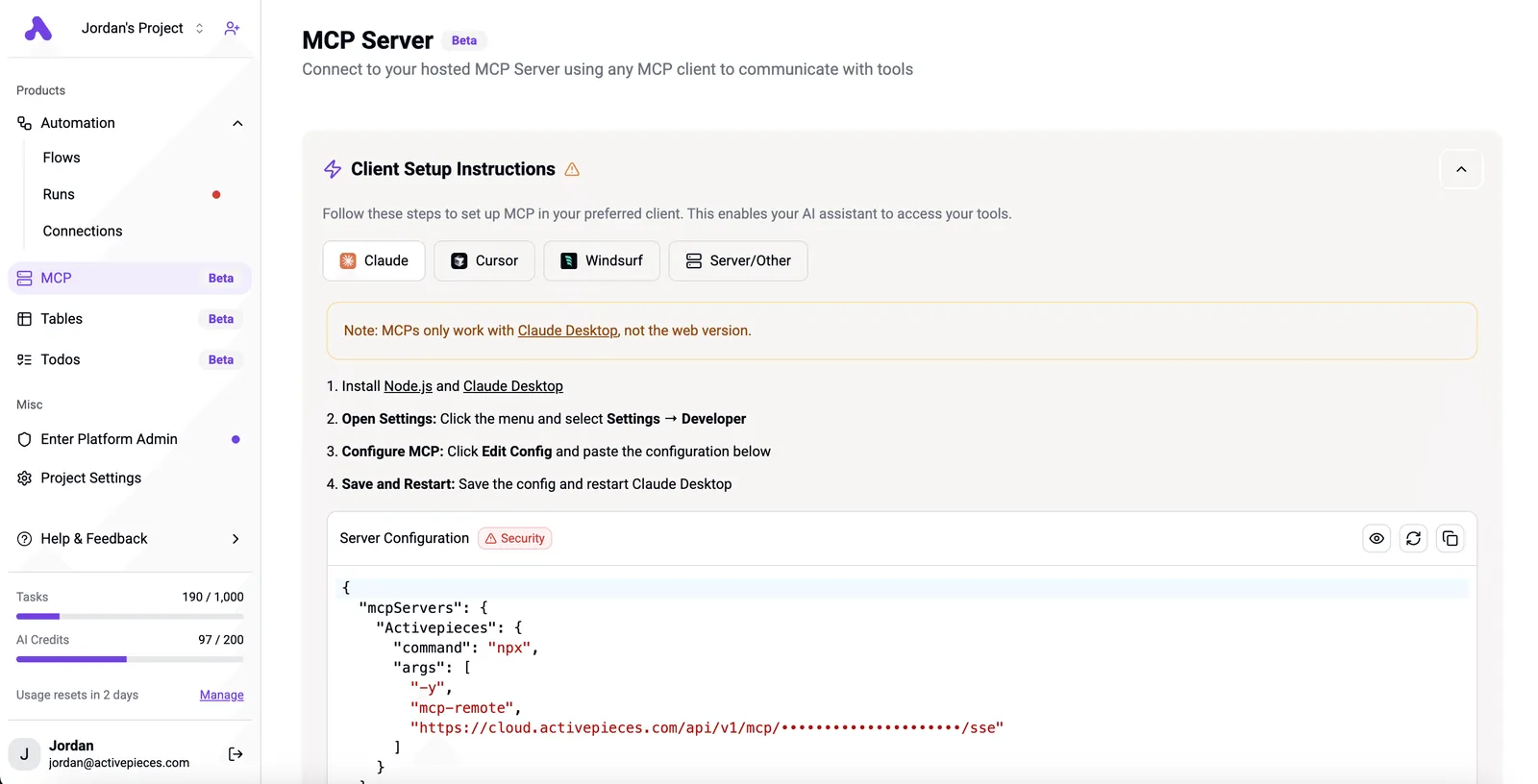
There is no secondary catalog to maintain or export; the same integration action found in the packages/pieces open-source repo runs in a flow or as an MCP tool. A catalog that requires re-integration for agents is just a second migration.
- Brave indexes 40 billion pages. This broad data set helps your agents avoid the knowledge gaps found in smaller, niche crawlers.
- The index receives 100 million daily page updates. Your agent retrieves fresh signals rather than cached data that has decayed for a week.
- Brave handles 22 million daily LLM Context answers. This volume proves the infrastructure can handle high-concurrency requests from reasoning models like GPT-6 Astra.
A catalog that requires re-integration for agents is just a second migration.
High-fidelity results justify the immediate cost. This volume of fresh data ensures that when your agent triggers a payment, it receives the quality it paid for.
How the x402 protocol functions
By utilizing HTTP 402 Payment Required headers, the x402 protocol challenges a requesting agent for a micropayment before the server returns the search results.
When a model identifies a need for external data, it receives a Lightning Network invoice in the response header. Your agent pays it via a connected wallet and resubmits the request with proof of payment.

Managing the agentic wallet
For an agent to settle these invoices autonomously, it must have programmatic access to a Lightning-enabled wallet. This wallet typically exists as a separate service or a node connection, such as an Alby account or a dedicated LND node.
The agent uses a specific SDK to communicate with this wallet. When the 402 header arrives, the library extracts the invoice, requests a signature from the wallet service, and returns the cryptographic proof to the agent for the final API call.

This protocol eliminates "sandbox rot" where developers test against stale data because they lack the budget for a full production tier. Every environment now operates on the same pay-per-call logic.
By shifting the financial burden to your agent's wallet, you can audit exact per-task costs, eliminating the waste of paying for idle capacity.
Everything below works on Activepieces' free plan. Start without code or a credit card.
Why per-request payments matter for your automation teams
Real-time demand now dictates the scale of your AI search operations. Per-request micro-payments remove the need to manage tiered API keys or manual credit top-ups.
This shift moves the financial burden from a fixed operational expense to a variable cost that only triggers when a model successfully initiates a data retrieval task.
Ending subscription costs with pay-per-use
Traditional data access requires maintaining active monthly seats for every service an agent might touch. This forces you to pay for idle capacity.
By utilizing a machine-to-machine payment protocol, an instance can negotiate and pay for its own queries only at execution, ensuring budget is never allocated to unused resources.
"Shelfware" becomes a thing of the past. This eliminates the problem where you pay for high-tier access to search indices that your automated workflows may only query during specific quarterly audit cycles.
Granular cost tracking for AI agents
Every cent spent on search now links directly to a specific agentic run or client project.
An SDK provides an agent with code, but it does not provide a tenant, a role, or an audit log. Activepieces places every agent within the same governance model as employees, using RBAC and SSO to control what it may connect to.
Each tool call is logged individually with its own inputs and outputs in the run detail view, ensuring that agents like those run by MoneyGram or FundingSocieties are treated as users rather than opaque code blocks.

A precise Agent Quality Score is the result. This metric weighs the cost of data acquisition against the accuracy of the final task.
| Provider | Agent Quality Score (0-20) |
|---|---|
| Brave | 14.89 |
| Firecrawl | 14.58 |
| Exa | 14.39 |
| Tavily | 13.67 |
Because its direct payment model ensures your agents only pull high-signal data without the latency overhead of subscription handshake protocols, Brave leads this performance metric.
Technical capabilities of the x402 implementation
By repurposing a dormant part of the HTTP standard, Brave Search API leverages the HTTP 402 Payment Required status code to transform a legacy web error into a functional machine-to-machine negotiation protocol.
The 402 Payment Required mechanism
The x402 handshake is a stateless transaction. The agent attaches the payment directly to the data request, which removes the need for API keys or monthly billing cycles.
When a model requires real-time web context, it initiates a sequence that treats capital as a functional input:
- Agent sends query to the Brave Search endpoint.
- Server returns a 402 Payment Required error containing a cryptographic invoice.
- Agent signs a USDC payment via the Base blockchain network to satisfy the invoice.
- Agent retries the original request with the payment proof attached to the header.
Proprietary index data is only released once your agent covers the specific compute cost.
Lightning Network integration for low-fee transfers
Traditional credit card rails carry flat fees that exceed the cost of a single search query. To solve this, Brave utilizes the Base blockchain to facilitate these micro-transactions.
By settling payments on a layer-two scaling solution, the system achieves the sub-second latency required for real-time inference. Administrative overhead vanishes as each transaction is self-validating and cryptographically audited at the point of request.
USDC settlement via Bitcoin payment rails
The x402 protocol utilizes USDC to provide price stability without requiring the agent to interact with the Ethereum mainnet. Instead, the payment is routed through providers that support Taproot Assets or specialized bridges that wrap USDC for the Lightning Network.
This allows the agent to hold a dollar-denominated balance while benefiting from the speed of Bitcoin's second layer. The invoice is denominated in USD, and the underlying transaction swaps the necessary units instantly to fulfill the exact cent-value requested.
Easier to see it running than to read about it: set it up free, no card.
Connecting Brave Search x402 to Activepieces workflows
Activepieces provides an MIT-licensed core that allows teams to build these x402 handshakes into their own infrastructure.
Using the HTTP Request step for payments
By managing the 402 Payment Required response headers, the HTTP Request integration functions as the execution layer for the x402 handshake.
When a workflow triggers an initial request, the integration captures the Lightning Network invoice provided by the Brave API. A subsequent step can then route funds from a pre-authorized digital wallet.
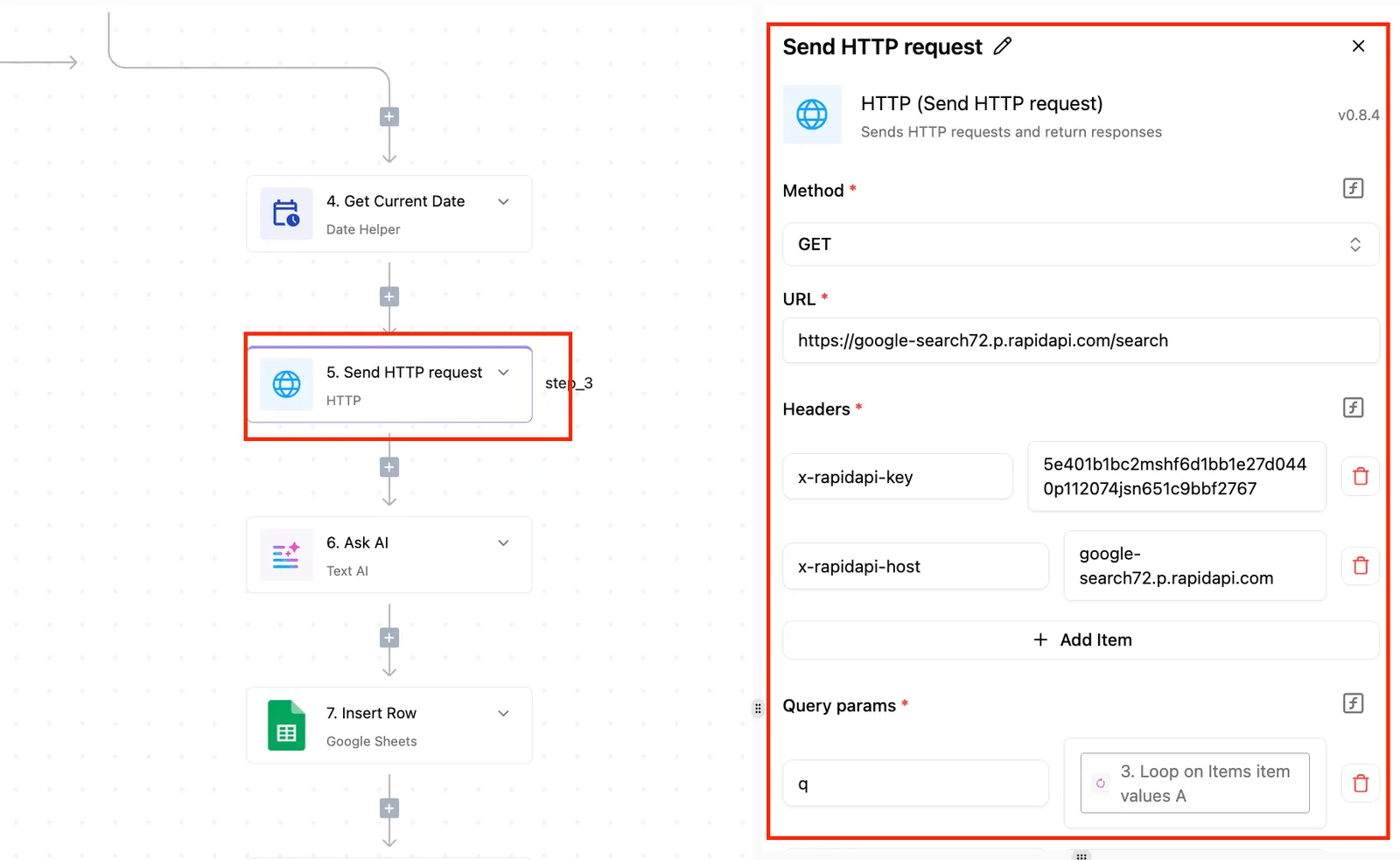
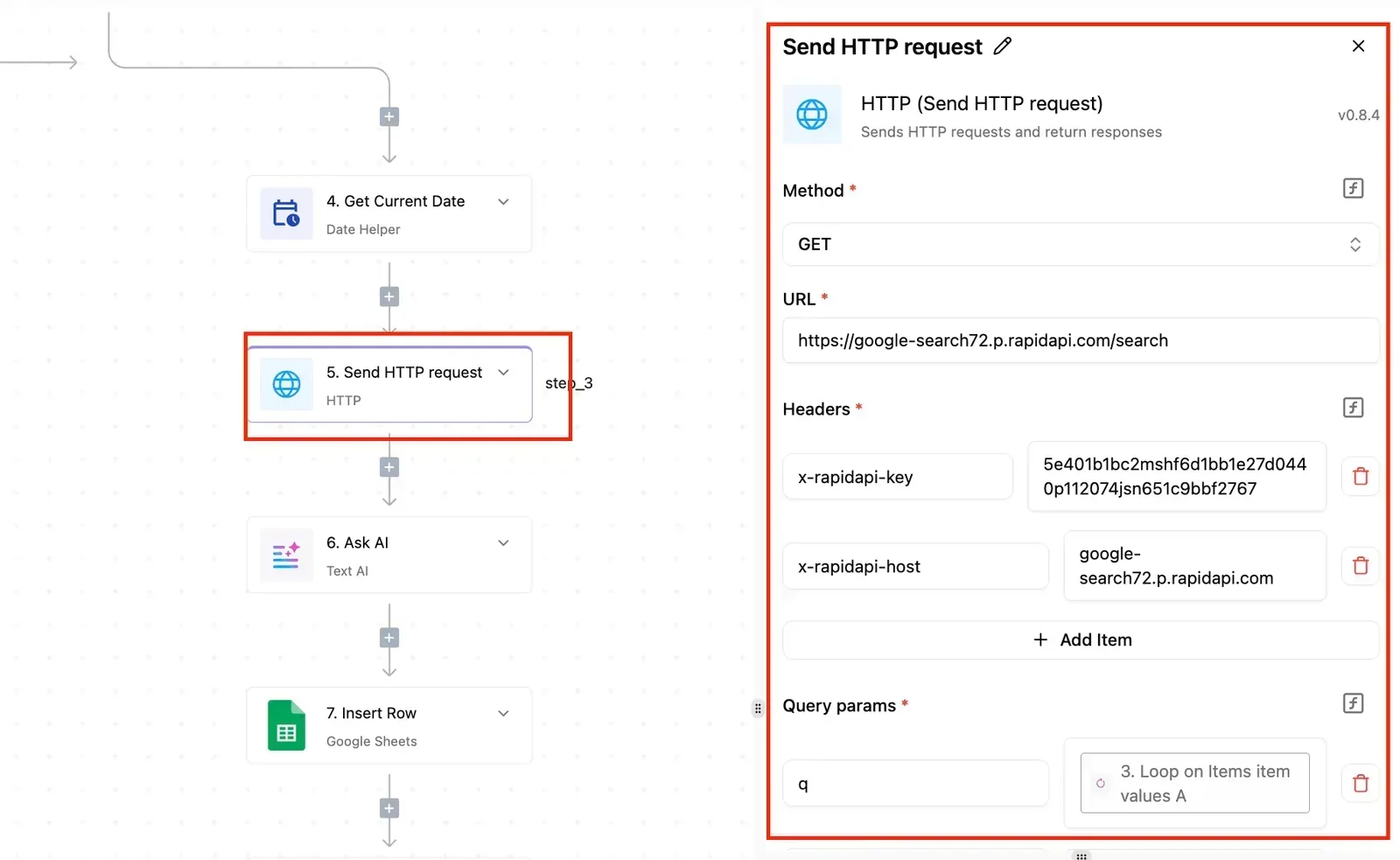
Within the Activepieces workflow builder, this specific configuration is visible.
A "Send HTTP request" step targets the search endpoint with the necessary payment details and query parameters defined in the right-hand panel, utilizing any of the 748 integrations available in the community monorepo to handle the subsequent data routing, so users have a vast ecosystem of pre-built connectivity options at their disposal.
Passing search data to AI steps
Once the payment is settled and the search results arrive as a JSON object, the system maps the data directly into the context window of high-reasoning models. This allows your agent to operate on real-time web data rather than static training weights.
Integration via MCP servers
Activepieces can interface with Model Context Protocol (MCP) servers, and every one of its hundreds of integrations is available as an MCP tool to expose search actions to external agents, meaning the majority of existing tools are already compatible with modern AI interoperability standards.
Cost and speed impact of agentic payments
The procurement bottleneck disappears with the Brave Search x402 update. By allowing your AI agents to pay for data access at the request level, you no longer wait for human-in-the-loop subscription approvals.
Traditional subscriptions vs. micro-payments
Micro-payments solve the "shelfware" problem where you pay for unused capacity in high-tier plans to avoid the risk of rate-limiting during peak operations.
| Provider | Price per 1k requests | p50 Latency |
|---|---|---|
| $2.00 | 400ms | |
| Bing | $5.00 | 400ms+ |
| Brave | $5.00 | 669ms |
While Brave maintains a slightly higher latency profile, the trade-off is a simplified billing architecture. The operational overhead of managing API keys often outweighs the raw millisecond advantages of competitors.
Reducing latency in agent provisioning
The handshake of the payment protocol is now the only limit on agent provisioning speed. It no longer waits for the administrative speed of a legal department.
When you deploy a fleet of instances for time-sensitive analysis, the x402 header allows these instances to authorize their own data spend immediately.
By treating data as a utility metered and paid at the edge, the time-to-value for new agentic workflows is reduced to the duration of a single network request.
The future of standardized agentic payments
Whether major index providers transition from account-based gatekeeping to this standardized machine-to-machine payment handshake will determine the adoption of the x402 protocol.
Manual seat provisioning disappears if a reasoning model can negotiate its own access to a live index. The following timeline illustrates how x402 collapses friction:
- Traditional SaaS: Requires legal review, seat-based billing setup, and manual API key rotation.
- x402 Protocol: Uses lightning-based macaroons to authorize specific queries without pre-existing accounts.
- OpenPayment: Represents the theoretical limit of zero-touch settlement for autonomous micro-transactions.
Real-time data source pivoting
A high-reasoning model can now pivot between data sources in real-time as a task evolves. When the payment is coupled to the request, the vendor’s risk of unpaid overages is eliminated. This incentivizes providers to drop the "Contact Sales" wall for high-volume agentic traffic.
Frequently asked questions
What wallet is required for x402?
A wallet that supports USDC on the Base blockchain is required for implementing x402. This protocol allows the instant, micro-incremental settlement necessary for an agent to pay for a single search result without a central clearinghouse.
This architecture removes the need for pre-funding a developer account with a credit card. A script can go from deployment to data acquisition without you approving a billing profile. To initiate a transaction, the infrastructure must meet three specific technical standards:
- A wallet that supports USDC on the Base blockchain provides the payment channel for sub-cent transactions.
- USDC on a supported network is the stable value layer to prevent price volatility during the request-response cycle.
- An agent capable of parsing HTTP 402 Payment Required headers allows the software to recognize a price demand and programmatically sign the transaction.
If the wallet has a balance, the task continues. This stack ensures that the agent remains autonomous.
Can i still use traditional API keys?
Alongside the x402 protocol, Brave maintains support for standard API keys. Legacy enterprise workflows can continue while you transition to machine-to-machine payments.
This dual-track system allows your finance team to keep a fixed monthly subscription for predictable internal dashboards while deploying autonomous agents on the x402 protocol for bursty, unpredictable research tasks.
Which AI models support Brave Search x402?
Any model capable of tool-calling and handling structured HTTP responses can interface with x402. The orchestration layer must be able to sign the Lightning invoices.
High-reasoning models like GPT-6 Astra or Claude Opus 5.5 are particularly suited for this. They can evaluate whether a specific search query is worth the transaction cost before executing the payment.
Broad web-scraping sweeps can be handled by faster, high-volume models such as Gemini 3.5 Flash-Lite or GPT-6 Luna.
Because the protocol relies on standard HTTP status codes, you can implement this on any frontier model. This ranges from the reasoning-heavy Gemini 4 Carbon to the code-centric Grok 4.7.