
Best Pipedrive Alternatives for Sales Teams in 2026

Oct 8, 202614 min read
Maintaining data integrity across high-velocity cycles while minimizing the technical debt of custom API maintenance is the primary goal of a modern sales stack. Engineering teams typically hit a ceiling with Pipedrive when the demand for multi-step logic outpaces the platform’s native trigger-action capacity.
As teams scale, the selection shifts from "ease of use" to "depth of extensibility," and Activepieces synchronizes lead intelligence between disparate systems to ensure the change propagates everywhere.
Selection Criteria for Modern Sales Stacks
Total Cost of Advanced Automation
The financial profile of a CRM changes significantly as a team moves from basic record-keeping to autonomous pipeline management.
Pipedrive notes that while it offers an entry point of $14 per user, this price reflects a seat in a system designed for manual updates, which means administrative overhead will quickly erode the initial savings.
The financial profile of a CRM changes significantly as a team moves from basic record-keeping to autonomous pipeline management.
85x. That is the premium a firm pays to access enterprise-grade automation and reporting when moving to the highest tiers of HubSpot.
Onealgorithm’s analysis puts the scale at up to $1,200 per user, so companies must budget for a significant premium to achieve full operational capability. The following table illustrates how these platforms stack up across the primary levers of scale and extensibility.
| Criterion | Pipedrive | HubSpot | Salesforce |
|---|---|---|---|
| Entry Price | $14 | $50 | $25 |
| Native Automation Limit | 150 | 1,000 | Unlimited (Flow) |
| Marketplace Apps (2024) | 350+ | 1,500+ | 7,000+ |
Prices and plan limits checked against pipedrive.com on October 8, 2026.
Roughly 17 times more pre-built integrations are available in a Salesforce implementation than in Pipedrive. This volume reduces the need for expensive custom-coded middleware.
Consequently, engineering hours required to build what larger ecosystems provide out of the box can quickly erase the initial savings of a lower-cost seat.
Marketing and Sales Alignment
When the lead handoff depends on manual status changes rather than real-time data synchronization, alignment fails. Marketing teams frequently break Pipedrive guardrails by attempting to push high-volume interaction data into a UI optimized for simple deal stages.
This includes data such as webinar attendance or whitepaper downloads. Delayed signals force the sales team to work with stale intent data, which lowers conversion rates on outbound calls.

Pipedrive customization versus implementation speed
The trade-off between deployment speed and long-term flexibility is the primary friction point for operations leads. Pipedrive allows a sales team to go live in under 48 hours, meaning that deployment delays are virtually eliminated for new users.

This speed comes from a rigid data structure that resists non-standard business processes. It often forces companies to adapt their workflows to the software.
Providing the network isolation and custom objects required for complex industries, Salesforce offers the inverse. The implementation often requires a three-month roadmap before the first lead moves through the system.
The fastest way to settle a shortlist is to try one. Activepieces is free to try, no credit card.
1. Activepieces
Activepieces provides an MIT-licensed AI automation platform for teams that have outgrown Pipedrive's native automation limits but require a self-hosted environment to maintain data sovereignty.
While a closed vendor catalogue acts as a ceiling for Pipedrive users, Activepieces provides a floor where missing connectors are generated with AI and added privately to an instance.
Roughly 60% of the 738+ integrations are community-contributed, meaning teams no longer wait on a vendor's release queue to connect niche sales tools.
Engineering teams at the pilot stage frequently deploy it as a "headless" automation engine.
This setup moves data between specialized tools while keeping Pipedrive as a simple interface for the sales reps. These tools might include a vector database for RAG or a custom ERP.
Visual workflow management
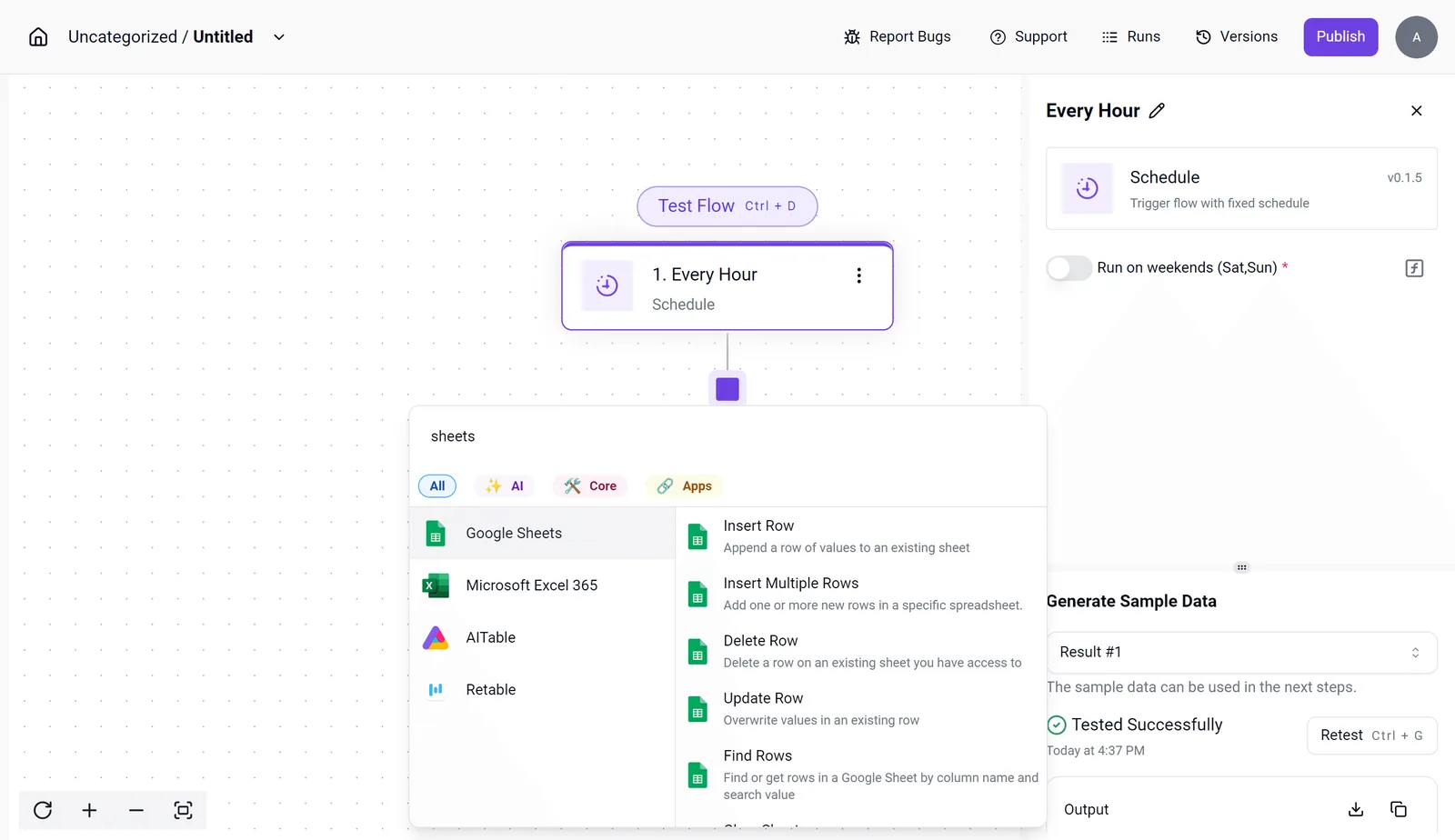
The platform’s flow builder is a visual canvas for mapping these cross-functional journeys. Visibility is essential as the number of active integrations grows. The following interface shows how a recurring sync is established between external data sources and the CRM:
[SCREENSHOT: The Activepieces flow builder with a test flow open. A Schedule trigger step labeled "Every Hour" is selected on the canvas. Below it, a integration selector modal is open showing spreadsheet integrations: Google Sheets, Microsoft Excel 365, AITable, and Retable on the left. Action options on the right include Insert Row, Insert Multiple Rows, Delete Row, Update Row, and Find Rows. The modal has category tabs: All, AI, Core, and Apps. On the right side, a settings panel shows the Schedule trigger configuration with a "Run on weekends" toggle. Below that a "Generate Sample Data" section shows a successful test result.]
Granular control over timing and data formatting is the result of this modular approach. Hourly batch updates prevent API rate-limiting on the CRM side. By offloading these tasks to a dedicated engine, organizations can leverage frontier reasoning models for lead enrichment.
A flow can trigger Gemini 3.7 Flash to analyze a new LinkedIn profile and update the Pipedrive "Person" record with a personalized outreach strategy. This bypasses the rigid constraints of the CRM's built-in workflow editor.
By treating its library as a foundation rather than a limit, this platform ensures that engineering teams are never restricted by a vendor's development roadmap.
Activepieces is the better fit for organizations that require total data sovereignty and the ability to instantly expand their integration library through community contributions and AI generation.
For those who view a fixed catalogue as a ceiling, the open-source transparency of this monorepo provides the necessary floor for limitless scaling.
2. Use HubSpot CRM
HubSpot is a consolidation point for teams that prioritize a unified data schema across marketing, sales, and service operations. While Pipedrive focuses on the individual contributor’s deal velocity, HubSpot is designed for the RevOps lead.

This lead requires a single source of truth to manage the entire customer lifecycle. They must do this without the technical debt of third-party middleware.
Architectural cohesion is reflected in the Brightfield Research 2026 CRM Quality Fit Scores. HubSpot achieved a perfect 100 score, indicating it's the most reliable platform for maintaining data integrity across disparate departmental hubs.
Data integrity benchmarks
How well the platform survives high-volume automation is the true measure of the gap between a unified suite and a specialized sales tool. According to Brightfield Research, Pipedrive and Zoho CRM both sit at an 86 score.

14% higher friction rates typically face teams using these tools when attempting to sync complex marketing attribution data back to sales records, resulting in a persistent disconnect between lead generation and closed deals, which means marketing ROI remains perpetually obscured.
Brightfield Research reports that Salesforce and Freshsales both trail at an 81 score.
For 19% of enterprise use cases, the platform requires significant manual intervention, forcing staff to dedicate hours each week to routine data maintenance, so internal resources are diverted from high-value strategic initiatives. It may also need custom code to maintain quality standards during a rollout.
The following chart illustrates the current market landscape for quality fit, highlighting how native integration impacts overall platform reliability:
| Platform | CRM Quality Fit Score (0-100) |
|---|---|
| HubSpot | 100 |
| Pipedrive | 86 |
| Zoho CRM | 86 |
| Salesforce | 81 |
| Freshsales | 81 |
This disparity in fit scores directly correlates with the success of agentic workflows. To handle high-reasoning tasks like automated lead qualification, teams are deploying Gemini 3.8 Flash to process HubSpot's unified activity logs.
Providing the model with a complete context window of every touchpoint is the goal. When data is siloed in platforms with lower fit scores, the model lacks the historical depth needed for accurate forecasting. This often results in hallucinations regarding lead intent.
Reading a table only gets you so far. Build the same workflow in Activepieces and compare it yourself.
3. Use Monday CRM
Monday CRM functions as a highly customizable work operating system for teams that treat sales as a multi-dimensional project. It differs from Pipedrive, which treats sales as a linear sequence of stages.
While Pipedrive enforces a rigid horizontal flow, Monday CRM allows the sales engineering team at organizations like Raytheon to restructure their workspace. High-value contracts are rarely simple; these non-linear groups reflect that actual complexity.
This flexibility ensures that internal dependencies are tracked alongside the deal progress. These dependencies, such as technical validation or resource allocation, no longer exist as invisible blockers in a separate tool.
Non-linear sales cycles
The platform utilizes a building-block architecture where every column is a specific data point. This could be a formula for weighted commission or a status label for security clearance.
For project-heavy sales cycles, this means a lead doesn't just sit in "Negotiation." It moves through parallel workstreams that involve stakeholders who never touch a traditional sales funnel.
Bottlenecks that occur outside the salesperson’s direct control become visible through the "Sales-as-a-Project" Workflow in Monday CRM. A board layout shows a deal moving through non-linear groups like "Legal Review," "Technical Scoping," and "Procurement."
By grouping items by their operational status rather than their probability of closing, managers gain a realistic view of resource strain. This visibility covers the entire fulfillment chain.
Native integration with advanced reasoning models further enhances this structural adaptability. By connecting the CRM to Gemini 3.8 Flash, teams can automate the extraction of specific requirements from long-form procurement documents.
This allows a project lead to summarize technical debt or compliance gaps without manual data entry. The CRM remains a live reflection of the project's health.
The transition from a signed contract to an active project board happens within the same environment. This eliminates the data loss typically seen during the handoff between sales and operations.
Salesforce Sales Cloud
Salesforce Sales Cloud functions as the industry standard for enterprise-level customization, though the complexity of its architecture requires significant implementation timelines. These timelines scale with project scope.
While a basic setup takes between 3 and 5 weeks according to Satisferra, this entry-level window typically only covers core object configuration, leaving advanced workflows unsupported until further development is completed, meaning immediate operational agility is severely restricted.

Plan for a longer transition if your team requires custom lead scoring or complex validation rules.
For mid-complexity projects, Cynoteck notes a timeline of 6 to 10 weeks, creating a substantial delay before teams can realize the expected productivity gains, which means stakeholders must wait nearly three months to see a return on their investment.
This introduces enough time for third-party integrations but delays the initial ROI for departments needing immediate data parity. Stakeholders must wait over two months before seeing tangible returns on their investment.

CRM adoption timelines by company size
CRM deployment timelines for SMBs and enterprises
The adoption curve varies further based on organizational size and the volume of legacy data being migrated. A standard SMB deployment requires 4 to 8 weeks.
Smaller teams must maintain their existing CRM licenses for at least two months to avoid operational blackouts during the switch. Nearly half a year of dual-platform overhead must be accounted for by the steering committee at mid-market organizations.

In these cases, the process extends to 16 to 24 weeks, effectively pushing the project completion into the next fiscal quarter, so budget allocations must be adjusted to account for the extended timeline.
These timelines reflect the technical debt inherent in a platform that prioritizes deep extensibility over out-of-the-box simplicity.
CRM switching costs and maintenance fees
Beyond the schedule, the financial commitment involves several structural layers that go beyond the per-user license fee.
Initial Setup costs range from $15k to $50k for SMBs, representing a significant upfront capital expenditure before any measurable value is delivered, leaving smaller firms with limited liquidity during the early implementation phase.
Upfront capital expenditure often exceeds the first year’s subscription cost. The Premier Success Plan adds 30% to the base license fees, forcing organizations to re-evaluate whether the additional support justifies the substantial increase in recurring overhead.
The total cost of ownership increases significantly for teams requiring 24/7 technical support. 60% of data sync maintenance attempts carry a failure rate risk, meaning that more than half of all technical interventions are likely to require repeated troubleshooting efforts.
This necessitates dedicated administrator hours to troubleshoot API breaks between the CRM and external ERP systems. Custom development requires Apex, which is a proprietary object-oriented programming language.
This forces teams to hire specialized developers rather than utilizing general-purpose IT staff. These requirements ensure the system can support virtually any business logic, provided the organization is prepared for the associated overhead.
As teams move toward more autonomous operations, they're increasingly evaluating how these rigid structures interact with modern intelligence layers.
Choosing Your Next Sales Platform
Auditing Your Current Pipeline Bottlenecks
Identifying where your sales velocity stalls requires a granular review of manual handoffs between discovery and closing. Our internal audit of the Business Development team revealed that the primary friction point was the latency in enriching contact records.
Lead response time increases when a sales representative spends time manually verifying a lead’s recent funding rounds or hiring trends. This directly lowers conversion rates.
You should categorize every repetitive task in your current CRM by the time it consumes and the technical skill required to automate it. If your team is frequently hitting the ceiling of Pipedrive's native automation builder, you've reached the limits of a visual-first management tool.
This includes the inability to branch logic based on external intent signals. Organizations like MoneyGram and FundingSocieties run Activepieces in production to handle these complex logic paths, ensuring that a ten-step enrichment process costs the same single credit as a simple sync.
Migrating CRM data from Pipedrive
A successful migration prioritizes data integrity over speed by cleaning legacy records before they enter the new environment. The Revenue Operations team at several early adopters found that migrating "dirty" data resulted in broken automation triggers.
These records often had duplicate emails or incomplete industry tags.
- Export and sanitize: Pull your current CSVs and use a dedicated cleaning tool to standardize naming conventions for companies and roles.
- Schema mapping: Define how custom fields in Pipedrive will correspond to objects in your new platform. This keeps historical deal velocity data intact for reporting.
- Phased transfer: Move closed-lost deals first to verify that reporting dashboards calculate conversion rates correctly before migrating active, high-value opportunities.
Testing Automation Workflows First
Validating your most complex logic in a controlled environment prevents operational downtime during the transition. Before a full rollout, the Engineering team must verify that long-horizon agentic work executes without hitting API rate limits.
This includes using Claude Opus 5.5 to draft multi-stage follow-up sequences.
Build the workflow in a staging environment using dummy data to ensure all conditional branches fire as expected. Assign specific tasks to the appropriate intelligence tier.
For example, utilize Gemini 3.5 Flash-Lite for rapid sentiment analysis of incoming emails. Reserve GPT-6 Astra for complex contract redlining.
Run a high-volume batch of historical leads through the new automation to identify any edge cases. This helps find where the logic fails to update the CRM status correctly.
Related reading
References
Still comparing
The fastest way to settle it is to build something.
Open source under MIT, so you can self-host the same thing later.
Start free Talk to sales