
AI Agents for Sales: What Teams Are Using Today
We're breaking down all you need to know about AI agents for sales, from how they work to the most common real-world use cases.

December 16, 202513 min read @ashrafsam
A sales rep finishes a call and promises to send details by the end of the day. Another lead replies with a pricing question.
By Friday, two follow-ups never go out, and one deal cools off. That's a common week for many sales teams.
To cover those gaps, the AI agent tracks replies, handles follow-ups, and keeps work moving when people get busy.
In this article, you'll learn how AI agents for sales work and how teams use them today.
Sales needs backup when humans get busy. Put AI agents to work using Activepieces!
TL;DR
- AI agents for sales help teams respond faster, qualify leads, send follow-ups, book meetings, and keep CRM data accurate without relying on memory or manual work.
- These agents rely on CRM data, email and calendar signals, enrichment tools, and internal systems to act with real context and avoid wrong messages.
- Common examples of AI agents in sales include lead qualification, outreach, deal management, CRM hygiene, and clean SDR to AE handoffs.
- Platforms like Activepieces let you build and run these agents across your tools with full control, testing, and security.
Everything below works on Activepieces' free plan. Start without code or a credit card.
What Are AI Agents for Sales?
Sales move fast once leads start replying. AI agents step in as digital teammates to support your sales teams across inboxes, calendars, and CRMs. These agents orchestrate the sales process with less human intervention.
Under the hood, sales agents run on AI technology that reads patterns from messages, meeting history, and past deals. And since they carry out conversations in natural language, they can adjust based on tone.
These AI agents further automate repetitive tasks like sorting replies, ranking interest, and triggering next steps. That shift cuts down the rest spent on administrative tasks that usually eat up hours every week.
AI Agents vs Traditional Sales Automation
Traditional sales automation relies on fixed rules that you need to define ahead of time. A flow sends an email after a trigger, then repeats the same steps forever. That approach works for routine tasks like basic follow-ups or simple data entry, but it struggles once a buyer asks an unexpected question or changes direction.
AI agents, on the other hand, work from intent. Autonomous agents read context, adjust timing, and decide next steps based on outcomes, which raises customer satisfaction and gives your reps more space to focus on building relationships.
AI Agents vs Sales Chatbots
Chatbots center on scripted replies and narrow data collection, which limits how far a conversation can go before it stalls. Once questions fall outside that script, you usually step in to keep things moving.
In comparison, AI agents support personalized interactions, remember context across channels, and act with human oversight only when approval or judgment matters. That wider scope helps conversations progress naturally.
Why AI Agents Are Replacing Complex Tasks
These explain why AI agents excel at taking on sales operations that often slow you down:
- AI agents handle multi-step sales workflows on their own, which removes delays caused by waiting on handoffs or manual follow-ups.
- Reps stay focused on conversations since agents take care of prep and cleanup.
- Support runs in the background so your human sales representatives step in only when judgment matters.
- Outreach stays timely and relevant, which helps improve customer engagement during active buying moments.
- Time shifts away from busywork so you can focus on high-value activities like customer relationship building.
- Lead prioritization stays clear, so your reps can focus their time on the right target accounts.
- Live assistance during calls provides context in the moment by equipping them with talking points and collateral and recommending next-best actions.
- Every action lines up with intent and timing, which supports a flow designed for every stage of your customer journey.
How AI Sales Agents Work
AI sales agents read signals, then take the next step before a deal cools off. Typically, they rely on inputs from your tools, then turn those inputs into actions like follow-ups, scheduling, and updates.
Inputs AI Sales Agents Rely On
Below are common inputs AI agents rely on.
CRM Data
CRM data gives the agent the full history of the account. It can pull sales data, such as last contact, deal stage, past notes, and outcomes, then run data analysis to spot patterns that point to intent.
Disorganized records cause "garbage in, garbage out," so clean fields help the agent pick the right next step and avoid wrong messages.
Email and Calendar Signals
Email shows the freshest buyer intent because it captures real questions, objections, and tone. Meanwhile, calendar activity often signals what happens next, such as reschedules, cancellations, and new attendees.
Agents use those signals to schedule appointments faster, since they can read natural replies like "Thursday afternoon works" and lock in a time without extra back-and-forth.
Enrichment Tools
Lead lists often start thin, so enrichment tools fill in gaps that change how you sell.
Adding missing information to existing records, like job titles, helps routing, since the agent can tell a decision maker from a researcher and adjust the next step.
Plus, the agent can reference what the company does and who the lead is, which makes your outreach sound relevant.
Internal Systems
Internal systems hold details your reps need but don't want to chase, like:
- Product rules
- Pricing logic
- Support history
- Order status
Agents use that info to reply with accurate information, so buyers don't get vague answers that delay trust. That also prevents promises your team can't keep, which protects the deal later in the cycle.
Actions AI Agents Can Take Across the Sales Funnel
Sales moves when the next step happens fast and matches the buyer's last move. These actions cover the spots where deals usually slow down.
Qualify Leads
Lead qualification means sorting real intent from casual interest, then confirming fit and timing with a few direct questions.
A human sales development rep (SDR) makes numerous phone calls to gather customer information like budget, decision role, and time frame. AI can handle that first pass, then hand the best leads to a rep with clear notes that save time.
Send Follow-Ups
Follow-ups work when they react to signals, such as:
- Pricing click
- Short reply
- Silence after a demo link
Sales AI can reference the last message in the thread, so the next email feels connected to the conversation. It can also stop when someone says no, which helps keep outreach out of the spam folder.
Schedule Meetings
Meeting planning drags when people respond with "Next week works," and calendars don't line up. AI agents can handle booking meetings by offering a few real-time options, reading the reply, and sending the invite right away.
In addition, it books meetings for you to close deals which drive revenue growth, since fast scheduling keeps intent warm.
Update CRM Records
CRM updates often fall behind, so nobody trusts the pipeline view. For customer data to stay usable for handoffs and forecasting, an AI agent can turn emails, call notes, and meeting outcomes into updates.
Clean records further help provide valuable insights, since managers can spot stalled deals without chasing people for status.
Route Deals
Routing decides who owns the next step, so you need to act once a lead looks ready. And to protect deal velocity when multiple leads hit at once, a sales agent can assign deals based on territory and workload.
Faster handoffs support closing deals because buyers get a quick reply from the right person.
Easier to see it running than to read about it: set it up free, no card.
Real-World Use Cases for AI Agents in Sales Today
The following are common examples of AI agents for different sales tasks.
AI Agents for Lead Qualification and Routing
Qualification agents don't "chat," they run a tight intake loop.
First, they do lead research by checking firm size, industry, recent site actions, and past conversations in the CRM.
Next, they ask one question tied to the gap, like "Are you looking to switch tools this quarter or later?" Then they log the answer and ask the next question only if it changes routing.
Although you usually need to set hard rules so it doesn't drift. Example rules include:
- Score above a threshold routes to an AE
- Score in the middle routes to an SDR queue
- Low score goes to nurture
- Any "not now" gets a future reminder
Routing logic often checks territory, product line, and rep load, then assigns an owner and posts a short summary that explains why the lead qualifies. That cuts manual tasks like list sorting, copying notes, and guessing who should take the lead.
AI Agents for Sales Outreach and Follow-Ups
Personalized outreach agents pull context, while reps would normally spend time researching accounts; they then draft a message that matches the account's situation and the offer.
Meanwhile, multi-channel outreach usually pairs email with social touches, and keeps timing clean so the buyer doesn't get hit from three places on the same day.
Every touch logs as sales activities, so the next rep who opens the record sees the full thread and doesn't repeat messages.
AI Agents for Deal Management and CRM Hygiene
Deal agents watch for risk signals that your teams miss when calendars get packed. For instance:
- Long gaps after a proposal
- Repeated reschedules
- Pricing questions with no reply
- New stakeholder joining late
When one of those happens, the agent updates the deal record with the latest context, then posts a prompt like "Buyer asked about security, send doc and confirm next call date."
CRM hygiene needs rules, too. You should define which fields must stay current, such as next step, close date, stage, key objections, and stakeholder list.
The agent can turn call notes and emails into structured updates, then flag conflicts like "Close date moved out, but stage stayed the same." That keeps pipeline reports grounded in recent activity.
AI Agents for SDR and AE Handoffs
Handoff agents prevent the classic "catch me up" start to the first AE call. Once the meeting is booked, the agent builds a short brief from the thread, then drops it into the CRM and sends it to the AE.
Teams often standardize the brief format so AEs can scan it fast.
Usually, it includes objectives, timeline, stakeholders, risks, next step, and two suggested questions for the first call.
How to Get Started With AI Agents on Activepieces
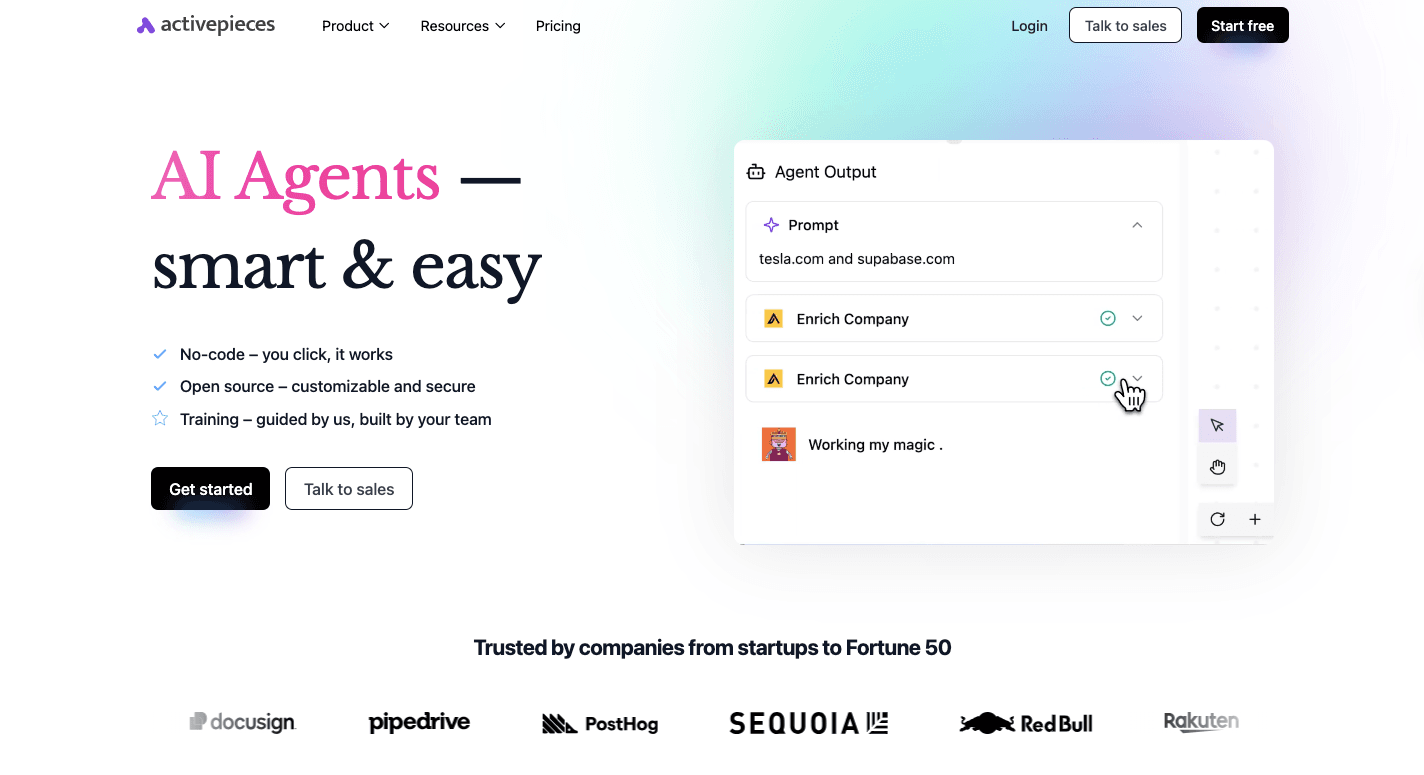
Activepieces gives you a simple way to build all-in-one agents that can actually do work. It's open source, runs with a drag-and-drop builder, and connects to your tools through pieces.
To get started, you need to:
Start With One Task
Select one sales task that already repeats every day:
- Lead triage
- Follow-ups
- Call recap logging
- Meeting booking
Tie the agent to one outcome, like "qualify inbound leads and route them."
Create the Agent Profile
Set up a new agent in the dashboard and write a short mission statement that describes what it should do and what it should never do.
Use simple instructions that mirror how a rep would act, including tone, do-not-contact rules, and what counts as a qualified lead.
Connect Tools From Your Existing Systems
Agents need access to the tools where work happens, so connect your CRM, email, calendar, Slack, and any sheets you use for lists or tracking.
Activepieces has a large library of integrations called pieces, so most teams can connect what they need without writing code. As of now, it offers 534 pre-built data integrations, but the library expands on a daily basis.
When you need something special, pieces are open source and written in TypeScript, so devs can tweak or build one with the same workflow builder the team already uses.
Build a Flow That Matches Your Work
A flow starts with a trigger, like a new lead, an inbound email, or a form submission, then runs steps in order.
Put the agent step where the "thinking" belongs, then follow it with actions like update the CRM, send a reply, post to Slack, or create a task.
Clear sequencing keeps the output predictable and reduces surprises when the flow runs on live leads.
Test Your Agent
Run the flow with sample leads that match real cases, such as:
- Low-fit lead
- High-intent lead
- "Not now" reply
Check tone, routing, and how it handles edge cases, so it doesn't send the wrong message or assign the wrong owner. Data security matters at this stage, so limit permissions to only the fields and apps needed for the job.
Roll Out in Layers
Launch with a small group first, then expand once results stay stable. Review logs weekly, adjust instructions, and tighten rules where mistakes show up.
Connect your tools, define the job, and let the agent run. Talk to our sales team!
Implement Sales AI Agents Across Your Tech Stack With Activepieces
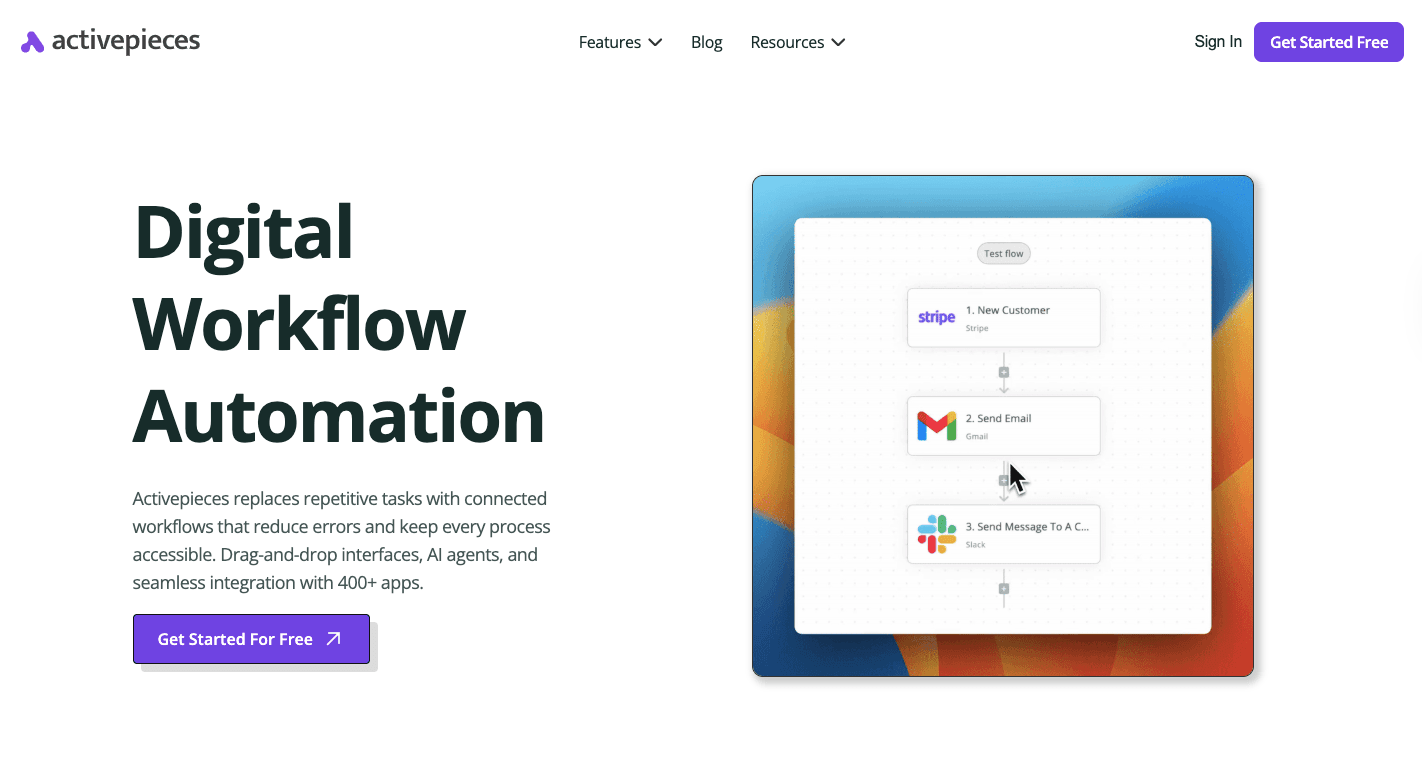
Sales work doesn't live in one app, so Activepieces, a workflow automation platform, connects your CRM, inbox, calendar, and Sheets into one flow that an agent can run end-to-end.
You get key features, like open-source integrations on npm, pieces written in TypeScript for deep edits, an AI SDK for custom agent behavior, and AI Copilot to help you build flows faster.
On the AI side, you can swap in different AI tools, then let the flow call them only when needed. Human approval steps further help you control when an agent acts.
Network-gapped and self-hosting setups support tight data security, plus logs help you track what happened on every run. Pulling fresh context right before outreach keeps records up to date, and you can keep accuracy through integrations by reading and writing back to the system of record.
Build AI sales agents that actually work across your stack. Get started with Activepieces!
FAQs About AI Agents for Sales
What are AI sales agents?
AI sales agents are software helpers that use artificial intelligence to handle parts of selling. You can use them to reply faster, keep messages consistent with your brand voice, and avoid missing easy follow-ups when the day gets packed.
Are AI sales calls legal?
Usually yes, but rules change by country and even by state, so the safe move is to treat consent as non-negotiable.
In the US, the FCC has said AI-generated voice calls count as "artificial" under the TCPA, which means many use cases require prior express consent, and robocall-style blasts can land you in trouble fast.
What is the best AI sales agent platform?
The best AI agent platform depends on the job. Relevance AI provides a team of AI agents that automate repetitive tasks when you want a built-out agent workforce approach.
For research and list work, Claygent can automate your sales efforts to speed up account digging and data gathering.
If you need one place to wire agents into your tools with approvals, logs, and self-hosting options, Activepieces fits that orchestration role.
Can AI really help you sell?
Yes, especially when you're dealing with high volumes and your team can't reply to everything on time. AI sales agents excel at the parts that break first in busy weeks, like first-response replies, lead routing, meeting scheduling, and turning call notes into clean CRM updates, so reps spend more time on real conversations.