
Extract Data from ACORD Forms: AI for Insurance Teams
ACORD standards provide a consistent framework for managing complex insurance data exchanges between disparate legacy and modern software platforms.

Covers scaling automation from pilot to enterprise: shared-services teams, onboarding that actually gets read, and governance that holds.
ContributorSeptember 18, 202614 min read
This article was researched and fact-checked by an advanced research system.
ACORD standards function as the universal syntax for the insurance industry, codifying how risk and policy information move between brokers, carriers, and reinsurers, often through automated workflows built with Activepieces to ensure data integrity.
Standardize global insurance transactions with ACORD
While these standards provide a common dictionary, the sheer volume of defined data points creates a processing bottleneck that manual entry teams can no longer bypass.
The role of ACORD XML and AL3 standards
As the underlying architectural frameworks, ACORD XML and AL3 allow disparate legacy systems to exchange policy data without losing semantic meaning.
The ACORD library currently governs 14,000 data elements for Property & Casualty lines. A carrier attempting manual mapping must account for thousands of potential field variations per product line.
For Life & Annuities, Brokerageaudit reports that the standard covers 17,500 elements. This forces digital transformation teams to prioritize high-coverage extraction models over simple regex scripts.
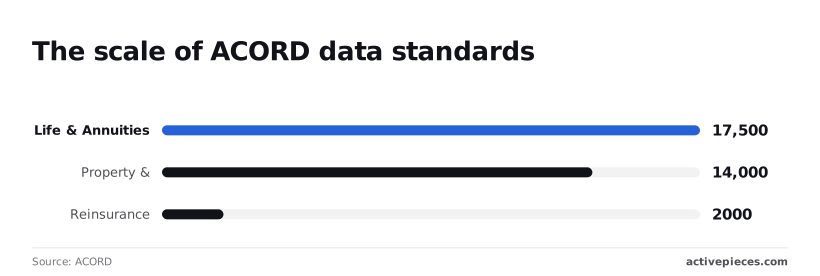
The 2,000 defined elements for Reinsurance represent the most condensed but high-value data sets. A single mapping error here can misrepresent millions in ceded risk.
Why ACORD 25 and 125 dominate commercial workflows
Acting as the primary intake valves for commercial insurance, the ACORD 25 and 125 forms represent the most frequent touchpoints for compliance and underwriting teams respectively. The following table illustrates the operational burden these forms impose based on their structural depth:
| Form Type | Typical Page Count | Estimated Field Count |
|---|---|---|
| ACORD 25 (Certificate of Liability) | 1 Page | 40–60 |
| ACORD 125 (Commercial Application) | 4+ Pages | 150–250 |
| ACORD 130 (Workers Compensation) | 4 Pages | 120–180 |
To verify coverage, firms use the ACORD 25 as a high-velocity document. By contrast, the ACORD 125 is a high-density document that dictates the technical profitability of a policy. Consequently, automation efforts must shift from simple OCR for certificates to deep-entity extraction for applications.
The persistence of semi-structured PDF data
Despite the existence of digital-first standards, the industry remains tethered to the "flat" PDF for several reasons:
- The PDF serves as a legally recognized snapshot of a risk at a specific point in time.
- Every connector in Activepieces is an agent tool, meaning once a integration is registered to handle an ACORD attachment, it is instantly available as a tool schema on a per-project MCP server for any LLM to call. This eliminates the need for a second migration or manual re-integration to make extraction logic reachable by an agent.
- Because 80% of commercial data still arrives as a semi-structured PDF, the primary challenge for IT steering committees is no longer document recognition, but the automated transformation of that visual data into a schema-validated output.
Everything below works on Activepieces' free plan. Start without code or a credit card.
Manual ACORD processing creates a $20-per-form bottleneck
The "stare and compare" workflow is replaced by automated extraction. In this manual process, human adjusters validate PDF fields against core systems, a task that currently consumes the majority of an underwriting assistant’s hourly capacity.
The firm incurs a labor cost that often exceeds the margin on small-commercial accounts when a team member spends twenty minutes toggling between a static ACORD 25 Certificate of Liability Insurance and a policy administration system.
The high price of 'stare and compare' workflows
Highly skilled adjusters are forced to act as human middleware by the "stare and compare" method. This prevents them from moving to higher-value risk analysis.
Highly skilled adjusters are forced to act as human middleware by the "stare and compare" method.
This manual friction is visualized in the contrast between a stressed adjuster physically checking a paper form against a screen and a digital pipeline where data flows directly into a decision engine.
While the adjuster is tethered to the visual verification of a single document, the digital pipeline allows for the simultaneous processing of hundreds of submissions.
This shift moves the department from a linear processing model to a scalable, concurrent operation. The bottleneck is no longer human eye-strain.
Why 70% of policy data stays trapped in legacy silos
Because it is stored as "flat" image files in document management systems like Guidewire or SharePoint, most policy data remains inaccessible. Downstream AI tools cannot index or query the information in this format.

Because these files lack a structured schema, a carrier’s predictive models cannot see the specific limit increases or named insured exclusions buried in the text.
Actuarial teams are forced by this lack of visibility to rely on sampled data rather than the full census of their book.
By converting these PDFs into machine-readable JSON, the data moves from a dead archive into a live data lake. It can then inform real-time pricing adjustments.
Manual re-keying errors in ACORD form data entry
Downstream claim denials or premium leakage often stem from the consistent failure rate in field accuracy introduced by manual data entry.
When an intake clerk misreads a "6" for an "8" on an ACORD 125 Commercial Insurance Application, the error propagates through the entire policy lifecycle.
Accuracy drops significantly after the fourth hour of continuous data entry, so fatigue-based errors mean afternoon submissions carry higher risk profiles.
Transposition errors, such as swapping digits in a Federal Tax ID, prevent automated OFAC compliance checks from running correctly. Omission errors happen when skipping non-mandatory fields on the form leaves the underwriting engine without the variables needed to apply discretionary credits.
Build structured pipelines for ACORD extraction
Automating ACORD data intake requires a multi-stage pipeline. Standard Large Language Models (LLMs) cannot natively interpret the spatial relationships of dense, multi-column insurance forms.
A human clerk might intuitively understand that a "Policy Number" label relates to the box below it. A raw LLM often flattens this text into a nonsensical string and loses the critical context needed for underwriting.
Why LLMs fail at raw ACORD PDF parsing
Because these documents rely on complex visual grids rather than linear text flows, Large Language Models struggle with ACORD forms.
When a model processes a PDF as a simple text stream, it frequently merges data from adjacent columns. A "Limit" from the General Liability section might be incorrectly attributed to the Umbrella policy listed next to it.
Because these documents rely on complex visual grids rather than linear text flows, Large Language Models struggle with ACORD forms.
To solve this, the engineering team at one Tier-1 carrier implemented a three-stage extraction pipeline to ensure data integrity:
- OCR & Layout Analysis: Tools like Amazon Textract, a machine learning service that extracts text and structure from scanned documents, identify multi-column grids and checkboxes so the system understands the visual boundaries of each data field.
- Schema Mapping: This stage translates those visual boxes into ACORD XML or JSON standards, which are the industry-recognized data structures. This step ensures the extracted "8" stays a "8" within the correct database field.
- Human-in-the-Loop: A validation interface allows a human reviewer to verify low-confidence extractions, acting as a final guardrail before the data enters the production environment.
This structure moves the process from a risky "black box" guess to a repeatable technical workflow.
Mapping vision-based OCR to ACORD XML schemas
Effective extraction requires a vision-based OCR layer to preserve the "XY coordinates" of every character on the page.
By capturing the exact physical location of text, the pipeline can map a specific coordinate on an ACORD 25 Certificate of Liability Insurance to its corresponding tag in the ACORD data model.
This precise mapping ensures that the "Description of Operations" text does not bleed into the "Authorized Representative" signature block. This prevents the downstream policy administration system from rejecting the file due to formatting errors.
Validating AI outputs against industry-standard code lists
Cross-referencing extracted values against official ACORD code lists is the final stage of the pipeline to ensure the data is actionable.
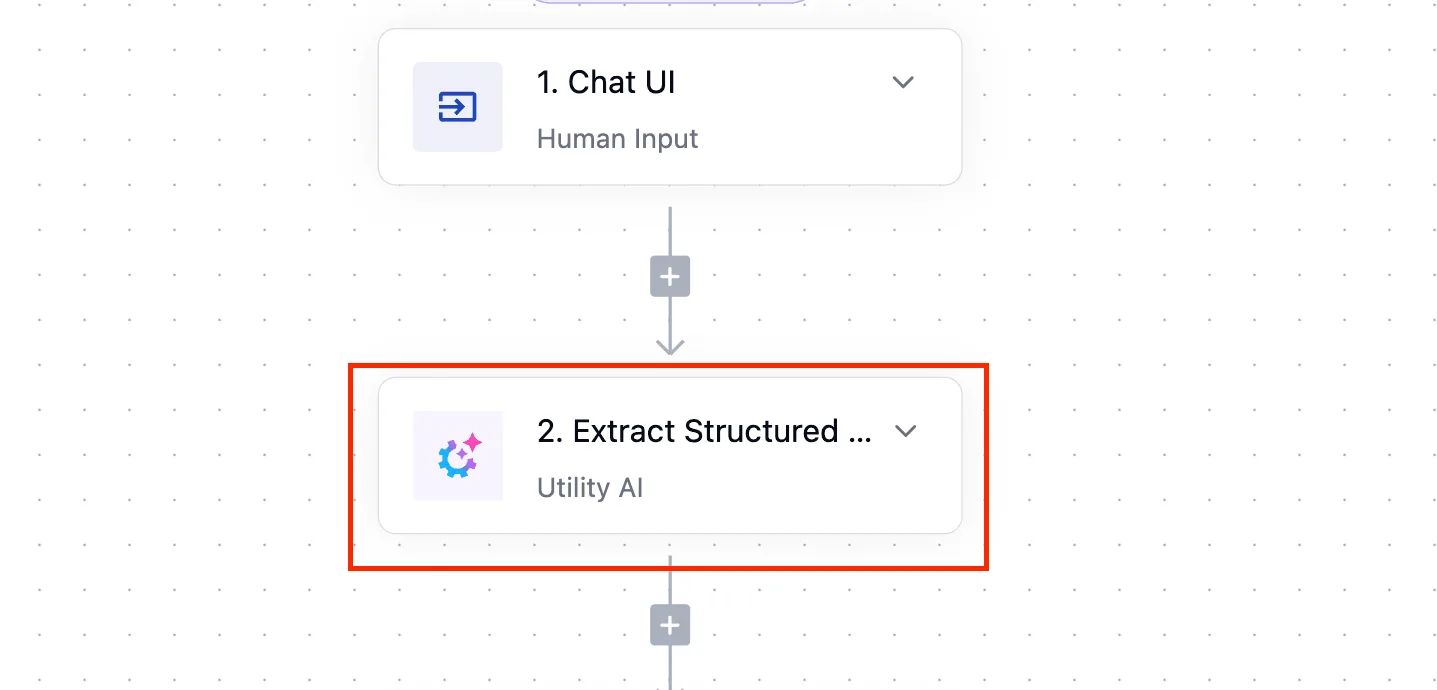
If the AI extracts a "Construction Class" that does not exist in the standard library, the system flags it for manual review rather than passing junk data to the rating engine.
This validation step turns raw text into "clean" data. It allows the underwriting team to trust the automated output without performing a secondary manual audit.
Easier to see it running than to read about it: set it up free, no card.
Activepieces automates the ACORD data flow across insurance stacks
By orchestrating the handoff between unstructured document captures and the core record systems used by agents, Activepieces serves as the central nervous system for policy data.
Every agent tool call and the specific ACORD data it acted upon is traced step-by-step in the Run Details UI, ensuring that an agent's decision to flag a policy is as auditable as a deterministic workflow step.
These traces export directly to a SIEM via event streams, a feature that companies like MoneyGram and Moneypenny run in production to maintain oversight.
Connecting OCR engines to Agency Management Systems (AMS)
The platform bridges the gap between specialized extraction tools and legacy databases. It provides pre-built connectors that map extracted ACORD fields directly to specific account entities.
This eliminates the "swivel-chair" data entry where an assistant manually re-types data from a PDF into a management platform like Vertafore, reducing the risk of clerical errors that lead to coverage gaps.
Activepieces ensures the output is routed to the correct client folder when a document is processed. The brokerage team then spends their time on risk assessment rather than file organization.
Triggering AI analysis on new ACORD submissions
The moment a new file hits a digital intake point, automated workflows initiate. This ensures that data extraction occurs in real-time rather than in batches.
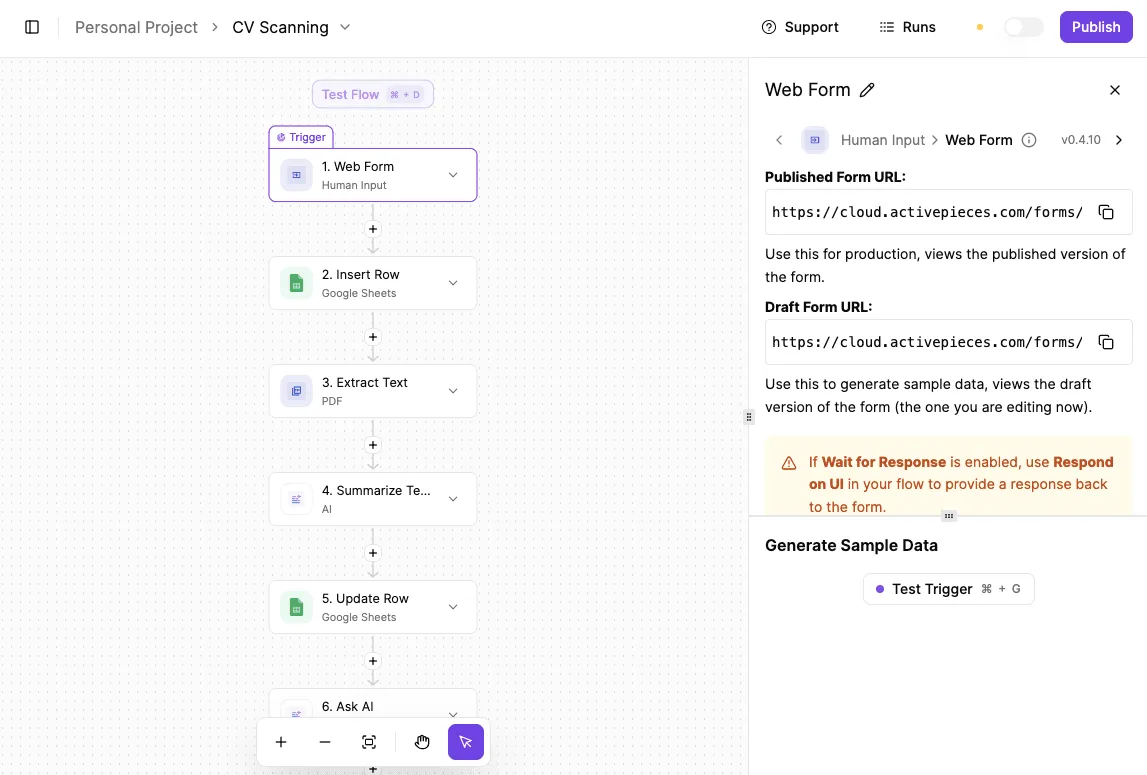
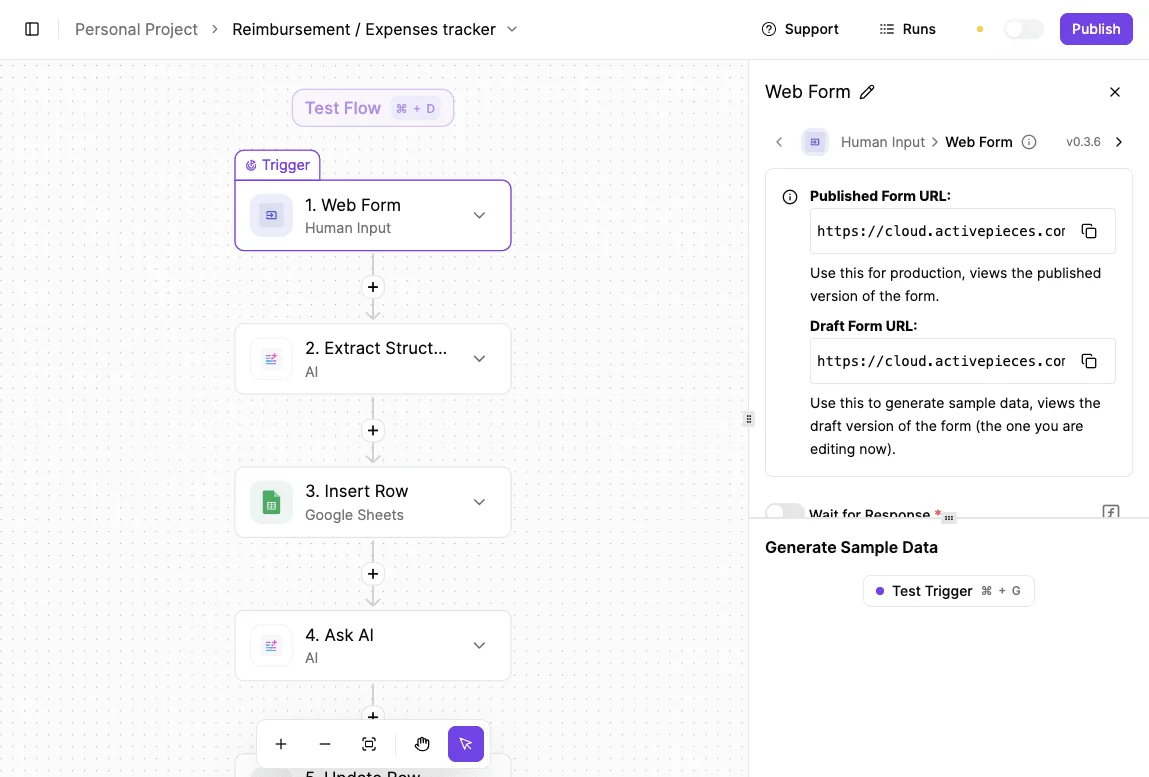
This screenshot of the Activepieces builder canvas demonstrates a five-step "CV Scanning" workflow that mirrors the ACORD intake process: a human submission triggers an immediate sequence of sheet logging, text extraction, and AI summarization.
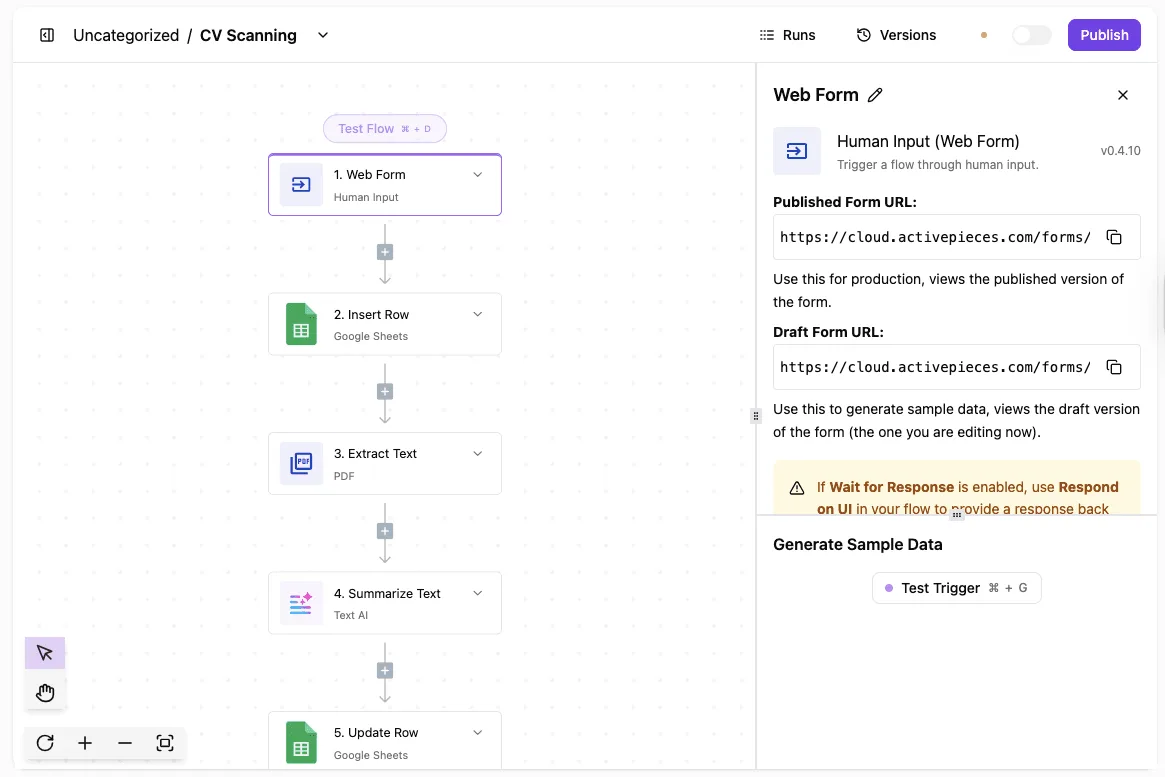
By using a Web Form trigger to ingest documents, the underwriting team creates a standardized entry point that prevents fragmented submissions from stalling the review queue. This immediate processing allows for instant validation against carrier appetite guides before a human ever opens the file.
Standardizing data payloads for cross-platform sync
Across all connected apps, Activepieces enforces a uniform data structure. This ensures that a "Policy Number" in a Google Sheet matches the formatting requirements of a downstream CRM.
This standardization prevents the sync failures that occur when different software providers use conflicting naming conventions for the same insurance data points.
By normalizing the payload at the integration layer, the IT team can swap out an OCR engine or an AMS without rebuilding the entire automation logic. This provides the firm with the technical agility to adopt better AI tools as they emerge.

The Monday morning plan for AI-driven ACORD integration
Standardizing the integration layer is the foundation for transitioning from manual oversight to a structured rollout that treats data extraction as a quantifiable operational lever.
This shift moves the firm into the implementation stage of the adoption curve, where success is measured by the reduction of technical debt rather than the mere presence of a new tool.
Audit your highest-volume ACORD form types
Prioritizing forms by frequency ensures that the initial automation effort targets the areas where human error and labor costs are most concentrated.
Meta-intelligence suggests that by focusing on the top three highest-volume form types, such as the ACORD 25 or the ACORD 125, the operations team can isolate the specific data schemas that will yield the fastest return on integration effort.
The Monday Morning ACORD Audit provides a framework for this prioritization:
- Identify the top 3 highest-volume form types to ensure the pilot addresses the most significant bottlenecks first.
- Calculate current 'Cost per Form' using the hourly rate of a claims adjuster or broker to establish a baseline for potential savings.
- Map the destination fields in your Agency Management System (AMS) or Customer Relationship Management (CRM) tool to verify that every extracted data point has a functional home.
- Document the current turnaround time from receipt to entry so that post-automation speed gains are measurable.
This audit establishes the benchmark against which all subsequent AI performance is judged.
Identify the 'system of record' for extracted data
Defining a single source of truth prevents the synchronization conflicts that occur when multiple platforms attempt to reconcile competing data updates.
The system of record, which is the primary database where policy and client information is officially maintained, must be the sole destination for the normalized payload.
This clarity ensures that downstream decision-making engines, like an automated underwriting workbench, are pulling from a validated and unified data set.
Run a 100-document pilot for extraction accuracy
Before a full-scale deployment, launching a controlled pilot allows the IT team to validate the AI’s ability to handle the noise of real-world documents. These documents include slanted scans or handwritten annotations.
A set of one hundred documents has enough variability to identify edge cases where the confidence score of the extraction engine falls below the threshold for straight-through processing.
This testing phase determines the specific guardrails required for the human-in-the-loop workflow. It ensures that only high-confidence data enters the production environment. Once these accuracy benchmarks are met, the firm can move from testing to active production.
Frequently asked questions
Does AI processing of ACORD forms meet HIPAA and SOC2 standards?
Compliance depends entirely on the underlying infrastructure provider’s encryption and data-handling protocols. The AI model itself does not determine compliance. When a team like our Underwriting Operations group selects a processing engine, they must verify that the vendor has a Business Associate Agreement (BAA).
This legal contract ensures the vendor assumes liability for protecting Protected Health Information (PHI) under HIPAA regulations.
SOC2 Type II certification confirms that a third-party auditor has validated the service’s internal controls over a period of time. The firm is not merely trusting a marketing claim but relying on verified security performance.
Can AI handle handwritten notes on ACORD applications?
Modern Intelligent Document Processing (IDP) tools utilize computer vision to extract handwritten data with high confidence levels.
These tools are software designed to convert unstructured text into machine-readable formats. This capability eliminates the "stare and compare" bottleneck where a human must manually transcribe scribbled policy limits or effective dates.
If the confidence score for a handwritten field falls below a pre-set threshold, the system flags the specific coordinate for human review. This prevents messy penmanship from resulting in corrupted downstream data.

What is the cost difference between manual entry and AI extraction?
Shifting to automated extraction moves the cost model from a fixed labor expense to a variable consumption-based expense.
In a manual environment, the cost per form is tied to the hourly rate of a data entry clerk. This remains static regardless of volume.
With AI, the cost per page decreases as volume increases due to economies of scale in API pricing. This allows the firm to scale during peak renewal seasons without increasing headcount.
Do I need a developer to map ACORD XML to my database?
Low-code integration platforms are tools that allow users to connect systems via a visual interface. While they reduce the need for custom coding, a technical resource is required to define the schema mapping.
A Data Engineer must establish the initial handshake between the extraction output and the destination database to ensure data types match.
A Solutions Architect needs to configure the error-handling logic so that malformed XML does not crash the ingestion pipeline.
A Business Analyst can then manage the ongoing field mapping as ACORD standards evolve, reducing the long-term reliance on the engineering backlog.