
Bright Data Pricing: Proxies, APIs and Datasets (2026)

Nov 4, 202614 min read
Bright Data's a web data platform selling proxies, scraping APIs, a hosted browser and ready-made datasets, and its output can feed into workflows built in tools like Activepieces. Each product bills in its own unit, so there's no single rate card to quote.
Bright Data pricing is the set of usage-based rates, add-ons and minimum commitments that determine what a customer pays across its proxy networks, scraping APIs, browser and datasets, billed per GB, per 1,000 requests or per record depending on the product.
Bright Data pricing by product
I have no confirmed rates for this check. The table below puts the plans in the order you'd cost them and marks each row's verification status instead of repeating figures I couldn't verify.
| Plan | Price | Inclusions | Overage rate | Check date | Status |
|---|---|---|---|---|---|
| Residential pay-as-you-go | Per-GB rate, not confirmed here | Traffic only, no monthly commitment | Same per-GB rate | Not dated | Unverified |
| Growth | Monthly fee, not confirmed here | Discounted per-GB rate | Not confirmed here | Not dated | Unverified |
| Business | Monthly fee, not confirmed here | Larger traffic allowance | Not confirmed here | Not dated | Unverified |
| Third monthly tier | Monthly fee, not confirmed here | Largest published allowance | Not confirmed here | Not dated | Unverified |
| Web Unlocker | Per-request rate, not confirmed here | Unblocking handled per request | Not confirmed here | Not dated | Unverified |
| Web Scraper | Per-record or per-request rate, not confirmed here | Prebuilt collectors | Not confirmed here | Not dated | Unverified |
| SERP API | Per-request rate, not confirmed here | Search-result pages | Not confirmed here | Not dated | Unverified |
Per GB, per request, per record: those are the three ways Bright Data charges. Proxies bill by bandwidth, unblocking and search APIs bill by successful request, and scrapers and datasets bill by record.

Proxy plans: residential, datacenter, ISP and mobile
If you buy proxies from Bright Data, you choose between four types, and they price differently. Residential's billed per GB and it's the most expensive per unit of traffic.
Datacenter is usually the cheapest and the easiest for sites to block. ISP's a hybrid of the two, and mobile's typically the premium tier.
If your success rate is high, the scraping products (Web Unlocker, SERP API, Browser, Scraper API) make a monthly forecast easier, because they charge for the result rather than the bandwidth.

When you buy datasets, you pay per record, and large volumes usually go through sales. Any figure from that channel's a quote, not a published rate, so it carries a minimum commitment you should get in writing.
If you are running this arithmetic for your own team, see what the same workload costs on Activepieces.
Bright Data costs across usage levels
At 10 GB, pay-as-you-go residential traffic costs $40 to $80. At 100 GB it costs $400 to $800, and at 800 GB, $3,200 to $6,400.
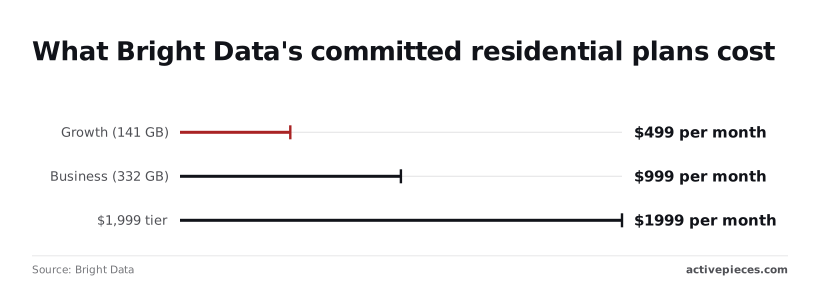
A commitment turns that into a flat $499 or $1,999, so the minimum you sign decides the bill.
These are our estimates, assuming residential traffic only, $4 to $8 per GB on pay-as-you-go, and no overage or add-ons, so costs will be higher if commercial traffic or services are included.
Commitments lose at the low end and win clearly at the high end.
Commit to Growth, the smallest committed plan, and you pay $499 a month for 141 GB. At 10 GB that works out to about $50 per GB, six to twelve times the pay-as-you-go rate.
A proof of concept should stay on pay-as-you-go, and you shouldn't sign anything until you've measured real traffic.
Mid: a team scraping daily
At 100 GB, pay-as-you-go costs $400 to $800. Growth at $499 covers 141 GB, so the effective rate's about $5 per GB if you use only 100 GB.
That's 25% more than the $400 low end and 38% less than the $800 high end, so which rate applies to you decides whether the commitment pays off here. Ask for it in writing.
The Business tier is $999 for 332 GB, about $3.01 per GB at full use. It only makes sense if you expect to use most of that allowance, because below roughly 200 GB you're paying for unused capacity.

Bright Data pricing for large committed volumes
At 800 GB, pay-as-you-go costs $3,200 to $6,400. The $1,999 tier covers 798 GB, about $2.51 per GB.
That's 38% below the $3,200 low end and 69% below the $6,400 high end, a monthly saving of $1,201 to $4,401.
When a month runs slightly over, you incur overage, because the tier stops 2 GB short of 800, and the overage rate is another term to confirm before signing.
Past this point, rates are negotiated rather than published. Treat the $2.51 per GB as your ceiling in that conversation, not your starting point.
Hidden costs and limits with Bright Data
Take the four-step workflow below: it runs on a schedule and reads targets from a Google Sheets step. It passes LinkedIn job descriptions to a GPT-6.1 Terra step that extracts keywords, and ends with a search HTTP call.
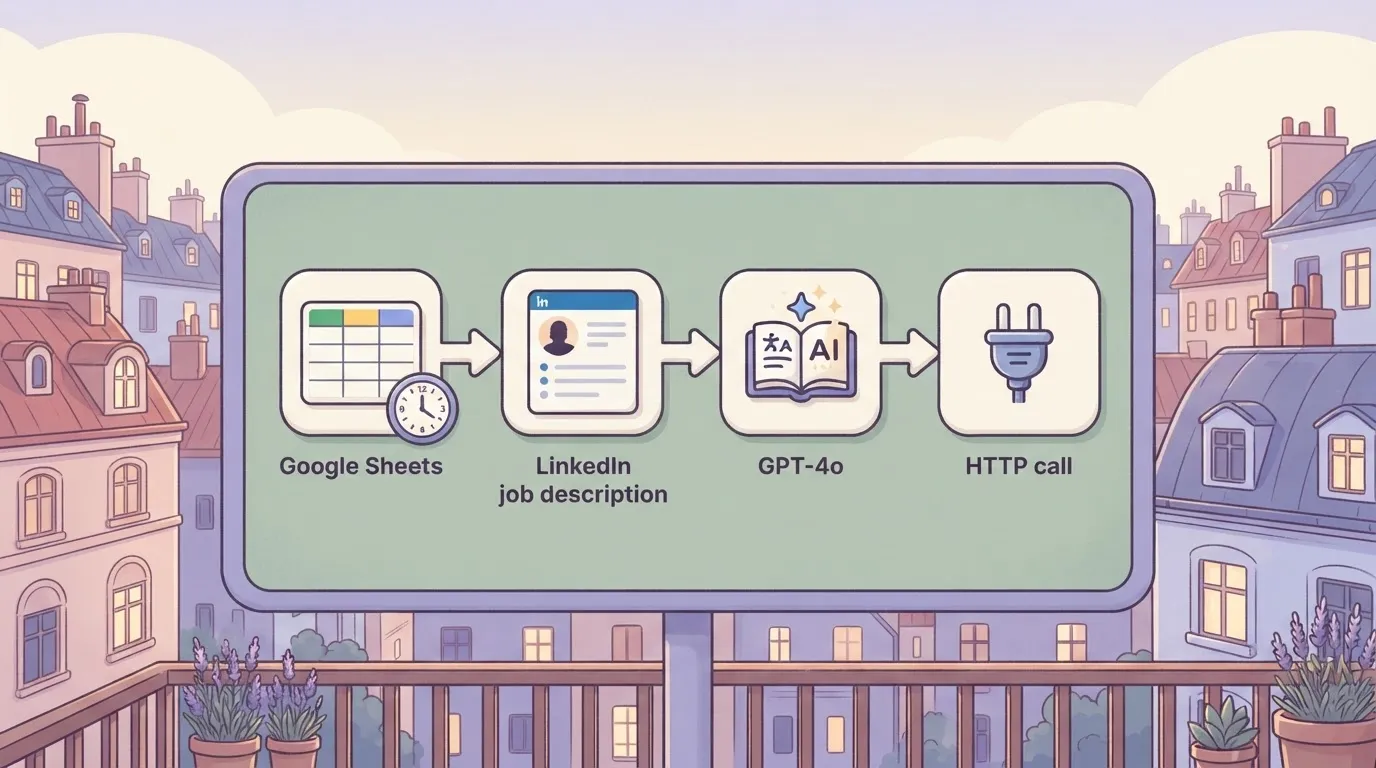
The automation around the scraper is the one meter in that pipeline that needn't grow with the number of steps.
A platform that takes Bright Data's output through HTTP or webhook steps and charges 1 credit per flow run, however many steps the run contains, keeps that meter flat (AI steps are priced separately).
Zapier's pricing page bills per task and Make's per module, so on those a ten-step version of that workflow costs more than the four-step one. Teams at MoneyGram, Moneypenny, Alan and FundingSocieties run the per-run model in production.
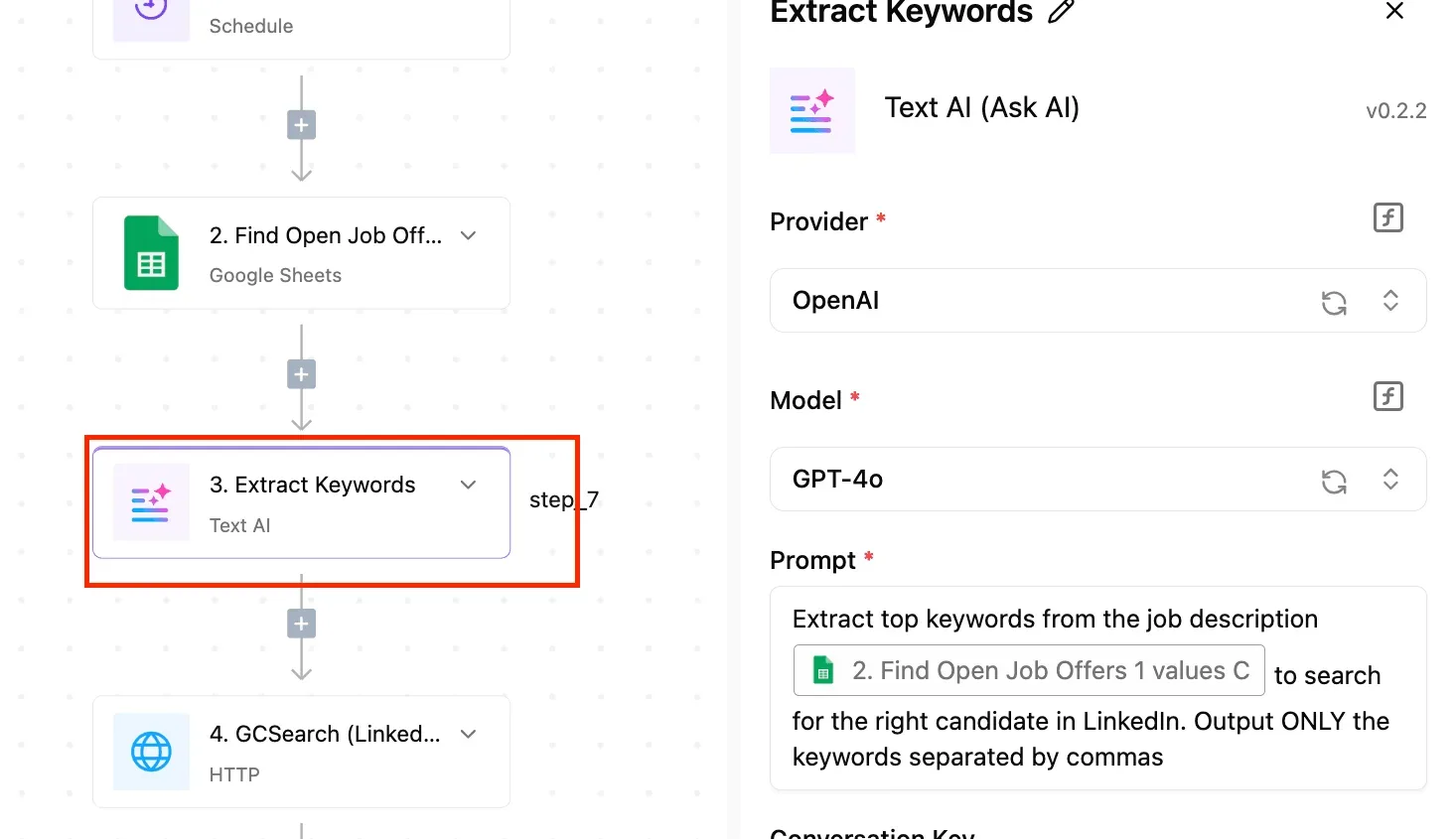
Bright Data's scraping stays on Bright Data's meter.
Bandwidth you pay for but do not use
On bandwidth-priced products you pay for everything that crosses the wire, not for the fields you keep.
Everything a job listing page loads gets billed: scripts, images, tracking calls and embedded widgets. Your keyword step only needs a few paragraphs of text.
On bandwidth-priced products you pay for everything that crosses the wire, not for the fields you keep.
You can cut this by blocking images, fonts and analytics requests in the browser session, and by caching pages that don't change between runs.
Measure the average bytes per successful record on your own targets before you compare vendors.
Bright Data KYC verification and restricted targets
Before you can use some products and target sites, Bright Data's terms require identity and use-case verification.
Plan for this as a schedule risk: a team that starts verification late may be unable to run on the intended targets at launch.
On some domains the pricing or handling is premium, which means the same request can cost more on one site than another. Check the docs for your specific domains before you fix a cost-per-record figure.
Bright Data minimums, overages and expiring balances
When a plan has a monthly minimum, a variable cost becomes a fixed one. If your usage dips in a slow month, you still pay the floor, so the effective rate per gigabyte or per thousand requests rises as usage falls.
Model the floor against your lowest-volume month, not your average.
Usage above the plan can bill at a different rate, so a successful scale-up may cost more per unit than the plan you priced.
Prepaid balances can lapse, so unused credit may be lost instead of rolling forward. Read the renewal and expiry terms before you buy ahead.
Worth checking against a plan that does not meter every step: one credit covers a whole run on Activepieces.
Bright Data pricing versus competitors
Bright Data's worth a premium over Oxylabs, Decodo or Zyte only when your targets are hard enough that a cheaper vendor's failed requests turn into retries. Those retries are billed on top of the base rate.
Entry price and free trial
On any of the four pricing pages, entry price is the least useful number, because it prices a volume almost nobody scrapes at.
The free trial or credit matters more, because it's the only free way to run your own target URLs and see the effective cost per successful page before you commit.
Test all four vendors on the same URL list, and divide the spend by pages that returned usable data, not pages requested.
Cost per GB and per 1,000 requests
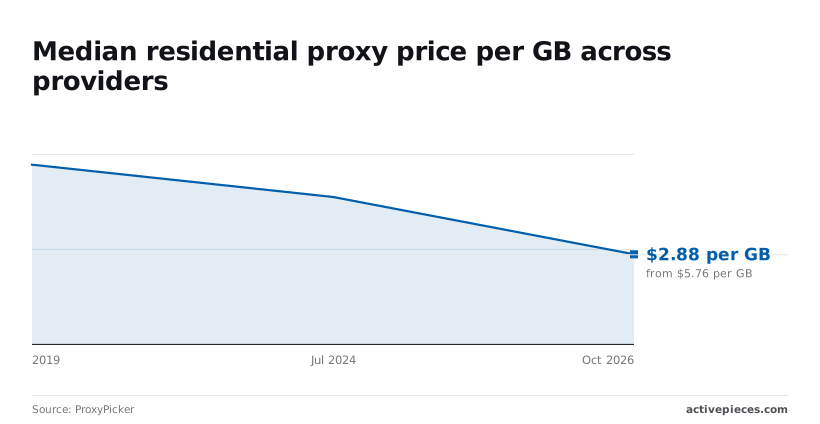
ProxyPicker puts the median residential price at $5.76 per GB in 2019, $4.72 in July 2024 and $2.88 in October 2026, so commodity proxy rates have compressed enough to warrant renegotiating any long-standing contracts.
| Date | Median residential price per GB | Cost of 1,000 GB |
|---|---|---|
| 2019 | $5.76 | $5,760 |
| Jul 2024 | $4.72 | $4,720 |
| Oct 2026 | $2.88 | $2,880 |
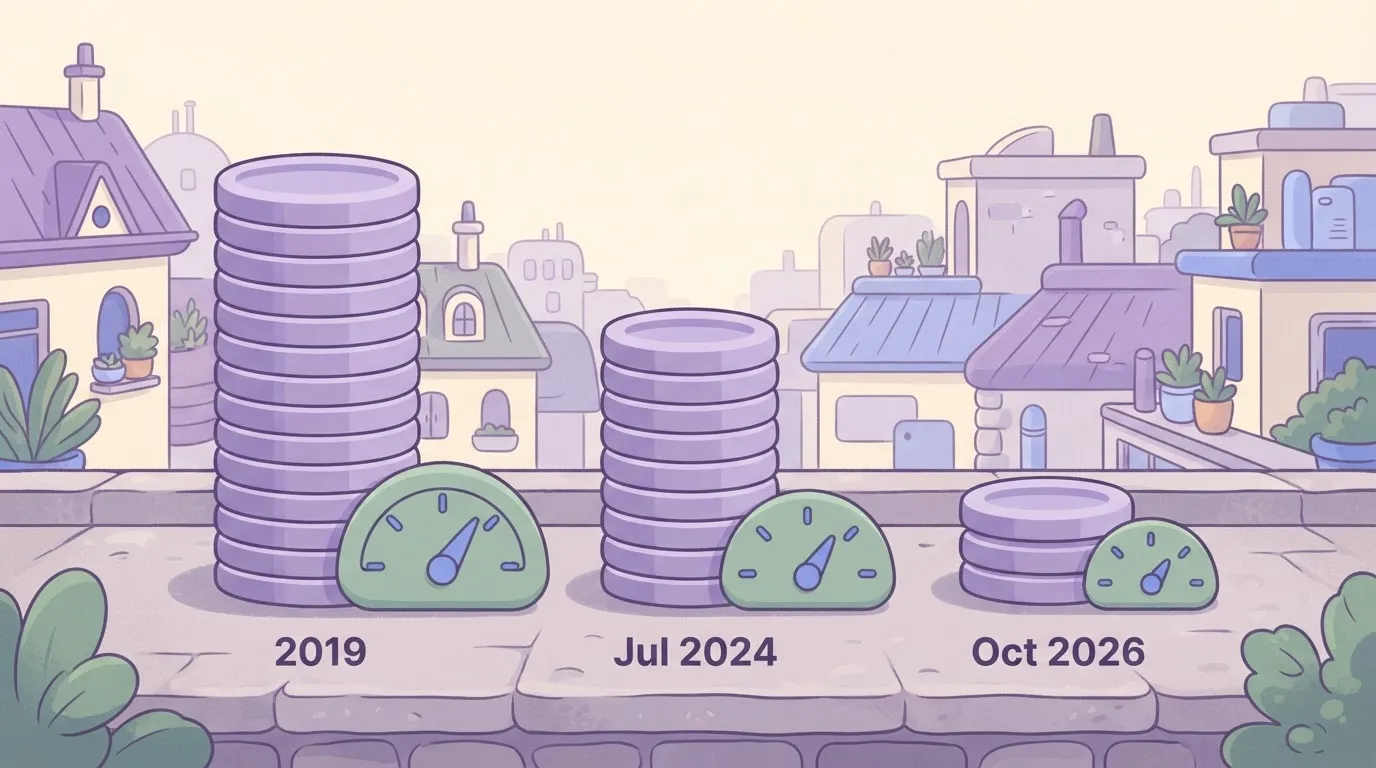
That's a 50% fall since 2019 and a 39% fall since July 2024. A team pulling 1,000 GB a month would pay $2,880 less than it would have in 2019.
Pull each vendor's residential $/GB at your own monthly volume and its scraping API $/1K requests on the day you decide, and note the date beside each.
Apply the same discipline to the per-request rate. A low $/1K that excludes JavaScript rendering or premium proxies will cost more on difficult sites than a higher all-in rate.
Bright Data commitment terms and support plans
More than the logo, the commitment changes the rate. A monthly minimum you under-use raises your effective $/GB.
At a $500 minimum and 100 GB of real usage, you pay $5.00 per GB, however low the listed rate. Compare pay-as-you-go against committed plans at your expected volume and at half of it, since projects slip.
Choose a cheaper vendor when your targets are lightly protected, your volume is steady and your engineers can handle blocks themselves.
Choose Bright Data when your targets are heavily defended or geographically broad, or when you need support that resolves blocks quickly. In those cases the premium buys fewer retries, and retries are where the bill grows.
Your Bright Data job pricing
Price your job by dividing what a trial actually costs by the results it actually returns. Four steps get you there.
- Count the pages or requests you need each month, then convert to gigabytes if you're buying bandwidth. A rough estimate is enough, but it must be yours.
- Run your hardest target on trial credit, and record cost per successful result. Divide the credit consumed by the number of usable records returned. Failed requests and retries sit inside that figure, so it's the only rate that predicts your invoice.
- Put an alert below your budget ceiling, not at it. A target that changes its defenses mid-month raises your retry rate, and an alert gives you time to react before the invoice does.
- Before you commit, re-check the pricing page, because rates, tiers and minimum commitments change. Check whether the minimum commitment exceeds your projected usage, because you pay for the minimum either way.
Multiply your cost per successful result by your monthly estimate and you have a burn rate you can defend to finance. Only then is a comparison with another vendor meaningful.
Moving scraped data into business tools
Once the cost per result is acceptable, the data still has to land somewhere useful.
Activepieces, an MIT-licensed automation platform with 747 integrations, can schedule HTTP calls to Bright Data on a timetable and send the responses to Google Sheets, a database or a Slack channel.
It isn't a scraping provider, so every request it makes is still billed by Bright Data at the rate you measured.
What Activepieces does about this
The article's advice comes down to one habit: measure your own cost per successful result before you trust a headline rate. Activepieces helps with that second half of the job, the plumbing around a trial, and it does not touch Bright Data's own meter.
It is an MIT-licensed automation platform with 747 integrations, and it can call Bright Data through its HTTP or webhook steps on a schedule, then write each response and its outcome to Google Sheets, a database or Slack.
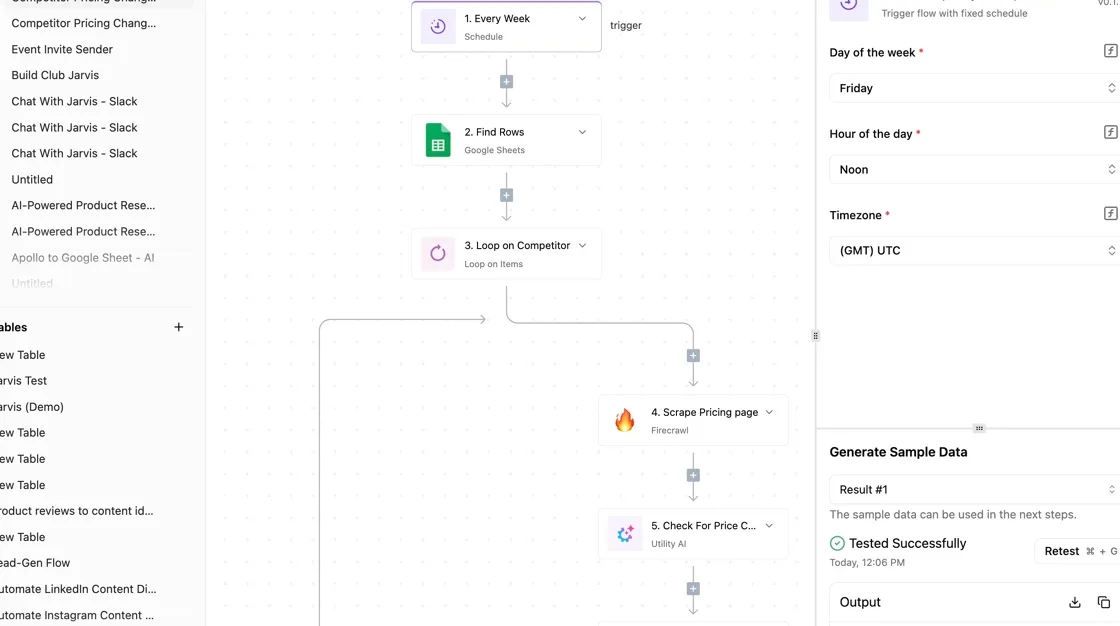
That setup makes the trial measurable. Log every request alongside its status, bytes returned and whether the record was usable, and the division the article asks for, spend over usable records, becomes a column in a sheet instead of a guess.
Route failures to a Slack alert as well, so a target that tightens its defenses mid-month shows up as a rising retry rate before it shows up on an invoice.
The pricing is deliberately simple. Activepieces charges 1 credit per flow run however many steps the run contains, with AI steps priced separately, and the free plan gives you 1,000 credits a month with unlimited flows.
A logging, alerting and sheet-writing flow therefore adds nothing to the bill while it stays inside those credits, and you aren't discouraged from splitting the work into smaller, more reliable steps. MoneyGram, Moneypenny, Alan and FundingSocieties run it in production.
The limit is the one stated above. Activepieces doesn't unblock sites, rotate proxies or solve CAPTCHAs, so every request is still billed by Bright Data at whatever rate your hardest target produces.
What we can offer is a cheap way to see that rate clearly and to keep the schedule from silently multiplying it.
Frequently asked questions
Does Bright Data have a free plan or free trial?
On some products, Bright Data has offered trial access or starter credit. Terms vary by product and change over time, so confirm on the current pricing page before relying on one.
Use a trial for one thing: measuring success rate and per-request cost on your hardest target sites. Run it on those pages, not on easy ones, because a trial on easy pages will understate your real bill.
Can I pay Bright Data as I go without a monthly commitment?
On several products, pay-as-you-go has been available, but the usual trade-off is a higher unit rate than a committed plan. That means you pay a premium for flexibility.
If your volume is steady, price the committed tier at your real usage. If it's spiky, price pay-as-you-go at your peak month, then compare. Whichever suits your usage pattern is the cheaper option, not the one with the lower headline rate.
Why is my Bright Data bill higher than the per-GB rate?
Because the per-GB or per-request rate covers only the base unit, while target-site difficulty, add-ons and minimum commitments sit on top of it, your bill comes out higher.
Heavy pages consume more bandwidth per useful record. Harder sites need more retries or a premium product. Optional features add their own charges, and a plan minimum can bill you for capacity you never use.
Put the two vendors' quote sheets side by side and run your own monthly volume through each calculator. The gap usually shows up in those layers, not in the headline rate. Then compare the totals.
Is Bright Data more expensive than Oxylabs?
Neither's cheaper in every case. The answer depends on which products you use, which sites you target and how much you commit to. A vendor with a lower base rate can still cost more if its add-ons or minimums fit your workload badly.
Request a quote from each for the same job, with the same sites, volume and success-rate target. Then compare cost per successfully delivered record, not the list rate.
Does Bright Data charge for failed requests?
It depends on the product. Bandwidth-billed proxy access generally counts the data transferred, so a failed attempt that still moves data can cost you. Some request-based scraping products bill only for successful responses, though definitions of "success" differ.
Read the billing terms for the exact product you plan to use. In your own logs, track retries and blocked responses separately from clean results, since that's where silent spend accumulates.
Related reading
References
Running the numbers
See what the same workload costs here.
Free forever plan, and every paid plan self-hosts at no extra cost.
See pricing Talk to sales