
Claude Fable 5.2 Pricing: Plans, API Rates (2026)

Nov 15, 202614 min read
Claude Fable 5.2 pricing in one paragraph
Claude Fable 5.2 pricing in brief
Claude Fable 5.2 is sold as a free tier, individual and team plans, and pay-as-you-go API access.
The plan's listed price tells you the least, because your real bill follows the usage limit you hit first and whatever the plan leaves out, which matters most once the model is wired into automated workflows, such as those built in Activepieces, where a single trigger can quietly multiply your usage.

Claude Fable 5.2 pricing is the set of charges for using the model, covering a free tier, per-seat individual and team plans, and pay-as-you-go API rates, with each option capped by usage limits and excluding some features and costs.
I haven't put a price table here. Vendors change prices without notice, and a figure I couldn't confirm against Anthropic's own pricing page is a figure that could cost you money.
Take every number from that page on the day you buy, and treat anything older, including anything in this article, as a lead to check.
What the model is and what else Anthropic sells
Picture a job that researches, drafts and checks on its own, instead of answering one question at a time. That is what "agentic" means, and it is the work Claude Fable 5.2 is Anthropic's model for, along with demanding reasoning and long-horizon tasks.
That is why this matters for cost: long jobs use far more of your allowance than short chats do.
Anthropic also sells Claude Haiku 5.5, Claude Sonnet 5.5 and Claude Opus 5.5, so Fable 5.2 isn't the only choice. If the work is simple and high-volume, the heavier model may be the wrong one to pay for.
When you run it inside automations, those runs are billed through the API, not the seat.
If you are running this arithmetic for your own team, see what the same workload costs on Activepieces.
Claude Fable 5.2 plans, pricing, and limits
Prices run from $0 to $200 a month, but only the Free plan has a usage limit stated below. The sticker price tells you what you pay before you hit the limit, not after.
The table lays out each plan, with "not published" wherever the vendor's page gave no figure.
| Plan | Price (monthly / annual) | Seat or flat | Included | Limits | Fit |
|---|---|---|---|---|---|
| Free | $0 | Individual | Up to 5 Projects | Limited usage every 5 hours and every week | Trying it out |
| Pro | $20 / $17 | Per seat | Not published | Not published | One person, regular use |
| Team Standard | $25 / $20 | Per seat | Not published | Not published | Small groups |
| Team Premium | $125 / $100 | Per seat | Not published | Not published | Heavy users in a team |
| Max | $100 | Individual | Not published | Not published | One person at the ceiling |
| API | $8 in / $40 out per MTok | Metered | Not published | Not published | Products and automation |
Consumer and individual plans
Free costs $0, but Claude's pricing page caps it at limited usage every 5 hours and every week. You run out of allowance multiple times before a day ends, and a weekly cap means one heavy afternoon can lock you out for days.
Commit up front to Pro at $200 billed annually, rather than $20 a month, and you pay less over the year. Max at $200 is ten times Pro's monthly price, so it only pays off if Pro's limit stops you regularly.
At $25 per seat, or $20 annually, Team Standard is the baseline, and Team Premium is $125, or $100 annually. Five Premium seats cost $625 a month, so give Premium only to the people who hit the Standard limit.

Enterprise and API billing
Volume, not seats, is what the API bills by. Input is $8 per million tokens, and Anthropic's pricing page lists the rest: output is $40, which is five times input, so long answers cost more than long questions.
Volume, not seats, is what the API bills by.
Hold a prompt in cache for 5 minutes and the write is $10; hold it for 1 hour and it is $16, so the longer hold costs 60% more. A cache read is $0.20, so reusing a large prompt costs a fraction of resending it.

What Claude Fable 5.2 costs at realistic usage
Reusing a prompt is cheap, but the monthly bill still depends on who is asking. A solo user pays $20, a five-person team $125, and 10,000 automated requests run about $243 to $360 before effort settings multiply it.

(chart here)
For a solo user, the $20 seat is the answer. Pay-per-token use at $8 in and $40 out per million tokens costs about $0.036 for a request of 2,000 tokens in and 500 out (my assumption).
That means the API wins only below roughly 555 requests a month. Beyond that, the $20 seat is cheaper, provided you stay under its usage limit.
Five $25 seats cost $125 a month. Five $125 seats cost $625. The $500 gap only pays for itself if someone on the team is hitting the limit and losing working hours. Check for that before you upgrade anyone.
Claude Fable 5.2 API cost at 10,000 requests
Using the same request size, 10,000 requests is 20 million input tokens ($160) and 5 million output tokens ($200). That totals $360. If 15 million of those input tokens are cache reads at $0.20 per million, the total falls to $243.

Nothing changes this more than the effort setting. Artificial Analysis puts a task at $3.10 on low effort, $9.08 on high, $14.83 on xhigh and $26.54 on max.
Max costs about 8.6 times low, so 10,000 tasks run $31,000 on low and $265,400 on max. Pick the lowest setting that gets the job done.
Hidden costs and limits for Claude Fable
You pay for the usage cap you reach first, the rate and context limits around it, seat minimums, and whatever has changed since launch, all of it beyond the seat price. The effort setting shows how quickly that adds up.
Claude Fable 5.2 usage caps and reset windows
Two meters run at once: a short rolling window and a weekly cap. The short window stops a heavy afternoon.
A team can be fine on Tuesday and locked out by Friday. That is the weekly cap, which stops a heavy week and is the one that surprises people.
Message counts aren't published, so you can't divide a cap by your workload in advance. You find your limit by hitting it.
(chart: cost per task by effort setting)
Every step up in effort also spends your cap faster, so the setting you choose decides how long the plan lasts.
That's why a cap can cost more than the price. What happens when you reach it matters: the plan may slow you down, switch you to a lesser model, or bill you for overage.
Claude Fable 5.2 rate limits and context limits
Neither of these shows up in the price: a rate limit caps how fast you can send requests, and a context limit caps how much text the model can hold in one conversation.
A team running many people at once can hit the first, and anyone feeding in long documents can hit the second. In both cases you split the work or pay for more capacity.
Check minimum seat counts and contract length before you sign, because a commitment you can't shrink is a cost even in a quiet month.
Caps, tiers and limits have been adjusted since launch. Re-read the current terms before budgeting from an older review, including this one.
Worth checking against a plan that does not meter every step: one credit covers a whole run on Activepieces.
Claude Fable 5.2 against its closest alternatives
Prices move, so treat these as a snapshot: Gemini 4 Carbon is the cheapest per token, Claude Fable 5.2 sits in the middle, and GPT-6 Astra costs the most.
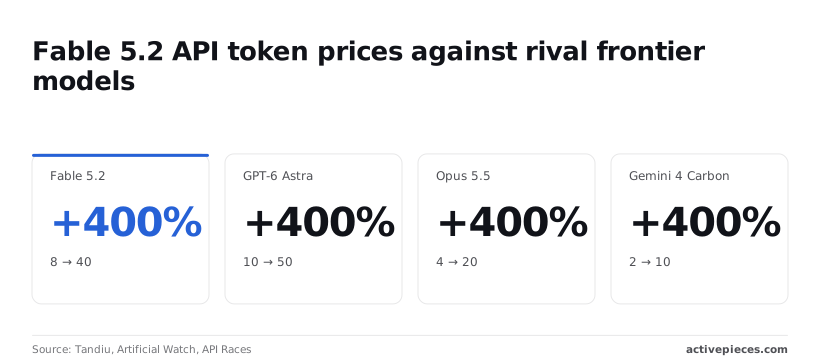
According to Tandiu, Fable 5.2 runs $8 to $40 per million tokens (input to output), so a long answer costs five times what reading the same amount does.
A quarter more than Fable on both sides: that is GPT-6 Astra at $10 to $50. Opus 5.5 runs $4 to $20, half of Fable. Gemini 4 Carbon runs $2 to $10, one-fourth of Fable.
The table breaks out the cached rate, which is what you pay when the same material is sent again, such as a long instruction sheet. Fable's is the steepest discount, so apps that repeat context benefit most.
| Model | API input / cached / output per million tokens | Checked |
|---|---|---|
| Fable 5.2 | $8 / $0.20 / $40 | 2026-11-15 |
| GPT-6 Astra | $10 / $1 / $50 | 2026-11-15 |
| Gemini 4 Carbon | $2 / $0.10 / $10 | 2026-11-15 |
One-fortieth of its fresh input price is Fable's cached rate, while Astra's is only one-tenth. If your work resends the same material, Fable's real bill lands well under its sticker price.
Choose Carbon for volume on a tight budget. Choose Opus 5.5 for long-running coding jobs, and Fable or Astra when the task is hard enough that a wrong answer costs more than the tokens.
Anthropic positions Fable 5.2 for demanding reasoning and long-horizon agentic work, meaning tasks where the model takes many steps on its own, according to its model overview.
The API prices come from Tandiu's token-market page. The table's check date is 2026-11-15. The plan prices and usage limits for each product aren't in the table, so confirm them on each vendor's page before you budget.
Tracking Claude Fable 5.2 spend with Activepieces
Activepieces won't change what Claude Fable 5.2 costs. What it can do is show you which task or team is using the model, so you find out about a runaway month before the invoice does.

Activepieces traces every tool call an agent makes, the data it touched and the order it decided things in, right beside the fixed steps in the same run, and exports that trace as audit logs and event streams to your SIEM.
A login record can't tell you what a Fable 5.2 agent did mid-job, and MoneyGram and Moneypenny run Activepieces in production.
If your team works on a flat seat plan, skip it. It earns its place when Fable 5.2 is called through the API or from scheduled jobs, where nobody is watching the meter.
Picture a flow titled "Test Flow" that runs on a schedule. It reads rows from Google Sheets, loops through them, calls an outside service over HTTP and passes the results through two AI steps.
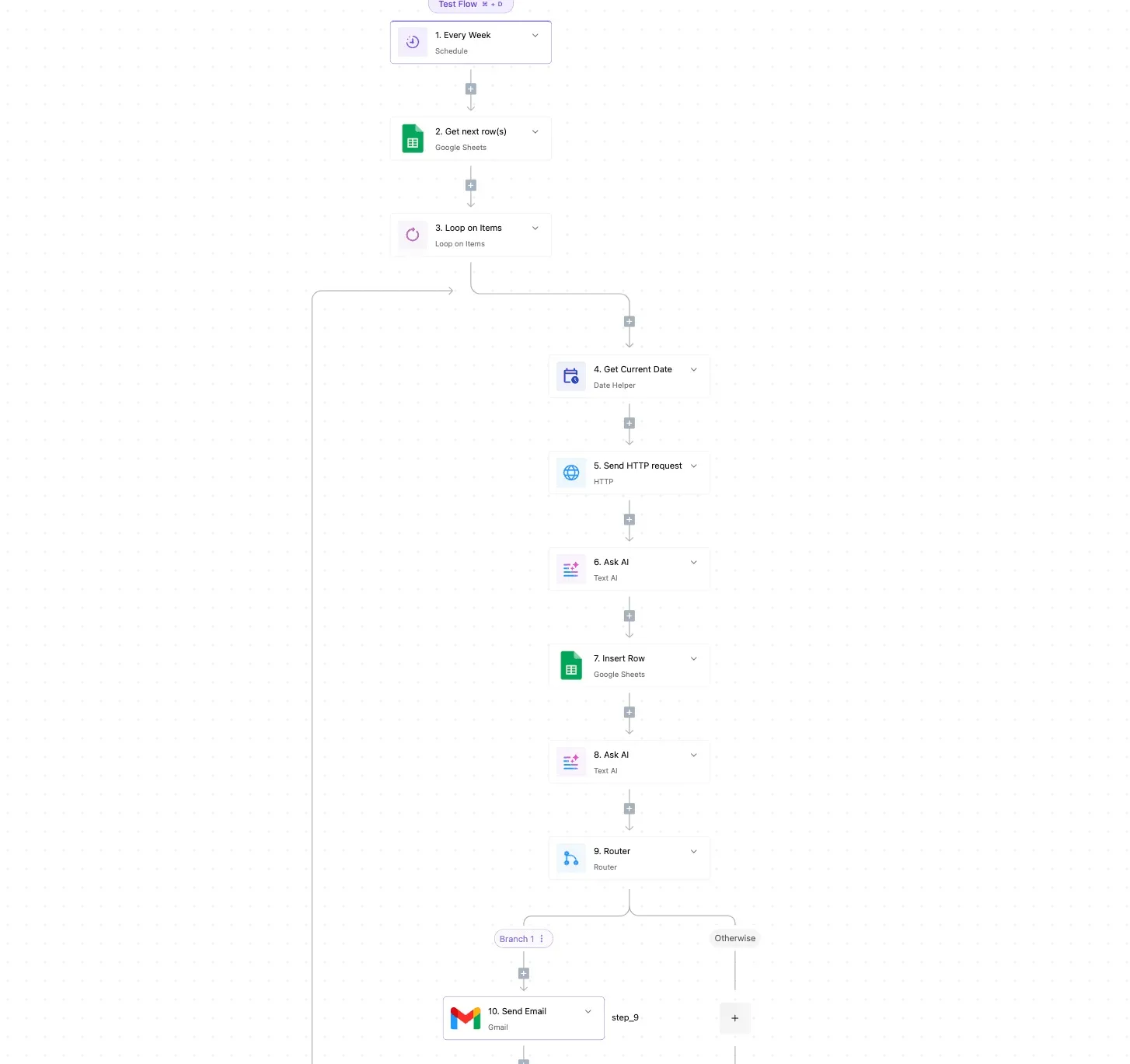
It then writes a row back to the sheet, splits into a branch, and sends an email through Gmail.
Take from the flow that every model call sits at a known step. Each step is somewhere you can record who asked and what for, and the branch is somewhere you can send a warning.
That's how you get per-team and per-task tracking: one logging step per model call, plus a branch that emails you when a running total crosses a line you set.
About Claude Fable 5.2 and its cost drivers
Long jobs make many calls, so they're the ones whose cost surprises people. Claude Fable 5.2 is Anthropic's model for demanding reasoning and long-horizon agentic work. Anthropic's Haiku 5.5 and Sonnet 5.5 are the lighter options for routine work.
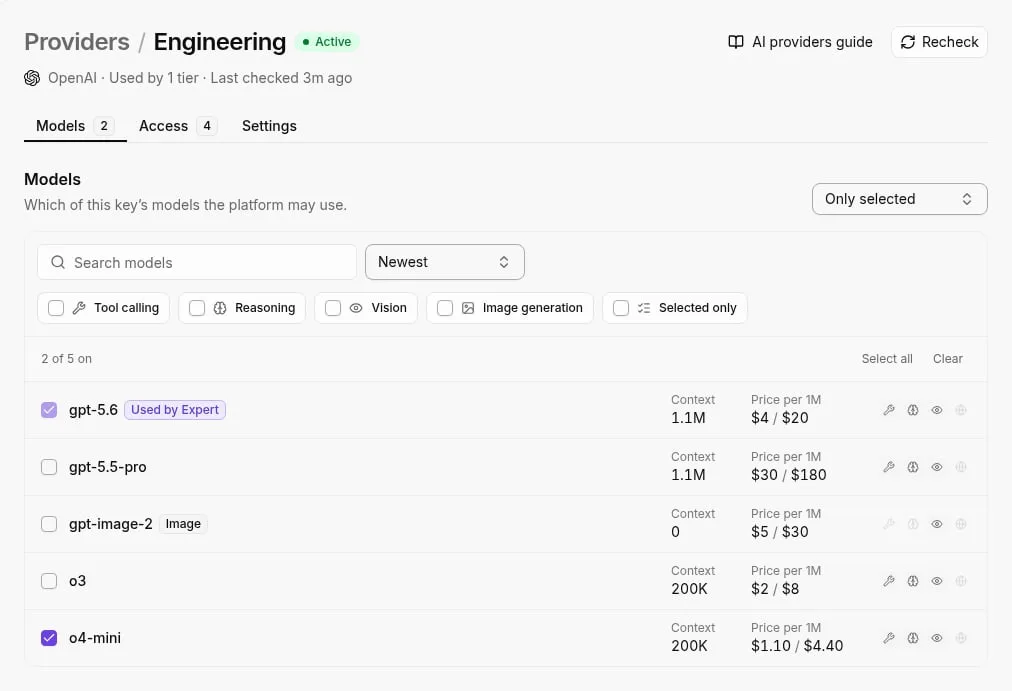
The model description was checked against Anthropic's model page on 15 November 2026.
I didn't verify plan prices, usage limits or any Activepieces pricing, so confirm those on each vendor's page before you build the flow.
Your first-week cost control plan
Once you've confirmed the prices on the vendor's page, the plan is five steps in one week that turn your own usage into a monthly cost you can defend. Skip them and the first honest number you see is the invoice.
- Pull last month's usage.
- Match it to a plan row.
- Set a budget alert or cap.
- Trial one cheaper option.
- Diarise a recheck of the vendor pricing page.
Export last month's usage from the account's billing or usage screen. Note which limit you came closest to, because that one will set your bill. If nobody can produce the export, that's your finding: you're paying for something you can't see.
Day two to three: match plan to usage
Lay your usage against each plan row and look for the limit you would hit first. Then look at what sits outside the plan, such as extra usage billed past the allowance.
A plan that looks cheaper but runs out mid-month costs more than one that fits.
Then trial one cheaper option. Run your routine tasks on Claude Sonnet 5.5 and keep Fable 5.2 for the demanding reasoning work, then compare results on real jobs. If the output holds up, that's spend you stop making.
Setting Claude Fable 5.2 spend alerts and caps
If you want a warning, set an alert. If you want a hard stop, set a cap. A cap protects the budget but can halt work in the middle of a job, so choose based on what an interruption costs you.
Finally, put a recheck of the vendor pricing page in your calendar. Prices and limits change, and a plan matched today quietly goes stale if nobody looks again.
Frequently asked questions
These five questions change what a plan costs after you've bought it, so settle them before you commit and again each time you review.
Is there a free version of Claude Fable 5.2? Don't budget on it. Vendors usually hold their most capable model back for paid plans, or allow only a small taste of it on free ones.
Check the current plan comparison on Anthropic's site. If Fable 5.2 isn't included on Free, a trial there tells you nothing about how it behaves under real workloads.
Can I switch plans or cancel mid-month? Usually yes, but the timing differs. Upgrades commonly start right away, while downgrades and cancellations often take effect at the next renewal.
Read the billing terms before you pay. If you assume a refund for the unused days, you may end up paying for a month you didn't use.
Billing, rollover and discounts
Does the API cost extra on top of a subscription? Yes. API access is billed by usage, separately from a chat subscription. A seat doesn't cover what your team's scripts or connected tools consume.
That's the cost people most often miss, and it can exceed the seat price once automation starts running every day.
Do unused usage allowances roll over? Generally no. Allowances reset on a schedule and don't accumulate, so a light month doesn't buy you a heavy one later.
That makes a plan sized for your peak week poor value, and it argues for sizing to a typical month and handling spikes separately.
Are there discounts for nonprofits or education? Some vendors run programs for both, but don't assume one applies to you. Ask Anthropic's sales team directly and get any discount in writing, since it changes the comparison more than any other line.
Related reading
Running the numbers
See what the same workload costs here.
Free forever plan, and every paid plan self-hosts at no extra cost.
See pricing Talk to sales