
Agent Harness vs Agent Loop: Which AI Architecture Should You Build?

Oct 4, 202612 min read
At the moment a support ticket hits Activepieces, the system faces a choice between letting the model pilot the entire flight path or forcing it to follow a pre-defined plan.
An Agent Loop lets the model choose its next steps based on a goal. An Agent Harness uses a fixed workflow to define how the model interacts with business data.
Agent architecture determines if AI leads or follows
The autonomous nature of the Agent Loop
Give an LLM a goal and a set of tools, and an Agent Loop begins to function. This allows the model to decide which tool to use and how many times to run the cycle until the task is complete.
This creates unpredictability, as the model might call a search tool twenty times in a row, increasing latency. When the control logic is hidden within the model's reasoning, you cannot easily set a hard stop on how a tool is accessed.
A loop could inadvertently trigger dozens of API calls that exhaust your rate limits.
The following diagrams illustrate the core structural difference. The Loop relies on internal model recursion; the Harness relies on external logic.
[Illustration here]
The structure of the agent harness
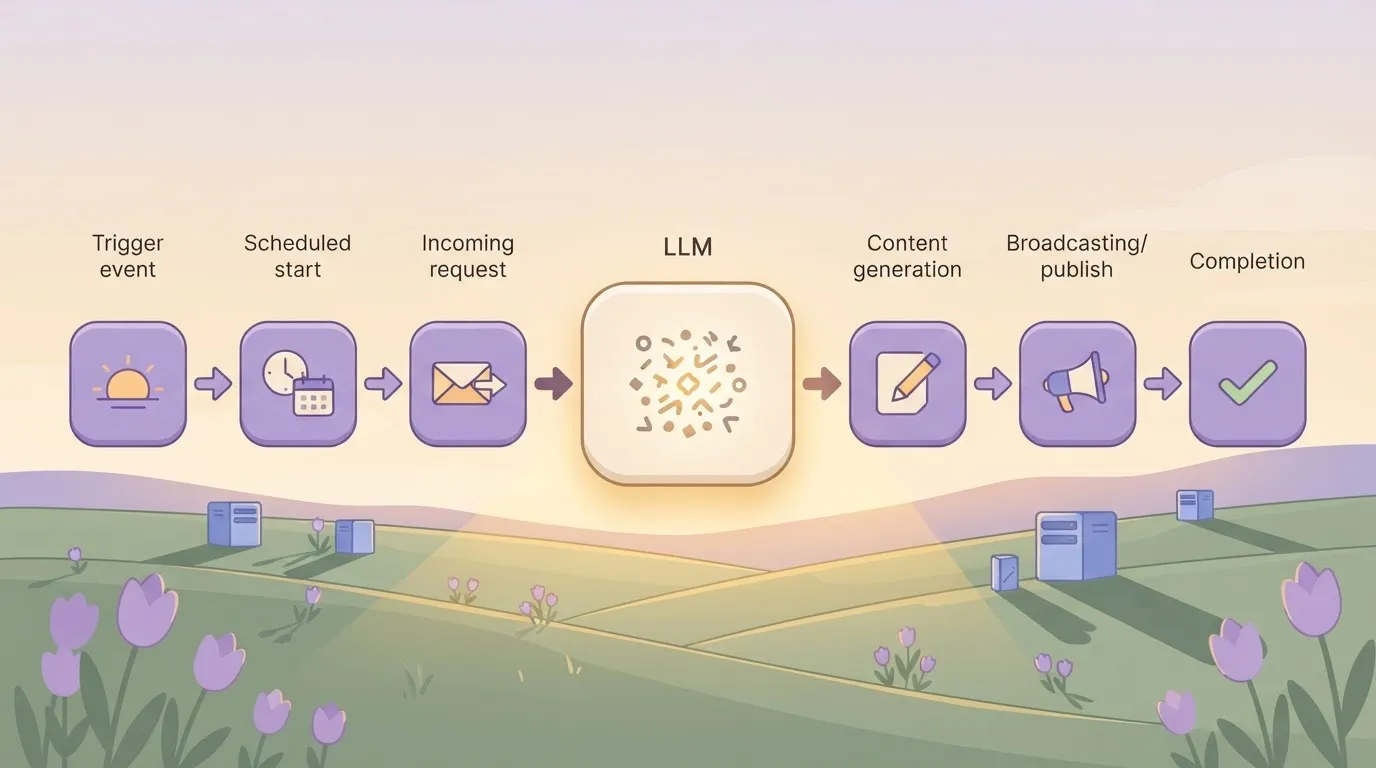
To keep the model within predefined boundaries, an Agent Harness wraps the LLM in a sequence of triggers and actions. Activepieces ensures the LLM categorizes a customer support ticket before passing it to a human agent, providing the deterministic structure required for production.
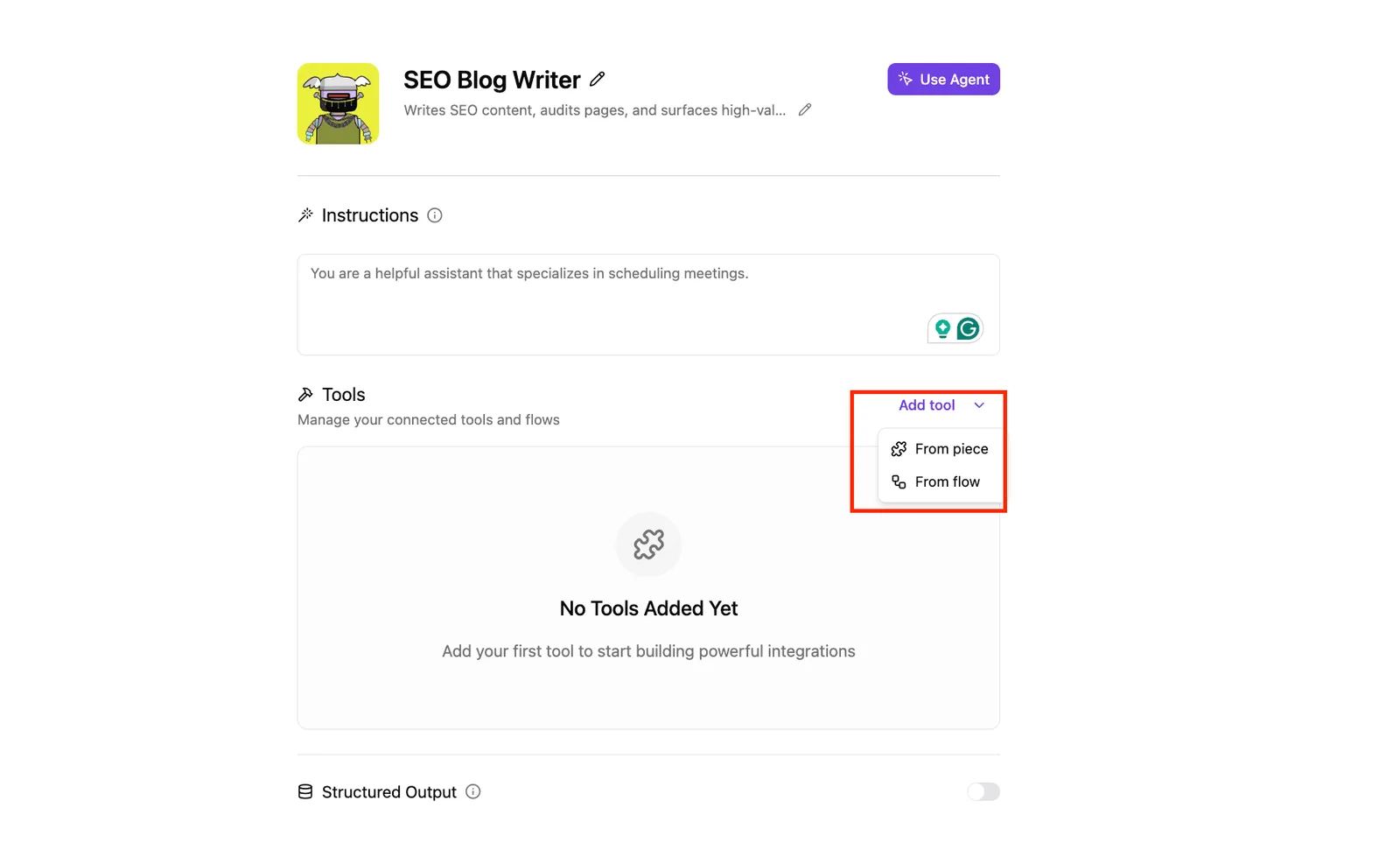
The moment a integration is connected in Activepieces, an agent can call it. Registering a integration once allows it to run as a step inside a flow or as a tool schema on the per-project MCP server, reachable from an agent you built yourself.
Check the Integrations Framework and MCP Server documentation in the open source repo to see how the same integration action that runs in a flow is the one exposed as an MCP tool.
Human review steps cannot be skipped when the model is constrained this way. Platforms such as Zapier use this linear approach to ensure that if a database connection fails, the process stops immediately. This is preferred over allowing the LLM to hallucinate a successful outcome.
Why the distinction matters for production stability
Whether your system fails gracefully or unpredictably depends on the choice between these architectures.
In a Harness, a failed step in a tool like Salesforce results in a clear error log that a support lead can fix.
Whether your system fails gracefully or unpredictably depends on the choice between these architectures.
If an Agent Loop fails, it may continue to loop while consuming tokens, resulting in a high bill for a process that never finished the task.
Production stability requires the ability to audit every decision. A Harness provides the breadcrumbs necessary to explain why the system took a specific automated action.
The fastest way to settle a shortlist is to try one. Activepieces is free to try, no credit card.
Comparing autonomous loops and governed harnesses
Every LLM output must pass through a predefined logic gate before execution in a governed harness, preventing the "black box" failures common in autonomous loops.
AI hallucination loops and predictability risks
Hard-coded constraints provide the predictability in a harness, preventing the model from spinning in a recursive logic loop.
In an autonomous setup, a model might misinterpret a "404 Not Found" error from a tool like Zendesk as a prompt to try a different search string indefinitely. A harness stops this by enforcing a linear path.
If the search fails, the harness follows a specific "if-else" branch to notify a human agent.
The following comparison illustrates how these two architectures handle the operational pressures of a live business environment:
| Dimension | Agent Loop | Agent Harness |
|---|---|---|
| Predictability | Low; the path changes based on model reasoning. | High; the developer defines the tool sequence. |
| Cost efficiency | Variable; multi-turn reasoning consumes more tokens. | Fixed; the workflow caps the number of LLM calls. |
| Security model | Permissive; the agent often requires broad API scopes. | Restricted; tools use granular, pre-authorized endpoints. |
Managing LLM token costs and resource use
By replacing expensive "reasoning steps" with static code, harnesses lower the cost per execution. When using an autonomous framework like LangChain, an agent might call the LLM five times just to decide which tool to use.
In a harness, the developer defines the tool sequence upfront. The LLM only fires once to extract the relevant data, resulting in a predictable budget that won't spike if the model becomes "confused."
Security boundaries and system permissions
Acting as a firewall, a harness ensures the LLM never has direct access to raw credentials.
In a loop, you might give an agent a full API key for GitHub. This allows it to potentially delete a repository if it hallucinates a "cleanup" task.
Activepieces puts every agent inside the same access model as your employees, where enterprise RBAC, SSO, and SCIM govern what it may connect to.
Each tool call it makes is logged individually with its own input and output in the run detail view, rather than being collapsed into one opaque result. MoneyGram, Moneypenny, Alan, and FundingSocieties run this in production to maintain control over their automated processes.
Only a single function is exposed by a harness. Even if the model suggests a destructive action, the underlying infrastructure lacks the permission to execute it.
Agent Loops thrive in open-ended discovery tasks
Agent loops allow a Large Language Model (LLM) to navigate tasks where you can't predict the specific sequence of actions at the start. This architecture relies on the model’s ability to reason through feedback in real-time for exploratory work.
How the ReAct pattern drives the loop
Before committing to a technical action, the ReAct (Reasoning and Acting) pattern enables an agent to "think" out loud. By logging its thought process, the agent can pivot if a search query returns no results.
The Agent Loop cycle:
- Receive objective
- LLM generates plan
- LLM selects tool
- Execute and observe result
- LLM decides to repeat or finish
When total autonomy is a business requirement
When a task requires the agent to browse the web or synthesize vast amounts of unstructured data, autonomy is essential. Because software can't anticipate every possible website layout, a rigid harness would break in discovery phases.
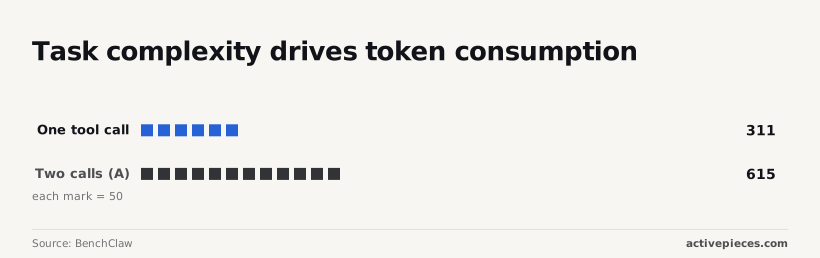
311 tokens are consumed by a single tool call according to BenchClaw, setting the baseline cost for even the simplest automated interaction. As the complexity grows and the agent requires two tool calls, the consumption jumps to 615 tokens.
How unconstrained agent loops fail
Without a harness to limit the scope, an agent loop can enter a "hallucination spiral." In a support context, an unconstrained agent might try to "fix" a billing error by cycling through every database tool, potentially corrupting records.
Until the model decides it is finished, the loop keeps going.
Reading a table only gets you so far. Build the same workflow in Activepieces and compare it yourself.
Agent Harnesses provide the safety for enterprise scale
Deterministic triggers vs. probabilistic decisions
Rather than allowing a model to decide when it should start working, an Agent Harness ensures that an LLM only activates when specific, pre-defined conditions are met.
Gating the AI's involvement requires a structured pipeline. A human-in-the-loop or a rigid database query always validates the intent before the reasoning engine spends a single cent.
The six components of a controlled architecture
This architecture relies on six distinct components to maintain control:
The Trigger is the event source, such as a new ticket in Zendesk.
The Context provider is a retrieval-augmented generation (RAG) system or a specific SQL database.
The Prompt template uses fixed instructions to define the model's persona and constraints.
The LLM is the reasoning engine, such as GPT-6 Astra or Claude Sonnet 5.5.
The Validator is a programmatic check or a second LLM call that verifies the output against business rules.
The Output sink is the final destination, like a Slack channel or a CRM record.
Wrapping LLMs in hard-coded business logic
To prevent the model from drifting into loops that waste API credits, the harness architecture surrounds the reasoning engine with rigid code.
In code, not in a prompt, is where the logic for retries and error handling is written. In a harness, the model is never in a position to ignore a "stop" command.
This structure allows a developer to swap out the underlying model without rewriting the entire business process.
Audit trails for AI agent decisions
A clear audit trail for every decision the AI makes is provided by a structured harness, meeting compliance requirements for regulated industries. Each step is logged as a discrete event.
If a customer receives an incorrect quote, the logs will show whether the error came from the Context Provider or the LLM.
Building a secure Agent Harness with Activepieces
Using workflow logic to constrain AI reasoning
By wrapping LLM prompts within a fixed sequence of steps, Activepieces enforces safety that the model can't bypass.
When a Gmail trigger feeds into a custom Code step for sanitization, the OpenAI step never sees the message before it is cleaned. By terminating the flow in a Slack notification rather than a direct reply, the system ensures a human remains the final gatekeeper.
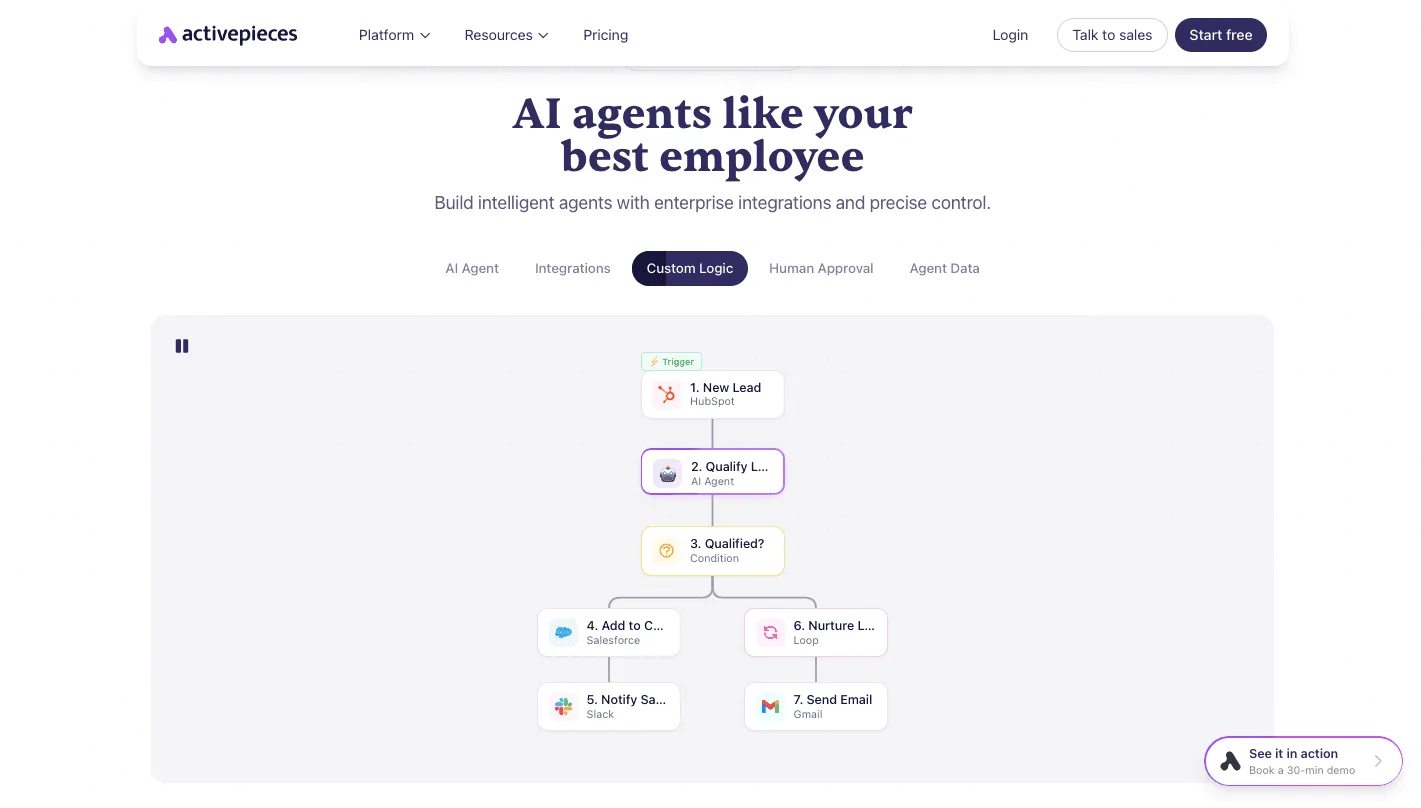
This prevents "prompt injection" where a customer could trick a bot into bypassing business rules.
Connecting agents to 733 verified business tools
Activepieces exposes 733 integrations as individual tools that an agent can call without ever seeing the underlying credentials.
Subscription status can be looked up without granting permission to modify billing cycles. Credentials never leak into the LLM’s conversational memory where they could be exposed.
Monitoring agent behavior through execution logs
Recorded in a chronological execution log is every interaction handled by the harness, showing exactly what data was passed to the AI and what it suggested in return.
You aren't guessing why a model failed. This visibility turns a vague AI glitch into a reproducible bug that can be patched by adjusting the flow logic.
By unifying its entire library of 733 verified connectors into a single framework where every piece action functions natively as an MCP tool, the platform eliminates the friction of manual agent configuration.
Activepieces is the better choice for developers who require a secure, production-ready agent harness that combines strict flow-based constraints with immediate access to a vast ecosystem of business integrations.
Choosing the right AI framework for Monday morning
Start with a harness for repetitive back-office work
For any task where a deviation from standard operating procedure results in a breach, a harness architecture is the appropriate choice.
The LLM becomes a component of a machine rather than the operator. You should prioritize this governed approach when the following criteria are met:
The LLM becomes a component of a machine rather than the operator.
The task has a known start and end state. The output matches a specific schema like a structured database entry.
Failure carries high financial or reputational risk. A single error could cost more in manual remediation than the automation saves in time.
The process must be audited for compliance, providing a clear trail of which prompt was used at which step for external regulators.
Token costs must be predictable, allowing the finance team to forecast monthly AI spend based on volume rather than unpredictable loop iterations.
Reserve loops for low-risk experimental research
For open-ended discovery where the cost of an incorrect path is merely the price of tokens, agent loops are best suited. Market trends that a rigid workflow might miss can be uncovered this way.
The migration path from autonomous to governed AI
Scaling an experimental success into a reliable production feature usually involves moving a process from an autonomous loop into a governed harness. When you observe an agent successfully resolving a specific inquiry ten times, you've found a repeatable pattern. Codifying this reduces compute overhead because a fixed workflow requires fewer reasoning steps.
Frequently asked questions
Can an Agent Harness eventually become a Loop?
When the developer removes the fixed step sequence and allows the LLM to call its own functions recursively, a harness evolves into a loop.
This transition means the system no longer follows a predictable path for a customer refund. The business loses the ability to guarantee that a specific compliance check happens before money leaves the account.
Which architecture is more expensive to maintain?
Higher operational costs are typically incurred by Agent Loops because their unpredictable pathing often results in redundant API calls to models like GPT-6 Astra.
If a loop gets stuck attempting to format a CSV incorrectly, it'll burn through tokens until it hits a limit. A harness fails at the specific step, so the bill reflects only the work actually completed.
Do I need a developer to build an Agent Harness?
Someone who can define the data schema and API authentications for the tools being used is required to build a harness.
Without a technical lead to set these boundaries, the LLM may receive raw data it can't parse. This leads to the system crashing when it encounters a non-standard response from a CRM like HubSpot.
How do I stop an Agent Loop from running forever?
You prevent infinite execution by setting a hard cap on the number of iterations or "turns" the agent can take.
A limit on how many times the agent can call a tool ensures a runaway process doesn't drain your API budget on a single ticket.
A clock-based cutoff stops the process if it hangs, so your server resources are freed up for other customers. A mandatory approval step after a set number of failures prevents the agent from repeating the same error indefinitely.
Related reading
References
Still comparing
The fastest way to settle it is to build something.
Open source under MIT, so you can self-host the same thing later.
Start free Talk to sales