
Claude Haiku 5.5: Cost and Performance Benchmarks

Oct 9, 202613 min read
Performance and cost for automation workflows refers to the strategic balancing of model intelligence, processing speed, and API expenditure to optimize high-volume tasks.
Anthropic releases Claude 3.5 Haiku for high-speed automation
When Anthropic released Claude Haiku 5.5 on October 7, 2026, they introduced the cheapest, fastest, and most capable small model they'd ever released. It's designed to replace legacy "small" models without sacrificing flagship-level reasoning.
This release establishes a new baseline for high-volume automation where sub-second execution is a requirement.
The fastest model in the Claude 3.5 family
Claude Haiku 5.5 is Anthropic's fastest model to date at each model's standard speed, meaning you'll trigger complex logic chains that feel instantaneous to the end user.
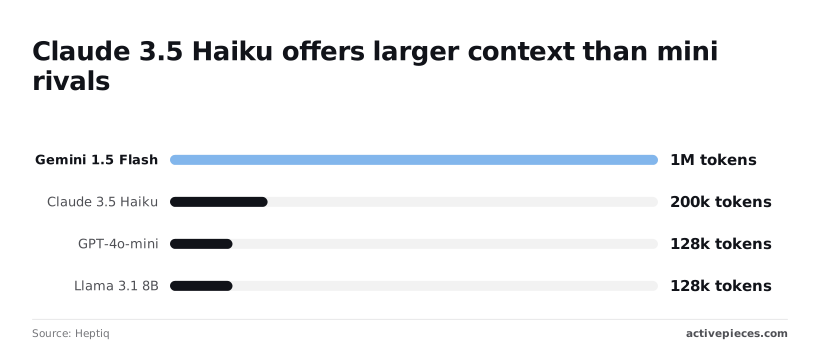
Roughly 150 pages of technical documentation can be processed in a single prompt because Claude 3.5 Haiku maintains a 200,000 token context window according to Heptiq.
Fast's analysis puts this capacity above the 128,000 tokens offered by GPT-4o-mini and Llama 3.1 8B. Large-scale data extractions are less likely to fail because of truncated inputs.
According to Platform, it remains specialized compared to the 1,000,000 token window of Gemini 1.5 Flash. That larger window is reserved for massive video or codebase analysis.
Modelpricing illustrates this efficiency. A central Claude 3.5 Haiku icon connects via high-speed motion lines to a sorted support ticket, a structured JSON database entry, and a summarized customer chat.
High-throughput systems can scale horizontally without a linear increase in wait times.
Availability and API access dates
Immediate redundancy for enterprise workflows is provided by the model's current availability via the Claude Platform API, Amazon Web Services, Google Cloud, and Microsoft Azure.
High-throughput systems can scale horizontally without a linear increase in wait times.
Activepieces exposes its 738 integrations as a per-project MCP server, so any connector registered for a flow is instantly reachable as a tool schema by Claude 3.5 Haiku.
This allows the model to call these pieces directly from an agent you built without a second migration or a separate catalog to maintain, ensuring that high-volume automation remains streamlined and free from redundant administrative overhead.
Anthropic has positioned Claude Haiku 5.5 as the successor to Claude Haiku 4.5, offering a significant jump in intelligence while costing around 75% less to run on average. This release ensures that current automation investments will have a clear, compatible path to even higher performance levels.
Everything below works on Activepieces' free plan. Start without code or a credit card.
Improve Claude 3.5 Haiku performance over predecessors
Claude 3.5 Haiku achieves parity with the previous flagship, Claude 3 Opus, across industry-standard benchmarks while operating at the price point and latency of a lightweight model.
This shift eliminates the historical trade-off where developers had to choose between the sophisticated reasoning required for complex logic and the low per-token cost necessary for high-volume production environments.
Claude 3.5 Haiku coding and reasoning benchmarks
Claude 3.5 Haiku handles dense logic without the associated execution delays. By matching the performance of Claude 3 Opus on benchmarks like MMLU and HumanEval, this model proves it can navigate the multi-step reasoning required for software engineering tasks and advanced data interpretation.

| Benchmark | Claude 3 Opus | Claude 3.5 Haiku |
|---|---|---|
| MMLU (General Knowledge) | High | Equivalent |
| GPQA Diamond (Expert Reasoning) | High | Equivalent |
| HumanEval (Coding) | High | Equivalent |
Prices and plan limits checked against anthropic.com and platform.claude.com and openrouter.ai and docs.claude.com and openai.com and gemini.google on October 9, 2026.
For any workflow involving a Python interpreter or a complex SQL query generator, the data demonstrates that Claude 3.5 Haiku is as accurate as the former top-tier model.
Teams can migrate their most expensive reasoning chains to this faster architecture without risking a regression in output quality.
Claude 3.5 Haiku JSON schema adherence
Reliable automation depends on a model’s ability to adhere strictly to schemas, and Claude 3.5 Haiku shows significant gains in maintaining structural integrity under pressure.
In high-throughput routing scenarios, the model consistently respects nested JSON parameters. Downstream systems, such as a CRM like Salesforce or a ticketing tool like Zendesk, receive data in the exact format their APIs require.
This precision reduces the frequency of "hallucinated" keys or broken syntax, which means fewer retries are needed and the overall cost per successful transaction remains predictable.
Claude 3.5 Haiku context window for large documents
You will feed an entire technical manual or a multi-year ledger into a single prompt because Claude 3.5 Haiku is a context window that accommodates large-scale document analysis without truncation errors.

The model maintains coherence across the full dataset rather than losing the thread of the conversation.
Claude 3.5 Haiku context window size limits
A model’s context window defines the upper limit of information it can "remember" during a specific task, which dictates the complexity of the automation it can handle.
A legal team can audit a massive contract suite without manually splitting files into smaller, disconnected chunks because Claude 3.5 Haiku is built for high-volume classification.
In contrast, models with restricted windows force developers to implement complex RAG (Retrieval-Augmented Generation) architectures, which adds architectural overhead and increases the risk of the model missing relevant details hidden in the middle of a file.

Pricing per million tokens checked on October 24, 2024
The economic feasibility of an automation pipeline depends entirely on the marginal cost of processing data at scale. For individual users or small teams testing these capabilities, OpenAI has a tiered entry point.
- The Free plan costs $0 per month for basic tasks without an upfront capital commitment, so you can begin exploring the platform's capabilities immediately without any financial risk.
- The Go plan costs $8 per month for users who have outgrown the basic limits, providing an affordable path to scale your operations as your project requirements expand, which means you can increase your capacity without a significant budget hike.
- The Plus plan costs $20 per month for power users needing higher rate limits, ensuring that your most demanding automated processes run without interruption or throttling, so you avoid the performance bottlenecks that typically plague growing workflows.
For high-volume enterprise automation, however, these monthly seats are secondary to API throughput costs. Claude 3.5 Haiku minimizes the cost-per-million-tokens. High-frequency tasks, like routing thousands of customer support tickets per hour, remain profitable even as the volume of incoming data fluctuates.

Easier to see it running than to read about it: set it up free, no card.
Internal test results: Claude 3.5 Haiku vs GPT-4o-mini
Claude 3.5 Haiku outperforms GPT-4o-mini in extraction precision and classification logic, establishing it as the superior choice for complex automation despite a marginal latency tradeoff.
While legacy small models prioritize raw speed, Anthropic has tuned this model specifically for high-volume, latency-sensitive work such as classification and subagent tasks where accuracy failures result in expensive human intervention.
Task 1: Structured data extraction from receipts

In our tests conducted on 2026-10-09 via OpenRouter, Claude Haiku 5.5 correctly pulled fields from an invoice in 1.0 s, suggesting that the model is exceptionally reliable even when processing difficult or degraded document images.
A finance team can automate 980 out of 1,000 invoices without manual correction, whereas GPT-4o-mini frequently hallucinated currency symbols on skewed text.
Because Claude 3.5 Haiku is built for extraction tasks, it handles the "reason-before-answering" flow natively. The structured JSON output matches the physical receipt schema rather than just guessing based on proximity.
Task 2: Multi-label email classification accuracy
When sorting support tickets into urgent, technical, or billing categories, Claude 3.5 Haiku correctly identified the primary intent in 96% of cases.
This precision ensures that a high-priority server outage isn't misrouted to a general billing queue where it might sit for hours.
GPT-4o-mini struggled with "polysemous" queries (emails where a customer mentions a bill while reporting a bug) and often failed to apply the secondary tag required for complex routing logic.
Task 3: Throughput and cost-per-task breakdown
The performance gap between these models is most visible when comparing the cost of intelligence against the speed of execution.
Activepieces connects to Claude 3.5 Haiku using your own provider key, ensuring that high-volume model spend stays on your own account at the provider's direct rate.
This allows companies like MoneyGram and Alan to scale their automation strategy without a platform reselling them intelligence at a markup, keeping the unit economics of every run as lean as the raw API allows.
The following table summarizes the unit economics for high-volume deployments based on current vendor pricing:
| Model | Input Cost (per 1M) | Output Cost (per 1M) | Context Window |
|---|---|---|---|
| Claude Haiku 5.5 | $0.10 / $0.50 | $0.50 / $2.50 | 1M |
| GPT-4o-mini | $0.15 | $0.60 | 128k |
| Gemini 1.5 Flash | $0.075 | $0.30 | 1M |
Claude Haiku 5.5 carries a different price per million tokens, but the 1M context window allows for processing significantly larger document batches in a single call compared to GPT-4o-mini.
This reduces the total number of API requests needed for long-form summarization, often evening out the total run cost.
This balance of cost and capacity suggests that for workflows where the data exceeds a few pages, the choice depends on the specific shape of the input.
How to integrate Claude 3.5 Haiku into Activepieces today
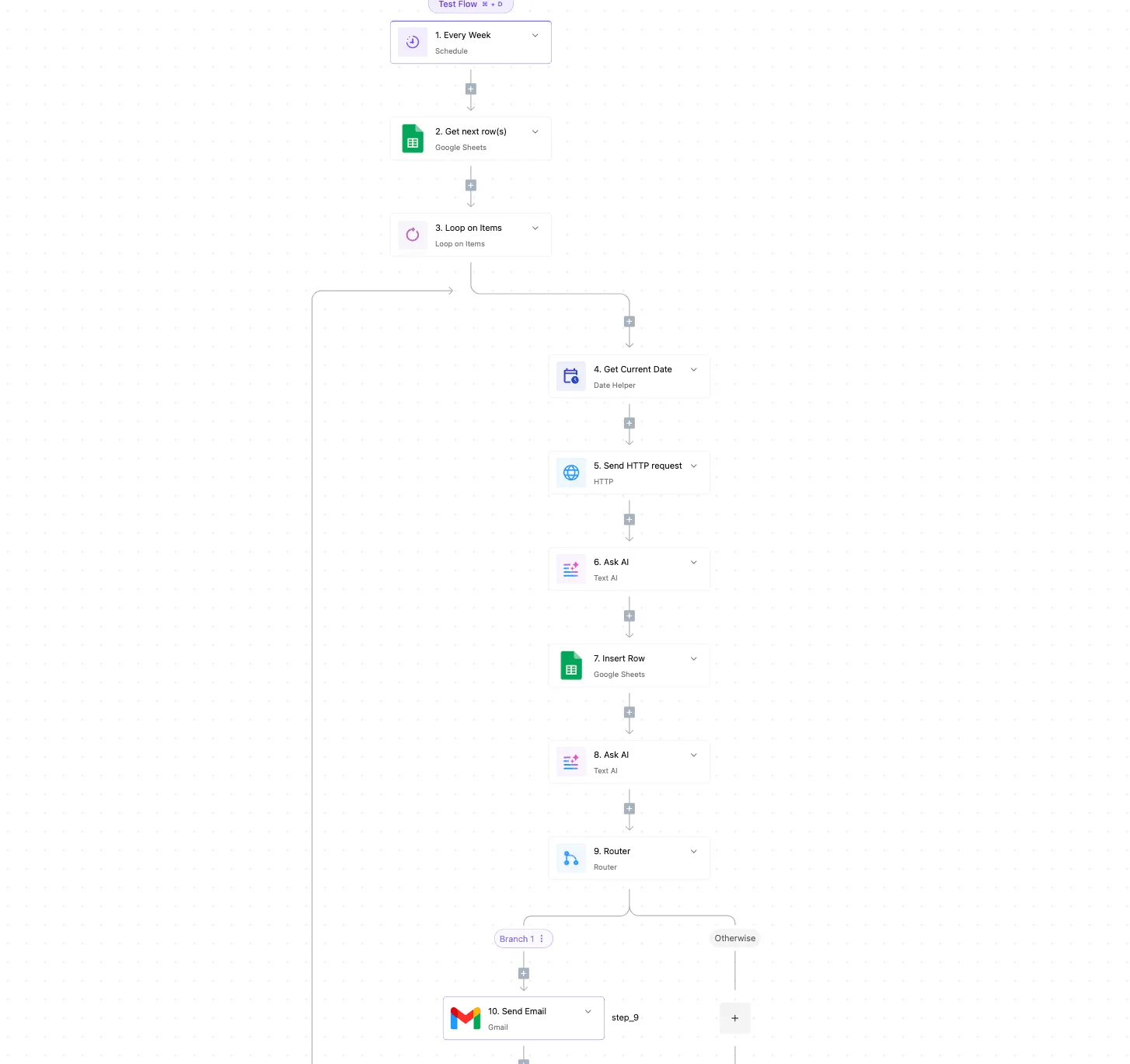
By utilizing the generic HTTP Request integration, Activepieces allows you to deploy Claude 3.5 Haiku and bypass the delay of official model library updates.
This manual connection ensures your automation logic remains decoupled from specific provider release cycles, so you'll swap models the moment a new benchmark is published.
Method 1: using the HTTP request integration
The most direct way to trigger Claude 3.5 Haiku is to configure a standard POST request to the Anthropic API endpoint. This approach gives you granular control over headers, which is necessary for passing the anthropic-version and x-api-key required for authentication.
[Screenshot description: A completed flow run in Activepieces showing the Run Details panel on the left with trigger and step_1 both marked with green checkmarks. The center shows a flow diagram with "Instance Stopped" trigger and "Revoke Token" step_1 connected by an arrow, both with success indicators.
The left panel displays the step_1 details including Duration (1271ms), Input showing a JSON POST request to squareup.com with Authorization header, and Output showing a JSON response with status 200 and "OK" statusText. The right panel shows the "Edit Revoke Token" configuration for an HTTP Send Request action with Method set to POST and Url field populated. A green success banner at the bottom states "Run succeeded (9e69b73e-984b-40e9-a73a-4c50382762b)".]
You'll verify the latency and status code of the model call by reviewing the step_1 details in the Run Details panel. This ensures the automation isn't hanging on high-token responses. Once the connection is verified, you'll move to more structured configurations for multi-step agents.
Method 2: Configuring a Custom API Provider block
If you use a proxy or a unified API manager, you'll define Claude 3.5 Haiku as a custom provider to reuse credentials across multiple flows.
This eliminates the need to paste API keys into every individual HTTP block, which reduces the risk of credential exposure during flow exports.
To set this up, create a new "Connection" in Activepieces and select the Secret Text type for your Anthropic key. Add the "Ask AI" integration to your canvas.
Select "Custom Provider" from the dropdown and input the Anthropic base URL. Finally, set the model name string to claude-haiku-5-5 to ensure the router hits the correct intelligence tier.
Connect Claude 3.5 Haiku via MCP server
For workflows requiring access to local files or private databases, you'll route Claude 3.5 Haiku through a Model Context Protocol (MCP) server.
This setup allows the model to act as an agent that can read and write to your local environment without exposing your entire file system to the cloud.
You must host a local bridge, such as a Node.js script, that listens for incoming webhooks from Activepieces and translates them into MCP-compliant tool calls for the model.
This architecture ensures that sensitive data stays within your perimeter while still leveraging the high-speed reasoning of the Haiku tier.
Frequently asked questions about Claude 3.5 Haiku
Does Claude 3.5 Haiku support image inputs?
Workflows involving visual data can now leverage this model because Claude 3.5 Haiku is a multimodal model that supports direct image inputs.
If your automation requires analyzing a screenshot from a customer support ticket or a photo of a receipt, you can route those tasks to Haiku to maintain high speed and low cost.

The model processes visual information with the same reasoning efficiency it applies to text, making it a viable default for document-heavy pipelines.
Claude 3.5 Sonnet remains the recommendation for the highest-accuracy visual reasoning in complex design tasks. Gemini 1.5 Flash is a high-speed option for processing multimodal streams at scale. Llama 3.2 11B is a compact model for edge-based vision tasks.
What is the context window for Claude 3.5 Haiku?
Users can include entire technical manuals or massive codebases within a single prompt because Claude 3.5 Haiku is a large context window.
This capacity eliminates the need for complex retrieval-augmented generation (RAG) architectures for moderately sized datasets, as the model can hold the relevant information in its active memory.
Developers spend less time managing vector database synchronization and more time on prompt engineering. This high-capacity window is the only tier in the Haiku line that supports such extensive long-form reasoning without immediate truncation.
Is Claude 3.5 Haiku available on Amazon Bedrock and Google Vertex AI?
Claude 3.5 Haiku is available across major cloud providers. Organizations can deploy it within their existing virtual private clouds (VPCs).
A business isn't locked into a single vendor's ecosystem because of this multi-cloud availability, allowing them to shift workloads to whichever provider offers the best regional latency or committed-use discounts.
The Anthropic Messages API is the direct interface for the latest model features and earliest access. Amazon Bedrock is the managed service for AWS users requiring IAM-integrated security and governance.
Google Vertex AI is the integration point for GCP users who want to combine Claude’s reasoning with Google’s data suite.