Claude Ship: What Anthropic Has Announced So Far

Nov 24, 202610 min read
Nothing here comes from reseller write-ups or forum summaries. Everything this article says about what Claude Ship is comes from Anthropic's own announcement.
This article reflects the vendor pages as they stood on 2026-11-23, and the claims below hold only as far as they were true that day.
Claude Ship is a product Anthropic put out under its own name. For a team that runs automations in Activepieces, the useful question is narrow, so the emphasis shifts to selecting the right integration.
What can an AI now take on inside a workflow that it couldn't take on before?
Anything dated earlier or later belongs to someone else's commentary, because the maker is Anthropic and the launch date is the one on its announcement. Read it as a rumor, however confident the tone.
What to know about Claude Ship
Open the vendor pages after 2026-11-23 and the wording may differ, because product pages get edited without notice. This article reads them as of that date.
If the two disagree, trust the page over this article, and treat the gap as a reason to re-check before changing a workflow.
Everything below works on Activepieces' free plan. Start without code or a credit card.
Why Claude Ship matters for automation
If the launch matters, it matters only as far as it changes which tasks a team can hand to AI inside workflows it already runs. The maker's pages are the only place that change is stated.
Where it touches an AI-plus-apps workflow
When a workflow links an AI model to business apps, it has handoff points: a record arrives, something reads it, something decides, something writes back. Claude Ship is relevant at those points and nowhere else in the argument here.
If a capability on the maker's pages doesn't alter one of those handoffs, it doesn't change an automation team's week, however good it sounds in a launch post.
Tasks Claude Ship can now automate in workflows
Read each stated capability as a clause in an agreement, and ask what it obliges the AI to do without a person stepping in.
A capability earns a place in a workflow only when it names a task, the task sits at a handoff, and the maker's own page says so.
Anything a team infers beyond that wording is an assumption, and assumptions are what break at the first failed run.
A capability earns a place in a workflow only when it names a task, the task sits at a handoff, and the maker's own page says so.
What Claude Ship doesn't change in your apps
Nothing in a new release rewrites what an existing app allows. The apps keep their own permissions, their own record structures and their own failure behavior.
The review step a team put in front of a risky action still belongs there until the maker's pages say otherwise. So the first test of any handoff is still a single run against real data, with someone watching the result.
What's new in Claude Ship from Anthropic
Start with a single watched run; it is the right first test. The only hard figures on Anthropic's pages are plan prices, and none of them describe Claude Ship's own limits.
In the material checked on 2026-11-24, no capability list, rate limit, or usage cap for Claude Ship appeared. So no team can yet size a handoff against a quota. The first run is also the first time anyone learns where the ceiling is.
Pricing and availability as published
On Anthropic's pricing page, four individual plans are listed:
- Free at $0 a month
- Pro at $20
- Max at $100
- Ultra at $200
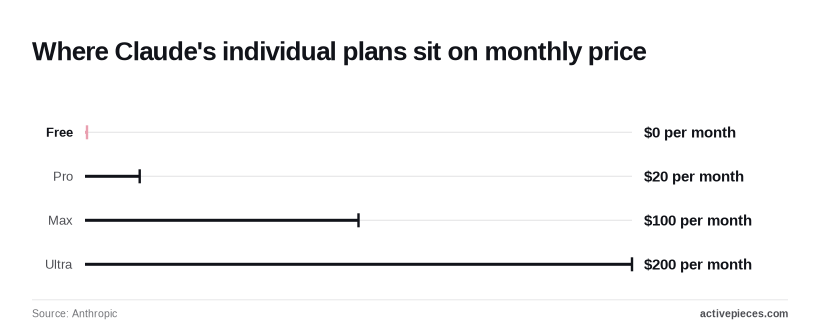
On the Free plan, a team can try Claude at no cost, but nothing published says Claude Ship is included.
The steps from $20 to $100 to $200 mean a team that outgrows Pro pays five times as much, and nothing published says which plan, if any, unlocks Claude Ship, so scaling teams cannot determine when upgrading will grant them this feature.
For Claude Ship itself, Anthropic has published no capability, limit, price, free tier or availability. Read each of those gaps as an open question to put to the vendor before any workflow depends on it.
Nobody can budget for this yet, because Anthropic hasn't stated a Claude Ship price, free allowance, usage cap, or plan eligibility. Until it does, treat any budget for Claude Ship work as a guess.

What Activepieces has already shipped for Claude Ship
Nothing in the findings shows Activepieces support built specifically for Claude Ship, even across the 750 integrations counted in its open source monorepo, so any budget stays a guess.
What the catalog does show is one Claude integration, listed among 126 AI pieces. That's 1 piece out of 126, so Claude is one option among many models and tools, not a featured path.

We haven't used or tested Claude Ship here, and nothing below implies we did.
For a dated announcement or dedicated page for Claude Ship, the findings give nothing, so we cite none. The only verifiable item is the pieces catalog.
Plan around a general-purpose Claude step inside a flow, not a Claude Ship feature.
Once that integration is connected in Activepieces, an agent can call it as well: the same action in packages/pieces of the open source repo runs as a flow step and as a tool on the project's MCP server, reachable from Claude, ChatGPT or Cursor.
Nothing is published or wired twice, so a handoff you test in a flow is the one an agent uses. MoneyGram, Moneypenny, Alan and FundingSocieties run Activepieces in production. Check the catalog again before committing a date.
Connecting it in a workflow today
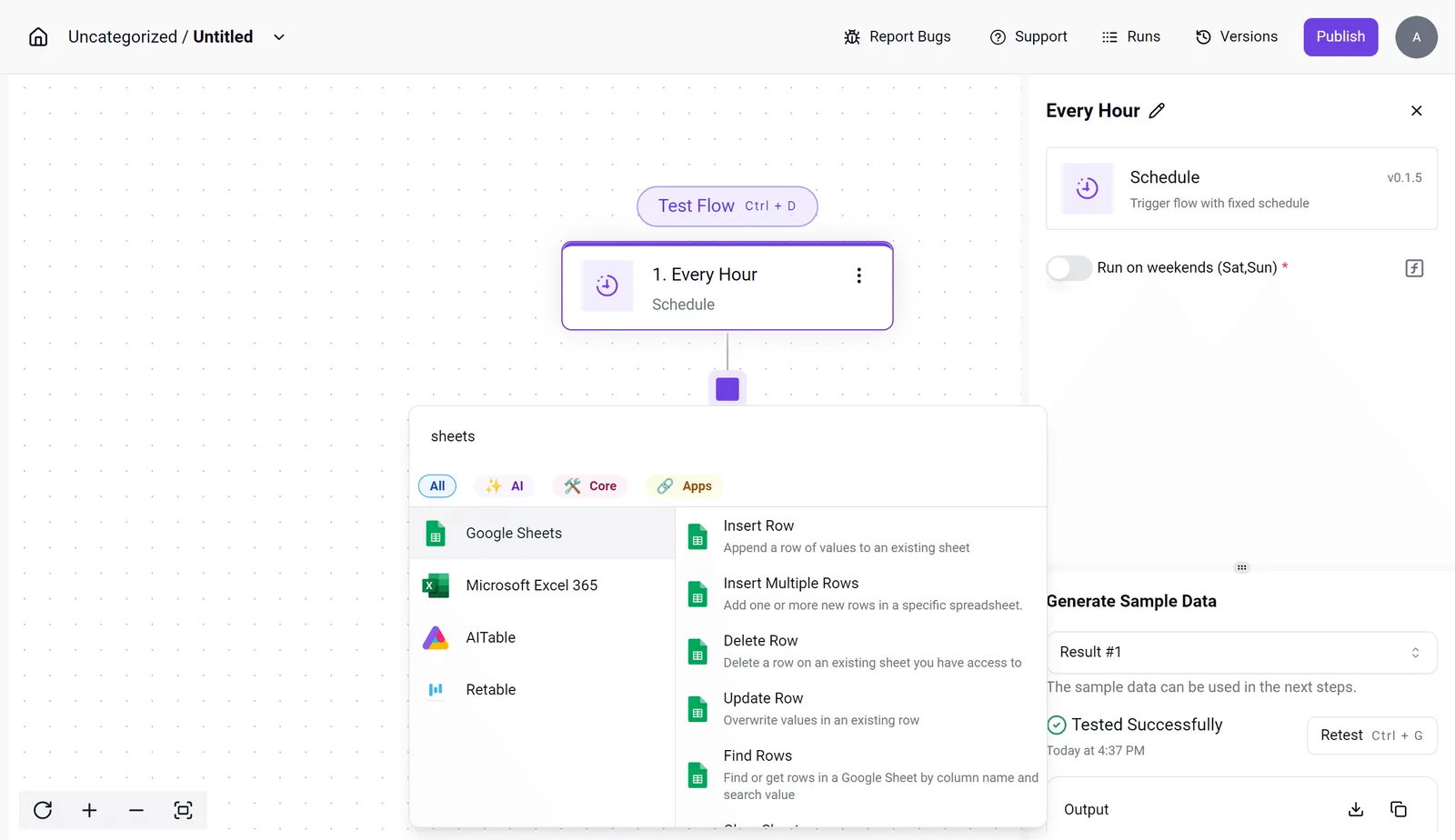
You need very little to set it up, as the flow builder shows.
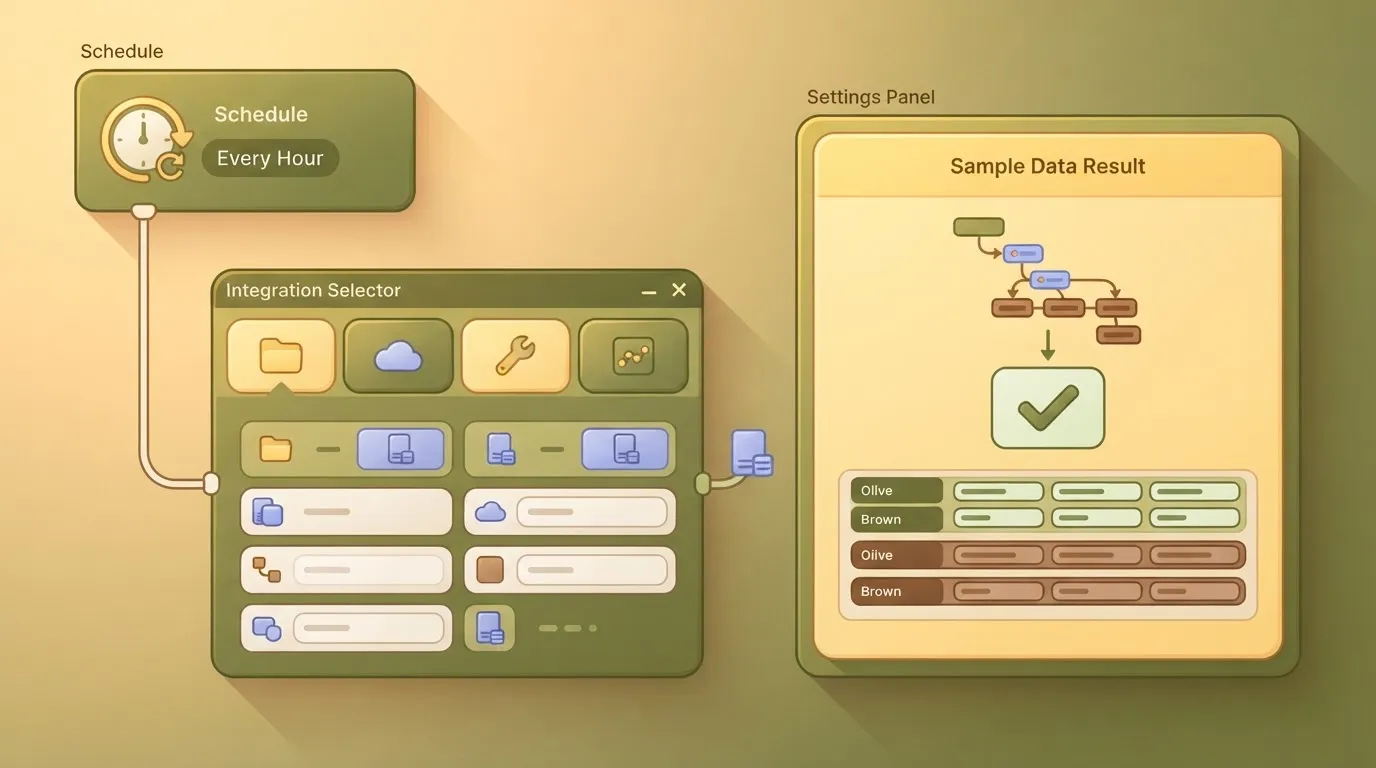
A Schedule trigger set to "Every Hour" is selected, the integration selector sits open beneath it with tabs for All, AI, Core and Apps, and the settings panel shows a successful Generate Sample Data result.
Look at that last panel first, because it shows output before anything touches live data. The order is:
- Add a trigger, such as Schedule, and set its interval.
- Open the integration selector and use the AI tab to find the Claude integration.
- Choose an action and supply the credentials the integration requests.
- Run Generate Sample Data and read the result before adding steps that write rows.
With the test passing, the next question is what you're willing to hand the step.
Easier to see it running than to read about it: set it up free, no card.
Comparing Claude Ship's costs and speed
A handed-off step can't be priced from vendor pages alone: no per-task price and no speed figure for any model appear on Anthropic's pages, only prices per million tokens.
Claude Ship pricing per task
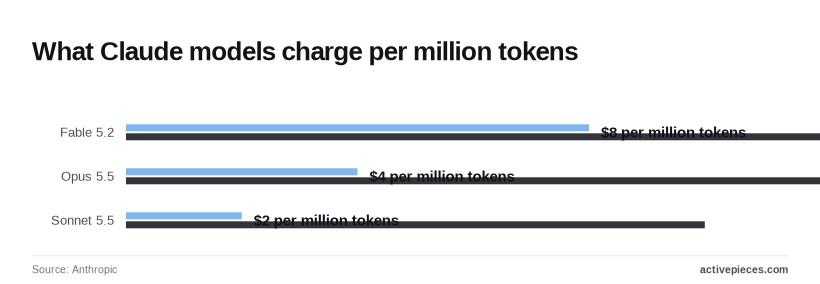
On the Anthropic models page, input and output prices are $8 and $40 per million tokens for Fable 5.2, which means output tokens represent the larger expense.
Opus 5.5 is $4 and $20, Sonnet 5.5 is $2 and $10, and Haiku 5.5 is $0.10 and $0.50.
Send a step to Fable and it costs four times the same step on Sonnet, so route by difficulty. Haiku costs one-twentieth of Sonnet, which is where high-volume steps belong.
The table shows what each row publishes, and the empty cells are the finding: none of them gives a per-task cost.
| Option | Published cost per task | Published speed | Source URL | Date checked |
|---|---|---|---|---|
| Claude Ship | vendor gives no figure | vendor gives no figure | vendor gives no figure | 2026-11-23 |
| Claude Sonnet 5.5 | vendor gives no figure | vendor gives no figure | https://docs.claude.com/en/docs/about-claude/models/overview | 2026-11-23 |
| Claude Opus 5.5 | vendor gives no figure | vendor gives no figure | https://docs.claude.com/en/docs/about-claude/models/overview | 2026-11-23 |
Prices and plan limits checked against github.com and docs.claude.com and claude.com and openai.com and gemini.google on November 24, 2026.
You can't forecast Ship's bill before running it, and its blank row says as much.
No latency or throughput number appears for any model above, so set workflow timeouts from your own test runs.
The Claude pricing page describes the free plan only as "limited usage every 5 hours and every week", with no count, leaving teams unable to determine whether a typical week of usage exceeds their allowance.
You can't plan a recurring job around a quota that has no number.
I include no competitor's figures because none were verified, and Ship has no published price. To get a cost per task, multiply the tokens one test run used by the rates above.
What to watch after the Claude Ship launch
Watch four pages: Anthropic's pricing page, its changelog, its docs, and the integration's pull request or integration page. Together they tell you whether your cost-per-task figure still holds and whether the connection still works.
Claude Ship docs and pricing pages to check
Start with the pricing page, because a changed rate makes your multiplication stale. The changelog shows what changed and on what date, which lets you match a break to a cause. The docs carry request rules that the changelog may not.
On the integration side there is a dated example. On 2026-11-08, a pull request fixed structured extraction and agents on Claude Opus 5.5, Sonnet 5.5 and Fable 5.1, which reject a forced tool choice with a 400 error.
Until that fix, a workflow set to force a tool call failed on those models. Your run history shows the failure as an error, not as a worse answer. Read the page for open or merged changes before you blame your prompt.
You can finish the steps below in one sitting, and they change nothing in production. Their output is a dated note you can compare against next week.
- Open Anthropic's pricing page and changelog.
- Note any change and its date.
- Check the pull request or integration page for the integration you use.
- Try the connection in one low-risk workflow.
If step four returns an error, copy the exact message and timestamp into your note. After that, you know whether to expand to more workflows or wait for a fix.
Frequently asked questions
Is Claude Ship free to use? The findings don't say. They record no free tier, trial, credit allowance or usage cap, so treat any free access as unconfirmed until the maker's own pricing page states it. Don't budget around a limit nobody has published.
Does integration work with your version?
Yes, there's an integration path today, and it rests on the platform's own dated support entry. The date matters.
Support recorded at one point in time says nothing about later changes, so check it against the version you run before you hand a live workflow to it.
Test one low-stakes flow first, because the findings don't describe which workflow steps it covers.
Who made Claude Ship and when did it launch? The findings place the measurable changes on the maker's own pages, but they don't give a launch date or a company history.
Without a date, you can't judge how mature the product is or how long its limits have been in place. Read the maker's pages directly for both.
How does Claude Ship pricing compare with the model I use now? The findings don't say. No price for Claude Ship is on record, so no honest comparison with your current model is possible.
A comparison needs your own usage volume against published rates. If the maker hasn't published them, ask for the rate card in writing before you move any workflow over.