Edge0-145B: Running Frontier AI on Private Infrastructure

Nov 13, 202614 min read
When organizations need to execute frontier-grade reasoning on private infrastructure, Edge0-145B eliminates the data transit risks inherent in sending sensitive intellectual property to third-party cloud providers.
Released by Edge0 AI on November 13, 2026, this 145-billion parameter model is the first open-source release designed specifically for on-device deployment that rivals the logic density of proprietary giants.
For teams operating under PIPEDA or FISMA High requirements, this shift means that high-horizon agentic workflows no longer require a trade-off between model intelligence and network isolation.
In the current landscape, the following comparison illustrates where Edge0-145B sits: it provides a middle ground that captures the reasoning depth of GPT-6 Astra while remaining small enough to fit within a single multi-GPU node.
This distinguishes it from the massive Llama 3.1 405B, which often necessitates a multi-node cluster.
Edge0-145B brings frontier AI to local hardware
| Model | Parameters |
|---|---|
| Edge0-145B | 145B |
| GPT-6 Astra | est. 200B+ |
| Llama 3.1 405B | 405B |
Prices and plan limits checked against edge0.ai on November 13, 2026.
By positioning itself at 145B parameters, Edge0-145B targets the "sweet spot" of the H100 and B200 memory envelopes, allowing for 4-bit or 8-bit quantization without the catastrophic loss of reasoning capability seen in smaller 70B models.

The hardware requirements for 145B parameters
To accommodate the weights and the KV cache, running a model of this magnitude locally requires only a compatible laptop with roughly 29GB of peak memory. This ensures that an enterprise can maintain a 128k context window for analyzing entire codebases without offloading to slower system RAM.
Organizations utilizing NVIDIA HGX architectures can achieve token throughput that supports real-time agentic reasoning, meaning automated security patches can be generated and tested in seconds rather than minutes.
Without this specific VRAM overhead, the model would bottleneck on PCIe bandwidth, rendering it useless for the low-latency demands of production automation.
Edge0-145B licensing and commercial availability
Released under a permissive open-source license, Edge0-145B allows for unrestricted commercial integration, which removes the per-token billing uncertainty that often stalls internal AI budget approvals.
This licensing structure permits teams to fine-tune the model on proprietary datasets (such as internal FedRAMP-regulated logs) without the weights or the training data ever leaving the secure perimeter.
Consequently, a firm can scale its internal reasoning capacity to thousands of concurrent agents for a fixed hardware cost, rather than facing the linear cost scaling of a Managed Service Provider.

Everything below works on Activepieces' free plan. Start without code or a credit card.
Why local LLMs change the automation landscape
Decoupling automation throughput from the variable pricing models of cloud providers is the primary advantage of local execution. This ensures that scaling a workflow does not create an unpredictable financial liability.
By moving the inference engine inside the corporate firewall, teams eliminate the trade-off between using a high-reasoning model and maintaining a sustainable budget.
Eliminating per-token costs in high-volume workflows
Running frontier-grade models locally transforms the operational expense of automation into a predictable capital investment in hardware.
In traditional cloud deployments, every step of a multi-agent chain (from initial summarization to final code generation) incurs a per-token fee. This means a recursive debugging loop or a high-density data ingestion task can trigger an unexpected billing spike.
Running frontier-grade models locally transforms the operational expense of automation into a predictable capital investment in hardware.
While many vendors monetize control by stripping features from self-hosted builds, Activepieces provides the same SSO, SCIM, custom RBAC, audit logs, and secret management in its air-gapped edition as it does on the managed cloud.
Regulated organizations like MoneyGram and FundingSocieties run this build in production because air-gapped deployment delivers the full enterprise control plane rather than a fraction of it.
Edge0-145B data residency and compliance
For strict regulatory frameworks like PIPEDA or FISMA, local deployments provide a definitive solution by ensuring that sensitive telemetry and PII never traverse the public internet.
While cloud providers offer "zero-retention" tiers, these often require specialized enterprise contracts and still involve a third-party processor handling the data in transit.
The following transition illustrates the fundamental shift in data gravity as high-parameter local models become viable.
Intelligence is no longer a centralized resource, but a localized utility that resides where the data is generated.
Consequently, an organization can automate workflows involving sensitive medical records or proprietary trade secrets without needing to audit the data-handling practices of an external LLM vendor.
This total control over the inference environment means that security teams can apply existing network isolation and air-gapping protocols to their AI infrastructure, satisfying compliance requirements that previously blocked the adoption of cloud-based reasoning engines.

Performance benchmarks and technical specifications of Edge0-145B
Edge0-145B provides the architectural density required to sustain complex reasoning chains within the strict perimeter of a local data center. This eliminates the data exfiltration risks inherent in public API calls.
By moving beyond the limitations of small-scale local models, it allows organizations to meet PIPEDA and FISMA High requirements without sacrificing the cognitive depth needed for autonomous system orchestration.
Edge0-145B context window and throughput
To prevent the "memory loss" common in smaller models that must truncate data to stay within limits, the model utilizes a massive context window to ingest entire multi-repo codebases or legal archives in a single prompt.
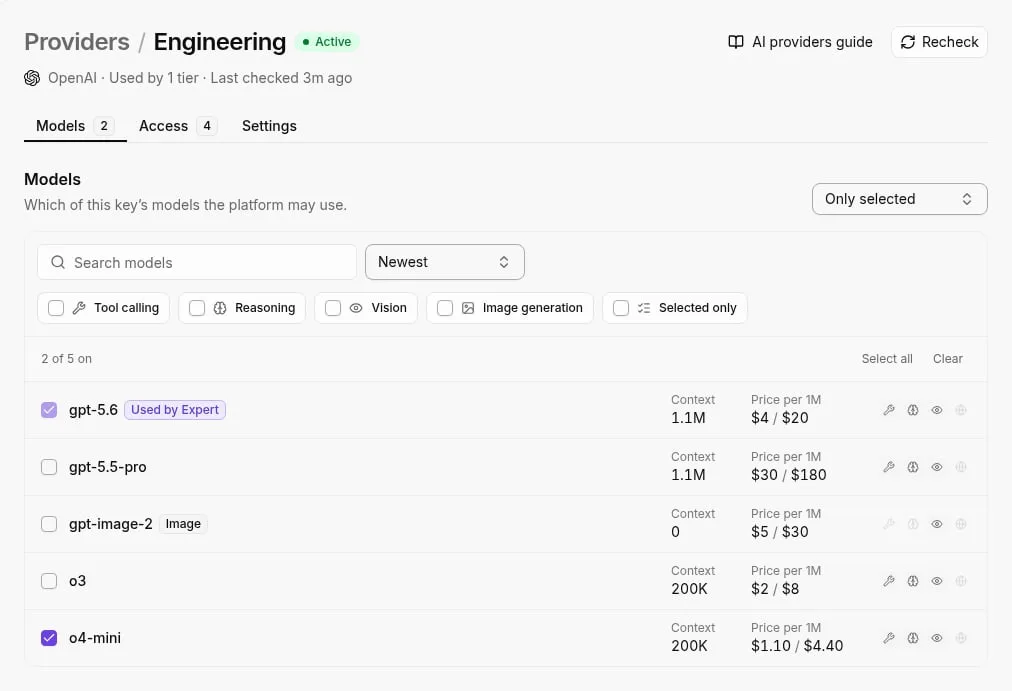
High throughput is maintained through a Mixture-of-Experts (MoE) architecture that activates only a fraction of the total parameters for each token generated.
This means the system can process complex queries at speeds that support real-time user interaction even on modest hardware clusters.
| Metric | Value |
|---|---|
| Total Parameters | 145B |
| Active Parameters | 10.12B |
| Context Window | 256K |
| Peak Memory | 29GB |
Understanding the memory footprint
The peak memory figure of 29GB is the measured result for running Edge0-145B at full capability, with the model scoring a 72.8 mean across six benchmarks at that footprint.
While this allows the model to technically fit on a single consumer-grade RTX 3090 or 4090, it significantly degrades the reasoning capabilities that make the 145B parameter count valuable.
To maintain the frontier-grade logic required for complex automation, the model must run at 4-bit or 8-bit precision.
This fidelity runs on the supported hardware the model lists, including a single NVIDIA RTX 4090 or RTX 5090 or Apple M-series chip, without requiring a dual H100 configuration.
These specifications demonstrate that the model can handle long-horizon reasoning tasks while maintaining a memory footprint small enough to fit on a single high-end enterprise GPU.
This efficiency allows teams to deploy frontier-grade intelligence on private infrastructure rather than provisioning entire server racks for a single model instance.
Comparison against existing edge-optimized models
By offering superior reasoning capabilities at a fraction of the traditional hardware cost, Edge0-145B bridges the gap between lightweight local models and massive cloud-only engines like GPT-6 Astra.
While smaller models struggle with the nuanced logic required for vulnerability research or life sciences (fields where GPT-5.6 Cyber and GPT-Rosalind currently dominate) this model provides a viable local alternative for sensitive internal workloads.
- Ministral 3 8B: Optimized for low-power mobile hardware and tagged by Mistral as supporting agentic, multi-step planning tasks.
- Gemini 3.5 Flash-Lite: Offers high speed for simple classification but requires a persistent Google Cloud connection for maximum effectiveness.
- Mistral Small 4: Provides a strong hybrid for general tasks but fails to maintain coherence over the massive document spans that Edge0-145B handles via its larger context window.
By consolidating these capabilities into a single local deployment, the model enables a shift away from fragmented, multi-vendor strategies toward a unified, private intelligence layer.
Easier to see it running than to read about it: set it up free, no card.
Connecting Edge0-145B to your existing workflows
Edge0-145B integrates with existing automation logic by exposing a standardized interface that mimics cloud-based inference providers. This compatibility allows architects to swap proprietary endpoints for local instances without refactoring the underlying DAG (Directed Acyclic Graph) structures or error-handling routines.
Option 1: The OpenAI-compatible API provider
Because the model supports the standard Chat Completions schema, most automation platforms utilize a dedicated OpenAI integration block that can be redirected to a local Edge0-145B instance by overriding the Base URL and API Key fields.
A platform that resells you a model has already decided your AI strategy; Activepieces runs whatever model you choose on your own provider key, so model spend lands on your own account.
You can reach Edge0-145B from Claude, ChatGPT, or any MCP client, as the strategy is yours to set rather than one sold back to you.
This transition ensures that sensitive prompt data never leaves the internal network, satisfying FISMA boundary requirements while maintaining the same low-code drag-and-drop experience.
Calling Edge0-145B via direct HTTP requests
For complex logic that requires precise control over headers or specialized sampling parameters, the HTTP Request block serves as a universal bridge to the model’s inference server.
This method allows for the programmatic revocation of access tokens or the dynamic adjustment of context windows based on the results of previous steps.
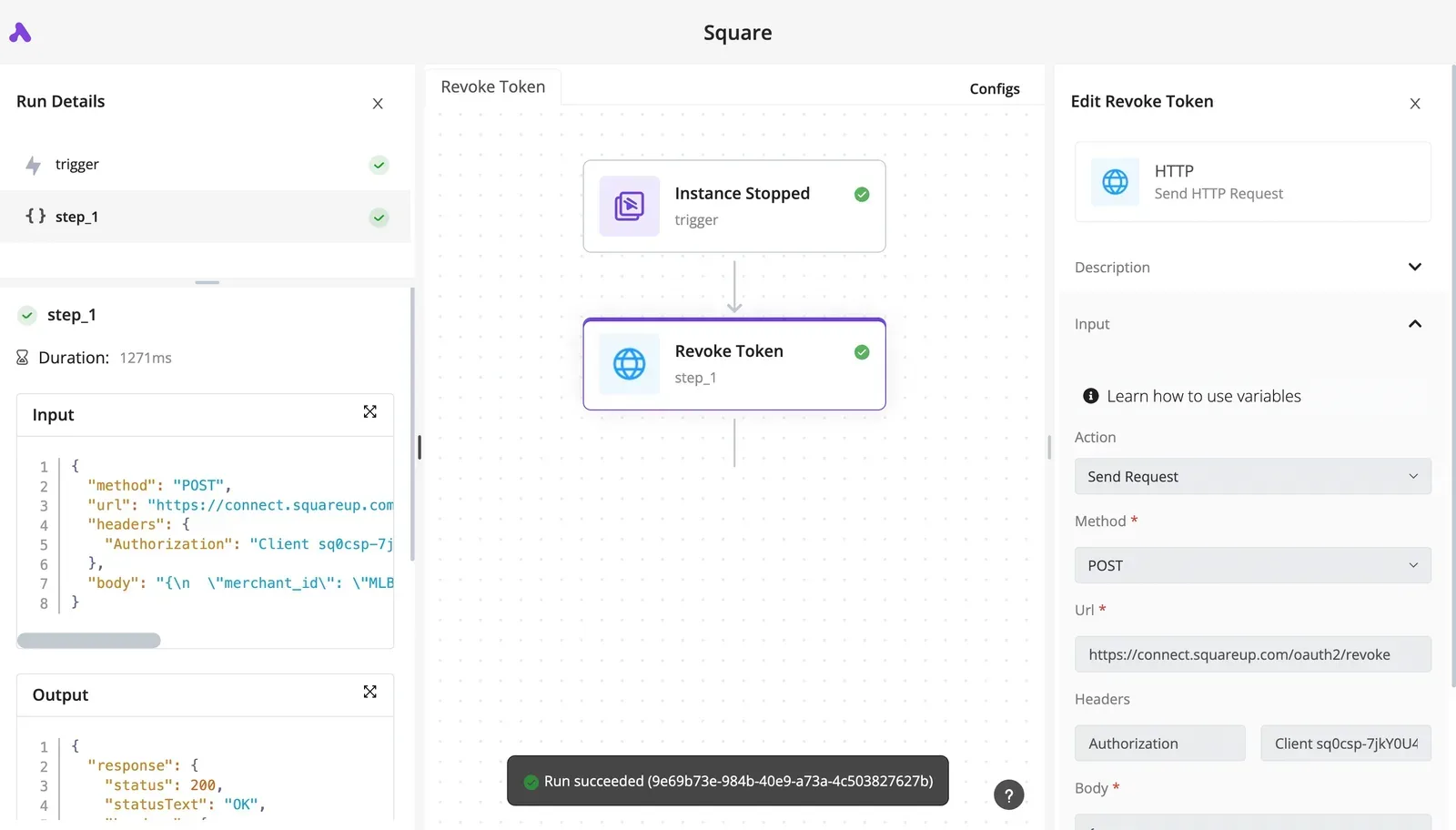
The following configuration demonstrates an automated security handshake where a system event triggers a state change in the model’s environment.
As soon as a local compute instance is decommissioned, this specific sequence ensures that the associated Squareup OAuth credentials are invalidated to prevent credential leakage.
By wrapping these calls in standard HTTP blocks, teams can build self-healing infrastructure that treats the local model as a first-class citizen in the DevOps lifecycle.
Using MCP servers for Edge0-145B tool-calling
Unlike cloud-constrained models that require complex proxy tunnels to reach on-premises data, an MCP-enabled local model can directly query internal services through a standardized JSON-RPC interface.
Edge0-145B leverages the Model Context Protocol (MCP) to interact with external data sources like PostgreSQL databases or local filesystem directories.
This setup allows the model to act as an agentic layer that can pull live records, perform reasoning, and push updates back to legacy systems without exposing those systems to the public internet.

Next steps for evaluating local frontier models
Evaluating Edge0-145B requires an immediate shift from monitoring API uptime to benchmarking the internal throughput of on-premises hardware.
Because this model functions as a localized reasoning engine, teams must validate its performance across three specific operational pillars to ensure it meets the strict compliance requirements of frameworks like FISMA or PIPEDA.
The following pillars define the transition from cloud-dependent workflows to self-hosted intelligence:
- Zero API Latency: By removing the round-trip time to external servers, the system eliminates network-induced delays, which allows agentic loops to execute more iterations per second during complex reasoning tasks.
- Absolute Data Sovereignty: All inference occurs within the organization’s private perimeter, ensuring that sensitive data never leaves the controlled environment and thus satisfies the data residency mandates of strict regulatory bodies.
- Fixed Hardware Cost vs. Variable Token Billing: Shifting to a capital expenditure model for compute resources provides a predictable budget ceiling, whereas cloud models like Claude Opus 5.5 or GPT-6 Astra incur unpredictable costs that scale linearly with volume.
The memory bandwidth of the local silicon, rather than the provider’s rate limits, is now the primary bottleneck.
Once these pillars are verified, the implementation team must focus on thermal management and VRAM allocation.
Since frontier-grade models demand high concurrency, monitoring the utilization of the H100 or equivalent clusters becomes the critical metric for maintaining the speed of the agentic layer.
Following this hardware audit, the next priority is integrating the model into the existing CI/CD pipeline to ensure that local updates do not break the reasoning logic used by legacy systems.
How Activepieces orchestrates local frontier reasoning
Activepieces provides the execution layer that turns Edge0-145B from a standalone model into a functional private agent. While the model handles the logic, Activepieces manages the state, triggers, and third-party integrations required to act on that logic without ever sending data to a cloud-based orchestrator.
Because Activepieces is open-source under the MIT license, organizations can audit the entire automation stack to ensure that no telemetry or prompt data leaks outside the local network boundary.
By deploying the Activepieces self-hosted edition alongside an Edge0-145B instance, teams can build complex, multi-step workflows that remain entirely air-gapped.
This architecture is why regulated entities like MoneyGram and FundingSocieties utilize Activepieces for mission-critical operations; it provides the enterprise-grade control plane (including SSO, RBAC, and audit logs) within a private perimeter.
This ensures that when a model analyzes a sensitive document, the orchestration of that task is as secure as the inference itself.
The platform eliminates the "black box" risk of managed automation services by allowing users to bring their own compute. Instead of being locked into a provider's specific AI strategy, you can point the Activepieces OpenAI-compatible connector to your local Edge0-145B endpoint.
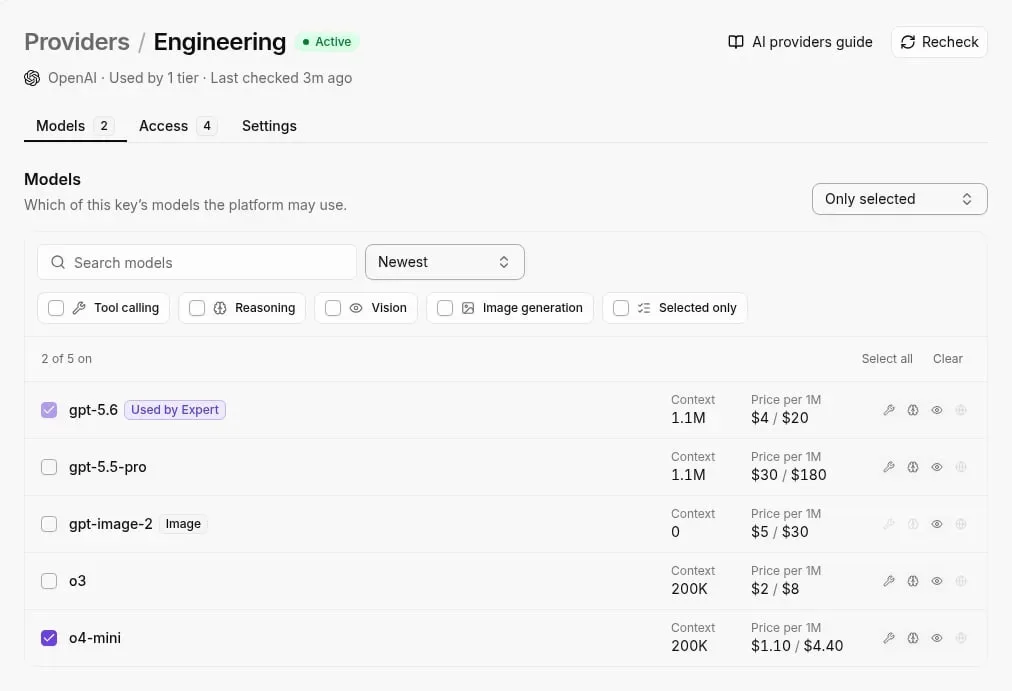
This configuration ensures that your model spend and data residency remain under your direct control, transforming the high-parameter reasoning of Edge0-145B into a predictable, secure utility for the entire enterprise.
Frequently asked questions about Edge0-145B?
When the parameter count exceeds the VRAM capacity of any single consumer or enterprise card currently on the market, Edge0-145B requires high-memory multi-GPU configurations for full-precision inference.
To run the model on a single node, architects must utilize NVIDIA H100 or H200 clusters connected via NVLink, which provides the high-speed interconnect necessary to prevent the communication bottlenecks that would otherwise throttle reasoning speed.
For teams restricted to smaller hardware footprints, 4-bit or 8-bit quantization is the only method to load the weights into memory, though this comes at the cost of a measurable degradation in the complex logic required for long-horizon planning.
Does Edge0-145B require multi-GPU setups?
Distributing the workload across multiple cards allows the system to leverage parallel processing, which ensures that token generation remains fast enough for real-time automation.
Without this distribution, the system would be forced to offload data to system RAM, resulting in latency that renders the model useless for synchronous API calls.
Can I use Edge0-145B for vision-based tasks?
Edge0-145B is a text-only reasoning model and does not natively process visual inputs, meaning it cannot be used for direct image analysis or video surveillance without a separate vision encoder.
To achieve multimodal capabilities on private infrastructure, engineers must pair it with a dedicated vision model like Ministral 3 8B, which can describe visual data in text that Edge0-145B then processes.
This modular approach ensures that the high-reasoning core is not bogged down by the heavy compute requirements of raw pixel processing.
Is there a smaller version for mobile devices?
No mobile-native version of the 145B architecture exists, as the computational requirements for its reasoning engine far exceed the thermal and power limits of handheld hardware.
Organizations requiring local mobile intelligence must instead deploy smaller, specialized models such as Ministral 3 3B, which is designed to fit within the memory constraints of a smartphone.
For mobile applications that still require the frontier-grade logic of Edge0-145B, the only viable architecture is a client-server model where the mobile device acts as a thin client to a private, on-premises server.